


 |
市場調查報告書
商品編碼
2125316
美國即時支付:市場佔有率分析、行業趨勢和統計數據、成長預測(2026-2031 年)United States Real Time Payments - Market Share Analysis, Industry Trends & Statistics, Growth Forecasts (2026 - 2031) |
||||||

※ 本網頁內容可能與最新版本有所差異。詳細情況請與我們聯繫。
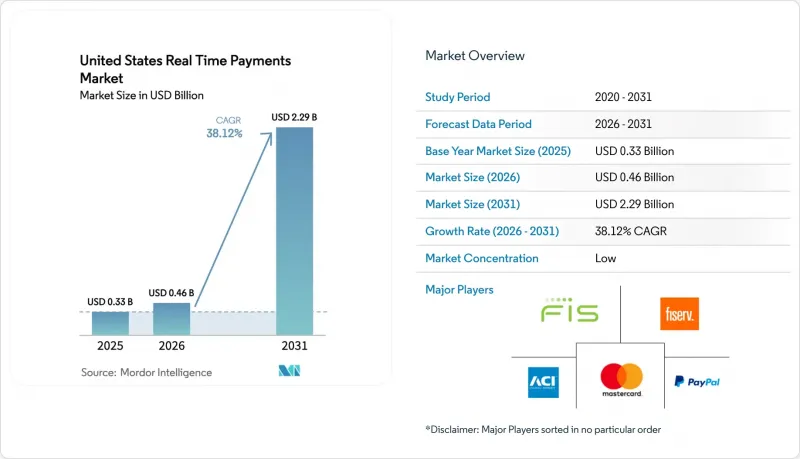
根據 Mordor Intelligence 估計,美國即時支付市場在 2026 年的價值將達到 4.6 億美元,高於 2025 年的 3.3 億美元,預計到 2031 年將達到 22.9 億美元。
預計 2026 年至 2031 年的複合年成長率將達到 38.12%。
本報告按交易類型(點對點 (P2P)、點對點 (P2B))、組件(平台/解決方案、服務)、部署方式(雲端、本地部署)、企業規模(大型企業、中小企業)和最終用戶行業(零售/電子商務、銀行、金融服務和保險 (BFSI)、公共產業/電信、醫療保健、其他)進行細分。市場預測以美元 (USD) 計價。
美國即時支付市場的趨勢和洞察
TCH RTP網路在中型和區域性銀行的擴展
TCH的資金代理模式允許資產低於10億美元的區域性金融機構以傳統成本的約40%參與即時結算計畫(RTP),從而與全國性銀行處於同一起跑線上。 Bankers' Bank和KeyBank已證明了該模式的擴充性。光是KeyBank一家就預計到2025年將完成400萬筆RTP交易,這將使依賴即時現金流的中西部製造業客戶受益。 2025年2月,單筆結算限額將提高至1,000萬美元,從而支援房地產結算和供應商融資等B2B應用情境。由於超過70%的美國銀行被歸類為區域性銀行,此因素將顯著擴大交易覆蓋範圍,為美國即時結算市場帶來新的競爭格局。
FedNow 服務上線,實現全天候銀行間結算。
FedNow將直接與聯準會的主帳戶結算,從而消除了先前限制私人支付網路發展的預注資金籌措和交易對手風險。其雲端原生設計確保了容錯性和擴充性,即使是中小型銀行也能在幾週內而非數個季度內啟動該服務。截至2024年底,已有超過900家金融機構註冊參與,幾乎是RTP用戶數的兩倍,顯示人們對政府營運的系統高度信任。隨著財政部強制要求聯邦機構在2025年9月前過渡到電子支付,預計市場需求將十分強勁。此外,計劃於2025年夏季實施的100萬美元交易限額將使FedNow有機會蠶食其傳統電匯的收入。
與傳統核心銀行系統的整合以及批量處理的限制。
美國約94%的銀行仍依賴幾十年前設計的夜間批量處理核心系統,使得全天候交易處理成為技術難題。根據堪薩斯城聯邦儲備銀行估計,徹底改造該系統將耗資數億美元,耗時3-5年,這將給區域性金融機構帶來更大的負擔。雖然第三方解決方案供應商正在努力減輕這一負擔,但整合的複雜性仍然很高,這減緩了技術的普及速度,並阻礙了美國即時支付市場的成長。
細分市場分析
到2025年,P2P交易將主導美國即時支付市場,佔71.76%的市場。光是Zelle一家公司在2024年上半年就處理了17億筆交易,總額達4,810億美元,證實了消費者對即時支付的廣泛接受。然而,市場成長的真正引擎是P2B領域。 P2B領域正以39.45%的複合年成長率成長,預計到2031年,隨著企業利用即時支付縮短應收帳款回收期,該領域的交易量差距將縮小。這一領域將釋放美國企業持有的7,070億美元資金,從而釋放價值鏈中的流動性。此外,FedNow計劃將支付限額提高至100萬美元,這將使高價值發票的支付成為可能,加速其在商業領域的應用。
金融科技閘道正在添加動態折扣工具,當發票即時支付時,這些工具會自動計算供應商的獎勵,這使得P2B(採購到付款)對財務部門具有戰略價值。瑞典中央銀行的初步數據顯示,買家採用即時支付將改善中小型供應商的銷售額和就業情況。潛在的獲利能力進一步推動了該領域的成長,中型企業表示願意為自動應付應付帳款結算支付3%的費用。
預計到2025年,平台支出將佔總支出的63.28%,凸顯了銀行連接RTP和FedNow等支付網路時對基礎設施的高需求。然而,託管服務(例如詐欺分析、ISO 20022轉換和財務儀錶板)預計將以33.9%的複合年成長率超越平台。銀行指出,將日常營運外包給Fiserv和Finastra等服務供應商將有助於降低整體擁有成本並縮短產品上市時間。
監管政策的變化正在推動市場轉向服務型模式。向 ISO 20022 標準過渡的最後期限迫使金融機構確保轉換閘道器的安全,而 63% 的企業期望其銀行能夠處理訊息轉換。隨著美國即時支付市場的日趨成熟,差異化競爭的重點正從單純的連接性轉向增值編配,這為服務供應商提供了拓展市場佔有率的絕佳機會。
其他好處:
- Excel格式的市場預測(ME)表
- 3個月的分析師支持
目錄
第1章:引言
- 研究假設和市場定義
- 調查範圍
第2章:調查方法
第3章執行摘要
第4章 市場狀況
- 市場概覽
- 市場促進因素
- TCH RTP網路在中型和區域性銀行的擴展
- 推出「FedNow」服務,實現全天候銀行間結算。
- 對零工經濟平台即時支付工資和收入的需求。
- 美國帳單公司和公共產業公司引入「付款請求」制度。
- ISO 20022 和開放 API 的整合將促進金融科技領域的合作。
- 商家即時儲值卡/電子商務即時預付計劃的擴展
- 市場限制因素
- 核心銀行舊有系統整合與批次限制
- 透過已通過核准推送支付(應用程式)增加詐騙和詐騙活動的風險
- 缺乏通用ID目錄阻礙了互通性
- 對單筆交易限額和流動性管理的擔憂。
- 價值鏈分析
- 監理趨勢(FedNow 營運規則、E 條例、統一商法典 (UCC) 修訂)
- 技術趨勢(雲端原生RTP中心、ISO 20022、人工智慧驅動的詐欺防制)
- 波特五力分析
- 美國支付產業的演變
- 加速無現金交易的關鍵趨勢
- 市場宏觀經濟趨勢的評估
第5章 市場規模與成長預測
- 按交易類型
- P2P
- P2B
- 按組件
- 平台/解決方案
- 服務
- 部署模式
- 雲
- 現場
- 按公司規模
- 大公司
- 小型企業
- 按最終用戶行業分類
- 零售與電子商務
- BFSI
- 公用事業和通訊
- 衛生保健
- 政府/公共部門
- 其他終端用戶產業
第6章 競爭情勢
- 市場集中度
- 策略性措施(併購、新產品發布、開設銀行帳戶)
- 市佔率分析
- 公司簡介
- ACI Worldwide Inc.
- Fidelity National Information Services Inc.(FIS)
- Fiserv Inc.
- Mastercard Incorporated
- Visa Inc.
- PayPal Holdings Inc.
- Worldpay LLC(FIS)
- Temenos AG
- Volante Technologies Inc.
- Montran Corporation
- The Clearing House Payments Company LLC
- Jack Henry and Associates Inc.
- Finastra Group Holdings Ltd.
- Bottomline Technologies Inc.
- Square Inc.(Block)
- Apple Inc.
- Google LLC
- Early Warning Services LLC(Zelle)
- Ingo Money Inc.
- Ripple Labs Inc.
第7章 市場機會與未來展望
According to Mordor Intelligence, the US real time payments market size in 2026 is estimated at USD 0.46 billion, growing from 2025 value of USD 0.33 billion with 2031 projections showing USD 2.29 billion, growing at 38.12% CAGR over 2026-2031.
This report is Segmented by Transaction Type (Peer-To-Peer (P2P), Peer-To-Business (P2B)), Component (Platform / Solution, Services), Deployment (Cloud, On-Premise), Enterprise Size (Large Enterprises, Small and Medium Enterprises), End-User Industry (Retail and E-Commerce, BFSI, Utilities & Telecom, Healthcare, and More). The Market Forecasts are Provided in Terms of Value (USD).
United States Real Time Payments Market Trends and Insights
Expansion of TCH RTP network across mid-tier & community banks
TCH's funding-agent model allows community institutions with assets under USD 1 billion to join RTP at roughly 40% of prior cost, leveling the competitive field against national banks. Bankers' Bank and KeyBank illustrate scalability: KeyBank alone expects 4 million RTP transactions in 2025, benefiting Midwest manufacturing clients that rely on just-in-time cash flow. February 2025's hike of the single-payment cap to USD 10 million opens B2B use cases such as real-estate closings and supplier finance. As over 70% of US banking institutions fall in the community category, this driver meaningfully enlarges addressable volume and injects new competitive dynamics to the US real time payments market.
Launch of FedNow Service enabling 24X7X365 interbank settlement
FedNow settles directly against Fed master accounts, eliminating prefunding and counterparty risk that limit private rails. Cloud-native design gives resiliency and scalability, letting smaller banks go live in weeks rather than quarters. More than 900 institutions enrolled by end-2024-nearly double RTP's base-highlight trust in a government-operated system. Treasury's mandate that federal agencies migrate to electronic disbursements by September 2025 guarantees a committed demand corridor, while the planned USD 1 million transaction ceiling in summer 2025 positions FedNow to cannibalize traditional wire revenue.
Core banking legacy integration & batch-processing constraints
Roughly 94% of US banks still rely on overnight batch cores conceived decades ago, making 24X7 posting a technical hurdle. The Federal Reserve Bank of Kansas City estimates full modernizations cost hundreds of millions and require 3-5 years, a burden magnified for community lenders. Third-party enablers mitigate pain, yet high integration complexity continues to slow rollouts, tempering the growth trajectory of the US real time payments market.
Other drivers and restraints analyzed in the detailed report include:
- Instant payroll & earnings disbursement demand from gig-economy platforms
- Adoption of Request-for-Payment by US billers & utilities
- Escalating authorised push-payment (APP) fraud & scam risks
For complete list of drivers and restraints, kindly check the Table Of Contents.
Segment Analysis
P2P transactions dominated the US real time payments market with 71.76% share in 2025. Zelle alone processed 1.7 billion transfers worth USD 481 billion in H1 2024, affirming consumer uptake. That said, the P2B corridor is the market's growth engine. At a 39.45% CAGR, P2B is forecast to narrow the volume gap by 2031 as corporates use instant settlement to cut days-sales-outstanding. The segment tackles the USD 707 billion in US corporate trapped cash, unlocking supply-chain liquidity. FedNow's planned USD 1 million limit also enables high-value invoice payments, accelerating commercial use.
Fintech gateways are adding dynamic discount tools that auto-calculate supplier incentives when invoices are paid instantly, making P2B strategically valuable for treasury teams. Early data from the Swedish central bank suggests small suppliers experience improved sales and employment once buyers deploy real-time settlements. As middle-market firms display willingness to pay 3% service fees for automated payables, monetization potential reinforces momentum in this corridor.
Platforms accounted for 63.28% of spending in 2025, underlining up-front infrastructure demand as banks connect to RTP and FedNow rails. However, managed services-fraud analytics, ISO 20022 translation, treasury dashboards-are projected to outpace with a 33.9% CAGR. Banks cite lower total cost of ownership and faster time-to-market when outsourcing ongoing operations to enablers such as Fiserv and Finastra.
Regulatory change drives the tilt toward services. ISO 20022 migration deadlines push institutions to secure translation gateways, and 63% of corporates expect their banks to handle message conversion. As the US real time payments market matures, differentiation shifts from mere connectivity to value-added orchestration, positioning service vendors for share gains.
Complete Report Scope:
- By Transaction Type
- Peer-to-Peer (P2P)
- Peer-to-Business (P2B)
- By Component
- Platform / Solution
- Services
- By Deployment Mode
- Cloud
- On-Premise
- By Enterprise Size
- Large Enterprises
- Small and Medium Enterprises
- By End-User Industry
- Retail and E-Commerce
- BFSI
- Utilities and Telecom
- Healthcare
- Government and Public Sector
- Other End-user Industries
List of Companies Covered in this Report:
- ACI Worldwide Inc.
- Fidelity National Information Services Inc. (FIS)
- Fiserv Inc.
- Mastercard Incorporated
- Visa Inc.
- PayPal Holdings Inc.
- Worldpay LLC (FIS)
- Temenos AG
- Volante Technologies Inc.
- Montran Corporation
- The Clearing House Payments Company L.L.C.
- Jack Henry and Associates Inc.
- Finastra Group Holdings Ltd.
- Bottomline Technologies Inc.
- Square Inc. (Block)
- Apple Inc.
- Google LLC
- Early Warning Services LLC (Zelle)
- Ingo Money Inc.
- Ripple Labs Inc.
Additional Benefits:
- The market estimate (ME) sheet in Excel format
- 3 months of analyst support
TABLE OF CONTENTS
1 INTRODUCTION
- 1.1 Study Assumptions and Market Definition
- 1.2 Scope of the Study
2 RESEARCH METHODOLOGY
3 EXECUTIVE SUMMARY
4 MARKET LANDSCAPE
- 4.1 Market Overview
- 4.2 Market Drivers
- 4.2.1 Expansion of TCH RTP Network Across Mid-Tier and Community Banks
- 4.2.2 Launch of FedNow Service Enabling 24X7X365 Interbank Settlement
- 4.2.3 Instant Payroll and Earnings Disbursement Demand from Gig-Economy Platforms
- 4.2.4 Adoption of Request-for-Payment by U.S. Billers and Utilities
- 4.2.5 ISO 20022 and Open-API Integration Driving FinTech Partnerships
- 4.2.6 Merchant Push-to-Card / Instant Funding Programs Scaling in E-commerce
- 4.3 Market Restraints
- 4.3.1 Core Banking Legacy Integration and Batch-Processing Constraints
- 4.3.2 Escalating Authorised Push-Payment (APP) Fraud and Scam Risks
- 4.3.3 Absence of Universal Identity Directory Hindering Interoperability
- 4.3.4 Per-Transaction Limit Caps and Liquidity Management Concerns
- 4.4 Value Chain Analysis
- 4.5 Regulatory Outlook (FedNow operating rules, Reg E, UCC updates)
- 4.6 Technological Outlook (Cloud-native RTP hubs, ISO 20022, AI fraud-defence)
- 4.7 Porter's Five Forces Analysis
- 4.7.1 Bargaining Power of Suppliers
- 4.7.2 Bargaining Power of Buyers
- 4.7.3 Threat of New Entrants
- 4.7.4 Threat of Substitutes
- 4.7.5 Intensity of Competitive Rivalry
- 4.8 Evolution of the U.S. Payments Landscape
- 4.9 Key Trends Accelerating Cashless Transactions
- 4.10 Assessment of Macro Economic Trends on the Market
5 MARKET SIZE AND GROWTH FORECASTS (VALUES)
- 5.1 By Transaction Type
- 5.1.1 Peer-to-Peer (P2P)
- 5.1.2 Peer-to-Business (P2B)
- 5.2 By Component
- 5.2.1 Platform / Solution
- 5.2.2 Services
- 5.3 By Deployment Mode
- 5.3.1 Cloud
- 5.3.2 On-Premise
- 5.4 By Enterprise Size
- 5.4.1 Large Enterprises
- 5.4.2 Small and Medium Enterprises
- 5.5 By End-User Industry
- 5.5.1 Retail and E-Commerce
- 5.5.2 BFSI
- 5.5.3 Utilities and Telecom
- 5.5.4 Healthcare
- 5.5.5 Government and Public Sector
- 5.5.6 Other End-user Industries
6 COMPETITIVE LANDSCAPE
- 6.1 Market Concentration
- 6.2 Strategic Moves (MandA, product launches, bank enrollments)
- 6.3 Market Share Analysis
- 6.4 Company Profiles (includes Global-level Overview, Market-level Overview, Core Segments, Financials, Strategic Information, Market Rank/Share, Products and Services, Recent Developments)
- 6.4.1 ACI Worldwide Inc.
- 6.4.2 Fidelity National Information Services Inc. (FIS)
- 6.4.3 Fiserv Inc.
- 6.4.4 Mastercard Incorporated
- 6.4.5 Visa Inc.
- 6.4.6 PayPal Holdings Inc.
- 6.4.7 Worldpay LLC (FIS)
- 6.4.8 Temenos AG
- 6.4.9 Volante Technologies Inc.
- 6.4.10 Montran Corporation
- 6.4.11 The Clearing House Payments Company L.L.C.
- 6.4.12 Jack Henry and Associates Inc.
- 6.4.13 Finastra Group Holdings Ltd.
- 6.4.14 Bottomline Technologies Inc.
- 6.4.15 Square Inc. (Block)
- 6.4.16 Apple Inc.
- 6.4.17 Google LLC
- 6.4.18 Early Warning Services LLC (Zelle)
- 6.4.19 Ingo Money Inc.
- 6.4.20 Ripple Labs Inc.
7 MARKET OPPORTUNITIES AND FUTURE OUTLOOK
- 7.1 White-space and Unmet-need Assessment

 中國即時支付:市場佔有率分析、產業趨勢與統計及成長預測(2026-2031年)亞太地區即時支付:市場佔有率分析、行業趨勢和統計數據以及成長預測(2026-2031 年)印度即時支付:市場佔有率分析、行業趨勢和統計數據以及成長預測(2026-2031 年)德國即時支付:市場佔有率分析、行業趨勢和統計數據以及成長預測(2026-2031 年)日本即時支付:市場佔有率分析、行業趨勢和統計數據以及成長預測(2026-2031 年)歐洲即時支付:市場佔有率分析、行業趨勢和統計數據以及成長預測(2026-2031 年)西班牙即時支付:市場佔有率分析、行業趨勢和統計數據以及成長預測(2026-2031 年)英國即時支付:市場佔有率分析、行業趨勢和統計數據以及成長預測(2026-2031 年)
 即時支付市場:按組件、部署模式、組織規模、交易類型、應用程式和最終用戶分類-2026-2032年全球市場預測
 2026年跨境即時支付(RTP)中心全球市場報告