

 |
市場調查報告書
商品編碼
2125298
日本即時支付:市場佔有率分析、行業趨勢和統計數據以及成長預測(2026-2031 年)Japan Real Time Payment - Market Share Analysis, Industry Trends & Statistics, Growth Forecasts (2026 - 2031) |
||||||

※ 本網頁內容可能與最新版本有所差異。詳細情況請與我們聯繫。
據 Mordor Intelligence 稱,日本即時支付市場在 2025 年的價值為 27.1 億美元,預計到 2031 年將從 2026 年的 35.6 億美元成長到 138.6 億美元,在預測期(2026-2031 年)內的複合年成長率為 31.28%。
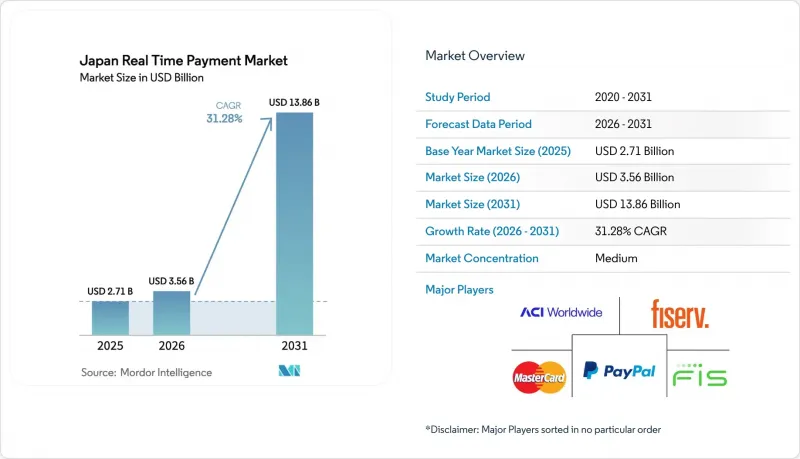
本報告按交易類型(P2P、P2B、B2B、B2C、G2C)、公司規模(大型企業、中小企業、微企業)、終端用戶行業(零售/電商、銀行、金融服務和保險、醫療保健、交通/出行等)以及技術/支付管道(Zengin RT-Net、QR碼疊加支付、市場預測以美元(USD)為單位。
日本即時支付市場的趨勢和洞察
智慧型手機普及率不斷提高以及5G的部署
日本的5G服務涵蓋範圍現已幾乎涵蓋全國,支付認證時間縮短至10毫秒以內,應用程式內支付體驗也更加流暢。網路連線的改善使詐欺偵測從夜間批量評分轉變為即時行為分析,減少了誤拒支付的情況,並鼓勵即使是習慣使用現金的用戶也開始使用行動錢包。亞馬遜網路服務(AWS)計劃在2027年投資150億美元建造本地資料中心,以確保低延遲的API調用,從而維持閘道器的即時回應能力。儘管取得了這些進步,但東北山區的一些家庭仍然存在通訊盲區,老年人仍然依賴現金支付。為了縮小都市區之間的普及差距,在農村地區持續部署微型基地台,並為老年人提供簡化的錢包介面仍然至關重要。
政府提出的100兆日圓無現金社會願景及補貼計劃
經濟產業省為年銷售額低於1,000萬日圓的零售商提供高達75%的終端成本津貼,以加速便利商店和餐飲業等商家採用2D碼支付。一項於2024年推出的跨部門API框架將基於「我的號碼卡」的身份驗證與支付系統連接起來,將錢包KYC(了解你的客戶)驗證所需時間從三天縮短至幾分鐘。各都道府縣的現金回饋宣傳活動曾一度使QR碼支付交易量增加了40%,但由於宣傳活動固定的結束日期,人們對其永續性表示擔憂。金融廳的目標是透過強制要求公用事業收費在2026年4月前實現即時支付,將推送支付培養成家庭的每月支付習慣。然而,一些市政計費系統仍然採用無法解析ISO 20022標籤的固定欄位格式處理數據,這給實施帶來了風險。
日本農村地區小額現金交易比例較高
在大都會圈以外,便利商店的現金交易中,硬幣和紙幣仍佔55%,反映出通訊網路不完善以及65歲及以上居民對現金的文化偏好。 My Number讀卡機尚未在獨立經營的小規模商家中普及,因為韌體成本超過了預期收益。由於人口減少導致每日銷售額下降,除非作為高利潤服務的一部分提供,否則為終端提供支援對支付服務提供者而言並不盈利。在離線QR碼和語音導航普及之前,在人口稀少的地區,1000日圓以下的消費很可能仍將以現金支付為主。
細分市場分析
在所有交易類型中,B2B支付預計將以32.60%的複合年成長率(CAGR)實現最快成長,這主要得益於財務負責人利用「全金延時系統」(Zengin More Time System)批量轉移閒置餘額,以及使用ISO 20022參考編號實現支付自動化。就交易量而言,到2025年,個人對個人轉帳仍將佔據主導地位,佔日本即時支付市場佔有率的41.05%,這主要得益於超級應用程式中的群組支付功能。
諸如工資和保險金支付等企業支付方式正從批量ACH轉帳轉向推播支付,使員工和受益人能夠在幾分鐘內收到款項。雖然政府向消費者的資金流動仍處於起步階段,但預計隨著數位管理局2026年指令的實施,社保福利的即時支付將加速推進。直通式對帳減輕了大型企業後勤部門營運的負擔,但沒有ERP插件的小規模供應商仍需要手動核對發票。
到2025年,低成本QR碼的廣泛應用將使中小企業在日本即時支付市場佔據46.10%的佔有率。目前,嵌入式金融套件甚至使自僱人士也能在同一個錢包中開立發票並獲得短期貸款,預計這將推動微企業以32.95%的複合年成長率成長。
大型企業平均交易量最高,它們正與 Zengin 協商建立直接連接以避免支付額外費用,但卻受限於無法讀取 ISO 20022 標籤的舊式會計系統。對於本地微型零售商而言,交換費上限仍然限制了其提供盈利服務,但它們或許可以透過結合「先買後付」和會員行銷來改善單位經濟效益。
其他好處:
- Excel格式的市場預測(ME)表
- 3個月的分析師支持
目錄
第1章:引言
- 研究假設和市場定義
- 調查範圍
第2章:調查方法
第3章執行摘要
第4章 市場狀況
- 市場概覽
- 市場促進因素
- 智慧型手機普及率不斷提高以及5G的部署
- 政府提出的100兆日圓無現金社會願景及補貼計劃
- 遷移到 ISO 20022 即時軌道(RT-Net 升級)
- 電子商務中支付放棄給經銷商。
- 企業財務部門的日內流動性需求
- 超級應用生態系中的用戶獲取競爭(LINE Pay/PayPay)
- 市場限制因素
- 在日本農村地區,小額現金交易的比例相對較高。
- 商家手續費上限限制了支付服務提供者的盈利。
- 涉及推送支付(應用程式詐騙)的網路詐騙激增
- QR碼標準的不一致性阻礙了其廣泛應用。
- 產業價值鏈分析
- 宏觀經濟因素對市場的影響
- 監理情勢
- 技術展望
- 波特五力分析
第5章 市場規模與成長預測
- 按交易類型
- 點對點(P2P)
- Peer-to-Business(P2B)
- 企業對企業 (B2B) 交易
- B2C(Business-to-Consumer)
- 從政府到消費者(G2C)
- 按公司規模
- 大公司
- 中小企業
- 微企業
- 按最終用戶行業分類
- 零售與電子商務
- 銀行、金融服務和保險(BFSI)
- 衛生保健
- 交通運輸與出行
- 政府和公共產業
- 其他終端用戶產業
- 透過技術/支付網路
- Zengin RT-Net(銀行帳戶轉帳)
- QR碼疊加服務
- 行動錢包疊加層(例如,PayPay、LINE Pay)
- API/ISO 20022 推送支付
第6章 競爭情勢
- 市場集中度
- 策略趨勢
- 市佔率分析
- 公司簡介
- ACI Worldwide Inc.
- Ant Group Co., Ltd.(Alipay)
- Apple Inc.
- FIS Global(Fidelity National Information Services, Inc.)
- Fiserv, Inc.
- Mastercard Incorporated
- PayPal Holdings, Inc.
- Visa Inc.
- SIA SpA
- Finastra Group Holdings Limited
- NTT DATA Corporation
- GMO Payment Gateway, Inc.
- PayPay Corporation
- LINE Pay Corporation
- Rakuten Group, Inc.(Rakuten Pay)
- JCB Co., Ltd.
- Mitsubishi UFJ Financial Group, Inc.
- Sumitomo Mitsui Banking Corporation
- Mizuho Bank, Ltd.
- Seven Bank, Ltd.
- Kyash Inc.
- Liquid Group Inc.
- Smartpay KK
第7章 市場機會與未來展望
According to Mordor Intelligence, the Japan real time payment market size was valued at USD 2.71 billion in 2025 and estimated to grow from USD 3.56 billion in 2026 to reach USD 13.86 billion by 2031, at a CAGR of 31.28% during the forecast period (2026-2031).
This report is Segmented by Transaction Type (P2P, P2B, B2B, B2C, and G2C), Enterprise Size (Large, Smes, and Micro-Businesses), End-User Industry (Retail and E-Commerce, BFSI, Healthcare, Transportation and Mobility, and More), and Technology / Payment Rail (Zengin RT-Net, QR-Code Overlay, Mobile Wallet Overlay, and API / ISO 20022 Push). The Market Forecasts are Provided in Terms of Value (USD).
Japan Real Time Payment Market Trends and Insights
Rising Smartphone Penetration and 5G Roll-Out
Japan's 5G footprint covers nearly the entire population, enabling sub-10-millisecond payment authentication and smoother in-app checkout experiences. Enhanced connectivity shifts fraud detection from overnight batch scoring to real-time behavioral analytics, reducing false declines and encouraging cash-centric users to adopt mobile wallets. Amazon Web Services is investing USD 15 billion in local data centers by 2027, guaranteeing low-latency API calls that keep real-time gateways responsive. Despite these gains, households in mountainous Tohoku prefectures still experience network blind spots, prolonging cash reliance among older residents. The continued rollout of rural micro-cell towers and simplified wallet interfaces for seniors remains critical to closing the urban-rural adoption gap.
Government JPY 100 Trillion Cashless Vision and Subsidy Schemes
The Ministry of Economy, Trade and Industry subsidizes up to 75% of terminal costs for retailers earning under JPY 10 million, accelerating merchant enablement in convenience-store and hospitality segments. A cross-ministry API framework launched in 2024 connects My Number Card identity verification to payment rails, trimming wallet KYC from three days to minutes. Prefectural cashback campaigns have temporarily lifted QR volumes by 40%, though sunset dates raise sustainability concerns. The Financial GIF now mandates real-time settlement for public-utility bills by April 2026, embedding push payments into monthly household routines. Execution risk lingers, as some municipal billing systems still process fixed-field data formats that cannot parse ISO 20022 tags.
High Share of Small-Value Cash Transactions in Rural Japan
Coins and notes still account for 55% of convenience-store purchases outside major metropolitan areas, reflecting patchy network coverage and a cultural preference for tangible money among residents aged 65 and above. My Number Card readers have yet to penetrate mom-and-pop shops, as the costs of firmware exceed the perceived benefits. Depopulation reduces daily sales, making terminal support unprofitable for processors unless it is bundled with higher-margin services. Until offline QR codes or voice-activated prompts reach mass deployment, cash will remain dominant for sub-JPY 1,000 tickets in sparsely populated districts.
Other drivers and restraints analyzed in the detailed report include:
- Migration to ISO 20022 Real-Time Rails (RT-Net Upgrade)
- E-Commerce Checkout Abandonment Pressure on Merchants
- Merchant Interchange Caps Limit Economics for PSPs
For complete list of drivers and restraints, kindly check the Table Of Contents.
Segment Analysis
B2B settlements are forecast to climb at a 32.60% CAGR, the quickest among transaction classes, as treasurers exploit the Zengin More Time System to sweep idle balances and automate payables using ISO 20022 references. Peer-to-peer transfers still led 2025 volume, holding 41.05% of Japan real time payment market share, energized by group-payment features in super-apps.
Corporate disbursements such as payroll and insurance claims are migrating from batch ACH to push payments, allowing employees and claimants to receive funds within minutes. Government-to-consumer flows remain nascent but will accelerate once real-time payouts of social-security benefits go live under the Digital Agency's 2026 mandate. Straight-through reconciliation cuts back-office workload for conglomerates, yet smaller suppliers without ERP plug-ins must still match invoices manually.
Small and medium-sized enterprises held 46.10% of Japan real time payment market share in 2025 thanks to low-cost QR adoption. Embedded-finance suites now let even sole proprietors issue invoices and obtain short-term credit inside the same wallet, driving a forecast 32.95% CAGR for micro-business transactions.
Large corporates wield the highest average ticket values and negotiate direct Zengin connections that bypass overlay fees, but they are hampered by legacy accounting systems unable to read ISO 20022 tags. Rural micro-merchants remain hard to serve profitably under capped interchange, though bundling with buy-now-pay-later or loyalty marketing can improve unit economics.
Complete Report Scope:
- By Transaction Type
- Peer-to-Peer (P2P)
- Peer-to-Business (P2B)
- Business-to-Business (B2B)
- Business-to-Consumer (B2C)
- Government-to-Consumer (G2C)
- By Enterprise Size
- Large Enterprises
- Small and Medium-sized Enterprises (SMEs)
- Micro-businesses
- By End-User Industry
- Retail and E-commerce
- Banking, Financial Services and Insurance (BFSI)
- Healthcare
- Transportation and Mobility
- Government and Public Utilities
- Other End-User Industries
- By Technology / Payment Rail
- Zengin RT-Net (Bank Account-to-Account)
- QR-Code Overlay Services
- Mobile Wallet Overlay (e.g., PayPay, LINE Pay)
- API / ISO 20022 Push Payments
List of Companies Covered in this Report:
- ACI Worldwide Inc.
- Ant Group Co., Ltd. (Alipay)
- Apple Inc.
- FIS Global (Fidelity National Information Services, Inc.)
- Fiserv, Inc.
- Mastercard Incorporated
- PayPal Holdings, Inc.
- Visa Inc.
- SIA S.p.A.
- Finastra Group Holdings Limited
- NTT DATA Corporation
- GMO Payment Gateway, Inc.
- PayPay Corporation
- LINE Pay Corporation
- Rakuten Group, Inc. (Rakuten Pay)
- JCB Co., Ltd.
- Mitsubishi UFJ Financial Group, Inc.
- Sumitomo Mitsui Banking Corporation
- Mizuho Bank, Ltd.
- Seven Bank, Ltd.
- Kyash Inc.
- Liquid Group Inc.
- Smartpay K.K.
Additional Benefits:
- The market estimate (ME) sheet in Excel format
- 3 months of analyst support
TABLE OF CONTENTS
1 INTRODUCTION
- 1.1 Study Assumptions and Market Definition
- 1.2 Scope of the Study
2 RESEARCH METHODOLOGY
3 EXECUTIVE SUMMARY
4 MARKET LANDSCAPE
- 4.1 Market Overview
- 4.2 Market Drivers
- 4.2.1 Rising Smartphone Penetration And 5G Roll-Out
- 4.2.2 Government JPY 100 Trillion Cashless Vision And Subsidy Schemes
- 4.2.3 Migration To ISO 20022 Real-Time Rails (RT-Net Upgrade)
- 4.2.4 E-Commerce Checkout Abandonment Pressure on Merchants
- 4.2.5 Corporate Treasury Demand for Intraday Liquidity
- 4.2.6 Super-App Ecosystems (LINE Pay / Paypay) Race for Users
- 4.3 Market Restraints
- 4.3.1 High Share Of Small-Value Cash Transactions in Rural Japan
- 4.3.2 Merchant Interchange Caps Limit Economics for PSPs
- 4.3.3 Cyber-Fraud Surge In Push Payments (APP Scams)
- 4.3.4 Fragmented QR Code Standards Slowing Ubiquity
- 4.4 Industry Value Chain Analysis
- 4.5 Impact of Macroeconomic Factors on the Market
- 4.6 Regulatory Landscape
- 4.7 Technological Outlook
- 4.8 Porter's Five Forces Analysis
- 4.8.1 Bargaining Power of Suppliers
- 4.8.2 Bargaining Power of Buyers
- 4.8.3 Threat of New Entrants
- 4.8.4 Threat of Substitutes
- 4.8.5 Intensity of Competitive Rivalry
5 MARKET SIZE AND GROWTH FORECASTS (VALUE)
- 5.1 By Transaction Type
- 5.1.1 Peer-to-Peer (P2P)
- 5.1.2 Peer-to-Business (P2B)
- 5.1.3 Business-to-Business (B2B)
- 5.1.4 Business-to-Consumer (B2C)
- 5.1.5 Government-to-Consumer (G2C)
- 5.2 By Enterprise Size
- 5.2.1 Large Enterprises
- 5.2.2 Small and Medium-sized Enterprises (SMEs)
- 5.2.3 Micro-businesses
- 5.3 By End-User Industry
- 5.3.1 Retail and E-commerce
- 5.3.2 Banking, Financial Services and Insurance (BFSI)
- 5.3.3 Healthcare
- 5.3.4 Transportation and Mobility
- 5.3.5 Government and Public Utilities
- 5.3.6 Other End-User Industries
- 5.4 By Technology / Payment Rail
- 5.4.1 Zengin RT-Net (Bank Account-to-Account)
- 5.4.2 QR-Code Overlay Services
- 5.4.3 Mobile Wallet Overlay (e.g., PayPay, LINE Pay)
- 5.4.4 API / ISO 20022 Push Payments
6 COMPETITIVE LANDSCAPE
- 6.1 Market Concentration
- 6.2 Strategic Moves
- 6.3 Market Share Analysis
- 6.4 Company Profiles (includes Global level Overview, Market level overview, Core Segments, Financials as available, Strategic Information, Market Rank/Share for key companies, Products and Services, and Recent Developments)
- 6.4.1 ACI Worldwide Inc.
- 6.4.2 Ant Group Co., Ltd. (Alipay)
- 6.4.3 Apple Inc.
- 6.4.4 FIS Global (Fidelity National Information Services, Inc.)
- 6.4.5 Fiserv, Inc.
- 6.4.6 Mastercard Incorporated
- 6.4.7 PayPal Holdings, Inc.
- 6.4.8 Visa Inc.
- 6.4.9 SIA S.p.A.
- 6.4.10 Finastra Group Holdings Limited
- 6.4.11 NTT DATA Corporation
- 6.4.12 GMO Payment Gateway, Inc.
- 6.4.13 PayPay Corporation
- 6.4.14 LINE Pay Corporation
- 6.4.15 Rakuten Group, Inc. (Rakuten Pay)
- 6.4.16 JCB Co., Ltd.
- 6.4.17 Mitsubishi UFJ Financial Group, Inc.
- 6.4.18 Sumitomo Mitsui Banking Corporation
- 6.4.19 Mizuho Bank, Ltd.
- 6.4.20 Seven Bank, Ltd.
- 6.4.21 Kyash Inc.
- 6.4.22 Liquid Group Inc.
- 6.4.23 Smartpay K.K.
7 MARKET OPPORTUNITIES AND FUTURE OUTLOOK
- 7.1 White-space and Unmet-Need Assessment

 中國即時支付:市場佔有率分析、產業趨勢與統計及成長預測(2026-2031年)亞太地區即時支付:市場佔有率分析、行業趨勢和統計數據以及成長預測(2026-2031 年)印度即時支付:市場佔有率分析、行業趨勢和統計數據以及成長預測(2026-2031 年)德國即時支付:市場佔有率分析、行業趨勢和統計數據以及成長預測(2026-2031 年)歐洲即時支付:市場佔有率分析、行業趨勢和統計數據以及成長預測(2026-2031 年)美國即時支付:市場佔有率分析、行業趨勢和統計數據、成長預測(2026-2031 年)西班牙即時支付:市場佔有率分析、行業趨勢和統計數據以及成長預測(2026-2031 年)英國即時支付:市場佔有率分析、行業趨勢和統計數據以及成長預測(2026-2031 年)
 即時支付市場:按組件、部署模式、組織規模、交易類型、應用程式和最終用戶分類-2026-2032年全球市場預測
 2026年跨境即時支付(RTP)中心全球市場報告