


 |
市場調查報告書
商品編碼
2125314
印度即時支付:市場佔有率分析、行業趨勢和統計數據以及成長預測(2026-2031 年)India Real Time Payments - Market Share Analysis, Industry Trends & Statistics, Growth Forecasts (2026 - 2031) |
||||||

※ 本網頁內容可能與最新版本有所差異。詳細情況請與我們聯繫。
據 Mordor Intelligence 稱,2025 年印度即時支付市值為 78.4 億美元,預計到 2031 年將達到 241.4 億美元,而 2026 年為 94.6 億美元,預測期(2026-2031 年)的複合年預計成長率為 20.62%。
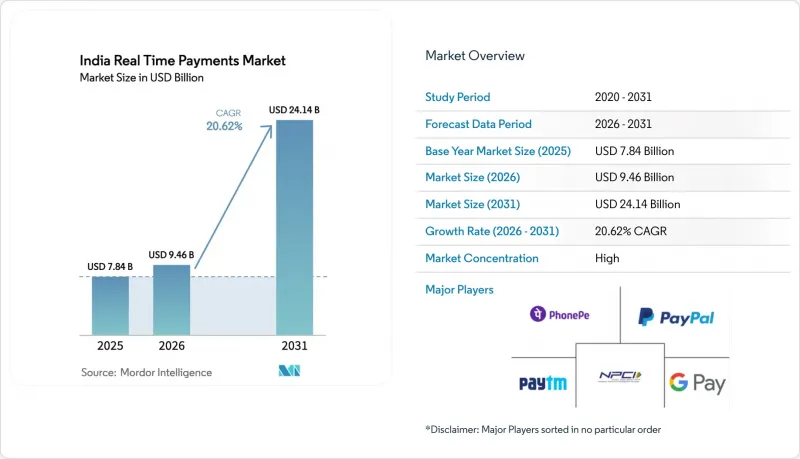
本報告按交易類型(點對點 (P2P)、點對點 (P2B))、組件(平台/解決方案、服務)、部署方式(雲端、本地部署)、企業規模(大型企業、中小企業)和最終用戶行業(零售和電子商務、銀行、金融服務和保險 (BFSI)、公用事業和電信、醫療保健、其他)進行細分。市場預測以美元 (USD) 為單位。
印度即時支付市場的趨勢和洞察
NPCI 為參與商家提供的獎勵和現金回饋推動了 UPI 的普及。
政府為2024-25會計年度設立的150億盧比獎勵基金資助的現金回饋計劃,推動了中小城市的交易量創下歷史新高,其中80%的新UPI用戶來自大都會圈。 2000盧比以下交易的補貼使得商家折扣保持在零,從而激勵雜貨店和攤販小販醒目地展示QR碼,隨著消費者便利性的提升,形成了一個良性循環的網路效應。因此,P2B交易量成長超過了P2P交易量,支付服務供應商(PSP)正利用其擴展的商家網路來降低獲客成本。根據印度國家支付公司(NPCI)的報告,2024年下半年活躍的QR碼數量激增126%,為無所不在的QR碼支付奠定了基礎。
政府主導的透過UPI-123PAY互通性
UPI-123PAY 讓印度 4 億功能手機用戶能夠透過雙音多頻 (DTMF) 提示發起即時支付,從而消除了設備差距,避免了農村地區數位參與度受限的問題。到 2025 年初,每月交易量將超過 1,000 萬筆,其中大部分集中在智慧型手機普及率低於 40% 的邦。與 BSNL 和 Airtel 等營運商的合作確保了 USSD通訊的不間斷。此外,NPCI 提供的通用庫實現了網路間的路由,避免了廠商鎖定,並確保無論支付服務提供者 (PSP) 品牌如何,用戶都能獲得一致的體驗。
農村地區的網路延遲會影響交易成功率。
在4G網路不穩定的村莊,高峰期的故障率超過15%,而在大都會圈則維持在2-3%。雖然隨著BharatNet光纖網路的部署(目前已完成60%),未來有望改善網路狀況,但在農業支付等對延遲敏感的領域,超時錯誤仍然時有發生。支付服務提供者(PSP)正在試點邊緣運算快取,將交易存儲以便稍後同步,但在小額交易盛行的農村地區,前期投資龐大。
細分市場分析
截至2025年1月,P2B支付佔UPI總交易量的28.45%,並以23.85%的複合年成長率快速成長。在印度的即時支付市場中,P2B支付市場預計將比以匯款為中心的P2P支付市場成長更快。這反映了消費者新的消費習慣,例如只需一次掃描即可支付公共交通、街頭小吃和公用事業收費。 P2B交易的平均金額為1471印度盧比,進一步印證了其在小額交易領域的滲透。與RuPay信用卡整合將為P2B消費增加循環信用的柔軟性,同時保持即時驗證。
儘管如此,預計到2025年,P2P支付仍將維持71.55%的交易佔有率,其成熟應用情境包括預支薪資、支付房租和家庭援助。透過與尼泊爾和新加坡建立的UPI合作夥伴關係,洲際匯款成為可能,即使P2P支付的成長率趨於正常,預計仍將保持其核心地位。電力供應不足的農村家庭依賴P2P快速轉移農作物收益,凸顯了印度即時支付市場所蘊含的社會包容性使命。
預計服務層將以28.05%的複合年成長率成長,目前包括詐欺分析、整合匹配和貸款API。支付服務供應商(PSP),例如Razorpay,在2024會計年度推出了40項新服務,這表明零商家折扣環境正在推動服務提供者在價值金字塔中向上攀升。印度的即時支付市場正受益於人工智慧驅動的風險模型,這些模型可在毫秒內對交易進行評分,從而在可疑資金流向結算前將其攔截。
到2025年,平台/解決方案收入將佔市場佔有率的63.20%,並將繼續成為吸引新晉數位化商家的入口網站。模組化SDK和低程式碼整合工具包正在縮短零售商的產品上市時間,並建立一個涵蓋從基礎支付工具到高級SaaS訂閱的完整管道。這種累積效應是印度即時支付產業長期獲利的核心所在。
其他好處:
- Excel格式的市場預測(ME)表
- 3個月的分析師支持
目錄
第1章:引言
- 研究假設和市場定義
- 調查範圍
第2章:調查方法
第3章執行摘要
第4章 市場狀況
- 市場概覽
- 市場促進因素
- UPI 的擴張是由 NPCI 向參與商家提供的獎勵和現金回饋所推動的。
- 政府主導的透過UPI-123PAY互通性
- 零工經濟平台對即時支付的需求正在推動市場發展。
- 三、四線城市線下QR碼支付的成長正在推動市場發展。
- RuPay信用卡與UPI的整合將提高每次支付的平均交易金額。
- 市場限制因素
- 遍遠地區網路延遲會影響交易成功率。
- 利用 UPI 付款請求和螢幕擷取應用程式詐騙正在擾亂市場。
- 關於交換費的爭議阻礙了支付服務提供者的商業化。
- 價值鏈分析
- 監理展望
- 波特五力分析
- 印度支付環境的變化
- 加速無現金交易的關鍵趨勢
- 市場宏觀經濟趨勢的評估
- 主要案例研究和使用範例
- 即時結算佔總交易量的百分比
- 非現金交易中即時結算的百分比
第5章 市場規模與成長預測
- 按交易類型
- P2P
- P2B
- 按組件
- 平台/解決方案
- 服務
- 部署模式
- 雲
- 現場
- 按公司規模
- 大公司
- 小型企業
- 按最終用戶行業分類
- 零售與電子商務
- BFSI
- 公用事業和通訊
- 衛生保健
- 政府/公共部門
- 其他終端用戶產業
第6章 競爭情勢
- 市場集中度
- 策略趨勢
- 市佔率分析
- 公司簡介
- Temenos AG
- ACI Worldwide Inc.
- Google LLC(Alphabet Inc.)
- Mastercard India Services Pvt Ltd
- PhonePe Private Limited
- Razorpay Technologies Pvt Ltd
- Pine Labs Pvt Ltd
- PayPal Payments Private Limited
- BharatPe
- WhatsApp Pay(Meta Platforms Inc.)
- Paytm Payments Bank Ltd
- Financial Software and Systems Pvt Ltd(FSS)
- Cashfree Payments
- Worldline India Pvt Ltd
- Amazon Pay(Amazon.com Inc.)
- Visa Worldwide(India)Pvt Ltd
- PayU Payments Pvt Ltd
- BillDesk(IndiaIdeas.com Ltd)
- CCAvenue(Infibeam Avenues Ltd)
- State Bank of India
- HDFC Bank Ltd
- ICICI Bank Ltd
- Axis Bank Ltd
- Volante Technologies Inc.
- NPCI(National Payments Corporation of India)
第7章 市場機會與未來展望
According to Mordor Intelligence, the India real-time payments market size was valued at USD 7.84 billion in 2025 and estimated to grow from USD 9.46 billion in 2026 to reach USD 24.14 billion by 2031, at a CAGR of 20.62% during the forecast period (2026-2031).
This report is Segmented by Transaction Type (Peer-To-Peer (P2P), Peer-To-Business (P2B)), Component (Platform / Solution, Services), Deployment (Cloud, On-Premise), Enterprise Size (Large Enterprises, Small and Medium Enterprises), End-User Industry (Retail and E-Commerce, BFSI, Utilities & Telecom, Healthcare, and More). The Market Forecasts are Provided in Terms of Value (USD).
India Real Time Payments Market Trends and Insights
Surge in UPI adoption driven by NPCI incentives and merchant cash-backs
Cash-back programs funded by the government's INR 1,500 crore incentive pool for FY 2024-25 have pushed transaction counts in smaller cities to new highs, with 80% of new UPI users emerging outside metros. The subsidy on sub-INR 2,000 tickets sustains a zero merchant discount rate, motivating kirana stores and street vendors to display QR codes prominently and creating a network-effect flywheel as consumer convenience rises. P2B volumes have consequently grown faster than P2P volumes, and PSPs have lowered customer-acquisition costs by leveraging expanded merchant footprints. NPCI reports a 126% surge in active QR codes during 2H 2024, supplying the physical infrastructure for omnipresent quick-response payments.
Government-mandated interoperability via UPI-123PAY
UPI-123PAY allows India's 400 million feature-phone users to initiate real-time payments through dual-tone multi-frequency (DTMF) prompts, closing the device-gap that had restricted digital participation in rural districts. Monthly volumes have already exceeded 10 million transactions in early 2025, concentrated in states with sub-40% smartphone penetration. Telecom alliances with BSNL and Airtel ensure unbroken USSD messaging, while NPCI's common library enables cross-network routing, preventing vendor lock-in and guaranteeing a consistent user experience regardless of PSP brand.
Rural network latency hitting transaction success rates
Peak-season failure rates exceed 15% in villages where 4G coverage remains inconsistent, compared to 2-3% in metros. BharatNet's optical-fiber roll-out, currently 60% complete, promises eventual relief, yet delay-sensitive sectors including agriculture payments continue to experience timeout errors. PSPs are testing edge-computing caches that queue transactions for later synchronization, though the upfront capital is substantial for low-ticket rural traffic.
Other drivers and restraints analyzed in the detailed report include:
- Instant settlement demand from gig-economy platforms drives the market
- QR-based offline payments growth in tier-3/4 towns
- Fraud via UPI collect requests & screen-scraping apps hinders the market
For complete list of drivers and restraints, kindly check the Table Of Contents.
Segment Analysis
P2B accounted for 28.45% of total UPI volume in January 2025 and is sprinting ahead at a 23.85% CAGR. The India real-time payments market size for P2B payments is on track to expand faster than remittance-oriented P2P flows, reflecting new consumer habits such as paying for public transport, street food, and utilities with a single scan. Average P2B ticket value stands at INR 1,471, confirming deeper penetration into micro-transactions. RuPay credit-card integration will add revolving-credit elasticity to P2B spend while maintaining instant confirmation.
P2P nevertheless preserves a dominant 71.55% share of 2025 transactions, illustrating entrenched use cases like salary advances, rent, and family support. Transcontinental remittances facilitated by UPI ties with Nepal and Singapore are set to sustain core P2P relevance, even as the segment's growth rate normalizes. Rural off-grid households rely on P2P to move harvest proceeds rapidly, underlining the social-inclusion mandate built into the India real-time payments market.
The services layer, forecast to rise at 28.05% CAGR, now comprises fraud analytics, unified reconciliation, and lending APIs. PSPs such as Razorpay launched 40 new service lines in FY 24, showcasing how the zero merchant discount-rate environment is pushing providers up the value pyramid. The India real-time payments market benefits from AI-driven risk models that can score transactions within milliseconds and throttle suspicious flows before they hit settlement.
Platform/solution revenues still contribute 63.20% of the 2025 base and remain the gateway for onboarding newly digital merchants. Modular SDKs and low-code integration kits reduce time-to-market for retailers, creating a funnel from basic acceptance tools to premium SaaS subscriptions. This stacking effect is central to long-term monetization within the India real-time payments industry.
Complete Report Scope:
- By Transaction Type
- Peer-to-Peer (P2P)
- Peer-to-Business (P2B)
- By Component
- Platform / Solution
- Services
- By Deployment Mode
- Cloud
- On-Premise
- By Enterprise Size
- Large Enterprises
- Small and Medium Enterprises
- By End-User Industry
- Retail and E-Commerce
- BFSI
- Utilities and Telecom
- Healthcare
- Government and Public Sector
- Other End-user Industries
List of Companies Covered in this Report:
- Temenos AG
- ACI Worldwide Inc.
- Google LLC (Alphabet Inc.)
- Mastercard India Services Pvt Ltd
- PhonePe Private Limited
- Razorpay Technologies Pvt Ltd
- Pine Labs Pvt Ltd
- PayPal Payments Private Limited
- BharatPe
- WhatsApp Pay (Meta Platforms Inc.)
- Paytm Payments Bank Ltd
- Financial Software and Systems Pvt Ltd (FSS)
- Cashfree Payments
- Worldline India Pvt Ltd
- Amazon Pay (Amazon.com Inc.)
- Visa Worldwide (India) Pvt Ltd
- PayU Payments Pvt Ltd
- BillDesk (IndiaIdeas.com Ltd)
- CCAvenue (Infibeam Avenues Ltd)
- State Bank of India
- HDFC Bank Ltd
- ICICI Bank Ltd
- Axis Bank Ltd
- Volante Technologies Inc.
- NPCI (National Payments Corporation of India)
Additional Benefits:
- The market estimate (ME) sheet in Excel format
- 3 months of analyst support
TABLE OF CONTENTS
1 INTRODUCTION
- 1.1 Study Assumptions and Market Definition
- 1.2 Scope of the Study
2 RESEARCH METHODOLOGY
3 EXECUTIVE SUMMARY
4 MARKET LANDSCAPE
- 4.1 Market Overview
- 4.2 Market Drivers
- 4.2.1 Surge in UPI adoption driven by NPCI incentives and merchant cash-backs
- 4.2.2 Government-mandated interoperability via UPI-123PAY
- 4.2.3 Instant settlement demand from gig-economy platforms drives the market
- 4.2.4 QR-based offline payments growth in Tier-3/4 towns drives the market
- 4.2.5 RuPay credit-card linkage on UPI boosts ticket size
- 4.3 Market Restraints
- 4.3.1 Rural network latency hitting transaction success rates
- 4.3.2 Fraud via UPI collect requests and screen-scraping apps hinders the market
- 4.3.3 Interchange disputes curbing PSP monetisation
- 4.4 Value Chain Analysis
- 4.5 Regulatory Outlook
- 4.6 Porter's Five Forces Analysis
- 4.6.1 Bargaining Power of Suppliers
- 4.6.2 Bargaining Power of Buyers/Consumers
- 4.6.3 Threat of New Entrants
- 4.6.4 Threat of Substitute Products
- 4.6.5 Intensity of Competitive Rivalry
- 4.7 Evolution of the Payments Landscape in India
- 4.8 Key Trends Accelerating Cashless Transactions
- 4.9 Assessment of Macro Economic Trends on the Market
- 4.10 Major Case Studies and Use-Cases
- 4.11 Real-Time Payments Share of Total Transactions
- 4.12 Real-Time Payments Share of Non-Cash Transactions
5 MARKET SIZE AND GROWTH FORECASTS (VALUES)
- 5.1 By Transaction Type
- 5.1.1 Peer-to-Peer (P2P)
- 5.1.2 Peer-to-Business (P2B)
- 5.2 By Component
- 5.2.1 Platform / Solution
- 5.2.2 Services
- 5.3 By Deployment Mode
- 5.3.1 Cloud
- 5.3.2 On-Premise
- 5.4 By Enterprise Size
- 5.4.1 Large Enterprises
- 5.4.2 Small and Medium Enterprises
- 5.5 By End-User Industry
- 5.5.1 Retail and E-Commerce
- 5.5.2 BFSI
- 5.5.3 Utilities and Telecom
- 5.5.4 Healthcare
- 5.5.5 Government and Public Sector
- 5.5.6 Other End-user Industries
6 COMPETITIVE LANDSCAPE
- 6.1 Market Concentration
- 6.2 Strategic Moves
- 6.3 Market Share Analysis
- 6.4 Company Profiles (includes Global level Overview, Market level overview, Core Segments, Financials as available, Strategic Information, Market Rank/Share for key companies, Products and Services, and Recent Developments)
- 6.4.1 Temenos AG
- 6.4.2 ACI Worldwide Inc.
- 6.4.3 Google LLC (Alphabet Inc.)
- 6.4.4 Mastercard India Services Pvt Ltd
- 6.4.5 PhonePe Private Limited
- 6.4.6 Razorpay Technologies Pvt Ltd
- 6.4.7 Pine Labs Pvt Ltd
- 6.4.8 PayPal Payments Private Limited
- 6.4.9 BharatPe
- 6.4.10 WhatsApp Pay (Meta Platforms Inc.)
- 6.4.11 Paytm Payments Bank Ltd
- 6.4.12 Financial Software and Systems Pvt Ltd (FSS)
- 6.4.13 Cashfree Payments
- 6.4.14 Worldline India Pvt Ltd
- 6.4.15 Amazon Pay (Amazon.com Inc.)
- 6.4.16 Visa Worldwide (India) Pvt Ltd
- 6.4.17 PayU Payments Pvt Ltd
- 6.4.18 BillDesk (IndiaIdeas.com Ltd)
- 6.4.19 CCAvenue (Infibeam Avenues Ltd)
- 6.4.20 State Bank of India
- 6.4.21 HDFC Bank Ltd
- 6.4.22 ICICI Bank Ltd
- 6.4.23 Axis Bank Ltd
- 6.4.24 Volante Technologies Inc.
- 6.4.25 NPCI (National Payments Corporation of India)
7 MARKET OPPORTUNITIES AND FUTURE OUTLOOK
- 7.1 White-Space and Unmet-Need Assessment

 中國即時支付:市場佔有率分析、產業趨勢與統計及成長預測(2026-2031年)亞太地區即時支付:市場佔有率分析、行業趨勢和統計數據以及成長預測(2026-2031 年)德國即時支付:市場佔有率分析、行業趨勢和統計數據以及成長預測(2026-2031 年)日本即時支付:市場佔有率分析、行業趨勢和統計數據以及成長預測(2026-2031 年)歐洲即時支付:市場佔有率分析、行業趨勢和統計數據以及成長預測(2026-2031 年)美國即時支付:市場佔有率分析、行業趨勢和統計數據、成長預測(2026-2031 年)西班牙即時支付:市場佔有率分析、行業趨勢和統計數據以及成長預測(2026-2031 年)英國即時支付:市場佔有率分析、行業趨勢和統計數據以及成長預測(2026-2031 年)
 即時支付市場:按組件、部署模式、組織規模、交易類型、應用程式和最終用戶分類-2026-2032年全球市場預測
 2026年跨境即時支付(RTP)中心全球市場報告