


 |
市場調查報告書
商品編碼
2073511
即時支付:市場佔有率分析、行業趨勢和統計數據、成長預測(2026-2031 年)Real-Time Payments - Market Share Analysis, Industry Trends & Statistics, Growth Forecasts (2026 - 2031) |
||||||

※ 本網頁內容可能與最新版本有所差異。詳細情況請與我們聯繫。
根據 Mordor Intelligence 估計,即時支付市場規模從 2025 年的 357.1 億美元成長到 2026 年的 445.8 億美元,預計到 2031 年將達到 1,352.7 億美元。
預計 2026 年至 2031 年的複合年成長率為 24.85%。
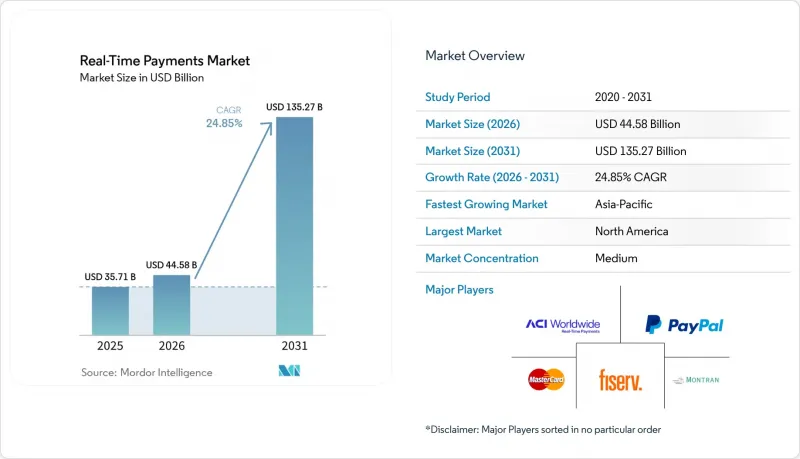
本報告按交易類型(點對點 (P2P)、點對點 (P2B))、組件(平台/解決方案、服務)、部署方式(雲端、本地部署)、企業規模(大型企業、中小企業)、最終用戶行業(零售和電子商務、銀行、金融服務和保險 (BFSI)、公共產業和地區電信、醫療保健等)以及最終用戶行業進行細分。市場預測以美元 (USD) 為單位。
全球即時支付市場趨勢及洞察
向 ISO 20022 過渡將加速基礎設施現代化。
ISO 20022 的實施截止日期為 2025 年 11 月,銀行必須同時更新其通訊和處理引擎,因此採用即時結算網路成為最具成本效益的合規措施。根據 SWIFT 統計,目前已有 32.9% 的跨國訊息使用 ISO 20022 發送,較 2024 年第四季增加了 6 個百分點。增強的數據有效載荷提高了製裁篩檢,德意志銀行也強調了即時合規對企業的益處。隨著共存期即將結束,金融機構不得不避免營運雙系統的成本。區域性銀行正透過外包給第三方處理商來彌合功能差距,這些第三方處理商將 ISO 20022 轉換能力與即時結算連接相結合。
FedNow的擴張正在鞏固其在美國市場的領先地位。
FedNow的網路效應在2025年第一季交易量(成長43.1%)和交易額(成長140.8%)的激增中顯而易見,與上一季相比,這表明其商業應用場景正在不斷擴大。聯準會雄心勃勃地計劃讓8,000家金融機構參與其中,這為該支付網路在全國範圍內的部署奠定了基礎。同時,巴西的PIX 2.0計劃於2025年9月推出定期付款和分期付款功能,展示了一個成熟的系統如何發展成為一個多功能平台。這些努力共同樹立了一個跨洲的性能標桿,其他市場將會跟進。
詐欺監控的複雜性限制了實施速度。
由於每種支付方案的收款人驗證框架各不相同,銀行必須為 FedNow、PIX 和 SEPA Instant 分別投資開發不同的規則集。 ACI Worldwide 與 Banfico 合作在歐洲開展的概念驗證(PoC) 項目,展示了一種夥伴關係模式,作為滿足歐盟 2025 年 10 月合規期限的替代方案。 Visa 收購 Featurespace 一事凸顯了基於人工智慧的即時詐欺偵測技術需要大量資金投入。小規模的金融機構面臨平行系統帶來的營運負擔,並且在採用多個網路方面進展緩慢。
細分市場分析
預計到2025年,個人對個人(P2B)支付將佔即時支付市場收入的54.62%,凸顯了消費者對P2B支付的廣泛接受度。目前,企業主導的支付流速超過了P2B支付,隨著即時薪水支付和商家支付的日益普及,P2B交易的年成長率僅為27.55%。 FedNow早期針對薪水支付和供應商支付的企業試點計畫凸顯了這一轉變,顯示營運資金的優勢正引起財務經理的共鳴。儘管B2B支付仍處於起步階段,但考慮到ACH結算需要數天時間,它代表最大的潛在市場。此外,在一些地區,「先買後付(BNPL)」服務提供者正在採用帳戶間支付來降低交易手續費,消費者對企業的資金轉帳也正在蓬勃發展。巴西的PIX清楚地展現了這一轉變,預測到2025年,電子商務企業的即時支付交易將達到300億美元。海灣合作理事會國家強制性的政府對個人支付已將全天候支付確立為一項新標準,鞏固了即時支付基礎設施作為公共服務標準的地位。
即時預支薪資服務正在改變薪水支付的經濟結構,其透過提高交易頻率而非交易量來增加絕對結算量。企業正在整合財務管理和應付帳款(AP) 流程,從每週支付轉向按需轉帳。跨國營運的企業正在利用 UPI-PayNow 等雙邊合作夥伴關係來縮短與東南亞供應商的結算週期。市場平台正在引入分期結算模式,同時分配費用和本金,從而消除對帳造成的延遲。這些應用案例共同凸顯了即時結算市場作為流動性最佳化關鍵要素的重要性。
到2025年,平台和解決方案支出將佔總收入的74.95%,這表明銀行更傾向於全面升級而非戰術性附加功能。向ISO 20022標準的過渡是推動這一趨勢的主要因素,因為訊息轉換、詐欺分析和API編配在整合架構上效率最高。然而,業務收益年增28.05%,反映出分階段部署對專業整合商的高度依賴。諮詢服務包括部署準備評估、藍圖設計和監管差距分析。金融機構正在根據服務等級協定(SLA)外包管理服務,以確保運作,從而在降低人員配置的同時確保合規性。 ACI Worldwide等整合合作夥伴在2025年第一季軟體業務成長了42%,這顯示平台和專業服務結合的合約模式在中型金融機構中廣受歡迎。
在整個預測期內,能夠編配即時和批次處理的中間件至關重要。採用容器化微服務的混合雲端編排器能夠逐步與傳統核心系統解耦。這種架構使銀行能夠在逐步淘汰大型主機模組的同時,透過即時結算 API 為客戶提供前端服務。培訓計畫旨在推動營運文化轉型為持續結算和即時流動性監控。
區域分析
預計到2025年,北美將佔據37.72%的市場佔有率,這主要得益於FedNow和清算所RTP網路的成熟。隨著區域性銀行擴大進入市場,以及雲端連接器的普及,交易量成長正在加速。關於即時扣款交易交換費的監管細則的明確,也促進了商戶的採用。加拿大計劃於2026年推出「即時鐵路」(Real-Time Rail),這有望開闢一條與美國之間以美元計價的跨境結算通道。
預計到2031年,亞太地區的複合年成長率將達到28.1%,位居全球之首。印度的統一支付介面(UPI)在2024會計年度處理了1310億筆交易(總額達200兆印度盧比,約合2.4兆美元),充分展現了政府支持的開放API模式的規模經濟效益。新加坡的「Nexus計畫」為多邊支付樹立了典範,而澳洲的NPP系統已完成強制性「PayTo」功能的開發,並正在擴展其企業結算功能。日本各地區銀行正在加快現代化進程,以實現該國無現金支付率的目標。
繼歐洲於2025年1月實施全天候支付受理要求後,德意志銀行當月即時結算量增加了27%。儘管2025年10月全面實施匯款功能將進一步促進其普及,但監管機構設定的價格上限可能會對續費利潤率造成壓力。由於北歐P27協議暫停,SEPA即時支付仍是歐洲事實上的跨境支付方式,迫使各銀行尋求與英國支付服務局(FPS)進行雙邊合作。
在南美洲,PIX 處於發展前沿,正拓展至分期付款和線下支付模式,逐步淘汰現金的最後用途。哥倫比亞、智利和阿根廷正在考慮為 PIX 實施官民合作關係模式。在中東,政策主導的成長勢頭強勁,沙烏地阿拉伯的「Sarie」和阿拉伯聯合大公國的 IPP 都強制要求公務員即時領取薪水。在非洲,行動支付業者正在整合開放回路型即時支付網路,將電子錢包的普及與銀行級支付能力結合。
其他好處:
- Excel格式的市場預測(ME)表
- 3個月的分析師支持
目錄
第1章:引言
- 研究假設和市場定義
- 調查範圍
第2章:調查方法
第3章執行摘要
第4章 市場狀況
- 市場概覽
- 市場促進因素
- 在歐洲和亞太地區採用符合 ISO 20022 標準的國內支付網路。
- FedNow 的擴展和即將推出的 PIX 2.0 正在加速美洲地區的採用。
- 美國零工勞動者對即時薪水支付和預付工資服務(EWA)的需求
- 歐洲的先買後付業者正在向即時支付 (RTP) 模式遷移,以實現向商家即時付款。
- 海灣合作理事會國家政府採取措施,強制要求即時支付薪資和福利金
- 透過RippleNet和Visa Direct實現的跨境RTP連線激增
- 市場限制因素
- 不同RTP方案的詐欺監控標準有差異
- 亞洲二線銀行傳統核心銀行系統現代化進程落後
- 卡片令牌化與帳戶間結算管道互通性之間的差距
- 美國商家手續費監管的不確定性
- 價值鏈分析
- 監管和標準展望
- 波特五力分析
- 市場宏觀經濟趨勢的評估
- 案例研究和使用範例
- RTP交易佔總交易量的比例-按地區和主要國家/地區細分
- RTP交易佔非現金交易的百分比-按地區和主要國家/地區細分
第5章 市場規模與成長預測
- 按交易類型
- Peer-to-Peer(P2P)
- Peer-to-Business(P2B)
- 按組件
- 平台/解決方案
- 服務
- 部署模式
- 雲
- 現場
- 按公司規模
- 大公司
- 小型企業
- 按最終用戶行業分類
- 零售與電子商務
- BFSI
- 公共產業及通訊
- 衛生保健
- 政府/公共部門
- 其他終端用戶產業
- 按地區
- 北美洲
- 美國
- 加拿大
- 墨西哥
- 歐洲
- 英國
- 德國
- 法國
- 西班牙
- 其他歐洲國家
- 亞太地區
- 中國
- 印度
- 日本
- 韓國
- 其他亞太國家
- 南美洲
- 巴西
- 阿根廷
- 哥倫比亞
- 其他南美國家
- 中東
- 阿拉伯聯合大公國
- 沙烏地阿拉伯
- 其他中東國家
- 非洲
- 南非
- 奈及利亞
- 其他非洲國家
- 北美洲
第6章 競爭情勢
- 市場集中度
- 策略趨勢
- 市佔率分析
- 公司簡介
- ACI Worldwide Inc.
- Fiserv Inc.
- PayPal Holdings Inc.
- Mastercard Inc.
- Montran Corporation
- FIS Global
- Temenos AG
- Volante Technologies Inc.
- Finastra Inc.
- Ant Group(Alipay)
- Tencent Holdings Ltd.(WeChat Pay)
- The Clearing House Payments Co.
- Visa Inc.
- SWIFT SCRL
- Worldline SA
- Nets Group
- Nexi SpA
- Ripple Labs Inc.
- Wise PLC
- Pay.UK
- GoCardless Ltd.
- Jack Henry and Associates Inc.
- Infosys Finacle
- VSoft Corporation
- OpenPayd Holdings Ltd.
第7章 市場機會與未來展望
According to Mordor Intelligence, real time payments market size in 2026 is estimated at USD 44.58 billion, growing from 2025 value of USD 35.71 billion with 2031 projections showing USD 135.27 billion, growing at 24.85% CAGR over 2026-2031.
This report is Segmented by Transaction Type (Peer-To-Peer (P2P), Peer-To-Business (P2B)), Component (Platform / Solution, Services), Deployment (Cloud, On-Premise), Enterprise Size (Large Enterprises, Small and Medium Enterprises), End-User Industry (Retail and E-Commerce, BFSI, Utilities & Telecom, Healthcare, and More), and Geography. The Market Forecasts are Provided in Terms of Value (USD).
Global Real-Time Payments Market Trends and Insights
ISO 20022 migration accelerates infrastructure modernization
The November 2025 ISO 20022 deadline compels banks to update messaging and processing engines simultaneously, making real-time payment rail adoption the most cost-efficient compliance path. SWIFT notes that 32.9% of cross-border messages already ride ISO 20022, up six percentage points in Q4 2024. Richer data payloads improve sanctions screening, and Deutsche Bank showcases real-time compliance benefits for corporates. The looming end of the coexistence period forces institutions to avoid dual-system overhead. Community banks mitigate capability gaps by outsourcing to third-party processors that bundle ISO 20022 translation with instant-payment connectivity.
FedNow expansion drives Americas market leadership
FedNow's network effects were evident with a 43.1% quarterly volume spike in Q1 2025 and a 140.8% value leap, signalling widening commercial use cases. The Federal Reserve's ambition to onboard 8,000 institutions positions the rail for nationwide ubiquity. In parallel, Brazil's PIX 2.0 will introduce recurring and instalment capabilities in September 2025, showing how mature systems evolve into multifunction platforms. Combined, these initiatives set cross-continental performance benchmarks that other markets emulate.
Fraud monitoring complexity constrains adoption velocity
Verification-of-Payee frameworks differ across schemes, obliging banks to invest in separate rule sets for FedNow, PIX, and SEPA Instant. ACI Worldwide's European PoC with Banfico illustrates workaround partnerships to meet the EU's October 2025 compliance deadline. Visa's Featurespace acquisition underscores the capital-intensive nature of AI-based instant fraud detection. Smaller institutions face operational strain from parallel systems, slowing onboarding to multiple networks.
Other drivers and restraints analyzed in the detailed report include:
- Earned-wage access transforms payroll economics
- Cross-border RTP corridors reshape international payments
- Legacy infrastructure modernization challenges
For complete list of drivers and restraints, kindly check the Table Of Contents.
Segment Analysis
Peer-to-peer transfers accounted for 54.62% of Real Time Payments market revenue in 2025, underscoring widespread consumer adoption. Business-driven flows now outpace personal transfers, with peer-to-business transactions growing 27.55% annually as instant payroll disbursements and merchant settlement take hold. FedNow's early corporate pilots in payroll and supplier payments highlight this pivot, signalling that working-capital benefits resonate with finance executives. Business-to-business adoption remains in early stages but promises the largest addressable pool, given ACH's multi-day settlement drag. Consumer-to-business flows gain momentum where buy-now-pay-later (BNPL) providers embed account-to-account settlement to minimise interchange costs. Brazil's PIX demonstrates this migration, with e-commerce merchants projected to book USD 30 billion in instant-payment turnover during 2025. Government-to-person mandates across GCC economies create a new baseline expectation for 24/7 disbursement, cementing instant infrastructure as a public-service standard.
Real-time salary advances reshape payroll economics, enlarging transaction frequency rather than ticket size, thus increasing absolute rail volume. Corporates synchronise treasury and AP processes, shifting from weekly payment runs to on-demand pushes. Cross-border organisations leverage bilateral links such as UPI-PayNow to shorten supplier settlement cycles in Southeast Asia. Market platforms introduce split-payment models that route commission and principal amounts simultaneously, removing reconciliation delays. These combined use cases reinforce the Real Time Payments market as indispensable for liquidity optimisation.
Platform & solution spending captured 74.95% of 2025 revenue, signalling that banks favour holistic overhauls versus tactical bolt-ons. ISO 20022 migration serves as the triggering event, since message translation, fraud analysis, and API orchestration are most efficient on unified stacks. Yet service revenue rises 28.05% annually, reflecting heavy reliance on specialist integrators for phased rollout. Consulting engagements cover readiness assessments, roadmap design, and regulatory gap analysis. Institutions outsource managed services for SLAs covering 24/7 uptime, ensuring compliance while containing headcount. Integration partners such as ACI Worldwide logged 42% software-segment growth in Q1 2025, proving that combinational platform-plus-professional-services deals resonate with mid-tier institutions.
Over the forecast period, middleware capable of orchestrating real-time and batch flows side-by-side becomes critical. Hybrid-cloud orchestrators with containerised microservices enable progressive decoupling from legacy cores. This architecture allows banks to retire mainframe modules gradually while front-ending customers with instant-payment APIs. Training programmes address the operational culture shift to continuous settlement and real-time liquidity monitoring.
Complete Report Scope:
- By Transaction Type
- Peer-to-Peer (P2P)
- Peer-to-Business (P2B)
- By Component
- Platform / Solution
- Services
- By Deployment Mode
- Cloud
- On-Premise
- By Enterprise Size
- Large Enterprises
- Small and Medium Enterprises
- By End-User Industry
- Retail and E-Commerce
- BFSI
- Utilities and Telecom
- Healthcare
- Government and Public Sector
- Other End-user Industries
- By Geography
- North America
- United States
- Canada
- Mexico
- Europe
- United Kingdom
- Germany
- France
- Spain
- Rest of Europe
- Asia-Pacific
- China
- India
- Japan
- South Korea
- Rest of Asia-Pacific
- South America
- Brazil
- Argentina
- Colombia
- Rest of South America
- Middle East
- United Arab Emirates
- Saudi Arabia
- Rest of Middle East
- Africa
- South Africa
- Nigeria
- Rest of Africa
- North America
Geography Analysis
North America posted 37.72% revenue share in 2025, anchored by FedNow and The Clearing House RTP network maturity. Volume growth accelerates as regional banks join en masse, aided by packaged cloud connectors. Regulatory clarity on interchange treatment for instant debit pushes merchant adoption. Canada plans Real-Time Rail launch in 2026, which could open a USD-denominated cross-border corridor with the United States.
Asia-Pacific delivers the highest CAGR at 28.1% to 2031. India's UPI handled 131 billion transactions worth INR 200 trillion (USD 2.4 trillion) in FY24, illustrating scale benefits of a government-backed open API model. Singapore's Project Nexus presents a template for multi-country clearing, while Australia's NPP finalises PayTo mandates, expanding business billing capabilities. Japan's regional banks accelerate modernization to meet the national cashless-ratio target.
Europe's mandatory 24/7 receiving requirement effective January 2025 induced a 27% instant-payment jump at Deutsche Bank that same month. Full send capability by October 2025 will drive further adoption yet may squeeze fee margins given regulation-imposed price caps. Nordic P27's pause leaves SEPA Instant as the de-facto cross-border option inside Europe, pushing banks toward bilateral links with the UK's FPS.
South America's trajectory centres on PIX, now extending to instalment and offline modes that remove the last cash use-cases. Colombia, Chile, and Argentina examine replicating PIX's public-private partnership structure. The Middle East experiences policy-driven growth where Saudi Arabia's Sarie rail and the UAE's IPP mandate instant salary credits for government workers. Africa witnesses mobile-money players integrating open-loop instant rails, blending wallet ubiquity with bank-grade clearing.
- ACI Worldwide Inc.
- Fiserv Inc.
- PayPal Holdings Inc.
- Mastercard Inc.
- Montran Corporation
- FIS Global
- Temenos AG
- Volante Technologies Inc.
- Finastra Inc.
- Ant Group (Alipay)
- Tencent Holdings Ltd. (WeChat Pay)
- The Clearing House Payments Co.
- Visa Inc.
- SWIFT SCRL
- Worldline SA
- Nets Group
- Nexi SpA
- Ripple Labs Inc.
- Wise PLC
- Pay.UK
- GoCardless Ltd.
- Jack Henry and Associates Inc.
- Infosys Finacle
- VSoft Corporation
- OpenPayd Holdings Ltd.
Additional Benefits:
- The market estimate (ME) sheet in Excel format
- 3 months of analyst support
TABLE OF CONTENTS
1 INTRODUCTION
- 1.1 Study Assumptions and Market Definition
- 1.2 Scope of the Study
2 RESEARCH METHODOLOGY
3 EXECUTIVE SUMMARY
4 MARKET LANDSCAPE
- 4.1 Market Overview
- 4.2 Market Drivers
- 4.2.1 Proliferation of ISO 20022-enabled domestic rails in Europe and Asia-Pacific
- 4.2.2 Expansion of FedNow and upcoming PIX 2.0 accelerating adoption in the Americas
- 4.2.3 Real-time payroll and earned-wage access (EWA) demand among U.S. gig workers
- 4.2.4 BNPL players shifting to RTP for instant merchant settlement in Europe
- 4.2.5 Government mandates for instant salary and welfare disbursement in GCC countries
- 4.2.6 Surging cross-border RTP corridors via RippleNet and Visa Direct
- 4.3 Market Restraints
- 4.3.1 Fragmented fraud-monitoring standards across RTP schemes
- 4.3.2 Legacy core-bank modernisation backlog in Tier-2 Asian banks
- 4.3.3 Interoperability gaps between card tokenisation and account-to-account rails
- 4.3.4 Merchant surcharge regulation uncertainty in the U.S.
- 4.4 Value Chain Analysis
- 4.5 Regulatory and Standards Outlook
- 4.6 Porter's Five Forces Analysis
- 4.6.1 Threat of New Entrants
- 4.6.2 Bargaining Power of Buyers
- 4.6.3 Bargaining Power of Suppliers
- 4.6.4 Threat of Substitutes
- 4.6.5 Intensity of Competitive Rivalry
- 4.7 Assessment of Macro Economic Trends on the Market
- 4.8 Case Studies and Use-cases
- 4.9 RTP Transactions as % of All Transactions - Regional and Key-Country Split
- 4.10 RTP Transactions as % of Non-Cash Transactions - Regional and Key-Country Split
5 MARKET SIZE AND GROWTH FORECASTS (VALUES)
- 5.1 By Transaction Type
- 5.1.1 Peer-to-Peer (P2P)
- 5.1.2 Peer-to-Business (P2B)
- 5.2 By Component
- 5.2.1 Platform / Solution
- 5.2.2 Services
- 5.3 By Deployment Mode
- 5.3.1 Cloud
- 5.3.2 On-Premise
- 5.4 By Enterprise Size
- 5.4.1 Large Enterprises
- 5.4.2 Small and Medium Enterprises
- 5.5 By End-User Industry
- 5.5.1 Retail and E-Commerce
- 5.5.2 BFSI
- 5.5.3 Utilities and Telecom
- 5.5.4 Healthcare
- 5.5.5 Government and Public Sector
- 5.5.6 Other End-user Industries
- 5.6 By Geography
- 5.6.1 North America
- 5.6.1.1 United States
- 5.6.1.2 Canada
- 5.6.1.3 Mexico
- 5.6.2 Europe
- 5.6.2.1 United Kingdom
- 5.6.2.2 Germany
- 5.6.2.3 France
- 5.6.2.4 Spain
- 5.6.2.5 Rest of Europe
- 5.6.3 Asia-Pacific
- 5.6.3.1 China
- 5.6.3.2 India
- 5.6.3.3 Japan
- 5.6.3.4 South Korea
- 5.6.3.5 Rest of Asia-Pacific
- 5.6.4 South America
- 5.6.4.1 Brazil
- 5.6.4.2 Argentina
- 5.6.4.3 Colombia
- 5.6.4.4 Rest of South America
- 5.6.5 Middle East
- 5.6.5.1 United Arab Emirates
- 5.6.5.2 Saudi Arabia
- 5.6.5.3 Rest of Middle East
- 5.6.6 Africa
- 5.6.6.1 South Africa
- 5.6.6.2 Nigeria
- 5.6.6.3 Rest of Africa
- 5.6.1 North America
6 COMPETITIVE LANDSCAPE
- 6.1 Market Concentration
- 6.2 Strategic Moves
- 6.3 Market Share Analysis
- 6.4 Company Profiles {(includes Global level Overview, Market level overview, Core Segments, Financials as available, Strategic Information, Market Rank/Share, Products and Services, and Recent Developments)}
- 6.4.1 ACI Worldwide Inc.
- 6.4.2 Fiserv Inc.
- 6.4.3 PayPal Holdings Inc.
- 6.4.4 Mastercard Inc.
- 6.4.5 Montran Corporation
- 6.4.6 FIS Global
- 6.4.7 Temenos AG
- 6.4.8 Volante Technologies Inc.
- 6.4.9 Finastra Inc.
- 6.4.10 Ant Group (Alipay)
- 6.4.11 Tencent Holdings Ltd. (WeChat Pay)
- 6.4.12 The Clearing House Payments Co.
- 6.4.13 Visa Inc.
- 6.4.14 SWIFT SCRL
- 6.4.15 Worldline SA
- 6.4.16 Nets Group
- 6.4.17 Nexi SpA
- 6.4.18 Ripple Labs Inc.
- 6.4.19 Wise PLC
- 6.4.20 Pay.UK
- 6.4.21 GoCardless Ltd.
- 6.4.22 Jack Henry and Associates Inc.
- 6.4.23 Infosys Finacle
- 6.4.24 VSoft Corporation
- 6.4.25 OpenPayd Holdings Ltd.
7 MARKET OPPORTUNITIES AND FUTURE OUTLOOK
- 7.1 White-space and Unmet-Need Assessment

 中國即時支付:市場佔有率分析、產業趨勢與統計及成長預測(2026-2031年)亞太地區即時支付:市場佔有率分析、行業趨勢和統計數據以及成長預測(2026-2031 年)印度即時支付:市場佔有率分析、行業趨勢和統計數據以及成長預測(2026-2031 年)德國即時支付:市場佔有率分析、行業趨勢和統計數據以及成長預測(2026-2031 年)日本即時支付:市場佔有率分析、行業趨勢和統計數據以及成長預測(2026-2031 年)歐洲即時支付:市場佔有率分析、行業趨勢和統計數據以及成長預測(2026-2031 年)美國即時支付:市場佔有率分析、行業趨勢和統計數據、成長預測(2026-2031 年)西班牙即時支付:市場佔有率分析、行業趨勢和統計數據以及成長預測(2026-2031 年)英國即時支付:市場佔有率分析、行業趨勢和統計數據以及成長預測(2026-2031 年)
 即時支付市場:按組件、部署模式、組織規模、交易類型、應用程式和最終用戶分類-2026-2032年全球市場預測