


 |
市場調查報告書
商品編碼
2125351
德國即時支付:市場佔有率分析、行業趨勢和統計數據以及成長預測(2026-2031 年)Germany Real Time Payments - Market Share Analysis, Industry Trends & Statistics, Growth Forecasts (2026 - 2031) |
||||||

※ 本網頁內容可能與最新版本有所差異。詳細情況請與我們聯繫。
根據 Mordor Intelligence 預測,德國即時支付市場規模預計將從 2025 年的 21.9 億美元成長到 2026 年的 29.8 億美元,到 2031 年將達到 139.4 億美元,2026 年至 2031 年的複合年成長率為 36.15%。
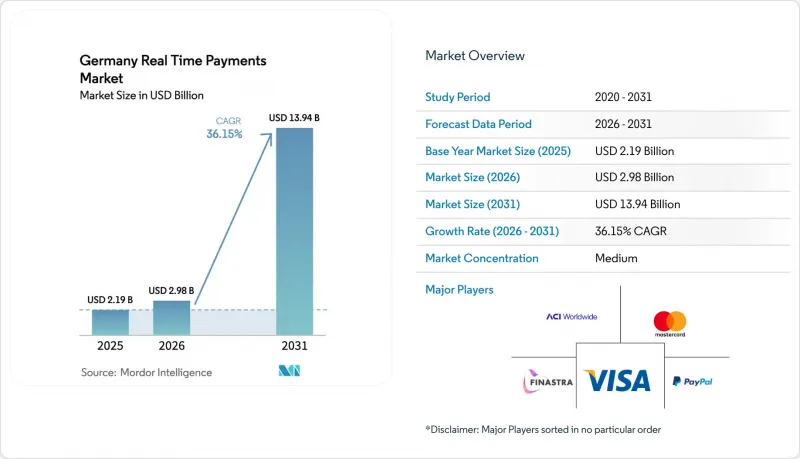
本報告按交易類型(點對點 (P2P)、點對點 (P2B))、組件(平台/解決方案、服務)、部署模式(雲端、本地部署)、公司規模(大型企業、中小企業)和最終用戶行業(零售/電子商務、銀行、金融服務和保險 (BFSI)、公共產業/電信、醫療保健、其他)進行細分。市場預測以美元 (USD) 計價。
德國即時支付市場的趨勢和洞察
SEPA即時轉帳限額提高,變革B2B支付方式
10萬歐元(115,602.93美元)的上限提高,迫使企業從批量處理的轉帳方式轉向即時結算系統,從而改善日內流動性管理,並實現高額發票在幾秒鐘內完成對帳。德國負責人正在將即時餘額整合到現金池儀錶板中,從而控制透支成本並增強客戶信心。能夠自動處理高額SCT即時轉帳的銀行正在企業客戶的結算方式領域佔據穩固地位。技術投資的重點在於直通式處理、詐欺分析以及豐富ISO 20022資料以容納更詳細的轉帳資料。中期來看,預計這項新的上限將模糊德國高額結算系統和零售即時結算系統之間的界限,進一步推動德國即時結算市場的普及。
強制電子帳單正在鼓勵企業採用即時支付系統。
一項將於2025年1月生效的德國強制規定將要求所有企業接受結構化電子帳單,從而實現自動支付。發票到付款的無縫資料傳輸將消除人工對帳和供應商催款的需要。製造業和汽車供應鏈中的先驅報告稱,應收帳款回收週期縮短,與爭議解決相關的管理成本降低。金融科技整合商正在向會計軟體供應商銷售基於訂閱的API,將電子帳單分析與內建的SCT即時支付發起功能捆綁在一起。因此,隨著企業重組其採購到付款流程,這項規定將增強德國的即時支付市場。
IBAN和姓名驗證問題阻礙了交易的完成。
雖然名稱匹配檢查在打擊帳戶名稱不符(APP)詐騙行之有效,但縮寫和公司名稱的差異目前會導致許多合法交易被錯誤識別。如果最終用戶一再遇到錯誤,就會放棄交易,從而損害其信任。由於字元集和公司名稱的差異,跨境支付的錯誤率更高。支付服務供應商(PSP)正在投資模糊匹配引擎和客戶教育,以降低客戶流失。在演算法成熟之前,誤報可能會阻礙德國即時支付市場的短期成長。
細分市場分析
預計到2031年,個人對企業(P2B)交易將以38.71%的複合年成長率成長,這反映出企業擴大採用電子帳單發票和「請求支付」整合。即使到了2025年,P2P仍將佔據德國即時支付市場59.20%的佔有率,但隨著用戶群的日益普及,其成長預計將趨於正常。隨著零售商、公共產業和專業服務機構將即時支付連結整合到其計費流程中,預計德國即時支付市場的P2B市場規模將顯著擴大。像wero這樣的金融科技錢包透過基於別名的支付方式減少了支付摩擦,進一步加速了P2P的普及。
企業可以從接受P2B轉帳中獲益,例如實現即時融資和降低交易手續費。政府獎勵,例如公共部門接受P2B支付稅款,將進一步推動這一趨勢。目前,P2P創新主要集中在分期付款和社交電商等增值領域。這些方向的結合將使成長路徑更加多元化,並擴大德國即時支付市場的規模。
隨著銀行加快部署SCT Inst的核心功能,預計到2025年,該平台的投資將佔總收入的67.40%。目前核心連結已趨於穩定,服務業預計將帶來最大的增量收入,年複合成長率將達到32.37%。德國即時支付市場的專業服務涵蓋系統整合、合規諮詢、詐欺預防和流動性最佳化等。
小規模的支付服務供應商(PSP) 正將 ISO 20022 標準的規則手冊更新、VoP 連接和資料增強等工作外包給專業的管理服務提供者。金融顧問公司則提供包含即時結算和現金流量預測模組的套餐服務。因此,競爭的關鍵已從結算速度轉向資料分析的深度和情境化附加價值。能夠協調多軌路由、整合 R2P 以及整合匹配儀錶板的供應商,預計在德國即時結算市場獲得更高的利潤率。
其他好處:
- Excel格式的市場預測(ME)表
- 3個月的分析師支持
目錄
第1章:引言
- 研究假設和市場定義
- 調查範圍
第2章:調查方法
第3章執行摘要
第4章 市場狀況
- 市場概覽
- 市場促進因素
- SEPA即時轉帳 (SCT Inst) 限額已提高至 110,000 美元,方便了大額 B2B 資金轉帳。
- 聯邦政府強制推行電子帳單要求(2025 年),正在加速企業即時支付的進程。
- 「請求支付(R2P)」的引入提高了電子商務即時支付的轉換率。
- 利用 Giropay 支付基礎設施的金融科技「先買即時付」服務
- 核心銀行向 ISO 20022 的過渡將使 Sparkassen 和 Volksbanken 的即時匯款網路得以擴展。
- 市場限制因素
- IBAN 與帳戶名稱不符導致的誤報正在增加帳戶放棄率。
- 針對每家門市額外收費的規則存在差異,這限制了小額支付領域的採用。
- 對於小規模的支付服務提供者而言,在夜間和週末時段獲得流動性的機會有限。
- 銀行附加價值服務貨幣化方面的不確定性
- 價值鏈分析
- 監理展望
- 技術展望
- 波特五力分析
- 市場宏觀經濟趨勢的評估
第5章 市場規模與成長預測
- 按交易類型
- 點對點(P2P)
- Peer-to-Business(P2B)
- 按組件
- 平台/解決方案
- 服務
- 部署模式
- 雲
- 現場
- 按公司規模
- 大公司
- 小型企業
- 按最終用戶行業分類
- 零售與電子商務
- BFSI
- 公共產業及通訊
- 衛生保健
- 政府/公共部門
- 其他終端用戶產業
第6章 競爭情勢
- 市場集中度
- 策略趨勢
- 市佔率分析
- 公司簡介
- ACI Worldwide Inc.
- Fiserv Inc.
- Fidelity National Information Services Inc.(FIS)
- Mastercard Inc.
- PayPal Holdings Inc.
- Visa Inc.
- EBA Clearing
- Deutsche Bank AG
- Worldline SA
- Nexi Group SpA
- PPI AG
- Finastra International GmbH
- Temenos AG
- Adyen NV
- Stripe Inc.
- Klarna Bank AB
- Tink AB
- Deutsche Sparkassen Finanzgruppe
- Volksbanken Raiffeisenbanken(BVR)
- Commerzbank AG
第7章 投資分析
第8章 市場機會與未來展望
- 評估未開發的領域和未滿足的需求
According to Mordor Intelligence, the Germany real time payments market size is expected to grow from USD 2.19 billion in 2025 to USD 2.98 billion in 2026 and is forecast to reach USD 13.94 billion by 2031 at 36.15% CAGR over 2026-2031.
This report is Segmented by Transaction Type (Peer-To-Peer (P2P), Peer-To-Business (P2B)), Component (Platform / Solution, Services), Deployment (Cloud, On-Premise), Enterprise Size (Large Enterprises, Small & Medium Enterprises), End-User Industry (Retail & E-Commerce, BFSI, Utilities & Telecom, Healthcare, and More). The Market Forecasts are Provided in Terms of Value (USD).
Germany Real Time Payments Market Trends and Insights
SEPA Instant Credit Transfer Limit Expansion Transforms B2B Payments
The elevated EUR 100,000 (USD 115602.93) threshold is pushing corporates to switch from batch wires to instant rails, improving intraday liquidity management and reconciling high-value invoices in seconds. German treasurers now integrate real-time balances into cash-pooling dashboards, curbing overdraft costs and enhancing counterparty confidence. Banks that enable automated high-value SCT Inst flows win entrenched positions in corporate wallets. Technology spend concentrates on straight-through processing, fraud analytics, and ISO 20022 enrichment to accommodate richer remittance data. Over the medium term, the new ceiling is expected to blur boundaries between domestic high-value systems and retail instant rails, underpinning broader Germany real time payments market adoption.
E-Invoicing Mandate Drives Corporate Instant Payment Adoption
Germany's January 2025 mandate compels every enterprise to receive e-invoices in structured formats, fostering auto-triggered payment initiation. Seamless data hand-over from invoice to payment removes manual reconciliation and supplier chasing. Early adopters in manufacturing and automotive supply chains report faster days-sales-outstanding and lower dispute overheads. Fintech integrators bundle e-invoice parsing with embedded SCT Inst initiation, selling subscription APIs to accounting software providers. The regulation therefore fortifies Germany real time payments market as corporates re-engineer procure-to-pay cycles.
IBAN-Name Verification Challenges Impede Transaction Completion
Mandatory name-match checks, though effective against APP fraud, currently flag numerous legitimate transfers because of abbreviations or legal entity variants. End-users abort journeys when repeated failures appear, eroding trust. Cross-border payments suffer higher drop-rates as character sets and trading names diverge. PSPs invest in fuzzy-matching engines and customer education to mitigate attrition. Until algorithms mature, false positives will cap short-term growth in Germany real time payments market.
Other drivers and restraints analyzed in the detailed report include:
- Request-to-Pay Revolutionizes E-Commerce Checkout Experience
- Fintech Innovation Sparks 'Buy Now Pay Instantly' Services
- Fragmented Surcharge Rules Limit Micro-Ticket Uptake
For complete list of drivers and restraints, kindly check the Table Of Contents.
Segment Analysis
Peer-to-Business volumes are projected to register a 38.71% CAGR through 2031, reflecting corporate alignment with e-invoicing and Request-to-Pay integration. P2P still accounts for 59.20% of Germany real time payments market share in 2025, yet its growth normalizes as the user base nears ubiquity. Germany real time payments market size for P2B is forecast to broaden materially as retailers, utilities, and professional services embed instant pay links into billing workflows. Fintech wallets like wero lower friction by alias-based payments, encouraging further P2P stickiness.
Businesses benefit from real-time cash positioning and reduced interchange when accepting P2B transfers. Government incentives such as public-sector acceptance for tax remittances will reinforce momentum. P2P innovation now concentrates on value-added layers including split-bill and social commerce. Collectively, these vectors diversify Germany real time payments market avenues and help achieve scale.
Platform investments delivered 67.40% revenue in 2025 as banks raced to achieve basic SCT Inst capability. Now that core connectivity stabilizes, Services are forecast to contribute most incremental revenue, expanding at 32.37% CAGR. Germany real time payments market size for professional services covers integration, compliance consulting, fraud mitigation, and liquidity optimization.
Smaller PSPs outsource rulebook updates, VoP connectivity, and ISO 20022 enrichment to managed-service specialists. Treasury advisory firms package instant payments with cash-forecast modules. Competitive differentiation therefore shifts from speed of settlement to depth of data analytics and contextual value. Vendors that orchestrate multi-rail routing, combine R2P, and wrap reconciliation dashboards will capture higher margins in Germany real time payments market.
Complete Report Scope:
- By Transaction Type
- Peer-to-Peer (P2P)
- Peer-to-Business (P2B)
- By Component
- Platform / Solution
- Services
- By Deployment Mode
- Cloud
- On-Premise
- By Enterprise Size
- Large Enterprises
- Small and Medium Enterprises
- By End-User Industry
- Retail and E-Commerce
- BFSI
- Utilities and Telecom
- Healthcare
- Government and Public Sector
- Other End-user Industries
List of Companies Covered in this Report:
- ACI Worldwide Inc.
- Fiserv Inc.
- Fidelity National Information Services Inc. (FIS)
- Mastercard Inc.
- PayPal Holdings Inc.
- Visa Inc.
- EBA Clearing
- Deutsche Bank AG
- Worldline SA
- Nexi Group SpA
- PPI AG
- Finastra International GmbH
- Temenos AG
- Adyen NV
- Stripe Inc.
- Klarna Bank AB
- Tink AB
- Deutsche Sparkassen Finanzgruppe
- Volksbanken Raiffeisenbanken (BVR)
- Commerzbank AG
Additional Benefits:
- The market estimate (ME) sheet in Excel format
- 3 months of analyst support
TABLE OF CONTENTS
1 INTRODUCTION
- 1.1 Study Assumptions and Market Definition
- 1.2 Scope of the Study
2 RESEARCH METHODOLOGY
3 EXECUTIVE SUMMARY
4 MARKET LANDSCAPE
- 4.1 Market Overview
- 4.2 Market Drivers
- 4.2.1 SEPA Instant Credit Transfer (SCT Inst) limit increase to USD 110 k stimulating high-value B2B flows
- 4.2.2 Federal e-invoicing mandate (2025) accelerating instant settlement for corporates
- 4.2.3 Request-to-Pay (R2P) roll-out boosting instant checkout conversion in e-commerce
- 4.2.4 Fintech "Buy Now Pay Instantly" propositions leveraging Giropay rails
- 4.2.5 Core-bank migration to ISO 20022 enabling ubiquity of instant rails in Sparkassen and Volksbanken
- 4.3 Market Restraints
- 4.3.1 IBAN-name-mismatch false positives raising abandonment rates
- 4.3.2 Fragmented merchant surcharge rules limiting adoption in micro-ticket segments
- 4.3.3 Limited evening and weekend liquidity windows for smaller PSPs
- 4.3.4 Value-added-service monetisation uncertainty for banks
- 4.4 Value Chain Analysis
- 4.5 Regulatory Outlook
- 4.6 Technological Outlook
- 4.7 Porter's Five Forces Analysis
- 4.7.1 Bargaining Power of Suppliers
- 4.7.2 Bargaining Power of Buyers/Consumers
- 4.7.3 Threat of New Entrants
- 4.7.4 Threat of Substitute Products
- 4.7.5 Intensity of Competitive Rivalry
- 4.8 Assessment of Macro Economic Trends on the Market
5 MARKET SIZE AND GROWTH FORECASTS (VALUES)
- 5.1 By Transaction Type
- 5.1.1 Peer-to-Peer (P2P)
- 5.1.2 Peer-to-Business (P2B)
- 5.2 By Component
- 5.2.1 Platform / Solution
- 5.2.2 Services
- 5.3 By Deployment Mode
- 5.3.1 Cloud
- 5.3.2 On-Premise
- 5.4 By Enterprise Size
- 5.4.1 Large Enterprises
- 5.4.2 Small and Medium Enterprises
- 5.5 By End-User Industry
- 5.5.1 Retail and E-Commerce
- 5.5.2 BFSI
- 5.5.3 Utilities and Telecom
- 5.5.4 Healthcare
- 5.5.5 Government and Public Sector
- 5.5.6 Other End-user Industries
6 COMPETITIVE LANDSCAPE
- 6.1 Market Concentration
- 6.2 Strategic Moves
- 6.3 Market Share Analysis
- 6.4 Company Profiles {(includes Global level Overview, Market level overview, Core Segments, Financials as available, Strategic Information, Market Rank/Share for key companies, Products and Services, and Recent Developments)}
- 6.4.1 ACI Worldwide Inc.
- 6.4.2 Fiserv Inc.
- 6.4.3 Fidelity National Information Services Inc. (FIS)
- 6.4.4 Mastercard Inc.
- 6.4.5 PayPal Holdings Inc.
- 6.4.6 Visa Inc.
- 6.4.7 EBA Clearing
- 6.4.8 Deutsche Bank AG
- 6.4.9 Worldline SA
- 6.4.10 Nexi Group SpA
- 6.4.11 PPI AG
- 6.4.12 Finastra International GmbH
- 6.4.13 Temenos AG
- 6.4.14 Adyen NV
- 6.4.15 Stripe Inc.
- 6.4.16 Klarna Bank AB
- 6.4.17 Tink AB
- 6.4.18 Deutsche Sparkassen Finanzgruppe
- 6.4.19 Volksbanken Raiffeisenbanken (BVR)
- 6.4.20 Commerzbank AG
7 INVESTMENT ANALYSIS
8 MARKET OPPORTUNITIES AND FUTURE OUTLOOK
- 8.1 White-space and Unmet-need Assessment

 中國即時支付:市場佔有率分析、產業趨勢與統計及成長預測(2026-2031年)亞太地區即時支付:市場佔有率分析、行業趨勢和統計數據以及成長預測(2026-2031 年)印度即時支付:市場佔有率分析、行業趨勢和統計數據以及成長預測(2026-2031 年)日本即時支付:市場佔有率分析、行業趨勢和統計數據以及成長預測(2026-2031 年)歐洲即時支付:市場佔有率分析、行業趨勢和統計數據以及成長預測(2026-2031 年)美國即時支付:市場佔有率分析、行業趨勢和統計數據、成長預測(2026-2031 年)西班牙即時支付:市場佔有率分析、行業趨勢和統計數據以及成長預測(2026-2031 年)英國即時支付:市場佔有率分析、行業趨勢和統計數據以及成長預測(2026-2031 年)
 即時支付市場:按組件、部署模式、組織規模、交易類型、應用程式和最終用戶分類-2026-2032年全球市場預測
 2026年跨境即時支付(RTP)中心全球市場報告