


 |
市場調查報告書
商品編碼
2125258
歐洲即時支付:市場佔有率分析、行業趨勢和統計數據以及成長預測(2026-2031 年)Europe Real Time Payments - Market Share Analysis, Industry Trends & Statistics, Growth Forecasts (2026 - 2031) |
||||||

※ 本網頁內容可能與最新版本有所差異。詳細情況請與我們聯繫。
據 Mordor Intelligence 稱,歐洲即時支付市場預計到 2026 年價值 79.6 億美元,高於 2025 年的 72.1 億美元,預計到 2031 年將達到 131 億美元。
預計 2026 年至 2031 年的複合年成長率為 10.46%。
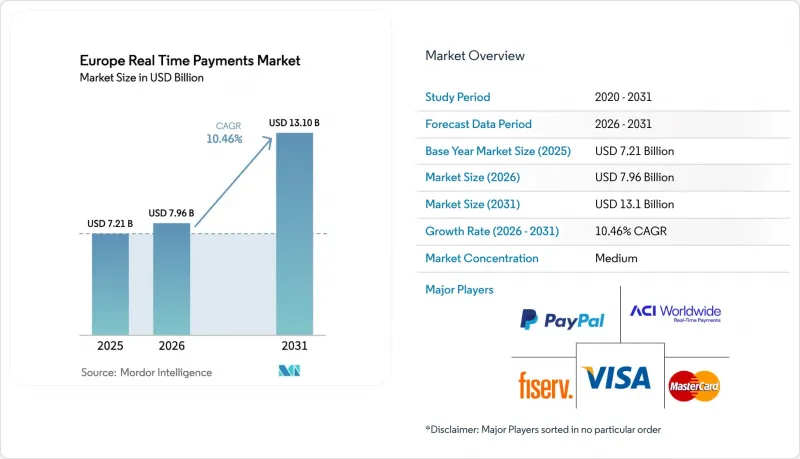
本報告按支付類型(P2P、P2B/C2B)、組件(平台/軟體、服務(諮詢、整合、託管))、企業規模(大型企業、中小企業)、最終用戶行業(銀行和金融服務業、零售和電子商務、電信和媒體、其他)以及國家/地區進行細分。市場預測以美元計價。
歐洲即時支付市場的趨勢與洞察
泛歐即時SEPA支付(SCT Inst)的推出正在推動市場加速發展。
SCT Inst合規要求規定,歐元區銀行必須在2025年1月前即時接受,並在2025年10月前完成轉帳處理。成本平價條款已將即時轉帳的平均費用從2.19歐元降至0.76歐元,消除了先前阻礙消費者接受該服務的費用障礙。最新法規將處理時間縮短至5秒,並將交易限額提高至近10億歐元(10.8億美元),為處理大型企業資金流動創建了平台。因此,銀行正將其投資從按交易收費模式轉向加值附加價值服務,例如「請求付款」和包含反詐欺措施的帳戶對帳。近乎即時的流動性結算將使企業能夠更快地獲得存款,從而進一步刺激歐洲即時結算市場的交易量成長。
PSD3 和 SPAA主導的開放銀行用例正在擴展到發起支付之外。
SPAA的補償框架最終為高階API引入了一種可行的經濟模式,鼓勵銀行推動資料產品的商業化,而不是將開放銀行視為合規成本。將於2025年前導測試的動態定期支付將允許商戶在無需新的授權委託書的情況下更改提款金額,從而降低拒付率並平滑現金流。 PSD3統一了支付和電子貨幣機構的許可,堵塞了導致市場准入分散的漏洞。這些改革將深化即時支付網路與加值數位服務的整合,為銀行和金融科技公司開闢新的獲利途徑。
RTP結算基礎設施分散,造成營運複雜性。
2024年上半年,TIPS處理了1.96億筆結算,總額達1,220億歐元(1,320億美元),其中99%的結算在5秒內完成。然而,支付服務提供者(PSP)仍需確保TIPS、RT1以及整個國家結算系統的流動性,這會佔用營運資金並增加結算風險。歐洲央行的單一流動性池計畫旨在整合現金緩衝,但由於實施進度不一,流動性仍然分散,給中小規模的PSP帶來了過重的負擔,並阻礙了歐洲即時結算市場的規模經濟效益。
細分市場分析
2025年,P2P轉帳佔總交易量的40.80%,而P2B/C2B交易量預計到2031年將以13.59%的年均成長率成長。隨著商家逐漸減少銀行卡交換費,歐洲即時支付市場的P2B交易預計將在2026年至2031年間新增33.6億美元的收入。 Wero於2024年7月在德國和比利時推出服務,這標誌著支付方式正從P2P轉向線上支付,而這種擴張也給全球各大銀行卡品牌帶來了競爭壓力。西班牙的Bizum、義大利的Bancomat Pay和葡萄牙的MB Way等新興的多方案路由服務體現了旨在滿足跨境消費者需求並維護國家主權的跨區域合作。對於商家而言,跨帳戶支付系統可以降低商家費用,提高支付速度,有助於提高客戶忠誠度,並鞏固其在歐洲即時支付市場中的地位,成為現有卡片網路的可靠替代方案。
次要趨勢顯示收入來源正在逐步重新平衡。能夠透過單一API存取多種即時支付方案的支付服務供應商最有利於取得大規模的P2B交易量。隨著「請求支付」(Request-to-Pay)技術的成熟,公共產業和公共機構將從不定期的批量收款轉向雙向計費,從而增加維持基礎設施利用率的常規交易量。因此,歐洲即時支付市場的重點將從消費者主導的匯款轉向企業主導的現金管理,加速整個服務層的貨幣化潛力提升。
平台/軟體授權在2025年佔總支出的62.70%,但服務業預計將以15.32%的複合年成長率成長。隨著歐元區在2025年10月前強制實施匯款功能,預計將出現諮詢和管理服務合約的激增,使歐洲即時支付市場服務業的市場規模從2025年的23億美元成長到2031年的54.1億美元。一級銀行通常採用「遷移」策略,對傳統支付中心進行現代化改造,同時將ISO 20022映射和方案認證等非差異化功能外包。 ACI Worldwide的雲端原生部署和基於IBM Z的擴展案例凸顯了對容錯性強、容量高的平台以及配套的專業服務封裝的需求。
IT預算有限的金融機構越來越傾向於選擇共用服務平台,這些平台無需大量資本投入即可滿足監管期限要求。這種轉變也為分析、欺詐管理和增值疊加服務等領域的交叉銷售創造了機會。隨著即時處理量的成長,持續的效能調優變得至關重要,這推動了對專業整合商的持續需求,並進一步鞏固了歐洲即時支付市場以服務為中心的收入趨勢。
其他好處:
- Excel格式的市場預測(ME)表
- 3個月的分析師支持
目錄
第1章:引言
- 研究假設和市場定義
- 調查範圍
第2章:調查方法
第3章執行摘要
第4章 市場狀況
- 市場概覽
- 市場促進因素
- 泛歐即時SEPA轉帳(SCT Inst)的引進
- 受PSD3和SPAA推動的開放銀行用例正在引領市場。
- 企業財務部門轉向 ISO 20022 以確保即時流動性,正在推動市場發展。
- 公共產業和公共部門「請求付費(R2P)」的興起正在推動市場發展。
- 市場限制因素
- RTP結算基礎設施分散(TIPS、RT1和國內系統),阻礙了市場發展。
- 支付詐騙,例如已通過核准匯款詐騙。
- 反洗錢/強客戶認證合規的高昂成本正在阻礙市場發展。
- 價值鏈分析
- 監理展望
- 波特五力分析
- 價格分析
- 歐洲支付環境的變化
- 無現金交易的成長趨勢
- 市場宏觀經濟趨勢的評估
- RTP佔所有交易的百分比 - 交易量和交易額(按國家/地區分類)
- RTP在非現金交易中的佔有率 - 交易量
第5章 市場規模與成長預測
- 按付款方式
- P2P
- P2B/C2B
- 按組件
- 平台/軟體
- 服務(諮詢、整合、管理)
- 按公司規模
- 大公司
- 中小企業
- 按最終用戶行業分類
- 銀行與金融服務 (BFSI)
- 零售與電子商務
- 通訊與媒體
- 衛生保健
- 其他終端用戶產業
- 國家
- 英國
- 德國
- 法國
- 西班牙
- 義大利
- 波蘭
- 其他歐洲國家
第6章 競爭情勢
- 市場集中度
- 策略性舉措(併購、合資、產品發布)
- 市佔率分析
- 公司簡介
- PayPal Holdings Inc.
- Fiserv Inc.
- ACI Worldwide Inc.
- Mastercard Inc.
- Visa Inc.
- FIS Global
- Adyen NV
- Nexi Group(Nets)
- Worldline SA
- Apple Inc.
- Klarna Bank AB
- Tink AB(Visa)
- Finastra
- Volante Technologies Inc.
- Temenos AG
- Modulr
- TrueLayer
- Trustly Group
- Banking Circle
- GoCardless
第7章 市場機會與未來展望
According to Mordor Intelligence, Europe real time payments market size in 2026 is estimated at USD 7.96 billion, growing from 2025 value of USD 7.21 billion with 2031 projections showing USD 13.1 billion, growing at 10.46% CAGR over 2026-2031.
This report is Segmented by Payment Type (P2P, P2B / C2B), Component (Platform / Software, Services (Consulting, Integration, Managed)), Enterprise Size (Large Enterprises, Small and Mid-Size Enterprises (SMEs)), End-User Industry (Banking and Financial Services (BFSI), Retail and ECommerce, Telecom and Media, and More), and Country. The Market Forecasts are Provided in Terms of Value (USD).
Europe Real Time Payments Market Trends and Insights
Adoption of Pan-European Instant SEPA Mandate (SCT Inst) Drives Market Acceleration
Mandatory SCT Inst adherence compels Eurozone banks to receive instant payments by January 2025 and dispatch them by October 2025. Cost-parity clauses cut average instant transfer fees from EUR 2.19 to EUR 0.76, eliminating the economic barrier that had capped consumer uptake. The latest rulebook also tightens execution to 5 seconds and lifts single-transaction limits close to EUR 1 billion (USD 1.08 billion), positioning the rail for high-value corporate flows. Banks are therefore shifting investment from per-transaction pricing models to value-added overlay services such as Request-to-Pay and fraud-verified account matching. As liquidity settles in near-real time, corporates gain faster access to incoming funds, further perpetuating volume growth in the Europe real time payments market.
PSD3 and SPAA-Driven Open-Banking Use-Cases Expand Beyond Payment Initiation
SPAA's remuneration framework finally introduces a viable economic model for premium APIs, encouraging banks to commercialise data products rather than treating open banking as a compliance cost. Dynamic Recurring Payments, pilot-tested in 2025, allow merchants to vary debits without fresh mandates, reducing rejection rates and smoothing cash flow. PSD3 harmonises licensing for Payment and Electronic Money Institutions, closing loopholes that had supported fragmented market entry. These reforms deepen integration between instant clearing rails and value-added digital services, creating new monetisation paths for banks and fintechs.
Fragmented RTP Clearing Infrastructure Creates Operational Complexity
TIPS processed 196 million payments worth EUR 122 billion (USD 132 billion) in H1 2024 with 99% completion inside 5 seconds. Yet PSPs must still fund liquidity across TIPS, RT1 and domestic schemes, tying up working capital and raising settlement risk. The ECB's project for a single liquidity pool aims to consolidate cash buffers, but divergent implementation timelines keep liquidity siloed, disproportionately burdening smaller PSPs and tempering scale economics in the Europe real time payments market.
Other drivers and restraints analyzed in the detailed report include:
- Corporate Treasury Shift to ISO 20022 for Instant Liquidity Management
- Rise of Request-to-Pay (R2P) for Utilities and Public Sector Applications
- Payment Fraud Escalation Threatens Consumer Confidence
For complete list of drivers and restraints, kindly check the Table Of Contents.
Segment Analysis
P2P transfers controlled 40.80% of 2025 volumes; however, P2B/C2B flows are forecast to grow 13.59% annually through 2031. The Europe real time payments market size for P2B transactions is expected to add USD 3.36 billion in incremental revenue between 2026 and 2031 as merchants pivot away from card interchange. Wero's July 2024 launch in Germany and Belgium showcases the strategic sequencing from P2P to online checkout, an expansion that brings competitive pressure to global card schemes. Emerging multi-scheme routing-Spain's Bizum, Italy's Bancomat Pay and Portugal's MB Way-illustrates regional collaboration designed to maintain domestic sovereignty while meeting cross-border consumer expectations. For merchants, account-to-account rails lower acceptance costs and improve settlement speed, strengthening loyalty propositions and solidifying the Europe real time payments market as a credible alternative to established card networks.
Second-order dynamics suggest a gradual re-balancing of revenue pools. Payment-service providers able to deliver single-API access across multiple instant schemes are best positioned to capture scaled P2B volumes. As Request-to-Pay matures, utilities and public entities will shift from episodic batch collections to interactive billing, adding recurring traffic that sustains infrastructure utilisation. The Europe real time payments market therefore pivots from consumer-initiated transfers to enterprise-led cash management, accelerating monetisation potential across service layers.
Platform/Software licences represented 62.70% of 2025 spending, but Services are forecast to grow 15.32% CAGR. Mandatory eurozone Send-capability by October 2025 drives a wave of consulting engagements and managed-service contracts, moving the Europe real time payments market size for Services from USD 2.3 billion in 2025 to USD 5.41 billion by 2031. Tier-1 banks frequently adopt "lift-and-shift" strategies-modernising legacy payment hubs while outsourcing non-differentiating functions such as ISO 20022 mapping and scheme certification. ACI Worldwide's cloud-native deployments and IBM Z-based scaling examples prove demand for resilient, high-volume platforms complemented by expert service wrappers.
Institutions with thin IT budgets increasingly favour shared-service utilities, allowing them to meet regulatory timelines without heavy capital spend. This shift also opens cross-selling potential for analytics, fraud management and value-added overlay services. As real-time volumes rise, continuous performance tuning becomes critical, keeping specialised integrators in constant demand and reinforcing the Europe real time payments market's service-centric revenue trajectory.
Complete Report Scope:
- By Payment Type
- P2P
- P2B / C2B
- By Component
- Platform / Software
- Services (Consulting, Integration, Managed)
- By Enterprise Size
- Large Enterprises
- Small and Mid-Size Enterprises (SMEs)
- By End-User Industry
- Banking and Financial Services (BFSI)
- Retail and eCommerce
- Telecom and Media
- Healthcare
- Other End-user Industries
- By Country
- United Kingdom
- Germany
- France
- Spain
- Italy
- Poland
- Rest of Europe
List of Companies Covered in this Report:
- PayPal Holdings Inc.
- Fiserv Inc.
- ACI Worldwide Inc.
- Mastercard Inc.
- Visa Inc.
- FIS Global
- Adyen NV
- Nexi Group (Nets)
- Worldline SA
- Apple Inc.
- Klarna Bank AB
- Tink AB (Visa)
- Finastra
- Volante Technologies Inc.
- Temenos AG
- Modulr
- TrueLayer
- Trustly Group
- Banking Circle
- GoCardless
Additional Benefits:
- The market estimate (ME) sheet in Excel format
- 3 months of analyst support
TABLE OF CONTENTS
1 INTRODUCTION
- 1.1 Study Assumptions and Market Definition
- 1.2 Scope of the Study
2 RESEARCH METHODOLOGY
3 EXECUTIVE SUMMARY
4 MARKET LANDSCAPE
- 4.1 Market Overview
- 4.2 Market Drivers
- 4.2.1 Adoption of Pan-European Instant SEPA Mandate (SCT Inst)
- 4.2.2 PSD3 and SPAA-Driven Open-Banking Use-Cases Drives the Market
- 4.2.3 Corporate Treasury Shift to ISO 20022 for Instant Liquidity Drives the Market
- 4.2.4 Rise of Request-to-Pay (R2P) for Utilities and Public Sector Drives the Market
- 4.3 Market Restraints
- 4.3.1 Fragmented RTP Clearing Infrastructure (TIPS vs. RT1 vs. Domestic) Hinders the Market
- 4.3.2 Payment Fraud such as Authorized Push Payment Scams
- 4.3.3 High AML/SCA Compliance Costs Hinders the Market
- 4.4 Value Chain Analysis
- 4.5 Regulatory Outlook
- 4.6 Porter's Five Forces Analysis
- 4.6.1 Bargaining Power of Suppliers
- 4.6.2 Bargaining Power of Buyers
- 4.6.3 Threat of New Entrants
- 4.6.4 Threat of Substitutes
- 4.6.5 Intensity of Competitive Rivalry
- 4.7 Pricing Analysis
- 4.8 Evolution of Europe's Payments Landscape
- 4.9 Cashless-Transaction Growth Trends
- 4.10 Assessment of Macro Economic Trends on the Market
- 4.11 RTP Share of All Transactions - Volumes and Values (Country-level)
- 4.12 RTP Share of Non-Cash Transactions - Volumes
5 MARKET SIZE AND GROWTH FORECASTS (VALUES)
- 5.1 By Payment Type
- 5.1.1 P2P
- 5.1.2 P2B / C2B
- 5.2 By Component
- 5.2.1 Platform / Software
- 5.2.2 Services (Consulting, Integration, Managed)
- 5.3 By Enterprise Size
- 5.3.1 Large Enterprises
- 5.3.2 Small and Mid-Size Enterprises (SMEs)
- 5.4 By End-User Industry
- 5.4.1 Banking and Financial Services (BFSI)
- 5.4.2 Retail and eCommerce
- 5.4.3 Telecom and Media
- 5.4.4 Healthcare
- 5.4.5 Other End-user Industries
- 5.5 By Country
- 5.5.1 United Kingdom
- 5.5.2 Germany
- 5.5.3 France
- 5.5.4 Spain
- 5.5.5 Italy
- 5.5.6 Poland
- 5.5.7 Rest of Europe
6 COMPETITIVE LANDSCAPE
- 6.1 Market Concentration
- 6.2 Strategic Moves (MandA, JV, Product Launches)
- 6.3 Market Share Analysis
- 6.4 Company Profiles (includes Global-level Overview, Market-level Overview, Core Segments, Financials, Strategic Info, Market Rank/Share, Products and Services, Recent Developments)
- 6.4.1 PayPal Holdings Inc.
- 6.4.2 Fiserv Inc.
- 6.4.3 ACI Worldwide Inc.
- 6.4.4 Mastercard Inc.
- 6.4.5 Visa Inc.
- 6.4.6 FIS Global
- 6.4.7 Adyen NV
- 6.4.8 Nexi Group (Nets)
- 6.4.9 Worldline SA
- 6.4.10 Apple Inc.
- 6.4.11 Klarna Bank AB
- 6.4.12 Tink AB (Visa)
- 6.4.13 Finastra
- 6.4.14 Volante Technologies Inc.
- 6.4.15 Temenos AG
- 6.4.16 Modulr
- 6.4.17 TrueLayer
- 6.4.18 Trustly Group
- 6.4.19 Banking Circle
- 6.4.20 GoCardless
7 MARKET OPPORTUNITIES AND FUTURE OUTLOOK
- 7.1 White-Space and Unmet-Need Assessment

 中國即時支付:市場佔有率分析、產業趨勢與統計及成長預測(2026-2031年)亞太地區即時支付:市場佔有率分析、行業趨勢和統計數據以及成長預測(2026-2031 年)印度即時支付:市場佔有率分析、行業趨勢和統計數據以及成長預測(2026-2031 年)德國即時支付:市場佔有率分析、行業趨勢和統計數據以及成長預測(2026-2031 年)日本即時支付:市場佔有率分析、行業趨勢和統計數據以及成長預測(2026-2031 年)美國即時支付:市場佔有率分析、行業趨勢和統計數據、成長預測(2026-2031 年)西班牙即時支付:市場佔有率分析、行業趨勢和統計數據以及成長預測(2026-2031 年)英國即時支付:市場佔有率分析、行業趨勢和統計數據以及成長預測(2026-2031 年)
 即時支付市場:按組件、部署模式、組織規模、交易類型、應用程式和最終用戶分類-2026-2032年全球市場預測
 2026年跨境即時支付(RTP)中心全球市場報告