


 |
市場調查報告書
商品編碼
2125294
亞太地區即時支付:市場佔有率分析、行業趨勢和統計數據以及成長預測(2026-2031 年)Asia Pacific Real Time Payment - Market Share Analysis, Industry Trends & Statistics, Growth Forecasts (2026 - 2031) |
||||||

※ 本網頁內容可能與最新版本有所差異。詳細情況請與我們聯繫。
根據 Mordor Intelligence 預測,亞太地區即時支付市場規模預計將從 2025 年的 135.7 億美元成長到 2026 年的 186 億美元,到 2031 年將達到 901.2 億美元,2026 年至 2031 年的複合年成長率為 37.09%。
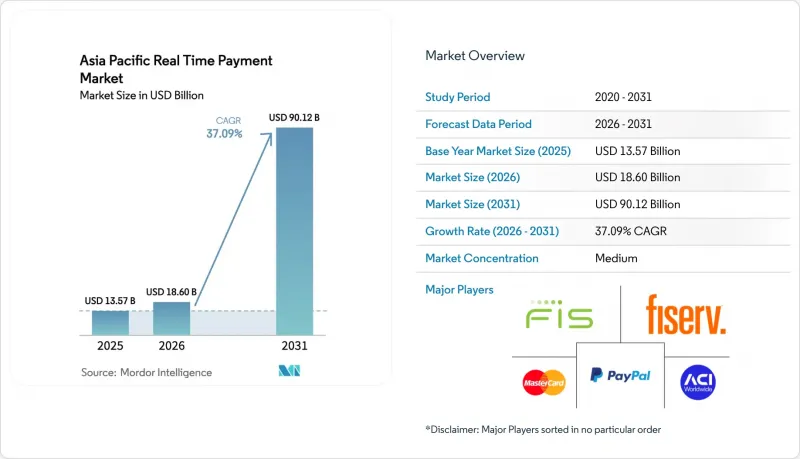
本報告按交易類型(點對點 (P2P) 和點對點 (P2B))、組件(平台/解決方案和服務)、部署模式(雲端和本地部署)、公司規模(大型企業和中小企業)、最終用戶行業(零售和電子商務、公共產業和電信等)以及國家/地區進行細分。市場預測以美元 (USD) 為單位。
亞太地區即時支付市場趨勢及洞察。
加速亞太地區開發中國家採用國內即時支付系統。
各國即時支付方案正改變新興亞洲經濟體的金融普惠格局。印尼的BI-FAST、菲律賓的InstaPay和馬來西亞的RTP平台展示了各國央行如何利用全天候支付網路運作代理網路,將結算時間從數天縮短至數秒,並透過改善現金流周轉率來刺激GDP成長。泰國的PromptPay目前佔國內支付的43.2%,顯示低成本的商家註冊可以促進其廣泛應用。巴基斯坦的「Raast」預計到2028年將新增6,350萬銀行用戶,這印證了即時支付基礎設施與社會公平之間的聯繫。印度、巴西、中國、泰國和墨西哥的即時支付在2023年創造了996億美元的GDP成長,展現了即時支付的宏觀經濟乘數效應。
以「行動優先」為核心的消費者群體,能夠建立基於QR碼和應用程式的即時支付生態系統。
智慧型手機在亞洲普及率高且價格親民。此外,標準化的QR碼規範使智慧型手機成為強大的支付方式。在中國,行動錢包的佔有率從2011年的3.5%成長到2018年的83%,基於應用程式的支付方式幾乎被所有消費者所接受。印尼的QRIS框架統一了先前分散的2D碼,使超過2600萬家商家能夠透過低成本行動電話接受跨境QR碼支付。根據研究,到2023年,東南亞72%的消費者將嘗試無現金支付,79%的消費者將使用行動錢包。跨國QR碼互通性,例如柬埔寨和日本之間的「Bakong-JPQR」合作項目,已將匯款成本降低了80%,並將支付時間縮短至最短10秒。
亞太地區各司法管轄區的監管標準有差異
跨國合作因各國資料在地化要求、洗錢防制法規以及ISO 20022實施進度安排的差異而變得複雜。服務提供者往往被迫在每個國家設立重複的合規團隊,導致營運成本增加和產品上市延遲。缺乏統一的技術標準意味著每個方案都採用各自的訊息格式,導致需要進行一次性整合項目,進而增加資本預算。各國央行對數位貨幣框架的不一致進一步加重了合規負擔,尤其對於缺乏法律資源的金融科技公司而言更是如此。小規模商家可能完全不願參與,這可能會加劇東南亞國協之間的數位落差。
細分市場分析
預計到2025年,點對點(P2P)支付將佔亞太地區即時支付市場收入的54.25%,這反映了該地區即時支付市場以消費者主導的特性。然而,點對企業(P2B)支付領域發展勢頭更為強勁,預計到2031年將以44.32%的複合年成長率成長,因為商家正在採用即時支付來釋放營運資金。光是中國大型企業就可以透過最佳化支付時間釋放高達4,210億美元的閒置資金,而東南亞71%的中小企業正在將數位支付與銷售額的成長連結起來。
P2B(個人對企業支付)的快速成長也得益於政府採購和稅收的數位化。例如,印度的Bharat Bill支付系統年交易量增加了60%。零售商也從中受益匪淺。 Reliance Retail的銷售額成長了19.4%,其中數位支付佔比已達40%;D-Mart的盈利也因UPI支付佔比達到四分之一而得到提升。預計到2028年,跨國B2B即時支付將佔16兆美元企業間支付總額的42%,顯示人們越來越依賴無需支付卡手續費的開放回路帳戶間支付方式。
預計到2025年,平台和解決方案將佔支出總額的67.15%,而專業服務目前正以41.05%的複合年成長率成長,這反映了現代即時支付生態系統在技術和監管方面的複雜性。雲端遷移、ISO 20022升級和API安全評估都需要專業知識,而銀行通常會將這些工作外包。 PayNet Malaysia在諮詢合作夥伴的幫助下,僅用了九個月就完成了核心系統的改造,以支援DuitNow2D碼和跨區域2D碼互通性,這表明市場對這些服務的需求日益成長。
舊有系統現代化也是推動需求成長的因素之一。 14%的金融機構仍依賴老舊的大型主機,需要分階段過渡以避免營運中斷。服務整合商正在實施外觀API、訊息轉換器和混合雲端設計,以確保過渡期間的運作。因此,諮詢和管理服務的收入超過了傳統的許可費,從而在亞太地區的即時支付市場建立了永續的收入來源。
其他好處:
- Excel格式的市場預測(ME)表
- 3個月的分析師支持
目錄
第1章:引言
- 研究假設和市場定義
- 調查範圍
第2章:調查方法
第3章執行摘要
第4章 市場狀況
- 市場概覽
- 市場促進因素
- 加速亞太地區發展中國家採用國內即時支付網路。
- 以「行動優先」為核心的消費群體,能夠利用QR碼和應用程式建立即時支付生態系統。
- 政府主導的無現金支付舉措,例如印度的“數位公共基礎設施”,正在推動市場發展。
- 跨境RTP通道促進了電子商務商家採用支付系統,從而推動了市場發展。
- 以 API主導的開放銀行框架正在降低即時支付平台 (RTP) 的整合門檻。
- 來自零工經濟和按需支付平台的需求不斷成長。
- 市場限制因素
- 亞太地區各司法管轄區的監管標準有差異
- 即時支付管道中詐騙和不當行為的高發生率正在阻礙市場成長。
- 傳統核心銀行系統限制了二線銀行的即時結算。
- 中小企業在RTP API整合的資本投資限制
- 產業價值鏈分析
- 監理展望
- 波特五力分析
- 亞太地區支付環境的變化
- 無現金支付的主要趨勢
- 市場宏觀經濟趨勢的評估
- 關鍵案例研究和用例分析
- 投資分析
第5章 市場規模與成長預測
- 按交易類型
- 點對點(P2P)
- Peer-to-Business(P2B)
- 按組件
- 平台/解決方案
- 服務
- 部署模式
- 雲
- 現場
- 按公司規模
- 大公司
- 小型企業
- 按最終用戶行業分類
- 零售與電子商務
- BFSI
- 公共產業及通訊
- 衛生保健
- 政府/公共部門
- 其他終端用戶產業
- 國家
- 中國
- 印度
- 日本
- 韓國
- 澳洲
- 新加坡
- 印尼
- 其他亞太國家
第6章 競爭情勢
- 市場集中度
- 策略趨勢
- 市佔率分析
- 公司簡介
- Fiserv Inc.
- PayPal Holdings Inc.
- Mastercard Inc.
- FIS Global
- Visa Inc.
- Ant Group Co. Ltd.
- Tencent Holdings Ltd.
- Paytm Payments Bank Ltd.
- ACI Worldwide Inc.
- Apple Inc.
- SIA SpA(Nexi Group)
- Finastra
- National Payments Corporation of India(NPCI)
- Australian Payments Plus
- Ripple Labs Inc.
- Temenos AG
- Huawei Technologies Co. Ltd.
- UnionPay International
- Nets Group
- Grab Holdings Ltd.
- Kakao Pay Corp.
- Gcash Inc.
第7章 市場機會與未來展望
According to Mordor Intelligence, the Asia Pacific real time payment market size is expected to grow from USD 13.57 billion in 2025 to USD 18.6 billion in 2026 and is forecast to reach USD 90.12 billion by 2031 at 37.09% CAGR over 2026-2031.
This report is Segmented by Transaction Type (Peer-To-Peer (P2P), and Peer-To-Business (P2B)), Component (Platform / Solution, and Services), Deployment Mode (Cloud, and On-Premise), Enterprise Size (Large Enterprises, and Small and Medium Enterprises), End-User Industry (Retail and E-Commerce, Utilities and Telecom, and More), and Country. The Market Forecasts are Provided in Terms of Value (USD).
Asia Pacific Real Time Payment Market Trends and Insights
Accelerated Adoption of National Instant-Payment Rails in Developing APAC Economies
National instant-payment schemes are transforming financial inclusion across emerging Asia. Indonesia's BI-FAST, the Philippines' InstaPay, and Malaysia's RTP platform illustrate how central banks use 24/7 rails to bypass correspondent networks, shrink settlement from days to seconds, and stimulate GDP through improved cash-flow velocity. Thailand's PromptPay now accounts for 43.2% of domestic payments, demonstrating that low-cost merchant onboarding can unlock mass acceptance. Pakistan's Raast projects 63.5 million new banked citizens by 2028, reinforcing the link between real-time rails and social-equity outcomes. Across India, Brazil, China, Thailand, and Mexico, instant payments lifted USD 99.6 billion in incremental GDP during 2023, validating the macroeconomic multiplier that accompanies real-time settlement.
Mobile-First Consumer Base Enabling QR-Code and App-Based RTP Ecosystems
Smartphones are ubiquitous and affordable across Asia, and standard QR specifications make them powerful payment instruments. In China, mobile wallets expanded from 3.5% share in 2011 to 83% in 2018, giving app-based payments near-universal consumer reach. Indonesia's QRIS framework harmonizes previously fragmented codes, enabling over 26 million merchants to accept domestic and cross-border QR payments on low-cost handsets. Surveys reveal that 72% of Southeast Asian consumers attempted cashless payments in 2023, with 79% using mobile wallets; cross-border QR interoperability, such as the Cambodia-Japan Bakong-JPQR link, further reduces remittance costs by 80% while shrinking settlement times to 10 seconds.
Fragmented Regulatory Standards Across APAC Jurisdictions
Diverging data-localization mandates, AML rules, and ISO 20022 adoption schedules complicate cross-border connections. Providers often duplicate compliance teams country-by-country, pushing up operating costs and slowing time-to-market. Absence of harmonized technical standards leaves each scheme running unique message formats, creating one-off integration projects that inflate capital budgets. Patchy central-bank digital-currency frameworks add another compliance layer, particularly for fintechs that lack legal resources. Smaller merchants may be deterred altogether, reinforcing digital divides among ASEAN economies.
Other drivers and restraints analyzed in the detailed report include:
- Government-Led Cashless Initiatives
- Cross-Border RTP Corridors Driving Merchant Acceptance in E-Commerce
- High Fraud and Scam Incidence in Instant-Payment Channels
For complete list of drivers and restraints, kindly check the Table Of Contents.
Segment Analysis
Peer-to-peer transfers held 54.25% revenue in 2025, reflecting the consumer origins of the Asia Pacific real time payment market. Yet the peer-to-business segment shows superior momentum, growing 44.32% CAGR to 2031 as merchants embrace instant settlement to unlock working capital. Corporates in China alone could free USD 421 billion by optimizing payment timing, while 71% of Southeast Asian SMBs link digital payments to sales increases.
The P2B surge also rides government digitization of procurement and tax receipts, illustrated by India's Bharat Bill Payment System registering 60% yearly value growth. Retailers showcase tangible benefits: Reliance Retail achieved 19.4% revenue growth with 40% digital payments; D-Mart lifted profitability as UPI captured a quarter of sales. Cross-border B2B instant transfers are forecast to reach 42% of USD 16 trillion in enterprise payments by 2028, signifying growing reliance on open-loop account-to-account rails that bypass card fees.
Platforms and solutions controlled 67.15% of 2025 spend, yet professional services now expand at 41.05% CAGR, reflecting the technical and regulatory complexity of modern instant-payment ecosystems. Cloud migrations, ISO 20022 upgrades, and API security assessments require specialized knowledge that banks often outsource. Malaysia's PayNet relied on consulting partners to adapt core systems for DuitNow QR and regional QR interoperability within nine months, underscoring services demand.
Legacy modernization is another driver; 14% of financial institutions still depend on outdated mainframes that need gradual conversion to avoid disruption. Service integrators deploy facade APIs, message converters, and hybrid cloud designs to maintain uptime during cutovers. Consequently, advisory and managed-service revenue outpaces traditional license fees, anchoring a recurring-revenue layer inside the Asia Pacific real time payment market.
Complete Report Scope:
- By Transaction Type
- Peer-to-Peer (P2P)
- Peer-to-Business (P2B)
- By Component
- Platform / Solution
- Services
- By Deployment Mode
- Cloud
- On-Premise
- By Enterprise Size
- Large Enterprises
- Small and Medium Enterprises
- By End-User Industry
- Retail and E-Commerce
- BFSI
- Utilities and Telecom
- Healthcare
- Government and Public Sector
- Other End-user Industries
- By Country
- China
- India
- Japan
- South Korea
- Australia
- Singapore
- Indonesia
- Rest of Asia-Pacific
List of Companies Covered in this Report:
- Fiserv Inc.
- PayPal Holdings Inc.
- Mastercard Inc.
- FIS Global
- Visa Inc.
- Ant Group Co. Ltd.
- Tencent Holdings Ltd.
- Paytm Payments Bank Ltd.
- ACI Worldwide Inc.
- Apple Inc.
- SIA SpA (Nexi Group)
- Finastra
- National Payments Corporation of India (NPCI)
- Australian Payments Plus
- Ripple Labs Inc.
- Temenos AG
- Huawei Technologies Co. Ltd.
- UnionPay International
- Nets Group
- Grab Holdings Ltd.
- Kakao Pay Corp.
- Gcash Inc.
Additional Benefits:
- The market estimate (ME) sheet in Excel format
- 3 months of analyst support
TABLE OF CONTENTS
1 INTRODUCTION
- 1.1 Study Assumptions and Market Definition
- 1.2 Scope of the Study
2 RESEARCH METHODOLOGY
3 EXECUTIVE SUMMARY
4 MARKET LANDSCAPE
- 4.1 Market Overview
- 4.2 Market Drivers
- 4.2.1 Accelerated Adoption of National Instant-Payment Rails in Developing APAC Economies
- 4.2.2 Mobile-First Consumer Base Enabling QR-Code and App-Based RTP Ecosystems
- 4.2.3 Government-Led Cashless Initiatives such as India's Digital Public Infrastructure Drives the Market
- 4.2.4 Cross-Border RTP Corridors Driving Merchant Acceptance in E-commerce Drives the Market
- 4.2.5 API-Driven Open-Banking Frameworks Lowering Integration Barriers for RTP
- 4.2.6 Rising Demand from Gig-Economy and Salary-On-Demand Platforms
- 4.3 Market Restraints
- 4.3.1 Fragmented Regulatory Standards Across APAC Jurisdictions
- 4.3.2 High Fraud and Scam Incidence in Instant-Payment Channels Hinders the Market
- 4.3.3 Legacy Core Banking Systems Limiting Real-Time Settlement by Tier-2 Banks
- 4.3.4 Capex Constraints Among SMEs for RTP API Integration
- 4.4 Industry Value Chain Analysis
- 4.5 Regulatory Outlook
- 4.6 Porter's Five Forces Analysis
- 4.6.1 Bargaining Power of Suppliers
- 4.6.2 Bargaining Power of Buyers
- 4.6.3 Threat of New Entrants
- 4.6.4 Threat of Substitute Products
- 4.6.5 Intensity of Competitive Rivalry
- 4.7 Evolution of the Payments Landscape in Asia-Pacific
- 4.8 Key Cashless-Transaction Trends
- 4.9 Assessment of Macro Economic Trends on the Market
- 4.10 Analysis of Major Case Studies and Use-Cases
- 4.11 Investment Analysis
5 MARKET SIZE AND GROWTH FORECASTS (VALUES)
- 5.1 By Transaction Type
- 5.1.1 Peer-to-Peer (P2P)
- 5.1.2 Peer-to-Business (P2B)
- 5.2 By Component
- 5.2.1 Platform / Solution
- 5.2.2 Services
- 5.3 By Deployment Mode
- 5.3.1 Cloud
- 5.3.2 On-Premise
- 5.4 By Enterprise Size
- 5.4.1 Large Enterprises
- 5.4.2 Small and Medium Enterprises
- 5.5 By End-User Industry
- 5.5.1 Retail and E-Commerce
- 5.5.2 BFSI
- 5.5.3 Utilities and Telecom
- 5.5.4 Healthcare
- 5.5.5 Government and Public Sector
- 5.5.6 Other End-user Industries
- 5.6 By Country
- 5.6.1 China
- 5.6.2 India
- 5.6.3 Japan
- 5.6.4 South Korea
- 5.6.5 Australia
- 5.6.6 Singapore
- 5.6.7 Indonesia
- 5.6.8 Rest of Asia-Pacific
6 COMPETITIVE LANDSCAPE
- 6.1 Market Concentration
- 6.2 Strategic Moves
- 6.3 Market Share Analysis
- 6.4 Company Profiles {(includes Global level Overview, Market level overview, Core Segments, Financials as available, Strategic Information, Market Rank/Share for key companies, Products and Services, and Recent Developments)}
- 6.4.1 Fiserv Inc.
- 6.4.2 PayPal Holdings Inc.
- 6.4.3 Mastercard Inc.
- 6.4.4 FIS Global
- 6.4.5 Visa Inc.
- 6.4.6 Ant Group Co. Ltd.
- 6.4.7 Tencent Holdings Ltd.
- 6.4.8 Paytm Payments Bank Ltd.
- 6.4.9 ACI Worldwide Inc.
- 6.4.10 Apple Inc.
- 6.4.11 SIA SpA (Nexi Group)
- 6.4.12 Finastra
- 6.4.13 National Payments Corporation of India (NPCI)
- 6.4.14 Australian Payments Plus
- 6.4.15 Ripple Labs Inc.
- 6.4.16 Temenos AG
- 6.4.17 Huawei Technologies Co. Ltd.
- 6.4.18 UnionPay International
- 6.4.19 Nets Group
- 6.4.20 Grab Holdings Ltd.
- 6.4.21 Kakao Pay Corp.
- 6.4.22 Gcash Inc.
7 MARKET OPPORTUNITIES AND FUTURE OUTLOOK
- 7.1 White-Space an Unmet-Need Assessment

 中國即時支付:市場佔有率分析、產業趨勢與統計及成長預測(2026-2031年)印度即時支付:市場佔有率分析、行業趨勢和統計數據以及成長預測(2026-2031 年)德國即時支付:市場佔有率分析、行業趨勢和統計數據以及成長預測(2026-2031 年)日本即時支付:市場佔有率分析、行業趨勢和統計數據以及成長預測(2026-2031 年)歐洲即時支付:市場佔有率分析、行業趨勢和統計數據以及成長預測(2026-2031 年)美國即時支付:市場佔有率分析、行業趨勢和統計數據、成長預測(2026-2031 年)西班牙即時支付:市場佔有率分析、行業趨勢和統計數據以及成長預測(2026-2031 年)英國即時支付:市場佔有率分析、行業趨勢和統計數據以及成長預測(2026-2031 年)
 即時支付市場:按組件、部署模式、組織規模、交易類型、應用程式和最終用戶分類-2026-2032年全球市場預測
 2026年跨境即時支付(RTP)中心全球市場報告