

 |
市場調查報告書
商品編碼
2124972
日本設施管理:市場佔有率分析、產業趨勢與統計及成長預測(2026-2031)Japan Facility Management - Market Share Analysis, Industry Trends & Statistics, Growth Forecasts (2026 - 2031) |
||||||

※ 本網頁內容可能與最新版本有所差異。詳細情況請與我們聯繫。
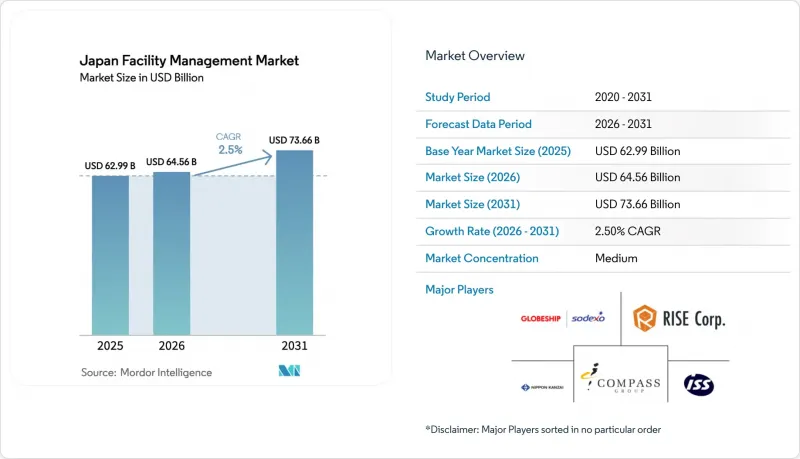
根據 Mordor Intelligence 預測,日本設施管理 (FM) 市場規模預計將從 2025 年的 629.9 億美元成長到 2026 年的 645.6 億美元,到 2031 年將達到 736.6 億美元,2026 年至 2031 年的複合年成長率為 2.5%。
本報告按服務類型(硬服務和軟服務)、交付方式(內部和外包)以及最終用戶行業(商業、酒店、公共和社會基礎設施、醫療保健、工業和流程以及其他最終用戶行業)進行分類。市場預測以美元計價。
日本設施管理市場趨勢與洞察
主要大都會圈的都市化和人口成長
隨著農村人口減少,居民和企業向東京、大阪和名古屋等大都會圈集中,這種快速的都市化趨勢正在增加日本整體設施管理市場的服務量和複雜性。預計到2025年,光是東京的商業房地產投資就將超過4兆日圓,這促使業主升級辦公物業,配備智慧建築基礎設施、健康設施和靈活的佈局,從而提高了對設施管理人員營運標準的要求。密集的物業組合使服務提供者能夠在多個叢集中部署標準化的物聯網建築系統和人工智慧驅動的預測性維護工具,從而在滿足租戶日益成長的期望的同時,實現數據驅動的效率提升。因此,都市區園區正在成為“活體試驗場”,用於在進行大規模部署之前完善高度可擴展、技術豐富的模型。隨著企業尋求達到關鍵規模以處理多站點契約,同時還要承擔日益成長的合規性和ESG報告義務,這一趨勢正在加速行業重組。大都會圈的成長使預計複合年成長率提高了 0.8 個百分點,凸顯了它們在維持日本設施管理市場方面發揮的關鍵作用。
促進老舊建築的抗震維修和永續維修。
目前,日本約65%的辦公大樓年齡超過20年,迫使業主同時實施抗震加固和脫碳改造項目,以符合修訂後的《建築節能法》的要求,並力爭在2050年實現淨零排放。設施管理合約正日益以綜合服務的形式提供,涵蓋長期維修工程的監管、能源績效監測以及與租戶的協調。兼具結構工程專業知識和能源分析能力的供應商正努力爭取多年期契約,以確保業務連續性並保護資產價值。隨著客戶對從設計諮詢到試運行和持續性能檢驗等承包解決方案的需求不斷成長,資料管治和遠端監控的作用也日益凸顯。在這些不斷湧現的機會中,老舊建築存量是推動日本設施管理市場複合年成長率(CAGR)成長的最大正面因素(+0.9%)。
勞動力老化導致人事費用上升
設施管理業的總薪資成長速度超過了銷售額的成長速度。 2024年,85.6%的公司實施了薪資成長,但3%的中位數增幅不足以應對員工流動加速導致的勞動力短缺問題。同年,因人手不足而破產的企業數量達到創紀錄的350家,其中建設業和物流行業的破產事件擾亂了支撐設施運營的分包網路。企業現在需要在已經因材料通膨而加重成本負擔的基礎上,增加再培訓獎勵、留任獎金和自動化投資。這些壓力正在降低利潤率,並使日本設施管理市場的複合年成長率下降了0.6個百分點。
細分市場分析
至2025年,硬性服務將佔日本設施管理市場佔有率的60.10%。這包括資產管理、機電(機械、電氣和管道)和暖通空調(暖氣、通風和空調)維護、消防系統以及其他對營運韌性至關重要的技術功能。由於老舊資產必須滿足更嚴格的抗震和能源效率標準,迫使資產所有者實施預測性維護和性能再檢驗調試計劃,因此市場需求仍然強勁。資產效能儀錶板和數位孿生技術有助於服務提供者確定回應優先級,而物聯網感測器則透過提供即時狀態資料來減少非計劃性停機時間。隨著服務提供者從被動維修轉向與運作和能源效率指標掛鉤的基本契約,預計日本硬性服務領域的設施管理市場規模將溫和成長。
軟性服務,包括清潔、保全、辦公室支援、餐飲和禮賓服務,預計到2031年將以4.72%的複合年成長率成長,超過硬性服務。隨著租戶對健康、衛生和飯店式配套設施的期望不斷提高,軟性服務的策略重要性日益凸顯,其溢價的合理性也隨之增強。數位化工作指導平台和機器人(例如自動地面清潔機)正在提高生產力並緩解人手不足。能夠將飯店服務技能與數據驅動的品管相結合的服務供應商正在獲得競爭優勢,實現收入來源多元化,並加速日本設施管理市場中各服務業的整合。
其他好處
- Excel格式的市場預測(ME)表
- 3個月的分析師支持
目錄
第1章:引言
- 研究假設和市場定義
- 調查範圍
第2章:調查方法
第3章執行摘要
第4章 市場狀況
- 市場概覽
- 目前運轉率
- 主要設施管理業者的盈利指標
- 勞動指標:勞動參與率
- 按服務類型分類的設施管理市場佔有率(%)
- 以硬性服務分類的設施管理市場佔有率(%)
- 軟性服務在設施管理市場的市佔率(%)
- 主要大都會圈的都市化和人口成長
- 日本基礎設施發展計畫中的產業投資重點
- 與勞動和安全標準相關的監管因素
- 市場促進因素
- 主要大都會圈的都市化和人口成長
- 主要FM業者的獲利能力
- 目前運轉率
- 勞動和安全標準方面的監管促進者
- 將外包擴展到綜合設施管理合約
- 促進老舊建築的抗震維修和永續維修。
- 市場限制因素
- 勞動指標:勞動參與率
- 基礎設施規劃中的產業投資優先事項
- 勞動力老化導致人事費用上升
- 公共設施管理(FM)競標中嚴格的競標價格上限。
- 價值鏈分析
- PESTLE分析
- 市場准入者的法規和法律體制
- 宏觀經濟指標對FM需求的影響
- 波特五力分析
- 投資與資金籌措分析
第5章 市場規模與成長預測
- 按服務類型
- 硬服務
- 資產管理
- 機電/暖通空調服務
- 消防系統和安全
- 其他硬體維修服務
- 軟服務
- 辦公室支援和安全
- 清潔服務
- 餐飲服務
- 其他軟調頻服務
- 硬服務
- 按服務類型
- 內部
- 外包
- 單頻調頻
- 捆綁式調頻廣播
- 整合調頻
- 按最終用戶行業分類
- 商業(IT/電信、零售/倉儲、其他)
- 飯店餐飲業(飯店、餐廳、大型餐廳)
- 公共和社會基礎設施(政府、教育、交通)
- 醫療保健(公立和私立機構)
- 工業和流程(製造業、能源業、採礦業)
- 其他終端用戶產業(多用戶住宅、娛樂、運動和休閒)
第6章 競爭情勢
- 市場集中度
- 策略趨勢
- 市佔率分析
- 公司簡介
- Globeship Sodexo
- Compass Group Japan
- RISE Corp. Tokyo
- Nippon Kanzai Co.
- ISS Facility Services Japan
- Aramark Facilities Services Japan
- G4S Facilities Management Japan
- SECOM Co., Ltd.
- Tokai Building Maintenance Co., Ltd.
- Yamato Facility Co., Ltd.
- Kanden Facilities
- MC Facilities
- Sagawa Express(FM Division)
- Asahi Facilities Inc.
- Tokyu Community Corporation
- Mitsubishi Estate Property Management
- Kajima Building Systems
- ALSOK(Sohgo Security Services)
- JLL Japan
- CBRE Group Japan
第7章 市場機會與未來趨勢
- 評估閒置頻段和未滿足的需求
- 技術主導整合設施管理(利用物聯網、建築管理系統和人工智慧的預測性維護)
- 對符合ESG標準的設施管理解決方案的需求
- 未來服務模式轉型(基本契約)
According to Mordor Intelligence, the Japan facility management market size is expected to grow from USD 62.99 billion in 2025 to USD 64.56 billion in 2026 and is forecast to reach USD 73.66 billion by 2031 at 2.5% CAGR over 2026-2031.
This report is Segmented by Service Type (Hard Services and Soft Services), Offering Type (In-House and Outsourced), End-User Industry (Commercial, Hospitality, Institutional and Public Infrastructure, Healthcare, Industrial and Process, and Other End-User Industries). The Market Forecasts are Provided in Terms of Value (USD).
Japan Facility Management Market Trends and Insights
Urbanisation and Population Growth in Major Metros
Rapid metropolitan concentration is swelling service volumes and complexity across the Japan facility management market as rural depopulation funnels residents and businesses into Tokyo, Osaka, and Nagoya. Commercial real-estate investment in Tokyo alone exceeded JPY 4 trillion in 2025, prompting landlords to upgrade office stock with smart-building infrastructure, wellness amenities, and flexible layouts that raise the operational bar for facility managers. Dense portfolios let providers deploy standardized IoT-enabled building systems and AI-driven predictive maintenance tools across clusters, extracting data-led efficiencies while meeting higher occupant expectations. Urban campuses are thus becoming living laboratories where scalable, technology-rich models are refined before wider rollout. This dynamic, in turn, accelerates consolidation as firms chase critical mass to serve multi-site contracts while absorbing escalating compliance and ESG reporting obligations. Cumulatively, metropolitan growth adds 0.8 percentage points to forecast CAGR, underscoring its pivotal role in sustaining the Japan facility management market.
Aging Building Stock Driving Seismic and Sustainability Retrofits
Roughly 65% of Japan's office inventory now exceeds 20 years of age, pushing owners toward simultaneous seismic reinforcement and decarbonization projects to comply with the amended Building Energy Efficiency Act and achieve net-zero emissions by 2050. Facility management contracts increasingly bundle long-horizon retrofitting oversight, energy-performance monitoring, and tenant liaison into integrated offerings. Providers that command both structural engineering know-how and energy-analytic capability are winning multi-year engagements to safeguard asset value while ensuring operational continuity. Client appetite for turnkey coordination-from design consultation through commissioning and ongoing performance verification-magnifies the role of data governance and remote monitoring. As these opportunities widen, aging stock contributes the single-largest positive lift (+0.9%) to the Japan facility management market CAGR.
Rising Labour Costs Amid Ageing Workforce
The facility management payroll base is swelling faster than revenue growth. Wage hikes were implemented by 85.6% of companies in 2024, yet median increases of 3% failed to ease recruitment gaps as retirement accelerates. Labor-shortage bankruptcies hit a record 350 during the same year, with construction and logistics insolvencies disrupting subcontracting networks feeding facility operations. Providers must now layer retraining incentives, retention bonuses, and automation investments onto cost structures already burdened by inflation in materials. The squeeze erodes margins and knocks 0.6 percentage points off the Japan facility management market CAGR.
Other drivers and restraints analyzed in the detailed report include:
- Growth in Outsourcing to Integrated FM Contracts
- Regulatory Drivers Specific to Labour and Safety Standards
- Stringent Bid-Price Caps in Public FM Tenders
For complete list of drivers and restraints, kindly check the Table Of Contents.
Segment Analysis
Hard Services accounted for 60.10% of the Japan facility management market share in 2025. They encompass asset management, MEP and HVAC maintenance, fire-safety systems, and other technical functions essential for operational resilience. Demand remains steady because aging assets must meet tighter seismic and energy-efficiency codes, pushing asset owners to adopt predictive maintenance regimes and retro-commissioning campaigns. Asset-performance dashboards and digital twins help providers prioritize interventions, while IoT-enabled sensors deliver real-time condition data that reduces unscheduled downtime. The Japan facility management market size for Hard Services is expected to expand moderately as providers shift from reactive repairs to outcome-based contracts tied to uptime and energy-saving metrics.
Soft Services, covering cleaning, security, office support, catering, and concierge functions, are growing at a 4.72% CAGR to 2031, faster than Hard Services. Occupier expectations for wellness, hygiene, and hospitality-style amenity packages raise the strategic weight of Soft Services and justify premium pricing. Digital work-order platforms and robotics-such as autonomous floor scrubbers-are improving productivity and mitigating labor constraints. Providers able to fuse hospitality skills with data-driven quality control gain competitive leverage, broadening the revenue mix and accelerating integration across service silos within the Japan facility management market.
Complete Report Scope:
- By Service Type
- Hard Services
- Asset Management
- MEP and HVAC Services
- Fire Systems and Safety
- Other Hard FM Services
- Soft Services
- Office Support and Security
- Cleaning Services
- Catering Services
- Other Soft FM Services
- Hard Services
- By Offering Type
- In-house
- Outsourced
- Single FM
- Bundled FM
- Integrated FM
- By End-user Industry
- Commercial (IT and Telecom, Retail and Warehouses, etc.)
- Hospitality (Hotels, Eateries, Large-scale Restaurants)
- Institutional and Public Infrastructure (Govt, Education, Transportation)
- Healthcare (Public and Private Facilities)
- Industrial and Process (Manufacturing, Energy, Mining)
- Other End-user Industries (Multi-housing, Entertainment, Sports and Leisure)
List of Companies Covered in this Report:
- Globeship Sodexo
- Compass Group Japan
- RISE Corp. Tokyo
- Nippon Kanzai Co.
- ISS Facility Services Japan
- Aramark Facilities Services Japan
- G4S Facilities Management Japan
- SECOM Co., Ltd.
- Tokai Building Maintenance Co., Ltd.
- Yamato Facility Co., Ltd.
- Kanden Facilities
- MC Facilities
- Sagawa Express (FM Division)
- Asahi Facilities Inc.
- Tokyu Community Corporation
- Mitsubishi Estate Property Management
- Kajima Building Systems
- ALSOK (Sohgo Security Services)
- JLL Japan
- CBRE Group Japan
Additional Benefits:
- The market estimate (ME) sheet in Excel format
- 3 months of analyst support
TABLE OF CONTENTS
1 INTRODUCTION
- 1.1 Study Assumptions and Market Definition
- 1.2 Scope of the Study
2 RESEARCH METHODOLOGY
3 EXECUTIVE SUMMARY
4 MARKET LANDSCAPE
- 4.1 Market Overview
- 4.1.1 Current Occupancy Rates
- 4.1.2 Profitability Rates of Major FM Players
- 4.1.3 Workforce Indicators - Labor Participation
- 4.1.4 Facility Management Market Share (%), by Service Type
- 4.1.5 Facility Management Market Share (%), by Hard Services
- 4.1.6 Facility Management Market Share (%), by Soft Services
- 4.1.7 Urbanization and Population Growth in Major Metros
- 4.1.8 Sector Investment Priorities in Japan's Infrastructure Pipeline
- 4.1.9 Regulatory Drivers Specific to Labour and Safety Standards
- 4.2 Market Drivers
- 4.2.1 Urbanisation and population growth in major metros
- 4.2.2 Profitability rates of major FM players
- 4.2.3 Current occupancy rates
- 4.2.4 Regulatory drivers specific to labour and safety standards
- 4.2.5 Growth in outsourcing to Integrated FM contracts
- 4.2.6 Aging building stock driving seismic and sustainability retrofits
- 4.3 Market Restraints
- 4.3.1 Workforce indicators - labour participation
- 4.3.2 Sector investment priorities in infrastructure pipeline
- 4.3.3 Rising labour costs amid ageing workforce
- 4.3.4 Stringent bid-price caps in public FM tenders
- 4.4 Value Chain Analysis
- 4.5 PESTEL Analysis
- 4.6 Regulatory and Legislative Framework for Market Entrants
- 4.7 Impact of Macroeconomic Indicators on FM Demand
- 4.8 Porter's Five Forces Analysis
- 4.8.1 Bargaining Power of Suppliers
- 4.8.2 Bargaining Power of Buyers
- 4.8.3 Threat of New Entrants
- 4.8.4 Threat of Substitute Services
- 4.8.5 Intensity of Competitive Rivalry
- 4.9 Investment and Funding Analysis
5 MARKET SIZE AND GROWTH FORECASTS (VALUES)
- 5.1 By Service Type
- 5.1.1 Hard Services
- 5.1.1.1 Asset Management
- 5.1.1.2 MEP and HVAC Services
- 5.1.1.3 Fire Systems and Safety
- 5.1.1.4 Other Hard FM Services
- 5.1.2 Soft Services
- 5.1.2.1 Office Support and Security
- 5.1.2.2 Cleaning Services
- 5.1.2.3 Catering Services
- 5.1.2.4 Other Soft FM Services
- 5.1.1 Hard Services
- 5.2 By Offering Type
- 5.2.1 In-house
- 5.2.2 Outsourced
- 5.2.2.1 Single FM
- 5.2.2.2 Bundled FM
- 5.2.2.3 Integrated FM
- 5.3 By End-user Industry
- 5.3.1 Commercial (IT and Telecom, Retail and Warehouses, etc.)
- 5.3.2 Hospitality (Hotels, Eateries, Large-scale Restaurants)
- 5.3.3 Institutional and Public Infrastructure (Govt, Education, Transportation)
- 5.3.4 Healthcare (Public and Private Facilities)
- 5.3.5 Industrial and Process (Manufacturing, Energy, Mining)
- 5.3.6 Other End-user Industries (Multi-housing, Entertainment, Sports and Leisure)
6 COMPETITIVE LANDSCAPE
- 6.1 Market Concentration
- 6.2 Strategic Moves
- 6.3 Market Share Analysis
- 6.4 Company Profiles (includes Global level Overview, Market level overview, Core Segments, Financials as available, Strategic Information, Market Rank/Share for key companies, Products and Services, and Recent Developments)
- 6.4.1 Globeship Sodexo
- 6.4.2 Compass Group Japan
- 6.4.3 RISE Corp. Tokyo
- 6.4.4 Nippon Kanzai Co.
- 6.4.5 ISS Facility Services Japan
- 6.4.6 Aramark Facilities Services Japan
- 6.4.7 G4S Facilities Management Japan
- 6.4.8 SECOM Co., Ltd.
- 6.4.9 Tokai Building Maintenance Co., Ltd.
- 6.4.10 Yamato Facility Co., Ltd.
- 6.4.11 Kanden Facilities
- 6.4.12 MC Facilities
- 6.4.13 Sagawa Express (FM Division)
- 6.4.14 Asahi Facilities Inc.
- 6.4.15 Tokyu Community Corporation
- 6.4.16 Mitsubishi Estate Property Management
- 6.4.17 Kajima Building Systems
- 6.4.18 ALSOK (Sohgo Security Services)
- 6.4.19 JLL Japan
- 6.4.20 CBRE Group Japan
7 MARKET OPPORTUNITIES AND FUTURE TRENDS
- 7.1 White-space and Unmet-Need Assessment
- 7.2 Technology-led Integrated FM (IoT, BMS, AI-based Predictive Maintenance)
- 7.3 ESG-compliant FM Solutions Demand
- 7.4 Future Service-Model Shifts (Outcome-based Contracts)

 2026-2030年全球設施管理市場
 設施管理(FM)軟體:市場佔有率分析、行業趨勢和統計數據以及成長預測(2026-2031 年)北美設施管理:市場佔有率分析、產業趨勢與統計、成長預測(2026-2031 年)亞太地區硬設施管理:市場佔有率分析、產業趨勢與統計及成長預測(2026-2031)硬設施管理:市場佔有率分析、產業趨勢與統計、成長預測(2026-2031 年)
 Frost Radar™:泰國設施管理,2026 年中國設施管理:市場佔有率分析、產業趨勢與統計、成長預測(2026-2031)印尼設施管理:市場佔有率分析、產業趨勢與統計、成長預測(2026-2031)德國設施管理:市場佔有率分析、產業趨勢與統計、成長預測(2026-2031)新加坡設施管理:市場佔有率分析、產業趨勢與統計、成長預測(2026-2031)