


 |
市場調查報告書
商品編碼
2124811
中國設施管理:市場佔有率分析、產業趨勢與統計、成長預測(2026-2031)China Facility Management - Market Share Analysis, Industry Trends & Statistics, Growth Forecasts (2026 - 2031) |
||||||

※ 本網頁內容可能與最新版本有所差異。詳細情況請與我們聯繫。
根據 Mordor Intelligence 預測,中國設施管理市場規模預計將從 2025 年的 2,118.9 億美元成長到 2026 年的 2,254.9 億美元,然後從 2026 年到 2031 年以 6.42% 的複合成長,到 2031 年達到 3080 億美元。
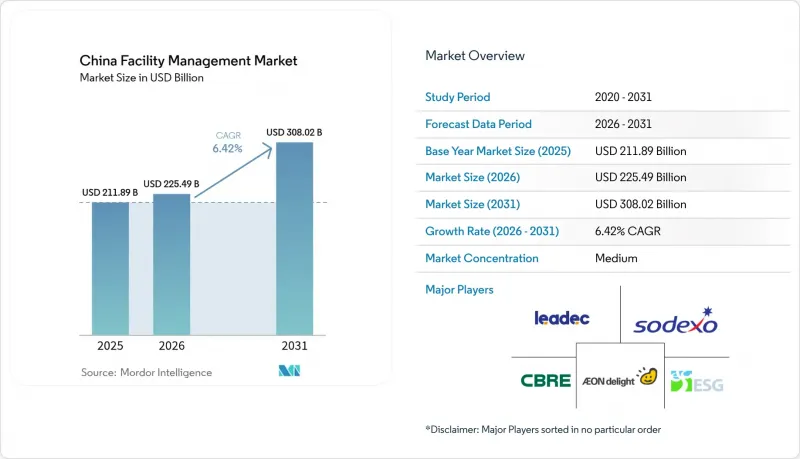
本報告按服務類型(硬性服務、軟性服務)、交付方式(內部、外包)和最終用戶行業(商業(IT/電信、零售/倉儲)、酒店(酒店、餐廳等)、醫療保健(公立/私立機構)等)進行分類。市場預測以美元計價。
中國設施管理市場趨勢與洞察
國營企業外包採用率提高
累計到2024年,中央國有企業將實現2.6兆元人民幣(約3,600億美元)的利潤和39.8兆元人民幣(約5.51兆美元)的收入,並透過外包非核心業務來籌集資金,從而專注於戰略重點領域。與股票掛鉤的監管體系加大了對營運效率的要求,刺激了更多綜合性合約流向專業服務商。國有資產監督管理委員會正在調整外包政策,使其與國家目標保持一致,從而為中國設施管理市場帶來一系列來自國有企業資產組合的穩定項目。隨著更多地方國營企業在交通、能源和電信等領域效法中央政府的模式,中期成長動能將進一步增強。
利用物聯網將智慧建築技術與預測性設施管理結合。
人工智慧驅動的建築管理系統可將大規模辦公大樓的能耗和碳排放量降低高達30%,物聯網診斷的故障辨識準確率高達97%。房地產科技公司已在大型綜合大樓中部署了超過1萬個感測器,降低了62%的人事費用。生成式人工智慧工具甚至可以重新設計工廠佈局,以適應工業4.0的工作流程,從而縮短安裝前置作業時間和停機時間。隨著租戶越來越重視室內環境品質與員工留任率之間的關聯,中國設施管理市場對提供端到端數位孿生、雲端儀錶板和數據驅動型節能維修的供應商給予了更高的定價。
房地產債務危機限制了新設施的供應和維修預算。
包括萬科在內的大型開發人員累計虧損62億美元,商業房地產交易金額從2021年的603億美元下降至2024年的386億美元。不良資產大幅折價出售導致資金外流用於維修,對物業管理預算造成壓力。尤其是在北京,辦公室空置率超過21%,供應商面臨更激烈的價格談判。只有當資產負債表狀況改善、建築業恢復營運後,短期不利因素才能得到緩解。
細分市場分析
預計2025年,中國設施管理市場中,硬性服務將佔61.15%。這主要歸因於消防安全規範「GB 55037-2022」對生命安全和機電(機械、電氣和管道)設備的強制性維護要求。市場需求主要集中在暖通空調系統維修、資產可靠性保障和法定檢查等。預計到2031年,軟性服務將以7.18%的複合年成長率成長,這得益於疫情後衛生標準的提高、靈活職場環境的普及以及人工智慧驅動的能源管理(試點購物中心已實現每年125萬元人民幣的節能)。隨著ESG(環境、社會和治理)資訊揭露的擴展,軟性服務供應商正將廢棄物回收和餐飲碳排放追蹤等服務作為加值服務進行包裝。因此,與硬性服務相比,中國設施管理市場的軟性服務成長速度更快。
其他好處:
- Excel格式的市場預測(ME)表
- 3個月的分析師支持
目錄
第1章:引言
- 研究假設和市場定義
- 調查範圍
第2章:調查方法
第3章執行摘要
第4章 市場狀況
- 市場概覽
- 目前運轉率
- 主要設施管理業者的盈利指標
- 勞動指標 - 勞動參與率
- 按服務類型分類的設施管理市場佔有率(%)
- 以硬性服務分類的設施管理市場佔有率(%)
- 按軟服務分類的設施管理市場佔有率(%)
- 主要大都會圈的都市化和人口成長
- 中國基礎建設規劃中的產業投資重點
- 與勞動和安全標準相關的監管因素
- 促進因素
- 國營企業外包採用率的擴大
- 利用物聯網將智慧建築技術與預測性設施管理結合。
- 綠建築的增加推動了對節能設施管理(FM)的需求。
- 中國二、三線城市商業不動產擴張
- 政府推行混合所有製改革,鼓勵私人設施管理業者參與公共資產投資。
- 跨境電商物流和冷鏈樞紐的專業設施管理需求。
- 抑制因子
- 房地產債務危機限制了新設施的供應和維修預算。
- 大型科技集團內部設施管理團隊之間的競爭日益激烈。
- 不同地區的消防安全標準各不相同,導致多個地點的合規成本增加。
- 中國全國碳排放交易體系下即將實施的碳審計處罰,對FM的利潤率帶來了壓力。
- 價值鏈分析
- PESTLE分析
- 市場准入者的法規和法律體制
- 宏觀經濟指標對FM需求的影響
- 波特五力分析
- 投資和資金籌措分析
第5章 市場規模與成長預測
- 按服務類型
- 艱苦的服務
- 資產管理
- 機電及暖通空調服務
- 消防系統和安全
- 其他硬體維修服務
- 軟服務
- 辦公室支援和安全
- 清潔服務
- 餐飲服務
- 其他軟調頻服務
- 艱苦的服務
- 按服務類型
- 內部
- 外包
- 單頻調頻
- 捆綁式調頻廣播
- 整合調頻
- 按最終用戶行業分類
- 商業(IT/電信、零售/倉儲等)
- 飯店餐飲業(飯店、餐廳、大型餐廳)
- 公共和社會基礎設施(政府、教育、交通)
- 醫療保健(公立和私立機構)
- 工業和流程(製造業、能源業、採礦業)
- 其他終端用戶產業(多用戶住宅、娛樂、運動和休閒)
第6章 競爭情勢
- 市場集中度
- 策略舉措和夥伴關係
- 市佔率分析
- 公司簡介
- Leadec Industrial Services(Shanghai)Co., Ltd.
- Sodexo China
- ESG Holdings Limited
- Aeon Delight Co., Ltd.
- Diversey Holdings LTD
- Serco Group Consultants(Shanghai)Ltd.
- China Shine(EQT Investors)
- ISS Group
- Colliers International Property Services Ltd.
- G4S China
- Aden Group
- Onewo Space-Tech Service Co., Ltd
- CBRE
- Cushman & Wakefield
- Jones Lang LaSalle IP, Inc.
第7章 市場機會與未來展望
According to Mordor Intelligence, the China facility management market size is expected to grow from USD 211.89 billion in 2025 to USD 225.49 billion in 2026 and is forecast to reach USD 308.02 billion by 2031 at 6.42% CAGR over 2026-2031.
This report is Segmented by Service Type (Hard Services, Soft Services), Offering Type (In-House, Outsourced), End-User Industry (Commercial (IT and Telecom, Retail and Warehousing), Hospitality (Hotels, Eateries, and Restaurants), Healthcare (Public and Private Facilities), and More). The Market Forecasts are Provided in Terms of Value (USD).
China Facility Management Market Trends and Insights
Rising Outsourcing Adoption Among State-Owned Enterprises
Central SOEs booked profits of CNY 2.6 (USD 0.36) trillion and revenue of CNY 39.8 (USD 5.51) trillion in 2024, freeing capital to concentrate on strategic priorities while outsourcing non-core operations. Stock-performance-linked oversight heightened pressure on operational efficiency, prompting a steady flow of bundled contracts to professional providers. The State-owned Assets Supervision and Administration Commission (SASAC) aligns outsourcing policy with national goals, giving the China facility management market a predictable pipeline from SOE portfolios. Medium-term growth is reinforced as more provincial SOEs replicate the central blueprint in transport, energy, and telecom estates.
Integration of Smart Building Technologies and IoT-Driven Predictive FM
AI-enabled building-management systems cut energy use and carbon emissions by up to 30% in large office towers, while IoT diagnostics achieve 97% fault-identification accuracy. Property technology firms deploy more than 10,000 sensors in flagship complexes, slashing labor cost by 62%. Generative AI tools even redesign plant layouts to meet Industry 4.0 workflows, shrinking installation lead-time and downtime. As tenants equate indoor-environment quality with talent retention, the China facility management market sees premium pricing for providers offering end-to-end digital twins, cloud dashboards, and data-driven energy retrofits.
Real-Estate Debt Crisis Limiting New Facility Supply and Renovation Budgets
Major developers such as China Vanke reported USD 6.2 billion losses, and commercial deals slid to USD 38.6 billion in 2024 from USD 60.3 billion in 2021. Distressed-asset sales at steep discounts divert capital from refurbishment, compressing FM budgets. Providers face intensified price negotiations, especially in offices where vacancies exceed 21% in Beijing. Short-term headwinds will be eased only after balance-sheet repair unlocked construction starts
Other drivers and restraints analyzed in the detailed report include:
- Growth of Green Building Stock Driving Demand for Energy-Efficient FM
- Expansion of Commercial Real Estate in Tier-2 and Tier-3 Chinese Cities
- Rising Competition from In-House FM Teams of Large Technology Conglomerates
For complete list of drivers and restraints, kindly check the Table Of Contents.
Segment Analysis
Hard services contributed 61.15% of the China facility management market in 2025 due to mandatory life-safety and MEP upkeep under GB 55037-2022 fire code. Demand clusters around HVAC retrofits, asset reliability, and statutory inspections. Soft services, projected at a 7.18% CAGR to 2031, gain from heightened post-pandemic hygiene standards, agile workplace support, and AI-enabled energy stewardship that delivered annual savings of CNY 1.25 million in pilot malls. With ESG disclosures expanding, soft-service vendors now bundle waste diversion and catering carbon-tracking as premium add-ons. As a result, the China facility management market size for soft services is on a steeper trajectory than its hard-services counterpart
Complete Report Scope:
- By Service Type
- Hard Services
- Asset Management
- MEP and HVAC Services
- Fire Systems and Safety
- Other Hard FM Services
- Soft Services
- Office Support and Security
- Cleaning Services
- Catering Services
- Other Soft FM Services
- Hard Services
- By Offering Type
- In-house
- Outsourced
- Single FM
- Bundled FM
- Integrated FM
- By End-user Industry
- Commercial (IT and Telecom, Retail and Warehouses, etc.)
- Hospitality (Hotels, Eateries, Large-scale Restaurants)
- Institutional and Public Infrastructure (Govt, Education, Transportation)
- Healthcare (Public and Private Facilities)
- Industrial and Process (Manufacturing, Energy, Mining)
- Other End-user Industries (Multi-housing, Entertainment, Sports and Leisure)
List of Companies Covered in this Report:
- Leadec Industrial Services (Shanghai) Co., Ltd.
- Sodexo China
- ESG Holdings Limited
- Aeon Delight Co., Ltd.
- Diversey Holdings LTD
- Serco Group Consultants (Shanghai) Ltd.
- China Shine (EQT Investors)
- ISS Group
- Colliers International Property Services Ltd.
- G4S China
- Aden Group
- Onewo Space-Tech Service Co., Ltd
- CBRE
- Cushman & Wakefield
- Jones Lang LaSalle IP, Inc.
Additional Benefits:
- The market estimate (ME) sheet in Excel format
- 3 months of analyst support
TABLE OF CONTENTS
1 INTRODUCTION
- 1.1 Study Assumptions and Market Definition
- 1.2 Scope of the Study
2 RESEARCH METHODOLOGY
3 EXECUTIVE SUMMARY
4 MARKET LANDSCAPE
- 4.1 Market Overview
- 4.1.1 Current Occupancy Rates
- 4.1.2 Profitability Rates of Major FM Players
- 4.1.3 Workforce Indicators - Labor Participation
- 4.1.4 Facility Management Market Share (%), by Service Type
- 4.1.5 Facility Management Market Share (%), by Hard Services
- 4.1.6 Facility Management Market Share (%), by Soft Services
- 4.1.7 Urbanization and Population Growth in Major Metros
- 4.1.8 Sector Investment Priorities in China's Infrastructure Pipeline
- 4.1.9 Regulatory Drivers Specific to Labour and Safety Standards
- 4.2 Drivers
- 4.2.1 Rising outsourcing adoption among state-owned enterprises (SOEs)
- 4.2.2 Integration of smart building technologies and IoT-driven predictive FM
- 4.2.3 Growth of green building stock driving demand for energy-efficient FM
- 4.2.4 Expansion of commercial real estate in Tier-2 and Tier-3 Chinese cities
- 4.2.5 Government mixed-ownership reforms enabling private FM participation in public assets
- 4.2.6 Specialized FM needs for cross-border e-commerce logistics and cold-chain hubs
- 4.3 Restraints
- 4.3.1 Real-estate debt crisis limiting new facility supply and renovation budgets
- 4.3.2 Rising competition from in-house FM teams of large technology conglomerates
- 4.3.3 Fragmented provincial fire-safety codes increasing multi-site compliance costs
- 4.3.4 Impending carbon-audit penalties under China's national emissions trading scheme compressing FM margins
- 4.4 Value Chain Analysis
- 4.5 PESTEL Analysis
- 4.6 Regulatory and Legislative Framework for Market Entrants
- 4.7 Impact of Macroeconomic Indicators on FM Demand
- 4.8 Porter's Five Forces Analysis
- 4.8.1 Bargaining Power of Suppliers
- 4.8.2 Bargaining Power of Buyers
- 4.8.3 Threat of New Entrants
- 4.8.4 Threat of Substitute Services
- 4.8.5 Intensity of Competitive Rivalry
- 4.9 Investment and Funding Analysis
5 MARKET SIZE AND GROWTH FORECASTS (VALUE)
- 5.1 By Service Type
- 5.1.1 Hard Services
- 5.1.1.1 Asset Management
- 5.1.1.2 MEP and HVAC Services
- 5.1.1.3 Fire Systems and Safety
- 5.1.1.4 Other Hard FM Services
- 5.1.2 Soft Services
- 5.1.2.1 Office Support and Security
- 5.1.2.2 Cleaning Services
- 5.1.2.3 Catering Services
- 5.1.2.4 Other Soft FM Services
- 5.1.1 Hard Services
- 5.2 By Offering Type
- 5.2.1 In-house
- 5.2.2 Outsourced
- 5.2.2.1 Single FM
- 5.2.2.2 Bundled FM
- 5.2.2.3 Integrated FM
- 5.3 By End-user Industry
- 5.3.1 Commercial (IT and Telecom, Retail and Warehouses, etc.)
- 5.3.2 Hospitality (Hotels, Eateries, Large-scale Restaurants)
- 5.3.3 Institutional and Public Infrastructure (Govt, Education, Transportation)
- 5.3.4 Healthcare (Public and Private Facilities)
- 5.3.5 Industrial and Process (Manufacturing, Energy, Mining)
- 5.3.6 Other End-user Industries (Multi-housing, Entertainment, Sports and Leisure)
6 COMPETITIVE LANDSCAPE
- 6.1 Market Concentration
- 6.2 Strategic Moves and Partnerships
- 6.3 Market Share Analysis
- 6.4 Company Profiles (includes Global level Overview, Market level overview, Core Segments, Financials as available, Strategic Information, Market Rank/Share for key companies, Products and Services, and Recent Developments)
- 6.4.1 Leadec Industrial Services (Shanghai) Co., Ltd.
- 6.4.2 Sodexo China
- 6.4.3 ESG Holdings Limited
- 6.4.4 Aeon Delight Co., Ltd.
- 6.4.5 Diversey Holdings LTD
- 6.4.6 Serco Group Consultants (Shanghai) Ltd.
- 6.4.7 China Shine (EQT Investors)
- 6.4.8 ISS Group
- 6.4.9 Colliers International Property Services Ltd.
- 6.4.10 G4S China
- 6.4.11 Aden Group
- 6.4.12 Onewo Space-Tech Service Co., Ltd
- 6.4.13 CBRE
- 6.4.14 Cushman & Wakefield
- 6.4.15 Jones Lang LaSalle IP, Inc.
7 MARKET OPPORTUNITIES AND FUTURE OUTLOOK
- 7.1 White-space and Unmet-Need Assessment
- 7.2 Technology-led Integrated FM (IoT, BMS, AI-based Predictive Maintenance)
- 7.3 ESG-compliant FM Solutions Demand
- 7.4 Future Service-Model Shifts (Outcome-based Contracts)

 2026-2030年全球設施管理市場
 設施管理(FM)軟體:市場佔有率分析、行業趨勢和統計數據以及成長預測(2026-2031 年)北美設施管理:市場佔有率分析、產業趨勢與統計、成長預測(2026-2031 年)亞太地區硬設施管理:市場佔有率分析、產業趨勢與統計及成長預測(2026-2031)硬設施管理:市場佔有率分析、產業趨勢與統計、成長預測(2026-2031 年)日本設施管理:市場佔有率分析、產業趨勢與統計及成長預測(2026-2031)
 Frost Radar™:泰國設施管理,2026 年印尼設施管理:市場佔有率分析、產業趨勢與統計、成長預測(2026-2031)德國設施管理:市場佔有率分析、產業趨勢與統計、成長預測(2026-2031)新加坡設施管理:市場佔有率分析、產業趨勢與統計、成長預測(2026-2031)