


 |
市場調查報告書
商品編碼
2116928
硬設施管理:市場佔有率分析、產業趨勢與統計、成長預測(2026-2031 年)Hard Facility Management - Market Share Analysis, Industry Trends & Statistics, Growth Forecasts (2026 - 2031) |
||||||

※ 本網頁內容可能與最新版本有所差異。詳細情況請與我們聯繫。
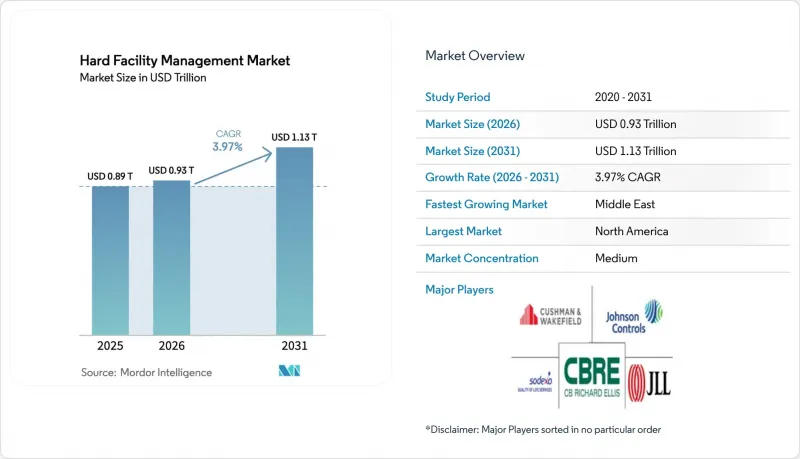
根據 Mordor Intelligence 預測,硬設施管理市場預計將從 2025 年的 8,900 億美元成長到 2026 年的 9,300 億美元,到 2031 年達到 1.13 兆美元,2026 年至 2031 年的複合年成長率預計為 3.97%。
本報告按服務類型(資產管理、機電和暖通空調服務、消防系統和安全、其他)、交付方式(內部設施管理、外包設施管理[單一設施管理、捆綁式設施管理、其他])、最終用戶行業(商業、酒店、機構和公共基礎設施、工業和流程行業、其他)以及地區進行細分。市場預測以美元計價。
全球硬設施管理市場趨勢與洞察
人工智慧驅動的預測性維護平台推動業務轉型
目前,機器學習模型能夠分析暖通空調冷卻器、鍋爐和開關設備的振動、溫度和能耗數據,在故障發生前數週即可檢測到異常情況,從而將意外停機轉化為計劃內維護。 ABM Industries 於 2025 年在 Ingredion 的一家工廠實施了這項方法,避免了壓縮機停機,並實現了每年 120 萬美元的成本節約。業主正在將運轉率條款納入服務契約,鼓勵供應商投資感測器網路和資料科學家。這種轉變有利於那些擁有足夠資金承擔初始數位化成本的大型公司,加速了產業整合。預測性合約也能加強與供應商的關係,因為分析平台將資產狀態與製造商資料進行基準比較,從而需要雙方協作最佳化零件庫存和保固範圍。因此,競爭激烈的設施管理市場正在轉向基於績效的定價模式,該模式與平均故障間隔時間 (MTBF) 掛鉤。
強制性脫碳將加速暖通空調和能源維修的投資。
隨著加州2025年建築規範強制要求新建商業建築安裝熱泵,以及歐盟修訂指令要求新建築在2030年前實現零排放,暖氣和通風系統的快速電氣化進程正在加速。市場對變冷媒流量(VRF)系統、地源熱泵以及能夠減少熱橋效應的高性能外牆的需求激增。設施管理人員正努力爭取可能超出傳統合約期限的維修資金,這促使他們對能源服務公司(ESCO)合約的興趣日益濃厚,因為這種合約可以將還款分攤到節能收益中。採購團隊面臨壓縮機和變頻器前置作業時間過長的問題,擴大了具備採購能力的綜合設施管理服務提供者的作用。 ISO 50001等合規架構現在已成為公共競標的強制性要求,提高了中小型承包商的准入門檻,同時,在硬設施管理市場中,脫碳業績記錄的戰略重要性也日益凸顯。
技術工人人手不足限制了提供服務的能力。
根據美國總承包商協會 (AGC) 預測,到 2025 年,美國將面臨 43.9 萬名工人的勞動力缺口。 68% 的技術人員年齡超過 45 歲,退休人員數量超過了新招收的學徒人數。工資年成長率超過 6%,給固定價格合約的利潤率帶來了壓力。建築自動化程式設計和火警警報器整合等專業受漫長的認證流程和供應商特定要求的影響最為嚴重。移民限制加劇了北美和歐洲的人手不足短缺。由於僅靠提高工資不足以解決勞動力短缺問題,服務提供者正在投資擴增實境(AR) 培訓和遠距專家支持,以最大限度地利用有限的勞動力。這種長期存在的勞動力短缺限制了設施管理市場吸收激增的維修需求的能力。
細分市場分析
2025年,機電工程(MEP)和暖通空調(HVAC)服務佔總收入的44.63%,凸顯了其在支撐設施層面硬設施管理市場規模的核心作用。資料中心功率密度飆升至每機架100千瓦,加速了對液冷、冗餘電源和精密控制的需求。在醫療保健領域,聯合委員會強制執行的季度檢查為消防安全相關操作提供了支持,但外牆和結構維修量取決於具體事件,並且往往會在氣候變遷相關事件發生後增加。
電腦化維護和管理系統的興起正在推動資產管理的發展,資產管理是成長最快的服務業,年複合成長率高達4.32%。這些平台能夠收集冷卻器、水泵和緊急電源系統的運作數據,計算剩餘使用壽命,並自動安排維護工作。隨著分析技術將機電遙測資料整合到策略規劃中,這種整合模糊了不同學科之間的界線。業主要求使用整合方案以減輕管理負擔,因此,僅提供暖通空調服務的小規模公司正面臨產業重組的壓力。符合NFPA 72-2025標準的無線煙霧偵測器和雲端警報系統進一步推動了巡檢工作的數位化。總而言之,該領域從「故障響應式」服務轉向「結果導向型」服務的轉變,是硬設施管理市場的一個顯著趨勢。
區域分析
北美擁有龐大的現有建築存量,且電氣化法規正在大力推進,預計到2025年,北美仍將佔全球收入的37.28%。聯邦獎勵和各州建築規範正在推動維修週期,熱泵已被強制安裝並確立為設計標準,尤其是在加州。美國資料中心集中在維吉尼亞和德克薩斯州,進一步推動了對高密度電力和節水冷卻的需求。加拿大的基礎設施更新項目採用官民合作關係(P3)模式,並包含設施管理(FM)擔保,確保長期獲利能力。
歐洲的發展趨勢受到一項修訂指令的主導,該指令設定了2030年新建建築零排放的目標,引導資金流向暖通空調電氣化和建築外圍護維修。德國已累計140億歐元(159億美元)用於提高能源效率,並為設施管理主導的維修項目提供津貼。符合能源性能證書(EPC)A級和B級標準正在重塑採購標準,擁有經ISO 50001檢驗的脫碳藍圖的供應商將獲得優先考慮。
中東地區以5.81%的複合年成長率(CAGR)領先,在「沙烏地阿拉伯2030願景」下的大型企劃中,包括NEOM新城和紅海度假城,都要求採用適應氣候的暖通空調(HVAC)和能源管理系統。阿拉伯聯合大公國的「杜拜2040總體規劃」指南正在推動智慧建築的整合和LEED金級認證的取得。由於環境溫度較高,需要配備蓄熱功能的冷卻器機組以及能夠承受50°C夏季高溫的材料,這導致每平方英尺的成本增加。亞太地區的成長主要得益於中國對大型商業設施的強制自動化以及印度的「智慧城市計畫」。同時,隨著都市化進程的加速和跨國公司入住率的上升,南美和非洲也呈現區域性的發展態勢。在各個地區,能源監管目標、極端氣候以及智慧城市計畫都在擴大硬設施管理市場的規模。
其他好處:
- Excel格式的市場預測(ME)表
- 3個月的分析師支持
目錄
第1章:引言
- 研究假設和市場定義
- 調查範圍
第2章:調查方法
第3章執行摘要
第4章 市場狀況
- 市場概覽
- 市場促進因素
- 人工智慧驅動的預測性維護平台
- 強制性脫碳正在推動暖通空調和能源維修。
- 整合硬體和軟體設施管理外包,以降低生命週期成本
- 數據驅動的設施管理採購和成本通膨對沖
- 加強應對氣候相關極端天氣事件韌性的措施
- 私募股權併購正在加速硬體維修技術的應用。
- 市場限制因素
- 技術工人人手不足和勞動力老化
- 重要機電設備備品原物料價格波動
- 互聯電池管理系統中的網路安全漏洞
- 短期合約期限限制了硬體維修資本投資的報酬率。
- 產業價值鏈分析
- 監理情勢
- 宏觀經濟因素的影響
- 波特五力分析
第5章 市場規模與成長預測
- 按服務類型
- 資產管理
- 機電及暖通空調服務
- 消防系統和安全
- 其他硬體維修服務
- 按服務類型
- 內部調頻
- 外包設施管理
- 單一設施管理
- 捆綁設施管理
- 綜合設施管理
- 按最終用戶行業分類
- 商業
- 飯店業
- 公共和基礎設施部門
- 衛生保健
- 工業和流程部門
- 其他終端用戶產業
- 按地區
- 北美洲
- 美國
- 加拿大
- 墨西哥
- 歐洲
- 英國
- 德國
- 法國
- 義大利
- 其他歐洲國家
- 亞太地區
- 中國
- 日本
- 印度
- 韓國
- 其他亞洲國家
- 中東
- 以色列
- 沙烏地阿拉伯
- 阿拉伯聯合大公國
- 土耳其
- 其他中東國家
- 非洲
- 南非
- 埃及
- 其他非洲國家
- 南美洲
- 巴西
- 阿根廷
- 其他南美國家
- 北美洲
第6章 競爭情勢
- 市場集中度
- 策略趨勢
- 市佔率分析
- 公司簡介
- CBRE Group, Inc.
- ISS A/S
- Sodexo SA
- EMCOR Group, Inc.
- Mitie Group plc
- ABM Industries Incorporated
- Aramark Corporation
- Apleona GmbH
- GDI Integrated Facility Services Inc.
- OCS Group Limited
- Atalian Holding Development and Strategy
- Compass Group PLC
- Cushman and Wakefield plc
- Jones Lang LaSalle Incorporated
- Bouygues Energies and Services SAS
- Dussmann Stiftung and Co. KGaA
- SBFM Limited
- BGIS Global Integrated Solutions, Inc.
- Al Shafar United for Facilities Management LLC
- Serco Group plc
第7章 市場機會與未來展望
According to Mordor Intelligence, the hard facility management market size is expected to increase from USD 890 billion in 2025 to USD 930 billion in 2026 and reach USD 1.13 trillion by 2031, growing at a CAGR of 3.97% over 2026-2031.
This report is Segmented by Service Type (Asset Management, MEP and HVAC Services, Fire Systems and Safety, and More), Offering Type (In-House FM, and Outsourced FM [Single FM, Bundled FM, and More]), End-User Industry (Commercial, Hospitality, Institutional and Public Infrastructure, Industrial and Process Sector, and More), and Geography. The Market Forecasts are Provided in Terms of Value (USD).
Global Hard Facility Management Market Trends and Insights
AI-Enabled Predictive Maintenance Platforms Drive Operational Transformation
Machine-learning models now analyze vibration, temperature, and power-draw data from HVAC chillers, boilers, and switchgear to flag anomalies weeks before a failure occurs, converting unplanned downtime into scheduled interventions. ABM Industries deployed the approach at an Ingredion site in 2025, avoiding compressor outages and saving USD 1.2 million annually. Building owners are embedding uptime clauses in service agreements, pushing providers to invest in sensor networks and data scientists. The shift favors large, capital-rich operators that can absorb upfront digital costs, accelerating consolidation. Predictive contracts also tighten supplier relationships because analytics platforms benchmark asset health against manufacturer data, compelling joint optimization of parts inventory and warranty coverage. As a result, the hard facility management market is moving toward outcome-based pricing tied to mean-time-between-failure metrics.
Decarbonization Mandates Accelerate HVAC and Energy Retrofit Investments
California's 2025 code now requires heat pumps in new commercial builds, and the EU's revised directive mandates zero-emission status for new structures by 2030, forcing rapid electrification of heating and ventilation. Demand has spiked for variable-refrigerant-flow systems, ground-source heat pumps, and high-performance facades that cut thermal bridging. Facility managers wrestle with securing retrofit capital that may exceed traditional contract horizons, amplifying interest in energy-service-company style agreements that spread repayment over savings. Procurement teams face lengthy lead times for compressors and inverters, a bottleneck that expands the role of integrated FM providers with sourcing leverage. Compliance frameworks such as ISO 50001 are now prerequisites for public tenders, raising entry barriers for smaller contractors and increasing the strategic importance of decarbonization credentials within the hard facility management market.
Skilled-Trades Labor Shortages Constrain Service Delivery Capacity
The Associated General Contractors of America revealed a 439,000-worker shortfall in the United States for 2025 projects, with 68% of technicians aged 45 plus and retirement outpacing apprenticeship intake. Wage inflation passed 6% annually, eroding fixed-price margins. Specialized roles in building-automation programming and fire-alarm integration face the steepest gaps because certification pathways are lengthy and vendor-specific. Immigration curbs intensify the squeeze in North America and Europe. Higher pay alone has not resolved the scarcity, prompting providers to invest in augmented-reality training and remote expert support to stretch scarce talent. Persistent shortages limit the capacity of the hard facility management market to absorb surging retrofit demand.
Other drivers and restraints analyzed in the detailed report include:
- Integrated Hard-Soft FM Outsourcing Reduces Lifecycle Costs
- Data-Driven FM Procurement Enables Cost-Inflation Hedging Strategies
- Volatile Input Prices for Critical MEP Spare Parts Increase Operational Costs
For complete list of drivers and restraints, kindly check the Table Of Contents.
Segment Analysis
MEP and HVAC services claimed 44.63% of 2025 revenue, underscoring their role as the backbone of the hard facility management market size at facility level. Data-center power densities jumping toward 100 kW per rack accelerate demand for liquid cooling, redundant feeds, and precision controls. Quarterly inspections mandated by Joint Commission in healthcare sustain fire-safety work, while facade and structural repair volumes are event-driven, rising after climate events.
The rise of computerized maintenance management systems is elevating asset management, the fastest-growing service line at 4.32% CAGR. Platforms capture run-time data from chillers, pumps, and emergency power systems, calculate remaining useful life, and auto-schedule tasks. This convergence blurs distinctions between trades because analytics pull MEP telemetry into strategic planning. Smaller HVAC-only shops face consolidation pressure as owners pursue integrated bundles that cut administrative effort. Wireless smoke detectors and cloud alarms, recognized in NFPA 72-2025, further digitize inspection routines. Overall, the segment's transition from break-fix to outcome-oriented service is a defining current for the hard facility management market.
Complete Report Scope:
- By Service Type
- Asset Management
- MEP and HVAC Services
- Fire Systems and Safety
- Other Hard FM Services
- By Offering Type
- In-House FM
- Outsourced FM
- Single Facility Management
- Bundled Facility Management
- Integrated Facility Management
- By End-User Industry
- Commercial
- Hospitality
- Institutional and Public Infrastructure
- Healthcare
- Industrial and Process Sector
- Other End-User Industries
- By Geography
- North America
- United States
- Canada
- Mexico
- Europe
- United Kingdom
- Germany
- France
- Italy
- Rest of Europe
- Asia-Pacific
- China
- Japan
- India
- South Korea
- Rest of Asia
- Middle East
- Israel
- Saudi Arabia
- United Arab Emirates
- Turkey
- Rest of Middle East
- Africa
- South Africa
- Egypt
- Rest of Africa
- South America
- Brazil
- Argentina
- Rest of South America
- North America
Geography Analysis
North America retained 37.28% of 2025 revenue because of vast legacy building stock and regulatory momentum around electrification. Federal incentives and state codes encourage retrofit cycles, especially in California where compulsory heat pumps now set design baselines. U.S. data-center clusters in Virginia and Texas amplify demand for high-density power and water-efficient cooling. Canada's infrastructure renewals concur with P3 models that embed FM guarantees, binding long-term revenue.
Europe's trajectory is dominated by the revised directive setting zero-emission goals for new buildings by 2030, which channels capital into HVAC electrification and envelope upgrades. Germany earmarked EUR 14 billion (USD 15.9 billion) for energy efficiency, subsidizing FM-led retrofits. Compliance with EPC classes A and B is reshaping procurement criteria, shunting preference toward providers with decarbonization roadmaps verified under ISO 50001.
The Middle East carries the fastest CAGR at 5.81% as Saudi Vision 2030 mega projects including NEOM and the Red Sea resort city demand climate-adapted HVAC and energy management. UAE directives under the Dubai 2040 master plan push smart-building integration and LEED Gold certifications. High ambient temperatures necessitate chiller plants with thermal storage and materials rated for 50 °C summers, intensifying per-square-foot spend. Asia-Pacific growth is propelled by China's automation mandate for large commercial builds and India's Smart Cities Mission, while South America and Africa progress in pockets as urbanization lures multinational occupiers. Across regions, regulatory energy targets, climatic extremes, and smart-city programs expand addressable volumes within the hard facility management market.
- CBRE Group, Inc.
- ISS A/S
- Sodexo S.A.
- EMCOR Group, Inc.
- Mitie Group plc
- ABM Industries Incorporated
- Aramark Corporation
- Apleona GmbH
- GDI Integrated Facility Services Inc.
- OCS Group Limited
- Atalian Holding Development and Strategy
- Compass Group PLC
- Cushman and Wakefield plc
- Jones Lang LaSalle Incorporated
- Bouygues Energies and Services S.A.S.
- Dussmann Stiftung and Co. KGaA
- SBFM Limited
- BGIS Global Integrated Solutions, Inc.
- Al Shafar United for Facilities Management LLC
- Serco Group plc
Additional Benefits:
- The market estimate (ME) sheet in Excel format
- 3 months of analyst support
TABLE OF CONTENTS
1 INTRODUCTION
- 1.1 Study Assumptions and Market Definition
- 1.2 Scope of the Study
2 RESEARCH METHODOLOGY
3 EXECUTIVE SUMMARY
4 MARKET LANDSCAPE
- 4.1 Market Overview
- 4.2 Market Drivers
- 4.2.1 AI-Enabled Predictive Maintenance Platforms
- 4.2.2 Decarbonization Mandates Driving HVAC and Energy Retrofits
- 4.2.3 Integrated Hard-Soft FM Outsourcing to Reduce Lifecycle Cost
- 4.2.4 Data-Driven FM Procurement and Cost-Inflation Hedging
- 4.2.5 Resilience Upgrades for Climate-Related Extreme Weather Events
- 4.2.6 Private-Equity Roll-Ups Accelerating Hard-FM Tech Adoption
- 4.3 Market Restraints
- 4.3.1 Skilled-Trades Labor Shortages and Aging Workforce
- 4.3.2 Volatile Input Prices for Critical MEP Spare Parts
- 4.3.3 Cyber-Security Vulnerabilities in Connected BMS
- 4.3.4 Short Contract Tenures Limiting ROI on Hard-FM Capex
- 4.4 Industry Value Chain Analysis
- 4.5 Regulatory Landscape
- 4.6 Impact of Macroeconomic Factors
- 4.7 Porter's Five Forces Analysis
- 4.7.1 Threat of New Entrants
- 4.7.2 Bargaining Power of Suppliers
- 4.7.3 Bargaining Power of Buyers
- 4.7.4 Threat of Substitutes
- 4.7.5 Industry Rivalry
5 MARKET SIZE AND GROWTH FORECASTS (VALUE)
- 5.1 By Service Type
- 5.1.1 Asset Management
- 5.1.2 MEP and HVAC Services
- 5.1.3 Fire Systems and Safety
- 5.1.4 Other Hard FM Services
- 5.2 By Offering Type
- 5.2.1 In-House FM
- 5.2.2 Outsourced FM
- 5.2.2.1 Single Facility Management
- 5.2.2.2 Bundled Facility Management
- 5.2.2.3 Integrated Facility Management
- 5.3 By End-User Industry
- 5.3.1 Commercial
- 5.3.2 Hospitality
- 5.3.3 Institutional and Public Infrastructure
- 5.3.4 Healthcare
- 5.3.5 Industrial and Process Sector
- 5.3.6 Other End-User Industries
- 5.4 By Geography
- 5.4.1 North America
- 5.4.1.1 United States
- 5.4.1.2 Canada
- 5.4.1.3 Mexico
- 5.4.2 Europe
- 5.4.2.1 United Kingdom
- 5.4.2.2 Germany
- 5.4.2.3 France
- 5.4.2.4 Italy
- 5.4.2.5 Rest of Europe
- 5.4.3 Asia-Pacific
- 5.4.3.1 China
- 5.4.3.2 Japan
- 5.4.3.3 India
- 5.4.3.4 South Korea
- 5.4.3.5 Rest of Asia
- 5.4.4 Middle East
- 5.4.4.1 Israel
- 5.4.4.2 Saudi Arabia
- 5.4.4.3 United Arab Emirates
- 5.4.4.4 Turkey
- 5.4.4.5 Rest of Middle East
- 5.4.5 Africa
- 5.4.5.1 South Africa
- 5.4.5.2 Egypt
- 5.4.5.3 Rest of Africa
- 5.4.6 South America
- 5.4.6.1 Brazil
- 5.4.6.2 Argentina
- 5.4.6.3 Rest of South America
- 5.4.1 North America
6 COMPETITIVE LANDSCAPE
- 6.1 Market Concentration
- 6.2 Strategic Moves
- 6.3 Market Share Analysis
- 6.4 Company Profiles (includes Global Level Overview, Market Level Overview, Core Segments, Financials as available, Strategic Information, Market Rank/Share, Products and Services, Recent Developments)
- 6.4.1 CBRE Group, Inc.
- 6.4.2 ISS A/S
- 6.4.3 Sodexo S.A.
- 6.4.4 EMCOR Group, Inc.
- 6.4.5 Mitie Group plc
- 6.4.6 ABM Industries Incorporated
- 6.4.7 Aramark Corporation
- 6.4.8 Apleona GmbH
- 6.4.9 GDI Integrated Facility Services Inc.
- 6.4.10 OCS Group Limited
- 6.4.11 Atalian Holding Development and Strategy
- 6.4.12 Compass Group PLC
- 6.4.13 Cushman and Wakefield plc
- 6.4.14 Jones Lang LaSalle Incorporated
- 6.4.15 Bouygues Energies and Services S.A.S.
- 6.4.16 Dussmann Stiftung and Co. KGaA
- 6.4.17 SBFM Limited
- 6.4.18 BGIS Global Integrated Solutions, Inc.
- 6.4.19 Al Shafar United for Facilities Management LLC
- 6.4.20 Serco Group plc
7 MARKET OPPORTUNITIES AND FUTURE OUTLOOK
- 7.1 White-space and Unmet-Need Assessment

 2026-2030年全球設施管理市場
 設施管理(FM)軟體:市場佔有率分析、行業趨勢和統計數據以及成長預測(2026-2031 年)北美設施管理:市場佔有率分析、產業趨勢與統計、成長預測(2026-2031 年)亞太地區硬設施管理:市場佔有率分析、產業趨勢與統計及成長預測(2026-2031)日本設施管理:市場佔有率分析、產業趨勢與統計及成長預測(2026-2031)
 Frost Radar™:泰國設施管理,2026 年中國設施管理:市場佔有率分析、產業趨勢與統計、成長預測(2026-2031)印尼設施管理:市場佔有率分析、產業趨勢與統計、成長預測(2026-2031)德國設施管理:市場佔有率分析、產業趨勢與統計、成長預測(2026-2031)新加坡設施管理:市場佔有率分析、產業趨勢與統計、成長預測(2026-2031)