


 |
市場調查報告書
商品編碼
2119648
北美設施管理:市場佔有率分析、產業趨勢與統計、成長預測(2026-2031 年)North America Facility Management - Market Share Analysis, Industry Trends & Statistics, Growth Forecasts (2026 - 2031) |
||||||

※ 本網頁內容可能與最新版本有所差異。詳細情況請與我們聯繫。
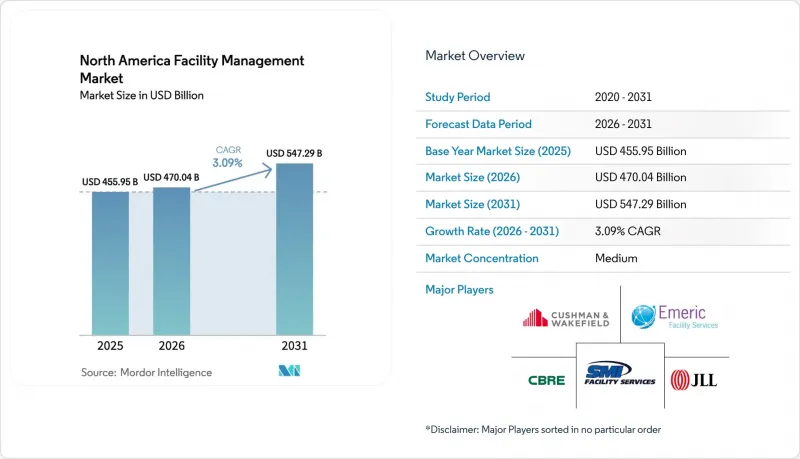
據 Mordor Intelligence 稱,2025 年北美設施管理市場價值 4,559.5 億美元,預計從 2026 年的 4,700.4 億美元成長到 2031 年的 5,472.9 億美元。
預測期(2026-2031 年)的複合年成長率預計為 3.09%。
本報告按服務類型(硬服務和軟服務)、交付方式(內部交付和外包)、最終用戶行業(商業、酒店、公共基礎設施、醫療保健、工業流程和其他最終用戶行業)以及地區(美國、加拿大和墨西哥)進行細分。市場預測以美元計價。
北美設施管理市場趨勢與洞察
基礎建設的擴展
全部區域聯邦、州和省的法規正在提高建築性能標準,迫使業主維修老化的暖通空調、生命安全和電氣系統。美國總務管理局 (GSA) 的 2024 P100 標準加強了聯邦政府所有物業的永續性和韌性標準,並可作為私人物業組合的參考範例。在墨西哥,透過近岸外包來適應工業擴張的趨勢,在抵消政治預算限制的同時,也支撐了對高規格物流和組裝空間的需求。在加拿大,旨在實現氣候目標的統一建築規範正在推動提高能源效率的維修。因此,在機電 (MEP) 方面擁有深厚專業知識的硬服務承包商正在獲得穩定且持續的收入來源,而技術驅動的監控平台正在加強合規性並延長北美設施管理市場的資產使用壽命。
建築管理外包的擴展
企業董事會越來越傾向於將設施管理 (FM) 視為策略工具,而不僅僅是成本中心。由於客戶優先考慮能夠減少供應商數量、確保單一聯絡點和責任歸屬的整合服務,ABM Industries 在 2024 年獲得了超過 10 億美元的新契約。軟硬體結合的合約能夠提高規模經濟效益,並且通常包含與安全、運轉率和能源目標相關的基於結果的關鍵績效指標 (KPI)。在醫療保健領域,像 Medxcel 這樣的供應商中立策略,透過最佳化內部資源和外包成本,在三年內節省了 1.04 億美元的成本。因此,北美設施管理市場的外包比例正在擴大,供應商憑藉透明的績效報告和數位化工具集,獲得了多年期、多站點的合約。
設備和網路漏洞方面的安全問題
針對建築管理系統 (BMS) 和物聯網 (IoT) 終端的網路攻擊,使生命安全、暖通空調 (HVAC) 和門禁系統等多層安全機制面臨潛在的中斷風險,27% 的設施管理人員報告稱,過去一年中曾發生過此類事件。關鍵基礎設施的網路保險保費飆升,進一步延緩了網路技術的大規模應用。醫療機構和政府園區等擁有敏感資料和關鍵任務系統的場所,需要端對端加密、零信任框架和全天候威脅監控,這提高了小規模設施管理服務商的准入門檻,並延長了北美設施管理市場的業務週期。
細分市場分析
預計到2025年,北美設施管理市場中,複合年成長率(CAGR)將達到58.72%,並將與整體市場擴張保持同步成長,到2031年將以3.09%的複合年成長率成長。該行業透過嚴格的機電(機械、電氣和管道)維護、遵守消防安全標準以及保護建築結構資產,為業務連續性提供支援。建築系統的普遍老化以及能源和生命安全法規的更新,正在催生對維修計劃、狀態監測和資產生命週期規劃的可預見需求。
儘管規模較小,但軟性服務正以4.08%的複合年成長率快速成長,這主要得益於人們對健康、安全和禮賓服務的需求不斷成長。更嚴格的室內空氣品質 (IAQ) 標準以及健康和安全認證的獲取,正在推動高階清潔服務的需求。隨著智慧儲物櫃和訪客管理技術的日益普及,辦公室支援和前台服務的範圍也在不斷擴大。這些趨勢使得綜合供應商能夠在確保硬性服務持續收入的同時,交叉銷售創新的軟性服務,從而提升其在北美設施管理市場的佔有率。
其他好處:
- Excel格式的市場預測(ME)表
- 3個月的分析師支持
目錄
第1章:引言
- 研究假設和市場定義
- 調查範圍
第2章:調查方法
第3章執行摘要
第4章 市場狀況
- 市場概覽
- 北美商業地產當前運轉率
- 主要設施管理服務提供者的盈利基準
- 勞動指標-技術純熟勞工和非技術純熟勞工的勞動參與率
- 按服務類型分類的設施管理市場佔有率(%)
- 按硬體服務分類的設施管理市場佔有率(%)
- 軟性服務在設施管理市場的市佔率(%)
- 主要都會區的都市化和人口成長
- 美國、加拿大和墨西哥基礎設施發展計畫的產業投資優先事項
- 與勞動和安全標準相關的監管因素
- 市場促進因素
- 基礎建設的擴展
- 建築管理外包的增加
- 安全保障的需求日益成長
- 設施管理的技術進步
- 建築運作中永續性和ESG合規性面臨的壓力
- 混合辦公模式正在推動對靈活設施管理(FM)解決方案的需求。
- 市場限制因素
- 設備和網路漏洞方面的安全問題
- 先進技術和熟練勞動成本高。
- 各州勞動法規不盡相同,增加了合規負擔。
- 中小規模設施管理服務供應商的數位化成熟度較低
- 價值鏈分析
- PESTLE分析
- 市場進入者的監管和法律框架
- 宏觀經濟指標對FM需求的影響
- 波特五力分析
- 投資與資金籌措分析
第5章 市場規模與成長預測
- 按服務類型
- 艱苦的服務
- 資產管理
- 機電及暖通空調服務
- 消防系統和安全
- 其他硬體維修服務
- 軟服務
- 辦公室支援和安全
- 清潔服務
- 餐飲服務
- 其他軟調頻服務
- 艱苦的服務
- 按服務類型
- 內部
- 外包
- 單頻調頻
- 捆綁式調頻廣播
- 整合調頻
- 按最終用戶行業分類
- 商業(IT/電信、零售/倉儲)
- 飯店餐飲業(飯店、餐廳、大型餐廳)
- 公共和社會基礎設施(政府、教育、交通)
- 醫療保健(公立和私立機構)
- 工業和流程(製造業、能源業、採礦業)
- 其他終端用戶產業(多用戶住宅、娛樂、運動和休閒)
- 國家
- 美國
- 加拿大
- 墨西哥
第6章 競爭情勢
- 市場集中度
- 策略舉措和夥伴關係
- 市佔率分析
- 公司簡介
- ABM Industries Inc.
- ISS A/S
- Sodexo Inc.
- Aramark
- CBRE Group Inc.
- EMCOR Group Inc.
- GDI Integrated Facility Services
- JLL(Jones Lang LaSalle IP, Inc.)
- Cushman and Wakefield PLC
- Compass Group PLC
- Kellermeyer Bergensons Services, LLC
- Guardian Service Industries Inc.
- SMS Assist, LLC
- AHI Facility Services Inc.
- Emeric Facility Services LLC
- SMI Facility Services
- Shine Facility Services
- Brookfield Global Integrated Solutions
- Honeywell Building Technologies(FM Division)
第7章 市場機會與未來展望
According to Mordor Intelligence, the North America facility management market size was valued at USD 455.95 billion in 2025 and estimated to grow from USD 470.04 billion in 2026 to reach USD 547.29 billion by 2031, at a CAGR of 3.09% during the forecast period (2026-2031).
This report is Segmented by Service Type (Hard Services, and Soft Services), Offering Type (In-House, and Outsourced), End-User Industry (Commercial, Hospitality, Institutional and Public Infrastructure, Healthcare, Industrial and Process, and Other End-User Industries), and Geography (United States, Canada, and Mexico). The Market Forecasts are Provided in Terms of Value (USD).
North America Facility Management Market Trends and Insights
Increasing Infrastructure Development
Federal, state, and provincial mandates across the region elevate building performance thresholds, pushing asset owners to retrofit outdated HVAC, life-safety, and electrical systems. The U.S. General Services Administration's 2024 P100 standards strengthen sustainability and resiliency criteria for federal properties, setting a template for private portfolios. Mexico's push to accommodate nearshoring-driven industrial expansion offsets political budget constraints yet sustains demand for high-spec logistics and assembly space. In Canada, harmonized construction codes aimed at meeting climate targets are amplifying energy-efficiency retrofits. Hard-service contractors with deep MEP expertise are consequently seeing stable recurring revenue streams, while technology-enabled monitoring platforms reinforce compliance and extend asset life cycles within the North America facility management market.
Rising Outsourcing in Building Management
Corporate boards increasingly frame FM as a strategic lever rather than a commodity cost center. ABM Industries secured more than USD 1 billion in new contracts during 2024 as clients prioritized integrated offerings that limit vendor sprawl and guarantee single-point accountability. Bundled hard-plus-soft contracts improve economies of scale and often embed outcome-based KPIs tied to safety, uptime, and energy targets. For healthcare, vendor-neutral strategies such as Medxcel's generated USD 104 million savings over three years by fine-tuning in-house resources and third-party spend. As a result, the outsourced slice of the North America facility management market is widening, with providers that can demonstrate transparent performance reporting and digital toolsets attracting multi-year, multi-site deals.
Security Concerns Over Device and Network Vulnerabilities
Cyberattacks on BMS and IoT endpoints expose life-safety, HVAC, and access-control layers to potential sabotage, with 27% of facility managers reporting incidents over the past year. Insurance premiums for cyber coverage in critical infrastructure have spiked, further delaying large-scale rollouts. Healthcare and government campuses, sitting on sensitive data and mission-critical systems, demand end-to-end encryption, zero-trust frameworks, and 24/7 threat monitoring, raising barriers for smaller FM providers and elongating sales cycles across the North America facility management market.
Other drivers and restraints analyzed in the detailed report include:
- Heightened Safety and Security Needs
- Technological Advancements in Facility Management
- High Costs of Advanced Tech and Skilled Labor
For complete list of drivers and restraints, kindly check the Table Of Contents.
Segment Analysis
Hard services account for 58.72% of the North America facility management market in 2025 and progress in lock-step with overall expansion at a 3.09% CAGR to 2031. This branch anchors operational continuity through disciplined MEP upkeep, fire-safety compliance, and structural asset preservation. Widespread building-system obsolescence and code updates around energy and life-safety create predictable demand for retrofit programs, condition-based monitoring, and asset-lifecycle planning.
Soft services, although smaller, rise faster at a 4.08% CAGR driven by wellness, security, and concierge expectations. Elevated indoor-air-quality protocols and health-security certifications fuel premium cleaning packages. Office support and front-of-house roles increasingly integrate smart-locker and visitor-management technologies, broadening scope. This divergence positions integrated suppliers to cross-sell soft-service innovations while defending recurring hard-service annuities, thereby enhancing wallet share inside the North America facility management market.
Complete Report Scope:
- By Service Type
- Hard Services
- Asset Management
- MEP and HVAC Services
- Fire Systems and Safety
- Other Hard FM Services
- Soft Services
- Office Support and Security
- Cleaning Services
- Catering Services
- Other Soft FM Services
- Hard Services
- By Offering Type
- In-house
- Outsourced
- Single FM
- Bundled FM
- Integrated FM
- By End-user Industry
- Commercial (IT and Telecom, Retail and Warehouses)
- Hospitality (Hotels, Eateries, Large-scale Restaurants)
- Institutional and Public Infrastructure (Govt, Education, Transportation)
- Healthcare (Public and Private Facilities)
- Industrial and Process (Manufacturing, Energy, Mining)
- Other End-user Industries (Multi-housing, Entertainment, Sports and Leisure)
- By Country
- United States
- Canada
- Mexico
List of Companies Covered in this Report:
- ABM Industries Inc.
- ISS A/S
- Sodexo Inc.
- Aramark
- CBRE Group Inc.
- EMCOR Group Inc.
- GDI Integrated Facility Services
- JLL (Jones Lang LaSalle IP, Inc.)
- Cushman and Wakefield PLC
- Compass Group PLC
- Kellermeyer Bergensons Services, LLC
- Guardian Service Industries Inc.
- SMS Assist, LLC
- AHI Facility Services Inc.
- Emeric Facility Services LLC
- SMI Facility Services
- Shine Facility Services
- Brookfield Global Integrated Solutions
- Honeywell Building Technologies (FM Division)
Additional Benefits:
- The market estimate (ME) sheet in Excel format
- 3 months of analyst support
TABLE OF CONTENTS
1 INTRODUCTION
- 1.1 Study Assumptions and Market Definition
- 1.2 Scope of the Study
2 RESEARCH METHODOLOGY
3 EXECUTIVE SUMMARY
4 MARKET LANDSCAPE
- 4.1 Market Overview
- 4.1.1 Current Occupancy Rates in North American Commercial Real Estate
- 4.1.2 Profitability Benchmarks of Major FM Providers
- 4.1.3 Workforce Indicators - Skilled and Unskilled Labor Participation
- 4.1.4 Facility Management Market Share (%) by Service Type
- 4.1.5 Facility Management Market Share (%) by Hard Services
- 4.1.6 Facility Management Market Share (%) by Soft Services
- 4.1.7 Urbanization and Population Growth in Top Metro Areas
- 4.1.8 Sector Investment Priorities in United States, Canada, and Mexico Infrastructure Pipeline
- 4.1.9 Regulatory Drivers Specific to Labour and Safety Standards
- 4.2 Market Driver
- 4.2.1 Increasing Infrastructure Development
- 4.2.2 Rising Outsourcing in Building Management
- 4.2.3 Heightened Safety and Security Needs
- 4.2.4 Technological Advancements in Facility Management
- 4.2.5 Sustainability & ESG Compliance Pressures on Building Operations
- 4.2.6 Hybrid-Work Models Driving Demand for Flexible FM Solutions
- 4.3 Market Restraint
- 4.3.1 Security concerns over device and network vulnerabilities
- 4.3.2 High costs of advanced tech and skilled labor
- 4.3.3 Fragmented State-Level Labor Regulations Increasing Compliance Burden
- 4.3.4 Limited Digital Maturity among Small & Mid-Sized FM Providers
- 4.4 Value Chain Analysis
- 4.5 PESTEL Analysis
- 4.6 Regulatory and Legislative Framework for Market Entrants
- 4.7 Impact of Macroeconomic Indicators on FM Demand
- 4.8 Porter's Five Forces Analysis
- 4.8.1 Bargaining Power of Suppliers
- 4.8.2 Bargaining Power of Buyers
- 4.8.3 Threat of New Entrants
- 4.8.4 Threat of Substitute Services
- 4.8.5 Intensity of Competitive Rivalry
- 4.9 Investment and Funding Analysis
5 MARKET SIZE AND GROWTH FORECASTS (VALUES)
- 5.1 By Service Type
- 5.1.1 Hard Services
- 5.1.1.1 Asset Management
- 5.1.1.2 MEP and HVAC Services
- 5.1.1.3 Fire Systems and Safety
- 5.1.1.4 Other Hard FM Services
- 5.1.2 Soft Services
- 5.1.2.1 Office Support and Security
- 5.1.2.2 Cleaning Services
- 5.1.2.3 Catering Services
- 5.1.2.4 Other Soft FM Services
- 5.1.1 Hard Services
- 5.2 By Offering Type
- 5.2.1 In-house
- 5.2.2 Outsourced
- 5.2.2.1 Single FM
- 5.2.2.2 Bundled FM
- 5.2.2.3 Integrated FM
- 5.3 By End-user Industry
- 5.3.1 Commercial (IT and Telecom, Retail and Warehouses)
- 5.3.2 Hospitality (Hotels, Eateries, Large-scale Restaurants)
- 5.3.3 Institutional and Public Infrastructure (Govt, Education, Transportation)
- 5.3.4 Healthcare (Public and Private Facilities)
- 5.3.5 Industrial and Process (Manufacturing, Energy, Mining)
- 5.3.6 Other End-user Industries (Multi-housing, Entertainment, Sports and Leisure)
- 5.4 By Country
- 5.4.1 United States
- 5.4.2 Canada
- 5.4.3 Mexico
6 COMPETITIVE LANDSCAPE
- 6.1 Market Concentration
- 6.2 Strategic Moves and Partnerships
- 6.3 Market Share Analysis
- 6.4 Company Profiles (includes Global level Overview, Market level overview, Core Segments, Financials as available, Strategic Information, Market Rank/Share for key companies, Products and Services, and Recent Developments)
- 6.4.1 ABM Industries Inc.
- 6.4.2 ISS A/S
- 6.4.3 Sodexo Inc.
- 6.4.4 Aramark
- 6.4.5 CBRE Group Inc.
- 6.4.6 EMCOR Group Inc.
- 6.4.7 GDI Integrated Facility Services
- 6.4.8 JLL (Jones Lang LaSalle IP, Inc.)
- 6.4.9 Cushman and Wakefield PLC
- 6.4.10 Compass Group PLC
- 6.4.11 Kellermeyer Bergensons Services, LLC
- 6.4.12 Guardian Service Industries Inc.
- 6.4.13 SMS Assist, LLC
- 6.4.14 AHI Facility Services Inc.
- 6.4.15 Emeric Facility Services LLC
- 6.4.16 SMI Facility Services
- 6.4.17 Shine Facility Services
- 6.4.18 Brookfield Global Integrated Solutions
- 6.4.19 Honeywell Building Technologies (FM Division)
7 MARKET OPPORTUNITIES AND FUTURE OUTLOOK
- 7.1 White-space and Unmet-Need Assessment
- 7.2 Technology-led Integrated FM (IoT, BMS, AI-based Predictive Maintenance)
- 7.3 ESG-Compliant FM Solutions Demand
- 7.4 Future Service-Model Shifts (Outcome-Based Contracts)

 2026-2030年全球設施管理市場
 設施管理(FM)軟體:市場佔有率分析、行業趨勢和統計數據以及成長預測(2026-2031 年)亞太地區硬設施管理:市場佔有率分析、產業趨勢與統計及成長預測(2026-2031)硬設施管理:市場佔有率分析、產業趨勢與統計、成長預測(2026-2031 年)日本設施管理:市場佔有率分析、產業趨勢與統計及成長預測(2026-2031)
 Frost Radar™:泰國設施管理,2026 年中國設施管理:市場佔有率分析、產業趨勢與統計、成長預測(2026-2031)印尼設施管理:市場佔有率分析、產業趨勢與統計、成長預測(2026-2031)德國設施管理:市場佔有率分析、產業趨勢與統計、成長預測(2026-2031)新加坡設施管理:市場佔有率分析、產業趨勢與統計、成長預測(2026-2031)