


 |
市場調查報告書
商品編碼
2125579
設施管理(FM)軟體:市場佔有率分析、行業趨勢和統計數據以及成長預測(2026-2031 年)Facility Management Software - Market Share Analysis, Industry Trends & Statistics, Growth Forecasts (2026 - 2031) |
||||||

※ 本網頁內容可能與最新版本有所差異。詳細情況請與我們聯繫。
據 Mordor Intelligence 稱,設施管理 (FM) 軟體市場預計將從 2025 年的 26.5 億美元成長到 2026 年的 29.8 億美元,到 2031 年達到 49.5 億美元,2026 年至 2031 年的複合年成長率為 10.68%。
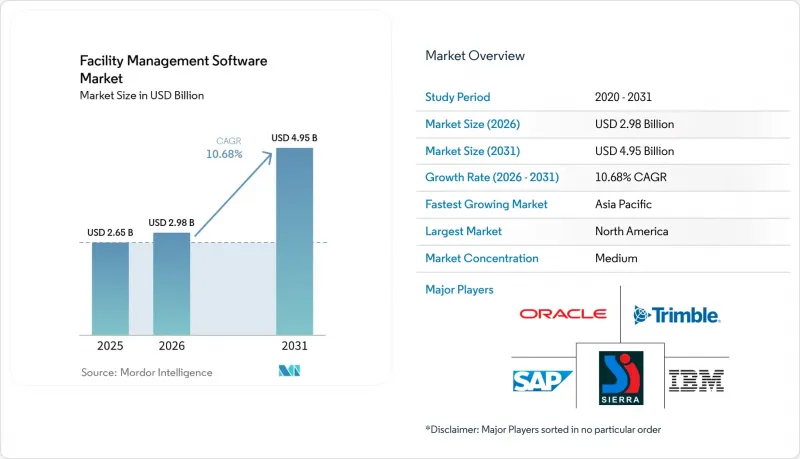
本報告按軟體類型(CAFM、IWMS、CMMS)、部署模式(雲端、本地部署、混合部署)、最終用戶(商業、機構、公共基礎設施、工業等)、功能(資產管理、維護管理、空間管理、能源管理)和地區進行細分。市場預測以美元計價。
全球設施管理 (FM) 軟體市場趨勢與洞察
雲端SaaS平台的普及應用日益廣泛
訂閱模式將資本投資轉化為營運成本,擴大了中型企業客戶群,同時將引進週期從 18 個月縮短至約 6 個月。 ServiceNow 的工作場所套件預計到 2025 年將獲得 1200 家企業客戶,定價柔軟性是主要因素。多租戶架構使供應商能夠持續提供 AI 更新,這是本地部署系統所沒有的優勢。這種靈活性雖然會加劇供應商鎖定並增加轉換成本,但卻支撐了兩位數的持續成長。
物聯網感測器整合用於預測性維護
感測器的普及正在推動維護方式從被動式轉向預測式,從而減少高達 40% 的停機時間。 Fracttal 在拉丁美洲工廠部署了 5 萬個振動感測器,實現了提前 72 小時檢測故障,預計到 2024 年可節省 1,200 萬美元的成本。邊緣運算和 5G 連接技術使得警報通知的響應速度不到一秒,而 SAP 與西門子 MindSphere 等夥伴關係在 2025 年開展的合作項目,則將遙測數據與資產歷史記錄相結合,以最佳化備件計劃。
整合舊有系統的複雜性
由於專有協議的限制,專案成本增加了40%至60%,而且西門子的Desigo CC控制器需要客製化中間件才能與第三方IWMS整合。雖然Honeywell在2024年發布了47個預置連接器,解決了一些難題,但仍有38%的項目超出預算。這項挑戰在醫療機構園區尤為突出。由於氣動控制系統老舊,12棟建築遷移到江森自控OpenBlue系統耗時14個月。
細分市場分析
整合工作場所管理系統 (IWMS) 是成長最快的細分市場,預計到 2031 年將以 16.80% 的複合年成長率成長。然而,截至 2025 年,電腦輔助設施管理 (CAM) 仍將佔據設施管理 (FM) 軟體市場 41.40% 的佔有率。大型企業傾向於使用 IWMS 來集中管理租賃、資本項目和能源分析,IBM TRIRIGA 和 Oracle Primavera Unifier 的廣泛應用便證明了這一點。電腦化維護管理系統 (CMMS) 則受到資產密集型產業的青睞,像 UpKeep 和 MaintainX 這樣的「行動優先」供應商在部署後 60 天內的採用率高達 89%。儘管隨著財務長們計劃在 2027 年前替換三個或更多個獨立解決方案,IWMS 設施管理 (FM) 軟體市場預計將快速擴張,但 CAFM 在優先考慮快速部署和低複雜性的領域仍然保持著強勁的支援。
IWMS 的複雜性導致其實施週期較長(通常為 6-12 個月),而 CMMS 則透過以技術人員為中心的工作流程實現更快的價值實現。 Planon 於 2024 年將 CMMS 整合到其 IWMS 架構中,模糊了不同細分市場之間的界線。 Archbus 於 2025 年引入數位孿生視覺化功能,縮小了功能差距,但其價值提案仍主要基於 CAFM。市場兩極化仍在持續:財富 500 強企業業主傾向於選擇以 IWMS 為中心的整合方案,中型工業企業優先考慮 CMMS 的簡易性,而商業房地產集團則在熟悉 CAFM 的基礎上,選擇性地升級到 IWMS。
預計到 2025 年,雲端解決方案將佔總收入的 72.12%,並將在 2031 年前以 11.30% 的複合年成長率持續成長。這反映了訂閱模式的成本效益、持續的 AI 更新以及 IT 營運成本的降低。 Oracle 將 Primavera 遷移到 Oracle 雲端基礎架構 (Oracle) 推動了設施管理 (FM) 軟體市場在雲端採用方面的快速擴張,預計到 2024 年,78% 的新客戶將選擇 SaaS 模式。在資料主權至關重要的國防和監管產業,本地部署仍然普遍存在。然而,研發投入正日益集中在增強雲端功能。混合部署能夠平衡安全性和分析需求。例如,透過利用 SAP S/4HANA for Real Estate,醫院可以在本地管理敏感的房間分配訊息,同時在 Azure 上處理運作分析。
多租戶模式的經濟效益使得純SaaS供應商能夠提供比傳統定價低40-50%的價格。 ServiceChannel在2024年處理1,400萬份工單,展現了可擴展性的優勢。 ISO 27001認證已成為業界標準,Eptura和Planon均在2024年實現了合規,從而降低了企業的安全疑慮。展望未來,雖然雲端採用預計會壓縮本地部署支援的利潤率,但預計也會加速以人工智慧、數位孿生和物聯網遙測為核心的生態系統夥伴關係。
區域分析
2025年,北美將佔全球銷售額的37.46%,這主要得益於紐約和舊金山等城市嚴格的能源績效法規,這些法規強制要求進行能源基準測試。美國總務管理局(GSA)於2024年強制實施的數位化建築管理系統(DMS)規定,創造了3.4億美元的採購機會。加拿大大約落後兩年,但卑詩省2024年對《建築標準法》的修訂加速了溫哥華的DMS應用。在墨西哥,近岸外包的蓬勃發展促使製造商優先考慮運作,從而推動了2024年CMMS市場28%的成長。
在歐洲,2024年修訂的《建築能源性能指令》(EPBD)強制要求新建築達到近零能耗標準。德國已投資5億歐元(約5.65億美元)津貼整合工作管理系統(IWMS)和能源平台。法國和北歐國家也推出了類似的獎勵。同時,英國2025年《建築安全法》收緊了維護文件編制的規定,從而推動了對施工管理系統(CMMS)的需求。
亞太地區是成長最快的地區,預計到2031年將以26.30%的複合年成長率成長,這主要得益於中國對智慧城市建設的投資以及印度市政資產的數位轉型。日本的「社會5.0」計畫計畫在2024年將23,000座公共建築連接到國家物聯網骨幹網路。韓國撥款7,800億韓元(約5.9億美元)用於智慧建築維修。澳洲2024年對《國家建築標準法》的修訂強制要求進行能源建模,將帶動雪梨和墨爾本基於SaaS的能源管理服務訂閱量的成長。
中東地區的需求主要集中在大型企劃上。沙烏地阿拉伯的NEOM專案整合了IBM TRIRIGA和西門子Desigo CC系統,實現了端到端的資產監控。杜拜市政府2025年的法規強制要求20層以上的高層建築採用數位孿生技術,從而確保了整合工作場所管理系統(IWMS)的持續部署。非洲仍在發展中,但隨著奈及利亞修訂其國家建築規範,發展勢頭強勁。南美洲的發展動能主要由巴西推動,聖保羅2024年的《績效法案》加速了IWMS的普及。智利推出了綠建築獎勵,而阿根廷則因宏觀經濟逆風而面臨支出限制。
其他好處:
- Excel格式的市場預測(ME)表
- 3個月的分析師支持
目錄
第1章:引言
- 研究假設和市場定義
- 調查範圍
第2章:調查方法
第3章執行摘要
第4章 市場狀況
- 市場概覽
- 市場促進因素
- 雲端SaaS平台的廣泛應用
- 物聯網感測器整合用於預測性維護
- 人們越來越關注永續發展和能源效率。
- 混合工作模式的普及推動了對空間最佳化工具的需求。
- 促進新興國家智慧城市建設的努力
- 數位孿生技術在資產生命週期管理的應用日益廣泛
- 市場限制因素
- 與舊有系統整合相關的複雜性
- 實施和培訓的初始成本很高
- 對資料隱私和網路安全的擔憂
- FM領域專業資料分析人員短缺
- 產業價值鏈分析
- 監理情勢
- 技術展望
- 宏觀經濟因素的影響
- 波特五力分析
第5章 市場規模與成長預測
- 軟體類型
- 電腦輔助設施管理(CAFM)
- 整合工作場所管理系統(IWMS)
- 電腦化維護管理系統(CMMS)
- 按部署模式
- 雲
- 現場
- 混合
- 最終用戶
- 商業
- 機構
- 公共基礎設施
- 產業
- 其他最終用戶
- 按功能
- 資產管理
- 維護管理
- 空間管理
- 能源管理
- 按地區
- 北美洲
- 美國
- 加拿大
- 墨西哥
- 歐洲
- 德國
- 英國
- 法國
- 義大利
- 西班牙
- 俄羅斯
- 其他歐洲國家
- 亞太地區
- 中國
- 日本
- 印度
- 韓國
- 澳洲
- 其他亞太國家
- 中東
- 沙烏地阿拉伯
- 阿拉伯聯合大公國
- 土耳其
- 其他中東國家
- 非洲
- 南非
- 奈及利亞
- 其他非洲國家
- 南美洲
- 巴西
- 阿根廷
- 其他南美國家
- 北美洲
第6章 競爭情勢
- 市場集中度
- 策略趨勢
- 市佔率分析
- 公司簡介
- IBM Corporation
- Oracle Corporation
- SAP SE
- SIERRA ODC Private Limited
- Trimble Inc.
- Broadcom Inc.
- Accruent LLC(Fortive)
- Planon Software
- Eptura
- UpKeep Technologies
- FTMaintenance(FasTrak)
- Brightly(Siemens)
- Infor(Hexagon)
- Limble CMMS
- MaintainX Inc.
- FMX(Facilities Management eXpress)
- eMaint(Fluke Corporation)
- Dude Solutions
- iOFFICE+SpaceIQ
- Archibus
- ServiceChannel
第7章 市場機會與未來展望
According to Mordor Intelligence, the facility management software market size is expected to increase from USD 2.65 billion in 2025 to USD 2.98 billion in 2026 and reach USD 4.95 billion by 2031, growing at a CAGR of 10.68% over 2026-2031.
This report is Segmented by Software Type (CAFM, IWMS, and CMMS), Deployment Model (Cloud, On-Premise, and Hybrid), End User (Commercial, Institutional, Public Infrastructure, Industrial, and More), Functionality (Asset Management, Maintenance Management, Space Management, and Energy Management), and Geography. Market Forecasts are Provided in Terms of Value (USD).
Global Facility Management Software Market Trends and Insights
Growing Adoption of Cloud-Based SaaS Platforms
Subscription economics convert capital expenditure into operating expenses, broadening access for mid-market buyers while shortening deployment cycles from 18 months to roughly six months. ServiceNow's workplace suite secured 1,200 enterprise customers in 2025, citing pricing flexibility as the top factor. Multi-tenant architectures enable vendors to continuously push AI updates, a benefit that on-premises systems lack. Such agility strengthens vendor lock-in and raises switching costs, underpinning sustained double-digit expansion.
Integration of IoT Sensors for Predictive Maintenance
Sensor proliferation enables a shift from reactive to predictive maintenance, resulting in up to 40% lower downtime. Fracttal's roll-out of 50,000 vibration sensors across Latin American plants detected failures 72 hours in advance and saved USD 12 million in 2024. Edge computing and 5G connectivity enable sub-second alerts, while partnerships, such as SAP's 2025 tie-up with Siemens' MindSphere, integrate telemetry with asset histories for optimized spare-part planning.
Legacy System Integration Complexities
Proprietary protocols inflate project costs by 40-60%, with Siemens Desigo CC controllers requiring custom middleware for third-party IWMS integration. Honeywell's 2024 launch of 47 pre-built connectors reduced some friction, yet 38% of projects still exceeded budgets. Healthcare campuses illustrate the challenge: a 12-building migration to Johnson Controls OpenBlue lasted 14 months due to pneumatic legacy controls.
Other drivers and restraints analyzed in the detailed report include:
- Rising Focus on Sustainability and Energy Efficiency
- Proliferation of Hybrid-Work Models Driving Space-Optimization Tools
- High Up-Front Implementation and Training Costs
For complete list of drivers and restraints, kindly check the Table Of Contents.
Segment Analysis
Integrated workplace management systems represented the fastest-growing segment, with a 16.80% CAGR through 2031. However, computer-aided facility management retained 41.40% of the facilities management software market share in 2025. Large enterprises favor IWMS for consolidated lease, capital project, and energy analytics, as evidenced by deployments of IBM TRIRIGA and Oracle Primavera Unifier. Computerized maintenance management systems appeal to asset-intensive verticals, with mobile-first vendors such as UpKeep and MaintainX posting 89% adoption within 60 days. The facilities management software market size for IWMS is forecast to expand rapidly as CFOs strive to replace three or more point solutions by 2027, while CAFM remains entrenched in sectors prioritizing rapid roll-out and lower complexity.
IWMS complexity demands longer roll-out horizons, often six to 12 months, while CMMS achieves faster time to value technician-centric workflows. Planon's integration of CMMS within its IWMS architecture during 2024 blurred segment lines. Archibus introduced digital-twin visualization in 2025 to narrow capability gaps, although its CAFM roots still underpin its value proposition. Market bifurcation persists: Fortune 500 landlords consolidate around IWMS, mid-market industrial players lean toward CMMS simplicity, and commercial real-estate groups balance CAFM familiarity with selective IWMS upgrades.
Cloud solutions accounted for 72.12% of the revenue in 2025 and are progressing at an 11.30% CAGR through 2031, reflecting subscription affordability, continuous AI updates, and lower IT overhead. The facilities management software market size for cloud deployments surged as Oracle migrated Primavera to Oracle Cloud Infrastructure, with 78% of new clients choosing SaaS in 2024. On-premises deployments persist in defense and regulated sectors where data sovereignty matters, but R&D outlays favor cloud enhancements. Hybrid deployments bridge the security and analytics needs; SAP S/4HANA for Real Estate enables hospitals to keep sensitive room assignments on-site while processing occupancy insights in Azure.
Multi-tenant economics allow pure-play SaaS vendors to undercut legacy pricing by 40-50%. ServiceChannel handled 14 million work orders in 2024, proving scalability benefits. ISO 27001 certification has become a standard, with Eptura and Planon both achieving compliance in 2024 to alleviate enterprise security concerns. Over time, cloud adoption is expected to compress margins for on-premises support while stimulating ecosystem partnerships centered on AI, digital twins, and IoT telemetry.
Complete Report Scope:
- By Software Type
- Computer-Aided Facility Management (CAFM)
- Integrated Workplace Management Systems (IWMS)
- Computerized Maintenance Management Systems (CMMS)
- By Deployment Model
- Cloud
- On-Premise
- Hybrid
- By End User
- Commercial
- Institutional
- Public Infrastructure
- Industrial
- Other End User Segments
- By Functionality
- Asset Management
- Maintenance Management
- Space Management
- Energy Management
- By Geography
- North America
- United States
- Canada
- Mexico
- Europe
- Germany
- United Kingdom
- France
- Italy
- Spain
- Russia
- Rest of Europe
- Asia-Pacific
- China
- Japan
- India
- South Korea
- Australia
- Rest of Asia-Pacific
- Middle East
- Saudi Arabia
- United Arab Emirates
- Turkey
- Rest of Middle East
- Africa
- South Africa
- Nigeria
- Rest of Africa
- South America
- Brazil
- Argentina
- Rest of South America
- North America
Geography Analysis
North America generated 37.46% of the revenue in 2025, driven by stringent performance ordinances in cities such as New York and San Francisco that require energy benchmarking. The U.S. General Services Administration's 2024 mandate for digital building oversight opened a USD 340 million procurement avenue. Canada trails by roughly two years, but British Columbia's 2024 code update accelerated adoption in Vancouver. Mexico's nearshoring boom spurred a 28% growth in CMMS in 2024, as manufacturers prioritized uptime.
Europe's revised 2024 EPBD compels near-zero energy in new buildings, funneling EUR 500 million (USD 565 million) in German grants toward IWMS and energy platforms. France and the Nordics mirror Germany's incentives, while the United Kingdom's 2025 Building Safety Act tightens maintenance documentation rules, boosting CMMS demand.
The Asia-Pacific region is the fastest-growing region, with a 26.30% CAGR through 2031, driven by China's smart-city investments and India's digitization of municipal assets. Japan's Society 5.0 program interconnected 23,000 public buildings with national IoT backbones in 2024. South Korea allocated KRW 780 billion (USD 590 million) for smart-building retrofits. Australia's 2024 National Construction Code revisions have enforced energy modeling, leading to increased SaaS energy-management subscriptions in Sydney and Melbourne.
Middle East demand centers on mega-projects: Saudi Arabia's NEOM integrated IBM TRIRIGA and Siemens Desigo CC for end-to-end asset oversight. Dubai Municipality's 2025 rule mandates the adoption of digital twins in towers exceeding 20 floors, ensuring sustained IWMS procurement. Africa is nascent, but it gains traction as Nigeria updates its national building code. South America's momentum rests in Brazil, where Sao Paulo's 2024 performance law accelerated IWMS penetration; Chile follows with green-building incentives, while Argentina's macroeconomic headwinds dampen spending.
- IBM Corporation
- Oracle Corporation
- SAP SE
- SIERRA ODC Private Limited
- Trimble Inc.
- Broadcom Inc.
- Accruent LLC (Fortive)
- Planon Software
- Eptura
- UpKeep Technologies
- FTMaintenance (FasTrak)
- Brightly (Siemens)
- Infor (Hexagon)
- Limble CMMS
- MaintainX Inc.
- FMX (Facilities Management eXpress)
- eMaint (Fluke Corporation)
- Dude Solutions
- iOFFICE + SpaceIQ
- Archibus
- ServiceChannel
Additional Benefits:
- The market estimate (ME) sheet in Excel format
- 3 months of analyst support
TABLE OF CONTENTS
1 INTRODUCTION
- 1.1 Study Assumptions and Market Definition
- 1.2 Scope of the Study
2 RESEARCH METHODOLOGY
3 EXECUTIVE SUMMARY
4 MARKET LANDSCAPE
- 4.1 Market Overview
- 4.2 Market Drivers
- 4.2.1 Growing Adoption of Cloud-Based SaaS Platforms
- 4.2.2 Integration of IoT Sensors for Predictive Maintenance
- 4.2.3 Rising Focus on Sustainability and Energy Efficiency
- 4.2.4 Proliferation of Hybrid-Work Models Driving Space-Optimization Tools
- 4.2.5 Smart-City Mandates in Emerging Economies
- 4.2.6 Increasing Use of Digital Twins for Asset Lifecycle Management
- 4.3 Market Restraints
- 4.3.1 Legacy System Integration Complexities
- 4.3.2 High Up-Front Implementation and Training Costs
- 4.3.3 Data-Privacy and Cyber-Security Concerns
- 4.3.4 Shortage of FM-Specific Data-Analytics Talent
- 4.4 Industry Value Chain Analysis
- 4.5 Regulatory Landscape
- 4.6 Technological Outlook
- 4.7 Impact of Macroeconomic Factors
- 4.8 Porter's Five Forces Analysis
- 4.8.1 Threat of New Entrants
- 4.8.2 Bargaining Power of Suppliers
- 4.8.3 Bargaining Power of Buyers
- 4.8.4 Threat of Substitutes
- 4.8.5 Competitive Rivalry
5 MARKET SIZE AND GROWTH FORECASTS (VALUE)
- 5.1 By Software Type
- 5.1.1 Computer-Aided Facility Management (CAFM)
- 5.1.2 Integrated Workplace Management Systems (IWMS)
- 5.1.3 Computerized Maintenance Management Systems (CMMS)
- 5.2 By Deployment Model
- 5.2.1 Cloud
- 5.2.2 On-Premise
- 5.2.3 Hybrid
- 5.3 By End User
- 5.3.1 Commercial
- 5.3.2 Institutional
- 5.3.3 Public Infrastructure
- 5.3.4 Industrial
- 5.3.5 Other End User Segments
- 5.4 By Functionality
- 5.4.1 Asset Management
- 5.4.2 Maintenance Management
- 5.4.3 Space Management
- 5.4.4 Energy Management
- 5.5 By Geography
- 5.5.1 North America
- 5.5.1.1 United States
- 5.5.1.2 Canada
- 5.5.1.3 Mexico
- 5.5.2 Europe
- 5.5.2.1 Germany
- 5.5.2.2 United Kingdom
- 5.5.2.3 France
- 5.5.2.4 Italy
- 5.5.2.5 Spain
- 5.5.2.6 Russia
- 5.5.2.7 Rest of Europe
- 5.5.3 Asia-Pacific
- 5.5.3.1 China
- 5.5.3.2 Japan
- 5.5.3.3 India
- 5.5.3.4 South Korea
- 5.5.3.5 Australia
- 5.5.3.6 Rest of Asia-Pacific
- 5.5.4 Middle East
- 5.5.4.1 Saudi Arabia
- 5.5.4.2 United Arab Emirates
- 5.5.4.3 Turkey
- 5.5.4.4 Rest of Middle East
- 5.5.5 Africa
- 5.5.5.1 South Africa
- 5.5.5.2 Nigeria
- 5.5.5.3 Rest of Africa
- 5.5.6 South America
- 5.5.6.1 Brazil
- 5.5.6.2 Argentina
- 5.5.6.3 Rest of South America
- 5.5.1 North America
6 COMPETITIVE LANDSCAPE
- 6.1 Market Concentration
- 6.2 Strategic Moves
- 6.3 Market Share Analysis
- 6.4 Company Profiles (includes Global level Overview, Market level overview, Core Segments, Financials as available, Strategic Information, Market Rank/Share for key companies, Products and Services, and Recent Developments)
- 6.4.1 IBM Corporation
- 6.4.2 Oracle Corporation
- 6.4.3 SAP SE
- 6.4.4 SIERRA ODC Private Limited
- 6.4.5 Trimble Inc.
- 6.4.6 Broadcom Inc.
- 6.4.7 Accruent LLC (Fortive)
- 6.4.8 Planon Software
- 6.4.9 Eptura
- 6.4.10 UpKeep Technologies
- 6.4.11 FTMaintenance (FasTrak)
- 6.4.12 Brightly (Siemens)
- 6.4.13 Infor (Hexagon)
- 6.4.14 Limble CMMS
- 6.4.15 MaintainX Inc.
- 6.4.16 FMX (Facilities Management eXpress)
- 6.4.17 eMaint (Fluke Corporation)
- 6.4.18 Dude Solutions
- 6.4.19 iOFFICE + SpaceIQ
- 6.4.20 Archibus
- 6.4.21 ServiceChannel
7 MARKET OPPORTUNITIES AND FUTURE OUTLOOK
- 7.1 White-Space and Unmet-Need Assessment

 2026-2030年全球設施管理市場
 北美設施管理:市場佔有率分析、產業趨勢與統計、成長預測(2026-2031 年)亞太地區硬設施管理:市場佔有率分析、產業趨勢與統計及成長預測(2026-2031)硬設施管理:市場佔有率分析、產業趨勢與統計、成長預測(2026-2031 年)日本設施管理:市場佔有率分析、產業趨勢與統計及成長預測(2026-2031)
 Frost Radar™:泰國設施管理,2026 年中國設施管理:市場佔有率分析、產業趨勢與統計、成長預測(2026-2031)印尼設施管理:市場佔有率分析、產業趨勢與統計、成長預測(2026-2031)德國設施管理:市場佔有率分析、產業趨勢與統計、成長預測(2026-2031)新加坡設施管理:市場佔有率分析、產業趨勢與統計、成長預測(2026-2031)