


 |
市場調查報告書
商品編碼
2124856
西班牙設施管理:市場佔有率分析、產業趨勢與統計、成長預測(2026-2031 年)Spain Facility Management - Market Share Analysis, Industry Trends & Statistics, Growth Forecasts (2026 - 2031) |
||||||

※ 本網頁內容可能與最新版本有所差異。詳細情況請與我們聯繫。
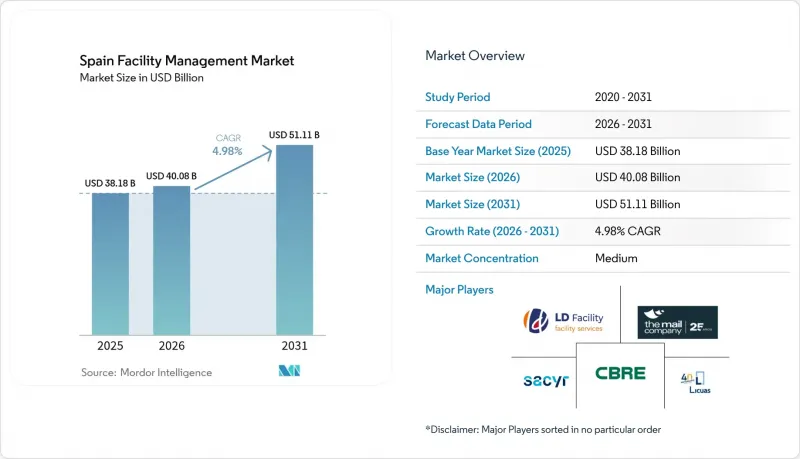
根據 Mordor Intelligence 預測,西班牙設施管理市場規模預計將從 2025 年的 381.8 億美元成長到 2026 年的 400.8 億美元,然後從 2026 年到 2031 年以 4.98% 的複合年成長率成長,到 2031 年達到 511.1 億美元。
本報告按服務類型(硬性服務、軟性服務)、交付方式(內部交付、外包)和最終用戶行業(商業、酒店、公共基礎設施、醫療保健、工業/流程以及其他最終用戶行業)進行分類。市場預測以美元計價。
西班牙設施管理市場的趨勢與洞察
大型企業向綜合設施管理(IFM)合約過渡
西班牙企業正將多家供應商整合到單一來源的綜合設施管理 (IFM) 合約中,以獲得即時建築分析、統一的服務水準以及 ESG 合規性保障。 Hotelatelier 就是一個顯著的例子,該公司在遷移到將暖通空調 (HVAC) 最佳化與前台服務協調相結合的模式後,客戶滿意度指數達到了 88%。雖然這種趨勢在多地點辦公大樓專案中尤其明顯,但醫院和資料中心營運商也開始整合技術和軟體運營,以提高運轉率並簡化管治。儘管合約規模和期限的增加能夠更好地展現供應商的收入預測,但要達到嚴格的關鍵績效指標 (KPI),則需要複雜的數位化平台和變更管理能力。
飯店和旅遊業的復甦
2024年至2025年初,赴日國際旅客人數激增,帶動了巴利阿里群島、加那利群島和太陽海岸飯店運轉率的回升。為因應季節性勞動力波動,飯店紛紛將清潔、保全和禮賓服務外包,同時致力於運用自動化入住等技術提升賓客體驗,Kora Living 的自動化入住率已達60%。與「NextGenerationEU」維修專案相關的永續發展目標進一步拓展了服務範圍,目前已涵蓋能源基準測試和廢棄物減量計畫。外包業務在旅遊旺季達到高峰,因此對靈活的合約結構和基於績效的定價機制的需求也日益成長。
由於新的集體談判協議,人事費用增加。
《第五次就業和集體談判協議》(簡稱「V協議」)規定,到2025年工資必須增加4%,這將推高西班牙設施管理市場合約中最大的成本組成。嚴重依賴軟性服務的供應商將受到最大影響,因為他們的自動化選擇有限。同時,加泰隆尼亞和巴斯克地區的區域薪資差距進一步擠壓了利潤空間。為了應對這種情況,各公司正在加快在清潔作業中引入機器人,重新評估服務等級範圍,並將服務捆綁銷售以分攤管理費用。
細分市場分析
到2025年,硬性服務將佔西班牙設施管理市場的62.94%,這反映出迫切需要對已使用了數十年的暖通空調、電氣和消防系統進行現代化改造。隨著業主運用預測分析來應對意外運作,資產管理分包正逐漸成為主流。穆爾西亞的一家化工廠透過整合能源管理和維護管理系統,在10年內將能耗降低了近50%。技術服務供應商透過簽訂多年期合約,將資本投資規劃與日常營運和維護服務相結合,從而提高了收入穩定性。
受混合辦公模式和旅館業復甦的推動,軟性服務業預計將跑贏其他行業,年複合成長率達5.08%。隨著使用模式每週波動,安保和辦公室支援營運變得日益複雜,對整合門禁控制和辦公桌預訂分析的需求也隨之增加。清潔合約面臨工資上漲帶來的成本上升的挑戰,但同時也受益於基於感測器的排班系統,該系統可根據即時訪客數量調整工作時間。餐飲業因員工重返辦公室和旅遊需求的復甦而呈現復甦跡象,但食品價格飆升帶來的菜單成本壓力迫使餐飲企業採用動態定價模式。
其他好處:
- Excel格式的市場預測(ME)表
- 3個月的分析師支持
目錄
第1章:引言
- 研究假設和市場定義
- 調查範圍
第2章:調查方法
第3章執行摘要
第4章 市場狀況
- 市場概覽
- 目前運轉率
- 主要設施管理業者的盈利指標
- 勞動指標 - 勞動參與率
- 按服務類型分類的設施管理市場佔有率(%)
- 以硬性服務分類的設施管理市場佔有率(%)
- 軟性服務在設施管理市場的市佔率(%)
- 主要都會區的都市化和人口成長
- 西班牙基礎設施計劃中的產業特定投資重點
- 與勞動和安全標準相關的監管因素
- 市場促進因素
- 大型企業向綜合設施管理(IFM)合約過渡
- 飯店和旅遊業的復甦正在提振對外包設施管理服務的需求。
- 電子商務物流和資料中心擴建需要專業的硬體維修服務。
- 社會基礎設施項目中的公私合營(PPP) 正在創造長期的設施管理 (FM) 項目儲備。
- NextGenerationEU 的「改造浪潮」資金正在推動公共建築的節能維修。
- 靈活辦公空間營運商對敏捷的微型合約設施管理模式的需求。
- 市場限制因素
- 新的集體談判協議導致人事費用上升,給FM的利潤率帶來了壓力。
- 能源價格波動正在削弱能源密集型硬服務的盈利。
- 老舊建築資產缺乏充分的文件記錄,導致營運和維護風險溢價上升。
- 公共部門客戶長期拖欠付款的趨勢給FM的營運資金帶來了壓力。
- 價值鏈分析
- PESTLE分析
- 市場准入者的法規和法律體制
- 宏觀經濟指標對FM需求的影響
- 波特五力分析
- 投資與資金籌措分析
第5章 市場規模與成長預測
- 按服務類型
- 硬服務
- 資產管理
- 機電及暖通空調服務
- 消防系統和安全
- 其他硬體維修服務
- 軟服務
- 辦公室支援和安全
- 清潔服務
- 餐飲服務
- 其他軟調頻服務
- 硬服務
- 按服務類型
- 內部
- 外包
- 單頻調頻
- 捆綁式調頻廣播
- 整合調頻
- 按最終用戶行業分類
- 商業領域(IT/電信、零售/倉儲等)
- 飯店餐飲業(飯店、餐廳、大型餐廳)
- 公共基礎設施(政府、教育、交通)
- 醫療保健(公立和私立機構)
- 工業和流程(製造業、能源業、採礦業)
- 其他終端用戶產業(多用戶住宅、娛樂、運動和休閒)
第6章 競爭情勢
- 市場集中度
- 策略措施和夥伴關係
- 市佔率分析
- 公司簡介
- ISS Global
- Ferrovial Servicios
- Acciona Facility Services SA
- Licuas SA
- CBRE
- Sacyr Facilites
- The Mail Company
- LD Facility
- Savills
- TDGI Spain
- Eulen Servicios
- Clece
- Serveo
- Valoriza Servicios
- Ilunion Facility Services
第7章 市場機會與未來展望
According to Mordor Intelligence, the Spain facility management market size is expected to grow from USD 38.18 billion in 2025 to USD 40.08 billion in 2026 and is forecast to reach USD 51.11 billion by 2031 at 4.98% CAGR over 2026-2031.
This report is Segmented by Service Type (Hard Services, Soft Services), Offering Type (In-House, Outsourced), End-User Industry (Commercial, Hospitality, Institutional and Public Infrastructure, Healthcare, Industrial and Process, Other End-User Industries). The Market Forecasts are Provided in Terms of Value (USD).
Spain Facility Management Market Trends and Insights
Shift toward integrated facility management (IFM) contracts among large enterprises
Spanish corporations are consolidating multiple vendors into single-source IFM agreements to gain real-time building analytics, unified service levels and ESG compliance assurance. A notable case is Hotelatelier, which achieved an 88% guest-satisfaction index after switching to an integrated model that merges HVAC optimization with front-of-house service orchestration. The move is strongest in multi-site office portfolios, but hospital and data-center operators are also beginning to bundle technical and soft scopes to improve uptime and simplify governance. Greater contract size and duration improve provider revenue visibility, yet require advanced digital-platform and change-management capability to meet stringent key-performance indicators.
Hospitality and tourism rebound
Spain welcomed a sharp rise in international arrivals in 2024 and early 2025, restoring room-occupancy levels in the Balearic and Canary Islands as well as the Costa del Sol. Hotels outsource cleaning, security and concierge functions to withstand seasonal labor swings and focus on guest experience technologies such as automated check-in, which reached 60% adoption at Kora Living properties. Sustainability targets linked to NextGenerationEU retrofits further widen the service scope to include energy benchmarking and waste-reduction programs. Outsourcing peaks during peak travel months, reinforcing the need for agile contract structures and performance-based pricing mechanisms.
Rising labor costs under new collective-bargaining agreements
The V Agreement for Employment and Collective Bargaining mandates wage increases of 4% for 2025, lifting the largest cost element in Spain facility management market contracts. Providers whose revenue mix tilts toward soft services face the greatest exposure because automation options are limited, while regional wage differentials intensify margin pressure in Catalonia and the Basque Country. Companies respond by accelerating robotics in cleaning, renegotiating service-level scopes and bundling services to dilute overhead.
Other drivers and restraints analyzed in the detailed report include:
- E-commerce logistics and data-center expansion
- PPP social-infrastructure projects
- Volatile energy prices
For complete list of drivers and restraints, kindly check the Table Of Contents.
Segment Analysis
Hard services commanded 62.94% of Spain facility management market size in 2025, mirroring the imperative to modernize decades-old HVAC, electrical and fire-safety installations. Asset-management subcontracts dominate as owners deploy predictive analytics to counter unplanned downtime. A chemical plant in Murcia cut energy use by almost 50% over ten years after pairing energy-management and maintenance-management systems. Technical-service providers secure multiyear agreements that couple capital-expenditure planning with day-to-day operations and maintenance tasks, improving revenue stability.
Soft services are forecast to outpace at 5.08% CAGR, fueled by hybrid workplaces and hospitality recovery. Security and office-support functions gain complexity as occupancy fluctuates weekly, prompting demand for access-control integrations and desk-booking analytics. Cleaning contracts face cost headwinds from wage inflation but also benefit from sensor-driven scheduling that aligns labor hours with real-time footfall. Catering rebounds on return-to-office trends and tourism demand, although menu-cost pressure from food inflation necessitates dynamic pricing models.
Complete Report Scope:
- By Service Type
- Hard Services
- Asset Management
- MEP and HVAC Services
- Fire Systems and Safety
- Other Hard FM Services
- Soft Services
- Office Support and Security
- Cleaning Services
- Catering Services
- Other Soft FM Services
- Hard Services
- By Offering Type
- In-house
- Outsourced
- Single FM
- Bundled FM
- Integrated FM
- By End-user Industry
- Commercial (IT and Telecom, Retail and Warehouses, etc.)
- Hospitality (Hotels, Eateries, Large-scale Restaurants)
- Institutional and Public Infrastructure (Govt, Education, Transportation)
- Healthcare (Public and Private Facilities)
- Industrial and Process (Manufacturing, Energy, Mining)
- Other End-user Industries (Multi-housing, Entertainment, Sports and Leisure)
List of Companies Covered in this Report:
- ISS Global
- Ferrovial Servicios
- Acciona Facility Services SA
- Licuas SA
- CBRE
- Sacyr Facilites
- The Mail Company
- LD Facility
- Savills
- TDGI Spain
- Eulen Servicios
- Clece
- Serveo
- Valoriza Servicios
- Ilunion Facility Services
Additional Benefits:
- The market estimate (ME) sheet in Excel format
- 3 months of analyst support
TABLE OF CONTENTS
1 INTRODUCTION
- 1.1 Study Assumptions and Market Definition
- 1.2 Scope of the Study
2 RESEARCH METHODOLOGY
3 EXECUTIVE SUMMARY
4 MARKET LANDSCAPE
- 4.1 Market Overview
- 4.1.1 Current Occupancy Rates
- 4.1.2 Profitability Rates of Major FM Players
- 4.1.3 Workforce Indicators - Labor Participation
- 4.1.4 Facility Management Market Share (%), by Service Type
- 4.1.5 Facility Management Market Share (%), by Hard Services
- 4.1.6 Facility Management Market Share (%), by Soft Services
- 4.1.7 Urbanization and Population Growth in Major Metros
- 4.1.8 Sector Investment Priorities in Spain's Infrastructure Pipeline
- 4.1.9 Regulatory Drivers Specific to Labour and Safety Standards
- 4.2 Market Drivers
- 4.2.1 Shift toward integrated facility management (IFM) contracts among large enterprises
- 4.2.2 Recovery of hospitality and tourism sectors boosting demand for outsourced FM services
- 4.2.3 Expansion of e-commerce logistics and data centers requiring specialized hard FM services
- 4.2.4 Public-private partnership (PPP) social-infrastructure projects creating long-term FM pipelines
- 4.2.5 NextGenerationEU renovation-wave funding driving energy-efficient retrofits in public buildings
- 4.2.6 Flexible workspace operators demanding agile micro-contract FM models
- 4.3 Market Restraints
- 4.3.1 Rising labor costs under new collective-bargaining agreements squeezing FM margins
- 4.3.2 Volatile energy prices eroding profitability of energy-intensive hard services
- 4.3.3 Legacy building stock with poor asset documentation inflating operations and maintenance risk premiums
- 4.3.4 Chronic late-payment culture among public-sector clients stressing FM working capital
- 4.4 Value Chain Analysis
- 4.5 PESTEL Analysis
- 4.6 Regulatory and Legislative Framework for Market Entrants
- 4.7 Impact of Macroeconomic Indicators on FM Demand
- 4.8 Porter's Five Forces Analysis
- 4.8.1 Bargaining Power of Suppliers
- 4.8.2 Bargaining Power of Buyers
- 4.8.3 Threat of New Entrants
- 4.8.4 Threat of Substitute Services
- 4.8.5 Intensity of Competitive Rivalry
- 4.9 Investment and Funding Analysis
5 MARKET SIZE AND GROWTH FORECASTS (VALUE)
- 5.1 By Service Type
- 5.1.1 Hard Services
- 5.1.1.1 Asset Management
- 5.1.1.2 MEP and HVAC Services
- 5.1.1.3 Fire Systems and Safety
- 5.1.1.4 Other Hard FM Services
- 5.1.2 Soft Services
- 5.1.2.1 Office Support and Security
- 5.1.2.2 Cleaning Services
- 5.1.2.3 Catering Services
- 5.1.2.4 Other Soft FM Services
- 5.1.1 Hard Services
- 5.2 By Offering Type
- 5.2.1 In-house
- 5.2.2 Outsourced
- 5.2.2.1 Single FM
- 5.2.2.2 Bundled FM
- 5.2.2.3 Integrated FM
- 5.3 By End-user Industry
- 5.3.1 Commercial (IT and Telecom, Retail and Warehouses, etc.)
- 5.3.2 Hospitality (Hotels, Eateries, Large-scale Restaurants)
- 5.3.3 Institutional and Public Infrastructure (Govt, Education, Transportation)
- 5.3.4 Healthcare (Public and Private Facilities)
- 5.3.5 Industrial and Process (Manufacturing, Energy, Mining)
- 5.3.6 Other End-user Industries (Multi-housing, Entertainment, Sports and Leisure)
6 COMPETITIVE LANDSCAPE
- 6.1 Market Concentration
- 6.2 Strategic Moves and Partnerships
- 6.3 Market Share Analysis
- 6.4 Company Profiles (includes Global level Overview, Market level overview, Core Segments, Financials as available, Strategic Information, Market Rank/Share for key companies, Products and Services, and Recent Developments)
- 6.4.1 ISS Global
- 6.4.2 Ferrovial Servicios
- 6.4.3 Acciona Facility Services SA
- 6.4.4 Licuas SA
- 6.4.5 CBRE
- 6.4.6 Sacyr Facilites
- 6.4.7 The Mail Company
- 6.4.8 LD Facility
- 6.4.9 Savills
- 6.4.10 TDGI Spain
- 6.4.11 Eulen Servicios
- 6.4.12 Clece
- 6.4.13 Serveo
- 6.4.14 Valoriza Servicios
- 6.4.15 Ilunion Facility Services
7 MARKET OPPORTUNITIES AND FUTURE OUTLOOK
- 7.1 White-space and Unmet-Need Assessment
- 7.2 Technology-led Integrated FM (IoT, BMS, AI-based Predictive Maintenance)
- 7.3 ESG-compliant FM Solutions Demand
- 7.4 Future Service-Model Shifts (Outcome-based Contracts)

 2026-2030年全球設施管理市場
 設施管理(FM)軟體:市場佔有率分析、行業趨勢和統計數據以及成長預測(2026-2031 年)北美設施管理:市場佔有率分析、產業趨勢與統計、成長預測(2026-2031 年)亞太地區硬設施管理:市場佔有率分析、產業趨勢與統計及成長預測(2026-2031)硬設施管理:市場佔有率分析、產業趨勢與統計、成長預測(2026-2031 年)日本設施管理:市場佔有率分析、產業趨勢與統計及成長預測(2026-2031)
 Frost Radar™:泰國設施管理,2026 年中國設施管理:市場佔有率分析、產業趨勢與統計、成長預測(2026-2031)印尼設施管理:市場佔有率分析、產業趨勢與統計、成長預測(2026-2031)德國設施管理:市場佔有率分析、產業趨勢與統計、成長預測(2026-2031)