


 |
市場調查報告書
商品編碼
2123139
非洲廢棄物管理:市場佔有率分析、產業趨勢與統計、成長預測(2026-2031 年)Africa Waste Management - Market Share Analysis, Industry Trends & Statistics, Growth Forecasts (2026 - 2031) |
||||||

※ 本網頁內容可能與最新版本有所差異。詳細情況請與我們聯繫。
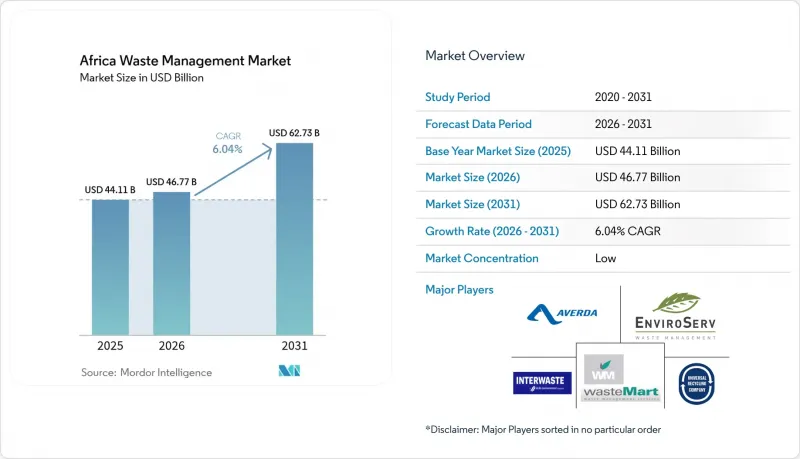
據 Mordor Intelligence 稱,非洲廢棄物管理市場規模預計在 2026 年達到 467.7 億美元,高於 2025 年的 441.1 億美元,預計到 2031 年將達到 627.3 億美元。
預計 2026 年至 2031 年的複合年成長率為 6.04%。
本報告按來源(家庭、商業、工業、醫療等)、服務類型(收集、運輸、分類等)、廢棄物類型(城市固態廢棄物、危險工業廢棄物、電子廢棄物、塑膠等)和地區(奈及利亞、南非、埃及、肯亞及其他非洲國家)進行細分。市場預測以美元計價。
非洲廢棄物管理市場的趨勢與洞察
城市人口的成長導致一般廢棄物的產生量增加。
非洲城市每年新增居民約2,200萬,導致家庭消費和日常垃圾量增加。光是拉各斯一地,每天就產生1.3萬至1.4萬噸廢棄物,但正規回收率僅0.37%,凸顯了基礎設施的嚴重不足。垃圾收集車輛無法滿足需求,迫使市政當局將業務外包,並吸引私人投資建造垃圾轉運站和資源回收設施。都市區垃圾的集中化降低了每噸垃圾的處理成本,提高了垃圾焚化發電發電廠和分類廠的獲利能力。因此,人口趨勢表明,城市固態廢棄物在2030年後仍將是非洲廢棄物管理市場的基石。
政府為提高回收目標和生產者責任延伸制度架構所做的努力
肯亞2024年的生產者責任延伸制度(EPR)規定,生產商必須承擔廢棄產品收集和回收的成本,這與南非《國家環境管理廢棄物法》下的強制性制度類似。在埃及,一項永續回收舉措正在實施,該計畫將非正規收集者與持證加工商聯繫起來,旨在提高材料品質的同時保障生計。不斷上漲的合規成本正促使回收從自願項目轉向法律強制義務,迫使品牌所有者與認證營運商簽訂長期服務合約。這些強制性規定正在穩步增加塑膠、金屬和電子廢棄物回收設施的原料供應,從而提升整個非洲廢棄物管理市場的收入。
掩埋法規和執法力道不足
東非超過90%的廢棄物仍被傾倒在露天垃圾掩埋場,釋放出的甲烷和滲濾液威脅著地下水。即使在亞的斯亞貝巴的萊皮垃圾掩埋場,廢棄物也未經檢查就被接收,該市僅有65%的廢棄物得到官方收集。監管不力使得無證運輸者得以規避入場費,從而壓低價格,損害了設計合理的掩埋的經濟效益。如果沒有統一的檢查體系,市政當局就無法收回營運成本,無法落實「污染者付費」原則,也無法實現非洲廢棄物管理市場處置基礎設施的現代化。
細分市場分析
預計到2025年,受人口向都市區遷移導致家庭消費增加的推動,生活垃圾將佔非洲廢棄物管理市場佔有率的60.45%。同時,受購物中心和辦公大樓擴張帶來的定期收集和安全文件處置需求成長的推動,商業廢棄物預計將以8.52%的複合年成長率成長。零售連鎖店正在簽訂多年合約以履行生產者責任延伸(EPR)的收集義務,從而確保綜合服務供應商的垃圾處理量可預測。工業廢棄物產生者面臨更嚴格的危險廢棄物法規,尤其是在南非,這導致他們更加依賴獲得許可的處置合作夥伴。由於醫療保健行業的投資不斷增加,醫療廢棄物也在增加,這為經認證的焚燒爐創造了一個高利潤的細分市場。
非洲的廢棄物管理市場受惠於種類繁多的原料。隨著基礎設施預算的增加,建築和拆除廢棄物的數量也在不斷成長,而郊區的農業廢棄物則為沼氣生產提供了機會。威立雅在多個非洲國家推行的多源服務模式,透過整合住宅和商業契約,實現了在處理量和盈利特種廢棄物之間的平衡,展現了其價值。非正式網路在塑膠收集方面仍然發揮著重要作用,但正規的收集商正開始透過特許經營體系吸收這些網路,這些體系提供標準化的安全培訓,並透過行動支付實現透明化。
其他好處:
- Excel格式的市場預測(ME)表
- 3個月的分析師支持
目錄
第1章:引言
- 市場分析與定義的前提條件
- 分析範圍
第2章 分析方法
第3章執行摘要
第4章 市場狀況
- 市場概覽
- 市場促進因素
- 城市人口的成長導致一般廢棄物產生量增加。
- 提高回收目標和政府在生產者責任延伸架構的努力
- 投資者對垃圾發電項目的興趣日益濃厚
- 數位化採集和路線最佳化平台
- 在偏遠礦區利用離網微型熱解將塑膠轉化為燃料。
- 市場限制因素
- 掩埋法規及其執行體系的缺陷
- 大型加工設施資金短缺
- 局限於非正規部門阻礙了正規的私人投資。
- 垃圾焚化發電廠氣候變遷相關的保險覆蓋不足
- 價值鍊和供應鏈分析
- 監理情勢
- 技術展望
- 產業吸引力:五力分析
- 新進入者的威脅
- 供應商的議價能力
- 買方的議價能力
- 替代品的威脅
- 競爭公司之間的競爭
- 物流基礎設施發展趨勢
- 專注於創業創新
第5章:預測市場規模與成長率
- 來源
- 家
- 商業(零售、辦公等)
- 產業
- 醫療保健(健康和藥品)
- 建設與拆除
- 其他(組織、農業等)
- 按服務類型
- 收集、運輸、分類和分離
- 處置/處理
- 掩埋處置
- 回收和資源回收
- 焚燒和垃圾焚化發電
- 其他(化學處理、堆肥等)
- 其他服務(諮詢、審計、訓練等)
- 按廢棄物類型分類
- 都市固態廢棄物(一般廢棄物)
- 危險工業廢棄物
- 電子廢棄物
- 塑膠廢棄物
- 醫療廢棄物
- 建築和拆除廢棄物
- 農業廢棄物
- 其他特殊廢棄物(例如放射性廢棄物)
- 按地區
- 奈及利亞
- 南非
- 埃及
- 肯亞
- 其他非洲國家
第6章 競爭情勢
- 市場集中度
- 策略趨勢
- 市佔率分析
- 公司簡介
- Averda
- EnviroServ
- Interwaste
- WasteMart
- Universal Recycling Company
- Desco
- PETCO
- The Glass Recycling Company
- Oricol Environmental Services
- WeCyclers
- The Waste Group
- SA Waste
- Veolia Africa
- SUEZ Recycling & Recovery Africa
- Biffa South Africa
- Mr Green Africa
- TakaTaka Solutions
- EcoPost
- Stericycle(MedWaste Africa)
- Dangote Recycling
第7章 市場機會與未來展望
According to Mordor Intelligence, the Africa waste management market size in 2026 is estimated at USD 46.77 billion, growing from 2025 value of USD 44.11 billion with 2031 projections showing USD 62.73 billion, growing at 6.04% CAGR over 2026-2031.
This report is Segmented by Source (Residential, Commercial, Industrial, Medical, and More), by Service Type (Collection, Transportation, Sorting & Segregation, and More), by Waste Type (Municipal Solid, Industrial Hazardous, E-Waste, Plastic, and More), and by Geography (Nigeria, South Africa, Egypt, Kenya, Rest of Africa). The Market Forecasts are Provided in Terms of Value (USD).
Africa Waste Management Market Trends and Insights
Rising Urban Population Driving Municipal Solid Waste Volumes
Africa's cities gain roughly 22 million new residents every year, elevating household consumption and daily waste flows. Lagos alone generates 13,000-14,000 tons of refuse each day, yet formal recycling diverts just 0.37%, underscoring severe infrastructure gaps. Collection fleets struggle to keep pace, prompting municipalities to outsource operations and invite private investment in transfer stations and material-recovery facilities. Concentrated urban waste streams lower per-ton processing costs, improving project economics for WtE and sorting plants. Demographic trends will therefore keep municipal solid waste (MSW) the anchor of the Africa waste management market well beyond 2030.
Government Push for Higher Recycling Targets & EPR Frameworks
Kenya's 2024 EPR regulations oblige producers to finance end-of-life collection and recycling, mirroring South Africa's mandatory schemes under the National Environmental Management Waste Act. Egypt has rolled out a sustainable recycling initiative that links informal pickers to licensed processors, raising material quality while preserving livelihoods. Compliance costs are shifting recycling from voluntary programs to legally enforced obligations, pushing brand owners to sign long-term service contracts with certified operators. These mandates steadily enlarge feedstock volumes for plastic, metal, and e-waste recycling facilities, bolstering revenues across the Africa waste management market.
Weak Landfill Regulation & Enforcement
More than 90% of East Africa's waste still winds up in open dumps, releasing methane and leachate that threaten groundwater. Addis Ababa's Repi site alone receives wastes unchecked, yet only 65% of the city's refuse is formally collected. Non-enforcement allows unlicensed haulers to undercut compliant operators by dodging gate fees, eroding the economics of engineered landfills. Without uniform inspection regimes, municipalities cannot recover operating costs or enforce polluter-pays principles, delaying modernization of disposal infrastructure across the Africa waste management market.
Other drivers and restraints analyzed in the detailed report include:
- Growing Investor Interest in Waste-to-Energy Projects
- Digitized Collection & Route-Optimization Platforms
- Capital Scarcity for Large-Scale Treatment Assets
For complete list of drivers and restraints, kindly check the Table Of Contents.
Segment Analysis
Residential streams secured 60.45% of the Africa waste management market share in 2025 as household consumption grew alongside urban migration. Commercial volumes, however, are projected to post an 8.52% CAGR, fueled by mall and office expansion that heightens demand for scheduled pickups and secure document destruction. Retail chains sign multi-year contracts to meet EPR take-back obligations, adding predictable tonnage for integrated service providers. Industrial generators confront tighter hazardous-waste regulations, particularly in South Africa, pushing them toward licensed disposal partners. Medical waste also rises with increased healthcare investment, creating a high-margin niche for certified incineration firms.
The Africa waste management market benefits from diverse feedstocks: construction and demolition debris escalates as infrastructure budgets climb, while agricultural residues present biogas opportunities in peri-urban zones. Veolia's multi-source service model across several African countries showcases the value of bundling residential and commercial contracts to balance volume with higher-yield specialty waste. Informal networks remain pivotal for plastics retrieval, yet formalized aggregators are beginning to absorb them via franchise schemes that deliver standardized safety training and mobile-payment transparency.
Complete Report Scope:
- By Source
- Residential
- Commercial (retail, office, etc.)
- Industrial
- Medical (Health and Pharmaceutical)
- Construction & Demolition
- Others (institutional, agricultural, etc)
- By Service Type
- Collection, Transportation, Sorting & Segregation
- Disposal / Treatment
- Landfill
- Recycling & Resource Recovery
- Incineration & Waste-to-Energy
- Others (Chemical Treatment, Composting, etc.)
- Others (Consulting, Audit & Training, etc.)
- By Waste Type
- Municipal Solid Waste
- Industrial Hazardous Waste
- E-waste
- Plastic Waste
- Biomedical Waste
- Construction & Demolition Waste
- Agricultural Waste
- Other Specialized Waste (radio active, etc)
- By Geography
- Nigeria
- South Africa
- Egypt
- Kenya
- Rest of Africa
List of Companies Covered in this Report:
- Averda
- EnviroServ
- Interwaste
- WasteMart
- Universal Recycling Company
- Desco
- PETCO
- The Glass Recycling Company
- Oricol Environmental Services
- WeCyclers
- The Waste Group
- SA Waste
- Veolia Africa
- SUEZ Recycling & Recovery Africa
- Biffa South Africa
- Mr Green Africa
- TakaTaka Solutions
- EcoPost
- Stericycle (MedWaste Africa)
- Dangote Recycling
Additional Benefits:
- The market estimate (ME) sheet in Excel format
- 3 months of analyst support
TABLE OF CONTENTS
1 Introduction
- 1.1 Study Assumptions & Market Definition
- 1.2 Scope of the Study
2 Research Methodology
3 Executive Summary
4 Market Landscape
- 4.1 Market Overview
- 4.2 Market Drivers
- 4.2.1 Rising urban population driving municipal solid waste volumes
- 4.2.2 Government push for higher recycling targets & EPR frameworks
- 4.2.3 Growing investor interest in waste-to-energy (WtE) projects
- 4.2.4 Digitised collection & route-optimisation platforms
- 4.2.5 Off-grid micro-pyrolysis for plastics-to-fuel in remote mines
- 4.3 Market Restraints
- 4.3.1 Weak landfill regulation & enforcement
- 4.3.2 Capital scarcity for large-scale treatment assets
- 4.3.3 Informal sector lock-in that deters formal private investment
- 4.3.4 Climate-linked insurance gaps for WtE plants
- 4.4 Value / Supply-Chain Analysis
- 4.5 Regulatory Landscape
- 4.6 Technological Outlook
- 4.7 Industry Attractiveness - Porter's Five Force Analysis
- 4.7.1 Threat of New Entrants
- 4.7.2 Bargaining Power of Suppliers
- 4.7.3 Bargaining Power of Buyers
- 4.7.4 Threat of Substitutes
- 4.7.5 Intensity of Competitive Rivalry
- 4.8 Logistics Infrastructure Insights
- 4.9 Startup & Innovation Spotlight
5 Market Size & Growth Forecasts (Value, In USD Billion)
- 5.1 By Source
- 5.1.1 Residential
- 5.1.2 Commercial (retail, office, etc.)
- 5.1.3 Industrial
- 5.1.4 Medical (Health and Pharmaceutical)
- 5.1.5 Construction & Demolition
- 5.1.6 Others (institutional, agricultural, etc)
- 5.2 By Service Type
- 5.2.1 Collection, Transportation, Sorting & Segregation
- 5.2.2 Disposal / Treatment
- 5.2.2.1 Landfill
- 5.2.2.2 Recycling & Resource Recovery
- 5.2.2.3 Incineration & Waste-to-Energy
- 5.2.2.4 Others (Chemical Treatment, Composting, etc.)
- 5.2.3 Others (Consulting, Audit & Training, etc.)
- 5.3 By Waste Type
- 5.3.1 Municipal Solid Waste
- 5.3.2 Industrial Hazardous Waste
- 5.3.3 E-waste
- 5.3.4 Plastic Waste
- 5.3.5 Biomedical Waste
- 5.3.6 Construction & Demolition Waste
- 5.3.7 Agricultural Waste
- 5.3.8 Other Specialized Waste (radio active, etc)
- 5.4 By Geography
- 5.4.1 Nigeria
- 5.4.2 South Africa
- 5.4.3 Egypt
- 5.4.4 Kenya
- 5.4.5 Rest of Africa
6 Competitive Landscape
- 6.1 Market Concentration
- 6.2 Strategic Moves
- 6.3 Market Share Analysis
- 6.4 Company Profiles (includes Global level Overview, Market level overview, Core Segments, Financials as available, Strategic Information, Products & Services, and Recent Developments)
- 6.4.1 Averda
- 6.4.2 EnviroServ
- 6.4.3 Interwaste
- 6.4.4 WasteMart
- 6.4.5 Universal Recycling Company
- 6.4.6 Desco
- 6.4.7 PETCO
- 6.4.8 The Glass Recycling Company
- 6.4.9 Oricol Environmental Services
- 6.4.10 WeCyclers
- 6.4.11 The Waste Group
- 6.4.12 SA Waste
- 6.4.13 Veolia Africa
- 6.4.14 SUEZ Recycling & Recovery Africa
- 6.4.15 Biffa South Africa
- 6.4.16 Mr Green Africa
- 6.4.17 TakaTaka Solutions
- 6.4.18 EcoPost
- 6.4.19 Stericycle (MedWaste Africa)
- 6.4.20 Dangote Recycling
7 Market Opportunities & Future Outlook
- 7.1 White-space & Unmet-need Assessment

 2026-2030年全球廢棄物管理市場
 PFAS廢棄物管理、修復和分解:市場佔有率分析、行業趨勢和統計數據以及成長預測(2026-2031年)紡織廢棄物管理:市場佔有率分析、產業趨勢與統計、成長預測(2026-2031)
 2026-2030年全球建築廢棄物管理市場中國廢棄物管理:市場佔有率分析、產業趨勢與統計、成長預測(2026-2031)印度廢棄物管理:市場佔有率分析、產業趨勢與統計及成長預測(2026-2031)新加坡廢棄物管理:市場佔有率分析、產業趨勢與統計及成長預測(2026-2031)東協廢棄物管理:市場佔有率分析、產業趨勢與統計及成長預測(2026-2031)越南廢棄物管理:市場佔有率分析、產業趨勢與統計、成長預測(2026-2031)
 多氟烷基物質 (PFAS)廢棄物管理市場:全球產業分析、市場規模、市場佔有率及 2026 年至 2033 年預測(按 PFAS 類型、服務領域、處理方法、廢棄物來源、國家和地區分類)