


 |
市場調查報告書
商品編碼
2123105
越南廢棄物管理:市場佔有率分析、產業趨勢與統計、成長預測(2026-2031)Vietnam Waste Management - Market Share Analysis, Industry Trends & Statistics, Growth Forecasts (2026 - 2031) |
||||||

※ 本網頁內容可能與最新版本有所差異。詳細情況請與我們聯繫。
據 Mordor Intelligence 稱,越南廢棄物管理市場預計到 2026 年價值 23.6 億美元,高於 2025 年的 22.1 億美元,預計到 2031 年將達到 32.6 億美元。
預計從 2026 年到 2031 年,其複合年成長率將達到 6.71%。
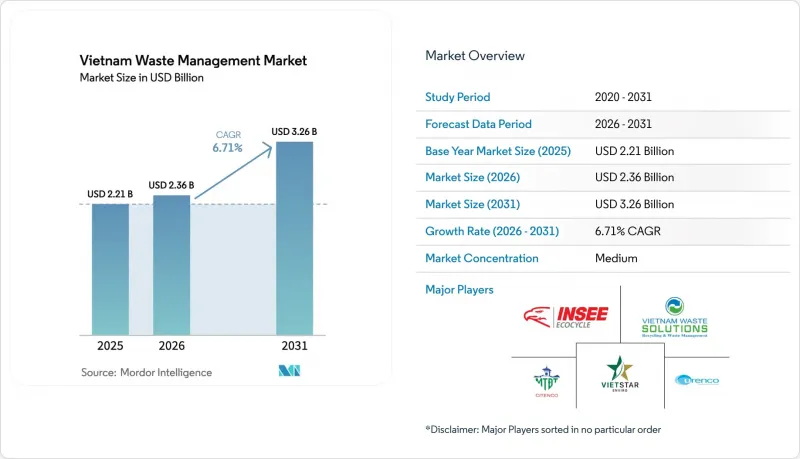
本報告按來源(住宅、商業、工業等)、服務類型(收集、運輸、分類等)、廢棄物類型(城市固態廢棄物、危險工業廢棄物、電子廢棄物、塑膠廢棄物、醫療廢棄物等)和地區(胡志明市、河內、峴港及越南其他地區)進行分類。市場預測以美元計價。
越南廢棄物管理市場趨勢與洞察
國家循環經濟藍圖,目標是2030年達到85%的廢棄物收集率
根據越南2030年循環經濟行動計劃,越南的目標是實現都市區95%的廢棄物收集率和農村地區80%的垃圾收集率,並將掩埋利用率降低到50%以下。該策略將生質能和城市廢棄物與可再生能源目標連結起來,為垃圾焚化發電企業提供政府認可的收入來源。農業每年產生9,361萬噸廢棄物,但只有52%被回收。現行法規要求到2025年有機肥產量增加25%,到2030年有機肥料佔所有註冊肥料的30%。這些目標將農村收入成長與減排目標聯繫起來,並為生物炭和堆肥計畫開放了農業用地市場。隨著收集目標的提高,越南的廢棄物管理市場對原料數量的了解更加透明,區域處理設施的資金籌措。
加強和執行環境法規
越南現行的法律體制以第05/2025/ND-CP號法令、第611/QD-TTg號決定和第11/2025/QD-TTg號決定為核心,這三項法令分別引入了更為嚴格的生產者延伸責任制(EPR)義務、區域處理區目標以及基於「污染者付費」原則的垃圾收集規則。新系統提高了利潤豁免門檻,正式認證了24家認證回收企業,並要求對廢棄物事故責任方承擔全部修復費用。這些法規正在加速市場結構調整,小規模企業難以資金籌措,而大型企業則可以利用規模經濟提高獲利能力。此外,可預測的執法降低了監管風險,並為大規模處理設施提供了長期資金籌措。因此,越南廢棄物管理市場中期擴張的前景更加明朗,投資環境也更有利。
掩埋容量不足和土地徵用障礙
位於得農省的達魯拉普垃圾處理廠等設施的運作已超出其設計負荷。這是因為像道義垃圾處理廠這樣的替代項目因土地徵用問題而停滯不前,預計要到2025年下半年才能完工。在胡志明市,已有四座垃圾處理廠佔地1,670公頃,但由於先前協議規定的緩衝區尚未建立,擴建受到限制。垃圾焚化發電開發商需要更大的場地和特殊的規劃用途,這進一步增加了核准程序的複雜性,並延長了建設週期。城市地區的土地稀缺推高了土地成本,迫使開發商轉向高密度或垂直開發技術,而這些技術需要更大的初始投資和更先進的技術能力。
細分市場分析
預計到2025年,生活垃圾將佔越南廢棄物管理市場佔有率的55.12%。這主要是由於城市人口不斷成長,導致垃圾量持續增加且密度較高。因此,市政營運商正在最佳化垃圾收集時間並統一垃圾桶規格,以降低每個家庭的成本,並確保有足夠的資金用於升級垃圾處理設施。雖然商業廢棄物市場目前在越南廢棄物管理市場中所佔比例較小,但預計到2031年將以7.92%的複合年成長率成長,這主要得益於二線城市購物中心、物流中心和住宿設施數量的不斷增加。商業客戶也開始接受利潤較高的加值服務套餐,例如週末收集和安全切碎機。
工業廢棄物、醫療廢棄物和建築廢棄物合計佔剩餘佔有率,每個細分市場都產生了專門的收入來源。危險廢棄物處理業者因獲得處理溶劑和污泥的認證而獲得額外補償,而北江省的醫院必須遵守第33/2025/QD-UBND號決定的嚴格分類規定。橡膠製造商已開始將污水污泥轉化為有機肥料,顯示農業領域存在增值回收的潛力。儘管在政策壓力不斷增加的情況下,這些細分領域預計將會擴大,但生活垃圾處理仍將是越南整體廢棄物管理市場中車輛運轉率的基礎。
其他好處:
- Excel格式的市場預測(ME)表
- 3個月的分析師支持
目錄
第1章:引言
- 市場分析與定義的前提條件
- 分析範圍
第2章 分析方法
第3章執行摘要
第4章 市場狀況
- 市場概覽
- 市場促進因素
- 加強環境法規和更嚴格的執法
- 公眾健康意識的提升與城市清潔宣傳活動
- 國家循環經濟藍圖的目標是到 2030 年達到 85% 的廢棄物回收率。
- 外國投資者主導的垃圾焚化發電項目技術轉讓
- 將生產者責任制(EPR)擴大應用於包裝和電子產品產業
- 市場限制因素
- 掩埋容量不足和土地徵用障礙
- 地方政府在發展廢棄物管理基礎設施面臨資金限制
- 農村公社收款系統的去中心化
- 價值供應鏈分析
- 監理情勢
- 技術展望
- 產業吸引力—五力分析
- 新進入者的威脅
- 供應商的議價能力
- 買方的議價能力
- 替代品的威脅
- 競爭公司之間的競爭
第5章 市場規模與成長預測
- 來源
- 家
- 商業(零售、辦公等)
- 產業
- 醫療(保健和製藥)
- 建設與拆除
- 其他(公共機構、農業等)
- 按服務類型
- 收集、運輸、分類和分離
- 處置/處理
- 掩埋
- 回收和資源回收
- 焚燒和垃圾焚化發電
- 其他(化學處理、堆肥等)
- 其他服務(諮詢、審計、訓練等)
- 按廢棄物類型分類
- 都市固態廢棄物(一般廢棄物)
- 危險工業廢棄物
- 電子廢棄物
- 塑膠廢棄物
- 醫療廢棄物
- 建築和拆除廢棄物
- 農業廢棄物
- 其他特殊廢棄物(例如放射性廢棄物)
- 按地區
- 胡志明市
- 河內
- 峴港
- 越南及其他地區
第6章 競爭情勢
- 市場集中度
- 策略趨勢
- 市佔率分析
- 公司簡介
- CITENCO
- URENCO(Urban Environment Company Hanoi)
- INSEE Ecocycle
- Vietnam Waste Solutions
- Vietstar Environment
- Tetra Tech Coffey Vietnam
- Thuan Thanh Environment JSC
- Sonadezi Services JSC
- DUYTAN Plastic Recycling
- Green Environment Production Services Trade Co. Ltd
- Vietnam Australia Environment JSC
- SGS Vietnam
- Tan Phat Tai Co. Ltd
- An Phat Holdings(AnEco)
- Ha Noi Urban Environment Co. Ltd
- Bac Ninh Clean & Environment JSC
- TKV Waste Treatment Centre
- Holcim Vietnam Geocycle
- Indovin Power(Waste-to-Energy)
- Green Growth Asia Corp.
第7章 市場機會與未來展望
According to Mordor Intelligence, Vietnam waste management market size in 2026 is estimated at USD 2.36 billion, growing from 2025 value of USD 2.21 billion with 2031 projections showing USD 3.26 billion, growing at 6.71% CAGR over 2026-2031.
This report is Segmented by Source (Residential, Commercial, Industrial, and More), by Service Type (Collection/Transportation/Sorting, and More), by Waste Type (Municipal Solid Waste, Industrial Hazardous Waste, E-Waste, Plastic Waste, Biomedical Waste, and More), and by Geography (Ho Chi Minh City, Hanoi, Da Nang, Rest of Vietnam). The Market Forecasts are Provided in Terms of Value (USD).
Vietnam Waste Management Market Trends and Insights
National Circular-Economy Roadmap Targeting 85% Waste Collection by 2030
Under the 2030 circular-economy action plan, Vietnam aims for 95% urban and 80% rural waste collection, while cutting landfill use below 50%. The strategy also links biomass and municipal waste to renewable-energy targets, giving waste-to-energy developers a government-endorsed revenue story. Agriculture generates 93.61 million tons of waste annually, yet just 52% is reused; regulations now call for a 25% jump in organic-fertilizer output by 2025 and a 30% organic share of all registered fertilizers by 2030. These targets integrate rural income growth with emissions goals, opening farmland markets for biochar and compost initiatives. As collection targets rise, the Vietnam waste management market gains visibility on feedstock volumes, improving bankability for regional treatment hubs.
Tightening Environmental Legislation & Enforcement
Vietnam's legal framework now revolves around Decree 05/2025/ND-CP, Decision 611/QD-TTg, and Decision 11/2025/QD-TTg, each introducing stricter EPR obligations, regional treatment-zone targets, and polluter-pays recovery rules. The new regime lifts revenue-exemption thresholds, formalizes 24 certified recyclers, and assigns full restoration costs to parties causing waste incidents. These rules accelerate market consolidation because smaller operators struggle to finance compliance upgrades, while integrated players monetize economies of scale. Predictable enforcement also reduces regulatory risk, unlocking long-tenor funding for large treatment plants. The net effect is a clearer, more investable backdrop that underpins the Vietnam waste management market's medium-term expansion.
Limited Landfill Capacity & Land-Acquisition Hurdles
Sites such as Dak R'lap in Dak Nong are operating beyond design limits because replacement projects like Dao Nghia remain stalled over land clearance, pushing completion to late 2025. In Ho Chi Minh City, four treatment complexes already span 1,670 ha, yet buffers mandated in earlier agreements are missing, constraining expansion. Waste-to-energy developers need larger footprints and special zoning, adding another layer of approvals that extends timelines. Scarcity of peri-urban land raises acquisition costs, forcing operators to pivot toward high-density or vertical technologies that demand larger upfront capital and more technical skill.
Other drivers and restraints analyzed in the detailed report include:
- Foreign-Investor-Led Technology Transfer in Waste-to-Energy Projects
- Rising Public-Health Awareness & Urban Cleanliness Campaigns
- Capital Constraints for Provincial Waste-Infrastructure Upgrades
For complete list of drivers and restraints, kindly check the Table Of Contents.
Segment Analysis
Residential streams held 55.12% of the Vietnam waste management market share in 2025, underpinned by an expanding urban population that generated predictable, route-dense tonnage. As a result, municipal operators have optimized pick-up times and standardized bins, bringing down per-household costs and freeing capital for treatment upgrades. The Vietnam waste management market size for commercial waste is much smaller today, yet it is forecast to rise at an 7.92% CAGR through 2031 as shopping centers, logistics hubs, and hospitality venues multiply across Tier-2 cities. Commercial clients also accept premium service packages, such as weekend pick-up and secure shredding, that carry higher margins.
Industrial, medical, and construction waste together account for the remaining share, yet each niche opens specialized revenue streams. Hazardous-waste contractors earn certification premiums to handle solvents and sludge, while hospitals in Bac Giang must conform to Decision 33/2025/QD-UBND's strict segregation rules. Rubber producers have begun converting wastewater sludge into organic fertilizer, signaling agricultural up-cycling potential. With policy pressure mounting, these sub-segments will scale, but residential tonnage will continue to anchor fleet utilization across the Vietnam waste management market.
Complete Report Scope:
- By Source
- Residential
- Commercial (retail, office, etc.)
- Industrial
- Medical (Health and Pharmaceutical)
- Construction & Demolition
- Others (institutional, agricultural, etc)
- By Service Type
- Collection, Transportation, Sorting & Segregation
- Disposal / Treatment
- Landfill
- Recycling & Resource Recovery
- Incineration & Waste-to-Energy
- Others (Chemical Treatment, Composting, etc.)
- Others (Consulting, Audit & Training, etc.)
- By Waste Type
- Municipal Solid Waste
- Industrial Hazardous Waste
- E-waste
- Plastic Waste
- Biomedical Waste
- Construction & Demolition Waste
- Agricultural Waste
- Other Specialized Waste (radio active, etc)
- By Geography
- Ho Chi Minh City
- Hanoi
- Da Nang
- Rest of Vietnam
List of Companies Covered in this Report:
- CITENCO
- URENCO (Urban Environment Company Hanoi)
- INSEE Ecocycle
- Vietnam Waste Solutions
- Vietstar Environment
- Tetra Tech Coffey Vietnam
- Thuan Thanh Environment JSC
- Sonadezi Services JSC
- DUYTAN Plastic Recycling
- Green Environment Production Services Trade Co. Ltd
- Vietnam Australia Environment JSC
- SGS Vietnam
- Tan Phat Tai Co. Ltd
- An Phat Holdings (AnEco)
- Ha Noi Urban Environment Co. Ltd
- Bac Ninh Clean & Environment JSC
- TKV Waste Treatment Centre
- Holcim Vietnam Geocycle
- Indovin Power (Waste-to-Energy)
- Green Growth Asia Corp.
Additional Benefits:
- The market estimate (ME) sheet in Excel format
- 3 months of analyst support
TABLE OF CONTENTS
1 Introduction
- 1.1 Study Assumptions & Market Definition
- 1.2 Scope of the Study
2 Research Methodology
3 Executive Summary
4 Market Landscape
- 4.1 Market Overview
- 4.2 Market Drivers
- 4.2.1 Tightening environmental legislation & enforcement
- 4.2.2 Rising public health awareness & urban cleanliness campaigns
- 4.2.3 National circular-economy roadmap targeting 85 % waste collection by 2030
- 4.2.4 Foreign-investor led technology transfer in waste-to-energy projects
- 4.2.5 Extended Producer Responsibility (EPR) expansion to packaging & electronics
- 4.3 Market Restraints
- 4.3.1 Limited landfill capacity & land-acquisition hurdles
- 4.3.2 Capital constraints for provincial waste-infrastructure upgrades
- 4.3.3 Fragmented collection system in rural communes
- 4.4 Value / Supply-Chain Analysis
- 4.5 Regulatory Landscape
- 4.6 Technological Outlook
- 4.7 Industry Attractiveness - Porter's Five Force Analysis
- 4.7.1 Threat of New Entrants
- 4.7.2 Bargaining Power of Suppliers
- 4.7.3 Bargaining Power of Buyers
- 4.7.4 Threat of Substitutes
- 4.7.5 Intensity of Competitive Rivalry
5 Market Size & Growth Forecasts (Values, In USD Billion)
- 5.1 By Source
- 5.1.1 Residential
- 5.1.2 Commercial (retail, office, etc.)
- 5.1.3 Industrial
- 5.1.4 Medical (Health and Pharmaceutical)
- 5.1.5 Construction & Demolition
- 5.1.6 Others (institutional, agricultural, etc)
- 5.2 By Service Type
- 5.2.1 Collection, Transportation, Sorting & Segregation
- 5.2.2 Disposal / Treatment
- 5.2.2.1 Landfill
- 5.2.2.2 Recycling & Resource Recovery
- 5.2.2.3 Incineration & Waste-to-Energy
- 5.2.2.4 Others (Chemical Treatment, Composting, etc.)
- 5.2.3 Others (Consulting, Audit & Training, etc.)
- 5.3 By Waste Type
- 5.3.1 Municipal Solid Waste
- 5.3.2 Industrial Hazardous Waste
- 5.3.3 E-waste
- 5.3.4 Plastic Waste
- 5.3.5 Biomedical Waste
- 5.3.6 Construction & Demolition Waste
- 5.3.7 Agricultural Waste
- 5.3.8 Other Specialized Waste (radio active, etc)
- 5.4 By Geography
- 5.4.1 Ho Chi Minh City
- 5.4.2 Hanoi
- 5.4.3 Da Nang
- 5.4.4 Rest of Vietnam
6 Competitive Landscape
- 6.1 Market Concentration
- 6.2 Strategic Moves
- 6.3 Market Share Analysis
- 6.4 Company Profiles (includes Global level Overview, Market level overview, Core Segments, Financials as available, Strategic Information, Products & Services, and Recent Developments)
- 6.4.1 CITENCO
- 6.4.2 URENCO (Urban Environment Company Hanoi)
- 6.4.3 INSEE Ecocycle
- 6.4.4 Vietnam Waste Solutions
- 6.4.5 Vietstar Environment
- 6.4.6 Tetra Tech Coffey Vietnam
- 6.4.7 Thuan Thanh Environment JSC
- 6.4.8 Sonadezi Services JSC
- 6.4.9 DUYTAN Plastic Recycling
- 6.4.10 Green Environment Production Services Trade Co. Ltd
- 6.4.11 Vietnam Australia Environment JSC
- 6.4.12 SGS Vietnam
- 6.4.13 Tan Phat Tai Co. Ltd
- 6.4.14 An Phat Holdings (AnEco)
- 6.4.15 Ha Noi Urban Environment Co. Ltd
- 6.4.16 Bac Ninh Clean & Environment JSC
- 6.4.17 TKV Waste Treatment Centre
- 6.4.18 Holcim Vietnam Geocycle
- 6.4.19 Indovin Power (Waste-to-Energy)
- 6.4.20 Green Growth Asia Corp.
7 Market Opportunities & Future Outlook
- 7.1 White-space & Unmet-need Assessment

 2026-2030年全球廢棄物管理市場
 PFAS廢棄物管理、修復和分解:市場佔有率分析、行業趨勢和統計數據以及成長預測(2026-2031年)紡織廢棄物管理:市場佔有率分析、產業趨勢與統計、成長預測(2026-2031)
 2026-2030年全球建築廢棄物管理市場中國廢棄物管理:市場佔有率分析、產業趨勢與統計、成長預測(2026-2031)印度廢棄物管理:市場佔有率分析、產業趨勢與統計及成長預測(2026-2031)新加坡廢棄物管理:市場佔有率分析、產業趨勢與統計及成長預測(2026-2031)東協廢棄物管理:市場佔有率分析、產業趨勢與統計及成長預測(2026-2031)非洲廢棄物管理:市場佔有率分析、產業趨勢與統計、成長預測(2026-2031 年)
 多氟烷基物質 (PFAS)廢棄物管理市場:全球產業分析、市場規模、市場佔有率及 2026 年至 2033 年預測(按 PFAS 類型、服務領域、處理方法、廢棄物來源、國家和地區分類)