


 |
市場調查報告書
商品編碼
2122787
印度聯合收割機:市場佔有率分析、產業趨勢與統計及成長預測(2026-2031)India Combine Harvester - Market Share Analysis, Industry Trends & Statistics, Growth Forecasts (2026 - 2031) |
||||||

※ 本網頁內容可能與最新版本有所差異。詳細情況請與我們聯繫。
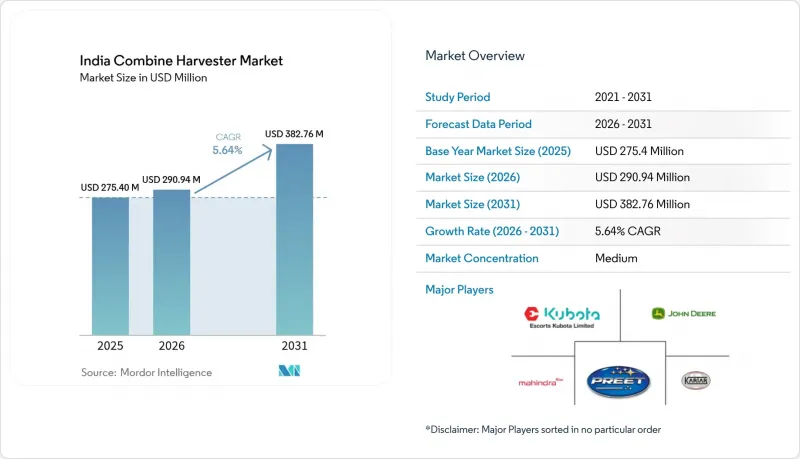
據 Mordor Intelligence 稱,2025 年印度聯合收割機市值為 2.754 億美元,預計到 2031 年將達到 3.8276 億美元,而 2026 年為 2.9094 億美元,預測期(2026-2031 年)的複合成長率為 5.64%。
本報告按類型(自走式聯合收割機、履帶式聯合收割機、曳引機牽引式聯合收割機)、額定功率(小於150馬力、150-300馬力、大於300馬力)、作物類型(小麥、水稻、玉米、其他)和驅動方式(輪式驅動、履帶式驅動)進行分類。市場預測以美元(USD)計價。
印度聯合收割機市場趨勢與洞察
糧食種植面積增加
糧食種植面積從2021-2022年度的1.30169億公頃增加到2023-2024年度的1.32104億公頃。耕地面積的擴大和收穫期的縮短促使生產者採用聯合收割機,以便在作物水分閾值達到最佳水平時進行收割,並最大限度地減少收穫後損失。中央政府的各項舉措,例如國家糧食安全任務,正在推廣高產量種子品種的種植,透過提高單位面積產量目標間接提升了對機械的需求。同時,各邦政府鼓勵機械化秸稈管理,以此作為減少秸稈焚燒的措施,這使得配備秸稈處理附件的聯合收割機備受關注。隨著玉米、豆類和油籽種植面積的擴大,製造商正在推出多作物收割台,以滿足多種作物種植地區的需求。因此,作物多樣化正在推進,促進了印度聯合收割機市場地域分散且永續的成長。
政府對機械化的補貼
根據“農業機械化申報計劃(SMAM)”,聯邦和邦政府對農機設備購置價格提供40%至50%的補貼。 「數位農業計畫」累計281.7億印度盧比(約3.394億美元),旨在透過電子農場識別系統簡化補貼發放流程,縮短核准時間並防止詐欺性申請。 「農民信用卡」計畫提供農民最高50萬印度盧比(約6,024美元)的低利率貸款,用於購買農機,降低了小規模農戶的資金籌措門檻。一些邦也實施了額外的激勵措施;卡納塔克邦資助公私合作的社區健康中心(CHC),旁遮普邦則補貼與「快樂雪松」(Happy Cedar)兼容的聯合收割機,以減少稻草焚燒。透過這些措施,新型聯合收割機的投資回收期已從五個季度縮短至三個季度,並大大促進了印度聯合收割機市場的發展。
機器初始成本高
中檔自走式聯合收割機的零售價為220萬印度盧比(約26,506美元),對大多數小規模來說,這是一筆難以負擔的投資。即使有50%的購買補貼,剩餘的還款額也往往超過農民的年收入,迫使他們只能依賴租賃模式。金融公司也意識到,由於在地理位置分散的村莊中收回抵押品十分複雜,農業機械貸款的違約風險很高。雖然農民信用卡提供優惠利率,但截至2024年,只有61%的符合資格的農民持有有效信用卡,這限制了其對融資的短期改善作用。低廉的作物保險費率進一步加劇了貸款機構的風險評估。因此,聯合收割機的所有權集中在大型農民和聯合收割機合作社(CHC)經營者手中,從而減緩了印度聯合收割機市場的銷售成長。
細分市場分析
到2025年,自走式聯合收割機將佔總銷售量的55.68%,其適用於所有作物的多功能性和自主移動能力使其對中大型農場極具吸引力。買家重視整合式引擎、大容量穀倉以及在漫長收割季節中操作員的舒適性,這些都使自走式聯合收割機成為生產力的標竿。在機械化程度較低的地區,曳引機驅動式聯合收割機仍然廣泛使用,透過利用現有的50-70馬力曳引機來降低資本投入。履帶式聯合收割機雖然屬於小眾產品,但它們解決了稻田被淹時的牽引問題,並被列入政府旨在實現氣候適應型機械化的採購清單,尤其是在沿海的安得拉邦。
展望未來,自走式聯合收割機的銷售量預計將以7.04%的複合年成長率成長,這得益於「第五階段」排放氣體法規鼓勵採用新技術。原始設備製造商(OEM)正在整合全球導航衛星系統(GNSS)自動駕駛、4G遠端資訊處理和秸稈切割附件,這推高了價格區間和單機平均收入。馬恆達(Mahindra & Mahindra)和凱斯紐荷蘭(Case IH)的「軸流式」(Axial Flow)系列聯合收割機的田間演示表明,其糧食損失減少了3-4%,證明了其較高的購買成本是合理的。這一性能優勢使這兩家公司得以繼續保持在主導地位。
預計到2025年,150-300馬力等級的聯合收割機將佔總銷售量的47.12%,憑藉其良好的處理能力和價格優勢,精準把握市場需求。這類機型非常適合印度各種規模的農場,因為它們可以配備多種作物收割台,並且能夠在4-6公頃的田地中快速作業,無需長時間轉彎。 150馬力以下的機型仍然吸引著小規模聯合收割機租賃企業(CHC)的關注,但它們面臨著糧倉容量和收割台寬度有限的挑戰,這降低了田間作業速度。儘管300馬力以上的機型價格較高,但由於大型農場主和企業農場主縮短了運作時間,它們的複合年成長率(CAGR)仍高達7.32%。
自2023年1月起,為符合第四階段TREM(運輸引擎排放氣體法規),原始設備製造商(OEM)被迫重新設計引擎,導致175馬力及以上功率的收割機產量增加。旁遮普邦和中央邦的租賃業者更傾向於使用這些高功率機型,以便在短暫的收割旺季最大化租賃收入。因此,功率等級的選擇直接影響印度聯合收割機市場的車輛組成和收入結構。
其他好處
- Excel格式的市場預測(ME)表
- 3個月的分析師支持
目錄
第1章:引言
- 研究假設和市場定義
- 調查範圍
第2章:調查方法
第3章執行摘要
第4章 市場狀況
- 市場概覽
- 市場促進因素
- 糧食種植面積增加
- 農業勞動成本上升
- 政府對機械化的補貼
- 客製化招募中心的快速成長
- 適用於老舊機械的精密農業改造套件。
- 拓展「收割機即服務」模式的應用機會
- 市場限制因素
- 機器初始成本高
- 零散的小規模規模土地所有權
- 高價售後服務
- 向小規模農戶提供農村信貸有延誤
- 監理情勢
- 技術展望
- 波特五力分析
第5章 市場規模與成長預測
- 按類型
- 自走式聯合收割機
- 履帶式聯合收割機
- 曳引機驅動的聯合收割機
- 按類型分類的額定輸出
- 小於150馬力
- 150~300HP
- 超過300馬力
- 按作物類型
- 小麥
- 米
- 玉米
- 其他
- 透過驅動系統
- 車輪驅動
- 爬行驅動
第6章 競爭情勢
- 市場集中度
- 策略趨勢
- 市佔率分析
- 公司簡介
- Mahindra & Mahindra Ltd.
- Deere & Company
- PREET Group
- Tractors and Farm Equipment Limited
- Kartar Agro Industries Private Limited
- Dasmesh Group
- International Tractors Limited(Sonalika)
- Indo Farm Equipment Limited
- Yanmar Holdings Co., Ltd.
- CNH Industrial NV
- Escorts Kubota Limited
- Tirth Agro Technology Private Limited
- KS Agrotech PVT.LTD
第7章 市場機會與未來展望
According to Mordor Intelligence, the India combine harvester market size was valued at USD 275.4 million in 2025 and estimated to grow from USD 290.94 million in 2026 to reach USD 382.76 million by 2031, at a CAGR of 5.64% during the forecast period (2026-2031).
This report is Segmented by Type (Self-Propelled Combine Harvester, Track Combine Harvester, and Tractor-Powered Combine Harvester), Power Rating (Below 150 HP, 150 To 300 HP, and Above 300 HP), Crop Type (Wheat, Rice, Corn, and Other Crops), and Drive Mechanism (Wheel Drive and Track Drive). The Market Forecasts are Provided in Terms of Value (USD).
India Combine Harvester Market Trends and Insights
Rising area under grain crops
Area cover under foodgrains reached 1,321.04 lakh hectares during 2023-2024 from 1,301.69 lakh hectares during 2021-2022. Larger fields and tighter harvest windows motivate growers to adopt combine harvesters that can clear crops within optimal moisture thresholds, thereby minimizing post-harvest losses. Central schemes such as the National Food Security Mission promote high-yield seed varieties, indirectly boosting machine demand by raising per-acre output targets. State governments are simultaneously incentivizing mechanized residue management to combat stubble burning, making combines equipped with straw-handling attachments particularly attractive. As acreage under maize, pulses, and oilseeds widens, manufacturers are introducing multi-crop headers to serve mixed-farming zones. The resulting diversity in crop profiles reinforces sustained, geographically dispersed growth for the India combine harvester market.
Government subsidies for mechanization
Under the Sub-Mission on Agricultural Mechanization (SMAM), the federal and state governments reimburse 40-50% of the equipment purchase price. The Digital Agriculture Mission earmarks INR 2,817 crore (USD 339.4 million) to streamline subsidy delivery via an electronic farm identity stack, cutting approval time and leakage. The Kisan Credit Card program offers low-interest loans up to INR 500,000 (USD 6,024) for machinery purchases, easing capital hurdles for smallholders. Several states layer additional incentives, Karnataka co-funds public-private CHCs, while Punjab subsidizes Happy Seeder-ready combines to curb paddy-straw burning. Combined, these instruments reduce payback periods on new harvesters from five seasons to three, decisively energizing the India combine harvester market.
High upfront cost of machines
A mid-range self-propelled harvester retails for INR 2.2 million (USD 26,506), an investment beyond the reach of most smallholders. Even with a 50% capital subsidy, the remaining payment often surpasses annual farm income, forcing reliance on rental models. Finance houses perceive higher default risk for equipment loans because collateral recovery is complex in geographically dispersed villages. Although the Kisan Credit Card offers subsidized rates, only 61% of eligible farmers held active cards in 2024, limiting immediate cash-flow relief. Limited uptake of crop insurance further compounds lenders' risk perception. Consequently, ownership concentrates among larger farmers and CHC operators, tempering unit-sales momentum for the India combine harvester market.
Other drivers and restraints analyzed in the detailed report include:
- Precision-ag retrofit kits for aging fleets
- Growing harvester-as-a-service models
- Fragmented and small land holdings
For complete list of drivers and restraints, kindly check the Table Of Contents.
Segment Analysis
Self-propelled units generated 55.68% of 2025 revenue, underscoring their appeal among medium-to-large farms for all-crop versatility and standalone mobility. Buyers value integrated engines, larger grain tanks, and operator comfort during extended harvest windows, making these machines the benchmark for productivity. Tractor-powered combine harvesters remain prevalent in lower-mechanization districts, leveraging existing 50-70 HP tractor fleets to reduce capital outlay. Track combines, though niche, solve traction issues in waterlogged paddy areas and appear in government procurement lists for climate-resilient mechanization, especially in coastal Andhra Pradesh.
Looking forward, self-propelled sales are positioned to expand at a 7.04% CAGR, benefiting from Stage V emission mandates that favor new-technology adoption. OEMs integrate GNSS auto-steer, 4G telematics, and straw chopper attachments, elevating price points and average revenue per unit. Field demonstrations by Mahindra & Mahindra Ltd. and Case IH's Axial-Flow series show 3-4% grain-loss reduction, justifying higher acquisition costs. This performance edge sustains their lead in the India combine harvester market.
Combines rated 150-300 HP accounted for 47.12% of 2025 sales, capturing the sweet spot between throughput and affordability. They handle multi-crop headers and traverse 4-6 hectare plots without extensive turnaround time, aligning well with India's farm-size spectrum. Below-150 HP machines still interest small CHCs but face limitations in grain-tank capacity and header width, slowing field progress. Above-300 HP models, despite commanding premium prices, are registering the fastest 7.32% CAGR because large-acreage farmers and corporate growers pursue machine hours aggregation.
Stage IV TREM (Transport Related Engine Emission Norms) compliance as of January 2023 nudged OEMs to redesign engines, increasing 175 HP-plus production runs. Custom-hiring entrepreneurs in Punjab and Madhya Pradesh gravitate toward these high-output machines to maximize rental income during brief harvest peaks. Consequently, power-rating choices directly steer fleet mix and revenue profiles in the India combine harvester market.
Complete Report Scope:
- By Type
- Self-propelled Combine Harvester
- Track Combine Harvester
- Tractor-powered Combine Harvester
- By Power Rating
- Below 150 HP
- 150 to 300 HP
- Above 300 HP
- By Crop Type
- Wheat
- Rice
- Corn
- Other Crops
- By Drive Mechanism
- Wheel Drive
- Track Drive
List of Companies Covered in this Report:
- Mahindra & Mahindra Ltd.
- Deere & Company
- PREET Group
- Tractors and Farm Equipment Limited
- Kartar Agro Industries Private Limited
- Dasmesh Group
- International Tractors Limited (Sonalika)
- Indo Farm Equipment Limited
- Yanmar Holdings Co., Ltd.
- CNH Industrial N.V.
- Escorts Kubota Limited
- Tirth Agro Technology Private Limited
- KS Agrotech PVT.LTD
Additional Benefits:
- The market estimate (ME) sheet in Excel format
- 3 months of analyst support
TABLE OF CONTENTS
1 Introduction
- 1.1 Study Assumptions and Market Definition
- 1.2 Scope of the Study
2 Research Methodology
3 Executive Summary
4 Market Landscape
- 4.1 Market Overview
- 4.2 Market Drivers
- 4.2.1 Rising area under grain crops
- 4.2.2 Escalating farm labor costs
- 4.2.3 Government subsidies for mechanization
- 4.2.4 Rapid growth of custom-hiring centers
- 4.2.5 Precision-ag retrofit kits for aging fleets
- 4.2.6 Growing availability of harvester-as-a-service models
- 4.3 Market Restraints
- 4.3.1 High upfront cost of machines
- 4.3.2 Fragmented and small land holdings
- 4.3.3 Expensive after-sales maintenance
- 4.3.4 Slow rural credit disbursement to small farmers
- 4.4 Regulatory Landscape
- 4.5 Technological Outlook
- 4.6 Porter's Five Forces Analysis
- 4.6.1 Bargaining Power of Suppliers
- 4.6.2 Bargaining Power of Buyers
- 4.6.3 Threat of New Entrants
- 4.6.4 Threat of Substitute Products
- 4.6.5 Intensity of Competitive Rivalry
5 Market Size and Growth Forecasts (Value)
- 5.1 By Type
- 5.1.1 Self-propelled Combine Harvester
- 5.1.2 Track Combine Harvester
- 5.1.3 Tractor-powered Combine Harvester
- 5.2 By Power Rating
- 5.2.1 Below 150 HP
- 5.2.2 150 to 300 HP
- 5.2.3 Above 300 HP
- 5.3 By Crop Type
- 5.3.1 Wheat
- 5.3.2 Rice
- 5.3.3 Corn
- 5.3.4 Other Crops
- 5.4 By Drive Mechanism
- 5.4.1 Wheel Drive
- 5.4.2 Track Drive
6 Competitive Landscape
- 6.1 Market Concentration
- 6.2 Strategic Moves
- 6.3 Market Share Analysis
- 6.4 Company Profiles (Includes Global Level Overview, Market Level Overview, Core Segments, Financials as Available, Strategic Information, Market Rank/Share for Key Companies, Products and Services, and Recent Developments)
- 6.4.1 Mahindra & Mahindra Ltd.
- 6.4.2 Deere & Company
- 6.4.3 PREET Group
- 6.4.4 Tractors and Farm Equipment Limited
- 6.4.5 Kartar Agro Industries Private Limited
- 6.4.6 Dasmesh Group
- 6.4.7 International Tractors Limited (Sonalika)
- 6.4.8 Indo Farm Equipment Limited
- 6.4.9 Yanmar Holdings Co., Ltd.
- 6.4.10 CNH Industrial N.V.
- 6.4.11 Escorts Kubota Limited
- 6.4.12 Tirth Agro Technology Private Limited
- 6.4.13 KS Agrotech PVT.LTD
7 Market Opportunities and Future Outlook

 2026年全球搭乘用聯合收割機市場報告
 聯合收割機:市場佔有率分析、產業趨勢與統計、成長預測(2026-2031 年)北美聯合收割機:市場佔有率分析、產業趨勢與統計及成長預測(2026-2031 年)
 聯合收割機市場規模、佔有率和成長分析:按設備移動方式、驅動系統、引擎功率、目標作物和地區分類-2026-2033年產業預測
 聯合收割機市場:按類型、引擎功率、驅動系統、應用和銷售管道-全球預測,2026-2032年德國聯合收割機:市場佔有率分析、產業趨勢與統計及成長預測(2026-2031 年)法國聯合收割機:市場佔有率分析、產業趨勢與統計及成長預測(2026-2031 年)歐洲聯合收割機:市場佔有率分析、產業趨勢與統計及成長預測(2026-2031 年)英國聯合收割機:市場佔有率分析、產業趨勢與統計及成長預測(2026-2031 年)中國聯合收割機:市場佔有率分析、產業趨勢與統計及成長預測(2026-2031年)