


 |
市場調查報告書
商品編碼
2072805
法國聯合收割機:市場佔有率分析、產業趨勢與統計及成長預測(2026-2031 年)France Combine Harvesters - Market Share Analysis, Industry Trends & Statistics, Growth Forecasts (2026 - 2031) |
||||||

※ 本網頁內容可能與最新版本有所差異。詳細情況請與我們聯繫。
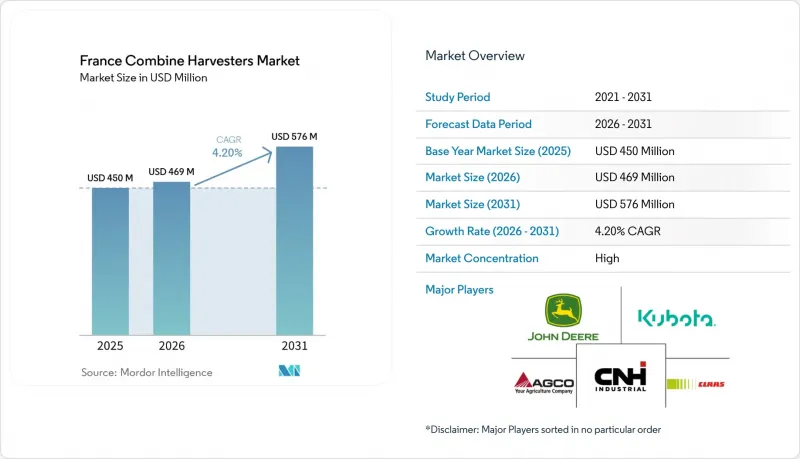
根據 Mordor Intelligence 預測,法國聯合收割機市場在 2025 年的價值將達到 4.5 億美元,從 2026 年的 4.69 億美元成長到 2031 年的 5.76 億美元,在 2026 年至 2031 年的預測期內,複合成長率將達到 4.2%。
本報告按類型(自走式、曳引機牽引式聯合收割機等)、功率輸出(小於150馬力、150-300馬力、301-450馬力及其他)、糧倉容量(小於6000公升、6000-9000公升及以上)、驅動方式(分類式驅動和履帶方式(分類式和穀物式作物)以及他類型(分式)以及他方式(分式驅動和履帶式(分類式)。市場預測以美元計價。
法國聯合收割機市場趨勢及洞察
法國糧食生產商引進精密農業
法國糧食生產商對精密農業的採用,推動了對配備自動化、遠端資訊處理和數位化農場管理系統的先進聯合收割機的需求。農民擴大使用連網收割設備來提高工作效率、降低油耗、減少收割損失並最佳化收割過程中投入品的使用。人們對永續農業實踐和數據驅動型農業的日益重視,也促使人們投資於具備即時監控和精準收割功能的智慧聯合收割機。
大型農場對大馬力聯合收割機的需求
在法國,由於需要提高收割效率、加快田間作業速度並在有限的收割期內最大限度地減少運作,大型農場對大馬力聯合收割機的需求日益成長。大規模糧食農場擴大使用配備更寬割台、更大糧倉、自動化系統和先進遠端資訊處理技術的聯合收割機,以提高生產效率並減少糧食損失。此外,農場整合以及對承包商收割服務的日益依賴也推動了對能夠在大片土地上高效作業的大容量收割機的需求。融資計劃和精密農業技術的引入進一步加速了法國先進大馬力聯合收割機的普及。
糧食價格波動導致資本投資計畫縮減規模。
糧食價格波動給法國糧食生產商帶來了不確定性,抑制了他們對農業機械的長期投資,並推遲了聯合收割機的更換。除了小麥和糧食市場的波動外,高昂的生產成本和出口競爭力的下降也降低了農民大規模購買機械的信心。因此,許多生產商將重點放在降低營運成本和延長現有收割設備的使用壽命上,而不是投資購買新的聯合收割機。盈利的不確定性也導致農民更加依賴承包收割服務和二手機械市場,尤其是在法國主要糧食產區面臨融資困境的中小農戶。
細分市場分析
預計到2025年,自走式聯合收割機將佔法國聯合收割機市場銷售的88.2%,凸顯了大規模糧食種植者對高產能收割機的需求趨勢。這些機器融合了先進的動力傳動系統、自動化系統和精準收割技術,能夠在有限的收割季節內有效收割大片面積。更高的處理能力、更少的曳引機依賴以及更高的作業效率等特點,使這些機器成為主要農業區的理想選擇。對遠端資訊處理和車輛管理解決方案的持續投入進一步推動了其普及,使該細分市場保持主導地位。
預計從2026年到2031年,動力輸出軸(PTO)驅動的聯合收割機細分市場將以6.4%的複合年成長率(CAGR)實現最高成長,這主要得益於中小農場對經濟高效收割解決方案的需求。與自走式聯合收割機相比,這類聯合收割機能夠讓農民充分利用現有曳引機,從而顯著降低資本投入。對於實行間作的農場、有季節性收割需求的農場以及希望最大限度提高設備利用率的農民而言,該細分市場尤其具有吸引力。人們對經濟型機械化的需求日益成長,加上小型、低成本收割機的普及,預計將推動該細分市場在法國聯合收割機市場的穩定成長並擴大其市場佔有率。
預計到2025年,150-300馬力級別的聯合收割機將佔據法國市場48.6%的最大佔有率,這主要得益於法國北部中大型糧食農場的廣泛應用。農民青睞這一功率範圍的收割機,因為它兼顧了燃油效率、收割速度以及與傳統糧食加工設施的兼容性。為了提高作業效率,設備製造商不斷在該層級中引入精準收割系統、自動脫粒控制和整合式遠端資訊處理技術。此外,承包商對該功率範圍的收割機需求強勁,因為該功率範圍的機器能夠在各種田間條件下高效收割小麥、大麥、油菜籽和玉米。
在法國聯合收割機市場,450匹馬力及以上功率等級的收割機預計將以最高的複合年成長率(CAGR)成長,從2026年到2031年達到6.8%。這主要得益於大型農業承包商對高產能收割解決方案的需求不斷成長。農民越來越重視縮短收割週期,以最大限度地減少因天氣原因造成的作物損失,並降低在收割高峰期對勞動力的依賴。該級別的先進聯合收割機整合了更大的穀倉、更寬的收割台和智慧自動化技術,從而提高了在大片穀倉中的作業效率。在種植灌溉玉米和高產小麥品種的地區,此類收割機的積極應用也推動了市場成長。製造商正在加強融資和售後服務支援計劃,以提高高階收割設備的普及性。
其他好處:
- Excel格式的市場預測(ME)表
- 3個月的分析師支持
目錄
第1章:引言
- 研究假設和市場定義
- 調查範圍
第2章:調查方法
第3章執行摘要
第4章 市場狀況
- 市場概覽
- 市場促進因素
- 法國糧食生產商對精密農業的採用
- 大型農場對大馬力收割機的需求
- 歐盟的「從農場到餐桌」補貼計畫支持機械設備的更換。
- 製造商為二手設備置換提供的融資計劃
- 遠端資訊處理技術的應用正在推動對預測性維護的需求。
- 奧克西塔尼和新阿基坦地區的合約收割機數量成長
- 市場限制因素
- 由於農產品價格波動,資本投資計畫正在縮減規模。
- 農民老化阻礙了他們購買新機械。
- 由於農村地區人手不足,收割工作被延誤了。
- 自動收割機的核准流程出現延誤
- 監理情勢
- 技術展望
- 波特五力分析
第5章 市場規模與成長預測
- 按類型
- 自推進式
- 曳引機牽引式聯合收割機
- 動力輸出軸驅動的聯合收割機
- 依輸出類型
- 小於150馬力
- 150~300 HP
- 301~450 HP
- 450馬力或以上
- 按容量分類的糧倉容量
- 不足6000升
- 6,000~9,000 L
- 9000公升或更多
- 透過驅動系統
- 車輪驅動
- 爬行驅動
- 按作物類型
- 穀類
- 玉米/米茲
- 油籽
- 其他作物
第6章 競爭情勢
- 市場集中度
- 策略趨勢
- 市佔率分析
- 公司簡介
- Deere & Company
- CNH Industrial NV
- CLAAS KGaA mbH
- AGCO Corporation
- Kubota Corporation
- SDF Group SpA
- Yanmar Co., Ltd.
- Rostselmash JSC
- Zoomlion Heavy Industry Science and Technology Co., Ltd.
- Lovol Heavy Industry Co., Ltd.
- Open Joint Stock Company "Gomselmash"
- Sampo Rosenlew Ltd.
- YTO Group Corporation
- Bernard Krone Holding GmbH & Co. KG
- Dewulf NV
第7章 市場機會與未來展望
According to Mordor Intelligence, the france combine harvesters market was valued at USD 450.0 million in 2025 and is projected to grow from USD 469.0 million in 2026 to USD 576.0 million by 2031, with a CAGR of 4.2% during the forecasted period from 2026 to 2031.
This report is Segmented by Type (Self-Propelled, Tractor-Pulled Combine, and and More), by Power Output (Less Than 150 HP, 150 To 300 HP, 301 To 450 HP, and More), by Grain Tank Capacity (Less Than 6, 000 L, 6, 000 To 9, 000 L, and More), by Drive Type (Wheel Drive and Track Drive), and by Crop Type (Cereals, Corn/Maize, and Other Crops). The Market Forecasts are Provided in Terms of Value (USD).
France Combine Harvesters Market Trends and Insights
Precision Agriculture Adoption Among French Cereal Growers
The adoption of precision agriculture among French cereal growers is driving demand for advanced combine harvesters equipped with automation, telematics, and digital farm management systems. Farmers are increasingly utilizing connected harvesting equipment to enhance operational efficiency, lower fuel consumption, reduce crop losses, and optimize input usage during harvesting. Rising awareness of sustainable farming practices and data-driven agriculture is promoting investment in smart combine harvesters with real-time monitoring and precision harvesting capabilities.
Demand for High-Horsepower Harvesters on Large Farms
The demand for high-horsepower combine harvesters is rising among large farming operations in France, driven by the need for higher harvesting efficiency, faster field coverage, and minimized operational downtime during limited harvesting periods. Large cereal farms are increasingly utilizing combines with wider headers, larger grain tanks, automation systems, and advanced telematics to enhance productivity and reduce grain losses. Additionally, farm consolidation and the growing reliance on contractor-based harvesting services are boosting the demand for high-capacity harvesting equipment capable of efficient operation across extensive agricultural areas. Financing programs and the integration of precision farming technologies are further promoting the adoption of advanced high-horsepower combine harvesters in France.
Volatile Crop Prices Reducing Capital Expenditure Plans
Volatile crop prices are causing uncertainty for cereal growers in France, restricting long-term capital investment in agricultural machinery and delaying the replacement of combine harvesters. Fluctuations in wheat and grain markets, coupled with high production costs and reduced export competitiveness, are diminishing farmer confidence in making significant equipment purchases. As a result, many growers are focusing on controlling operational costs and prolonging the service life of existing harvesting machinery rather than investing in new combines. The uncertain profitability environment is also driving increased dependence on contractor-based harvesting services and the used machinery market, particularly among small and medium-sized farms facing tighter financial constraints in key cereal-producing regions of France.
Other drivers and restraints analyzed in the detailed report include:
- European Union Farm-to-Fork Subsidies Supporting Machinery Renewal
- Manufacturer Financing Programs for Used Equipment Trade-Ins
- Aging Farmer Population Limiting New Machinery Purchases
For complete list of drivers and restraints, kindly check the Table Of Contents.
Segment Analysis
The self-propelled segment is anticipated to account for 88.2% of the France combine harvesters market revenue in 2025, highlighting the preference of large cereal-producing farms for high-capacity harvesting equipment. These machines incorporate advanced powertrains, automation systems, and precision harvesting technologies, enabling efficient harvesting of extensive acreage within limited seasonal windows. Their ability to deliver higher throughput, reduce reliance on additional tractor units, and enhance operational efficiency has established them as the preferred choice in major agricultural regions. Ongoing investments in telematics and fleet management solutions further bolster adoption, maintaining the segment's leading position in the market.
The PTO-powered combine segment is projected to grow at the fastest CAGR of 6.4% during 2026-2031, driven by demand from small and medium-sized farms seeking cost-effective harvesting solutions. These combines enable growers to utilize existing tractors, significantly lowering capital investment compared to self-propelled models. The segment is particularly appealing for mixed-crop operations, farms with seasonal harvesting needs, and operators aiming to maximize equipment utilization. Increasing interest in affordable mechanization, along with the availability of compact and lower-cost harvesting models, is projected to support steady growth and expand the segment's presence in the France combine harvesters market.
France combine harvesters market share for the 150 to 300 HP segment accounted for the largest 48.6% in 2025, supported by widespread adoption across medium and large cereal farms operating in northern France. Farmers prefer this power range because it balances fuel efficiency, harvesting speed, and compatibility with conventional grain handling infrastructure. Equipment manufacturers continue introducing precision harvesting systems, automated threshing controls, and integrated telematics in this category to improve operational productivity. The segment also benefits from strong contractor demand, since machines within this range can efficiently handle wheat, barley, rapeseed, and maize harvesting applications across varied field conditions.
France combine harvesters market size for the above 450 HP segment is projected to expand at the fastest 6.8% CAGR from 2026 to 2031, driven by rising demand for high-capacity harvesting solutions among large agricultural contractors. Farmers increasingly prioritize rapid harvesting windows to minimize weather-related crop losses and labor dependency during peak harvesting seasons. Advanced combines within this category integrate larger grain tanks, wider headers, and intelligent automation technologies that improve throughput efficiency across extensive cereal fields. Strong adoption in regions cultivating irrigated maize and high-yield wheat varieties also supports growth. Manufacturers are strengthening financing and after-sales support programs to improve accessibility for premium harvesting equipment.
Complete Report Scope:
- By Type
- Self-Propelled
- Tractor-Pulled Combine
- PTO-Powered Combine
- By Power Output
- Less than 150 HP
- 150 to 300 HP
- 301 to 450 HP
- Above 450 HP
- By Grain Tank Capacity
- Less than 6,000 L
- 6,000 to 9,000 L
- Above 9,000 L
- By Drive Type
- Wheel Drive
- Track Drive
- By Crop Type
- Cereals
- Corn / Maize
- Oilseeds
- Other Crops
List of Companies Covered in this Report:
- Deere & Company
- CNH Industrial N.V.
- CLAAS KGaA mbH
- AGCO Corporation
- Kubota Corporation
- SDF Group S.p.A.
- Yanmar Co., Ltd.
- Rostselmash JSC
- Zoomlion Heavy Industry Science and Technology Co., Ltd.
- Lovol Heavy Industry Co., Ltd.
- Open Joint Stock Company "Gomselmash"
- Sampo Rosenlew Ltd.
- YTO Group Corporation
- Bernard Krone Holding GmbH & Co. KG
- Dewulf NV
Additional Benefits:
- The market estimate (ME) sheet in Excel format
- 3 months of analyst support
TABLE OF CONTENTS
1 Introduction
- 1.1 Study Assumptions and Market Definition
- 1.2 Scope of the Study
2 Research Methodology
3 Executive Summary
4 Market Landscape
- 4.1 Market Overview
- 4.2 Market Drivers
- 4.2.1 Precision agriculture adoption among French cereal growers
- 4.2.2 Demand for high-horsepower harvesters on large farms
- 4.2.3 European Union Farm-to-Fork subsidies supporting machinery renewal
- 4.2.4 Manufacturer financing programs for used equipment trade-ins
- 4.2.5 Telematics adoption driving preventive maintenance demand
- 4.2.6 Growth of custom harvesting contractors in Occitanie and Nouvelle-Aquitaine
- 4.3 Market Restraints
- 4.3.1 Volatile crop prices reducing capital expenditure plans
- 4.3.2 Aging farmer population limiting new machinery purchases
- 4.3.3 Rural labor shortages delaying harvesting operations
- 4.3.4 Slow approval process for autonomous harvesters
- 4.4 Regulatory Landscape
- 4.5 Technological Outlook
- 4.6 Porter's Five Forces Analysis
- 4.6.1 Bargaining Power of Suppliers
- 4.6.2 Bargaining Power of Buyers
- 4.6.3 Threat of New Entrants
- 4.6.4 Threat of Substitutes
- 4.6.5 Intensity of Competitive Rivalry
5 Market Size and Growth Forecasts (Value)
- 5.1 By Type
- 5.1.1 Self-Propelled
- 5.1.2 Tractor-Pulled Combine
- 5.1.3 PTO-Powered Combine
- 5.2 By Power Output
- 5.2.1 Less than 150 HP
- 5.2.2 150 to 300 HP
- 5.2.3 301 to 450 HP
- 5.2.4 Above 450 HP
- 5.3 By Grain Tank Capacity
- 5.3.1 Less than 6,000 L
- 5.3.2 6,000 to 9,000 L
- 5.3.3 Above 9,000 L
- 5.4 By Drive Type
- 5.4.1 Wheel Drive
- 5.4.2 Track Drive
- 5.5 By Crop Type
- 5.5.1 Cereals
- 5.5.2 Corn / Maize
- 5.5.3 Oilseeds
- 5.5.4 Other Crops
6 Competitive Landscape
- 6.1 Market Concentration
- 6.2 Strategic Moves
- 6.3 Market Share Analysis
- 6.4 Company Profiles (Includes Global Level Overview, Market Level Overview, Core Segments, Financials as Available, Strategic Information, Market Rank/Share for Key Companies, Products and Services, and Recent Developments)
- 6.4.1 Deere & Company
- 6.4.2 CNH Industrial N.V.
- 6.4.3 CLAAS KGaA mbH
- 6.4.4 AGCO Corporation
- 6.4.5 Kubota Corporation
- 6.4.6 SDF Group S.p.A.
- 6.4.7 Yanmar Co., Ltd.
- 6.4.8 Rostselmash JSC
- 6.4.9 Zoomlion Heavy Industry Science and Technology Co., Ltd.
- 6.4.10 Lovol Heavy Industry Co., Ltd.
- 6.4.11 Open Joint Stock Company "Gomselmash"
- 6.4.12 Sampo Rosenlew Ltd.
- 6.4.13 YTO Group Corporation
- 6.4.14 Bernard Krone Holding GmbH & Co. KG
- 6.4.15 Dewulf NV
7 Market Opportunities and Future Outlook

 北美聯合收割機:市場佔有率分析、產業趨勢與統計及成長預測(2026-2031 年)
 聯合收割機市場規模、佔有率和成長分析:按設備移動方式、驅動系統、引擎功率、目標作物和地區分類-2026-2033年產業預測
 聯合收割機市場:按類型、引擎功率、驅動系統、應用和銷售管道-全球預測,2026-2032年德國聯合收割機:市場佔有率分析、產業趨勢與統計及成長預測(2026-2031 年)歐洲聯合收割機:市場佔有率分析、產業趨勢與統計及成長預測(2026-2031 年)英國聯合收割機:市場佔有率分析、產業趨勢與統計及成長預測(2026-2031 年)中國聯合收割機:市場佔有率分析、產業趨勢與統計及成長預測(2026-2031年)美國聯合收割機:市場佔有率分析、行業趨勢和統計數據以及成長預測(2026-2031 年)動力輸出軸驅動式聯合收割機:市場佔有率分析、行業趨勢和統計數據以及成長預測(2026-2031 年)
 聯合收割機市場:按類型和地區分類