


 |
市場調查報告書
商品編碼
2114041
聯合收割機:市場佔有率分析、產業趨勢與統計、成長預測(2026-2031 年)Combine Harvester - Market Share Analysis, Industry Trends & Statistics, Growth Forecasts (2026 - 2031) |
||||||

※ 本網頁內容可能與最新版本有所差異。詳細情況請與我們聯繫。
據 Mordor Intelligence 稱,聯合收割機市場預計到 2026 年價值 127.4 億美元,高於 2025 年的 121 億美元,預計到 2031 年將達到 164.8 億美元。
預計從 2026 年到 2031 年,其複合年成長率將達到 5.28%。
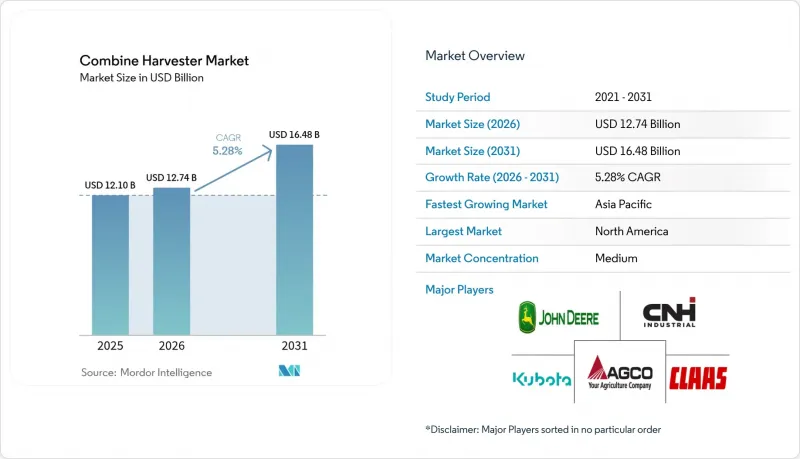
本報告按類型(自走式、曳引機牽引式、動力輸出軸驅動式)、功率輸出(150馬力以下、151-300馬力、301-450馬力、450馬力以上)和地區(北美、南美、歐洲、亞太、中東和非洲)進行細分。市場預測以美元計價。
全球聯合收割機市場趨勢及洞察
新興經濟體農業機械化過程
政府補貼和租賃設施的擴張持續擴大農業機械的普及範圍。印度的「農業機械化申報」計畫對購置成本提供40-50%的補貼,並已建立超過40,900個租賃中心,使機械化率從40%提升至接近中國60%的基準水準。中國在2025年實現75%機械化率的政策目標吸引了跨國供應商,並促成了規避進口關稅的合資企業。巴西和一些非洲國家類似的補貼計畫表明,聯合收割機市場正受到結構性推動。
農村地區長期勞動力短缺和工資上漲
由於許多糧食產區的失業率低於3%,農業工資已達到歷史新高,縮短了自動脫粒平台的投資回收期。目前,美國的大型農場主表示,勞動力短缺是他們轉向使用大馬力聯合收割機的主要原因,這種聯合收割機能夠由一名操作員進行多班次作業。西歐也出現了類似的情況,酪農和種植者由於無法及時獲得足夠的勞動力進行收割,不得不減少種植面積。這種勞動力短缺在關鍵的收割季節尤其嚴重,從而推動了對能夠最大限度延長作業時間並最大限度減少人工干預的大容量聯合收割機的需求。
高初始投資
新款旗艦機型的售價通常在40萬至50萬美元之間。利率上升推高了每個設備的年度維護成本,即使是資金雄厚的農場也需要更長時間才能達到損益兩平。雖然租賃和經營性租賃協議在一定程度上緩解了這種影響,但小規模生產商仍在推遲購買,減緩了聯合收割機市場的短期成長。 AGCO公司對OEM融資解決方案的戰略關注以及約翰迪爾公司在巴西不斷擴大的融資能力表明,製造商們意識到,獲取設備越來越依賴創新的支付結構,而不是傳統的購買模式。
細分市場分析
到2025年,自走式聯合收割機將佔據聯合收割機市場71.35%的佔有率,凸顯其在廣大農田上的主導地位。由於採用雙流脫粒技術帶來的糧食保留率提升,預計到2031年,光是曳引機牽引式聯合收割機就將推動該細分市場達到7.35%的複合年成長率。動力輸出軸驅動式聯合收割機仍然是注重成本的農民的理想選擇,但自動駕駛功能的不斷湧現正在模糊傳統分類之間的界限。曳引機牽引式聯合收割機仍然受到注重成本的農戶、擁有零散農田的農戶以及資金有限的農戶的青睞。製造商正在改進混合動力系統,以降低高達10%的油耗,使其對那些必須權衡柴油、尿素溶液和維護成本的營運商越來越有吸引力。
由於其機動性強、整合遠端資訊處理功能以及與12至18行割台的兼容性,車隊所有者更青睞自走式平台。目前,原始設備製造商(OEM)正在發布無線韌體,該韌體可根據作物含水量調整凹板間隙和轉子轉速,從而在現有馬力範圍內進一步提升處理能力。隨著未來土壤壓實法規的日益嚴格,聯合收割機市場的這一關鍵細分領域正擴大採用鉸接式底盤和寬履帶配置。該領域的創新重點在於透過自主模組擴大聯合收割機市場規模,這些模組允許一名駕駛人監控位於相鄰田地中的多台收割機。
區域分析
預計到2025年,北美將佔全球銷售額的31.85%,這反映了該地區先進的機械化水準和成熟的更新換代週期。然而,由於生產商預計2025年大型農業機械的交付將下降,因此資本投資已放緩。聯邦政府為氣候友善農業提供的補貼可能會在下半年提振訂單,特別是那些配備殘茬平衡裝置、符合土壤健康津貼資格的聯合收割機。加拿大農業部門正受惠於強勁的糧食出口需求以及政府對精密農業推廣的支持。同時,墨西哥農業機械化的進步也為北美製造商創造了擴張機會。
亞太地區將以7.85%的複合年成長率持續成長至2031年。印度的機械化差距正在迅速縮小。補貼合約中心目前已涵蓋了小規模農戶的脫粒費用,這些小農戶目前尚無力完全負擔機械設備。中國75%的機械化目標正在推動對國產高階聯合組裝的需求,這些收割機既能相容於國外製造的感測器陣列,又能避免進口關稅。日本和澳洲是成熟的市場,專注於精密農業和自動化技術,而隨著對農業生產力需求的成長,東南亞國家也看到了新的機會。
由於生產材料成本飆升和環境法規日益嚴格,歐洲市場正在降溫。歐盟機械法規(2023/1230)為檢驗自動駕駛的安全性制定了新的標準,導致企業為滿足這些標準而增加研發預算。相較之下,巴西和阿根廷正利用出口主導的現金流,將聯合收割機升級到350匹馬力或更高,並配備遠端資訊處理模組,從而最佳化其車隊。南美洲受益於強勁的農產品出口,巴西2023年甘蔗加工量創下7.13億噸的歷史新高,支撐了對農機設備的需求;而阿根廷在農業生物技術領域的領先地位,則為精密農業的整合創造了機遇。
其他好處:
- Excel格式的市場預測(ME)表
- 3個月的分析師支持
目錄
第1章:引言
- 研究假設和市場定義
- 調查範圍
第2章:調查方法
第3章執行摘要
第4章 市場狀況
- 市場概覽
- 市場促進因素
- 新興國家農業機械化過程
- 農村地區長期勞動力短缺和工資上漲
- 精密農業機械化系統的引進
- 人工智慧驅動的預測性維護的整合
- 將低損失碳捕撈的排碳權貨幣化
- 小規模農戶的OEM融資平台
- 市場限制因素
- 需要大量的初始投資。
- 售後服務網不足
- 對波動較大的農產品價格的依賴
- 關於快速土壤壓實的規定
- 監理情勢
- 技術展望
- 波特五力分析
第5章 市場規模與成長預測
- 按類型
- 自推進式
- 曳引機牽引式聯合收割機
- 動力輸出軸驅動的聯合收割機
- 按輸出功率(馬力)
- 小於150馬力
- 151~300 HP
- 301~450 HP
- 450馬力或以上
- 按地區
- 北美洲
- 美國
- 加拿大
- 墨西哥
- 其他北美國家
- 南美洲
- 巴西
- 阿根廷
- 其他南美國家
- 歐洲
- 德國
- 法國
- 英國
- 西班牙
- 義大利
- 俄羅斯
- 其他歐洲國家
- 亞太地區
- 中國
- 印度
- 日本
- 澳洲
- 其他亞太國家
- 中東
- 沙烏地阿拉伯
- 土耳其
- 其他中東國家
- 非洲
- 南非
- 埃及
- 其他非洲國家
- 北美洲
第6章 競爭情勢
- 市場集中度
- 策略趨勢
- 市佔率分析
- 公司簡介
- Deere & Company
- CNH Industrial NV
- AGCO Corporation
- Claas KGaA mbH
- Kubota Corporation
- SDF Group
- Jiangsu World Agricultural Machinery(World Group)
- Yanmar Holdings Co., Ltd.
- Mahindra and Mahindra Ltd.(Mahindra Group)
- Iseki and Co., Ltd.
- Versatile(Buhler Industries)
- Rostselmash
- Tractors and Farm Equipment Ltd.(Amalgamations Group)
- LOVOL Heavy Industry(Weichai Group)
- Zoomlion Heavy Industry Science and Technology
第7章 市場機會與未來展望
According to Mordor Intelligence, the combine harvester market size in 2026 is estimated at USD 12.74 billion, growing from 2025 value of USD 12.10 billion with 2031 projections showing USD 16.48 billion, growing at 5.28% CAGR over 2026-2031.
This report is Segmented by Type (Self-Propelled, Tractor-Pulled Combine, and PTO-Powered Combine), by Power Output (Less Than 150 HP, 151 To 300 HP, 301 To 450 HP, and Above 450 HP), and by Geography (North America, South America, Europe, Asia-Pacific, Middle East, and Africa). The Market Forecasts are Provided in Terms of Value (USD).
Global Combine Harvester Market Trends and Insights
Rising Farm Mechanization in Emerging Economies
Government grants and custom-hiring hubs continue to widen equipment access. India's Sub-Mission on Agricultural Mechanization reimburses 40-50% of purchase costs and has deployed more than 40,900 rental centers, lifting mechanization from 40% toward China's 60% benchmark . China's policy goal of 75% mechanization by 2025 attracts multinational suppliers into joint ventures that sidestep import tariffs . Similar subsidy schemes in Brazil and multiple African nations illustrate a structural push that enlarges the combine harvester market.
Persistent Rural Labor Shortage and Wage Inflation
Unemployment rates below 3% in many grain-producing regions have driven farm wages to record highs, narrowing the payback window for autonomous threshing platforms. Large United States growers now cite workforce scarcity as the primary justification for migrating to high-horsepower combines configured for one-operator, multi-shift deployment. Western Europe mirrors this tension, with dairy and arable producers trimming acreage whenever harvest labor cannot be secured in time. This labor scarcity is particularly acute during harvest seasons when timing is critical, driving demand for high-capacity combines that can maximize operational windows with minimal human intervention.
High Upfront Capital Requirement
New flagship frequently lists between USD 400,000 and USD 500,000. Elevated interest rates push annual carrying costs per unit, lengthening break-even periods even for well-capitalized farms. Although leasing and operating-rent contracts soften the blow, smaller growers still postpone purchases, slowing near-term combine harvester market growth. AGCO's strategic focus on OEM financing solutions and John Deere's expansion of financing capabilities in Brazil demonstrate manufacturers' recognition that equipment accessibility depends increasingly on innovative payment structures rather than traditional purchase models.
Other drivers and restraints analyzed in the detailed report include:
- Adoption of Precision-Ag Mechanization Suites
- Integration of AI-Enabled Predictive Maintenance
- Limited Aftermarket Service Networks
For complete list of drivers and restraints, kindly check the Table Of Contents.
Segment Analysis
The self-propelled segment generated a 71.35% market share in the combine harvester market in 2025, underscoring its primacy in high-acreage operations. Tractor-pulled variants alone are projected to lift the segment's CAGR to 7.35% through 2031 as dual-flow threshing boosts grain retention. PTO-powered combine remain viable among cost-sensitive growers, but ongoing autonomy retrofits are beginning to blur the lines between legacy categories. The Tractor-pulled combine endures in cost-sensitive or fragmented landholdings, especially where capital pools are modest. Manufacturers refine hybrid drivelines that reduce fuel consumption by up to 10%, increasing the appeal for operators who must juggle diesel, AdBlue, and maintenance costs.
Fleet owners prefer self-propelled platforms due to their tight turning radius, integrated telematics, and compatibility with 12- to 18-row headers. OEMs now release over-the-air firmware that tunes concave clearance and rotor speed to crop moisture, squeezing extra throughput from existing horsepower bands. As adherence to future compaction rules tightens, articulated undercarriages and wide-track options are gaining traction within this leading segment of the combine harvester market. The segment's innovation pipeline centers on the expansion of the combined harvesters market size through autonomous modules that enable a single driver to supervise multiple units across adjacent fields.
Complete Report Scope:
- By Type
- Self-propelled
- Tractor-pulled combine
- PTO-powered combine
- By Power Output (HP)
- Less than 150 HP
- 151 to 300 HP
- 301 to 450 HP
- Above 450 HP
- By Geography
- North America
- United States
- Canada
- Mexico
- Rest of North America
- South America
- Brazil
- Argentina
- Rest of South America
- Europe
- Germany
- France
- United Kingdom
- Spain
- Italy
- Russia
- Rest of Europe
- Asia-Pacific
- China
- India
- Japan
- Australia
- Rest of Asia-Pacific
- Middle East
- Saudi Arabia
- Turkey
- Rest of Middle East
- Africa
- South Africa
- Egypt
- Rest of Africa
- North America
Geography Analysis
North America retained 31.85% revenue in 2025, reflecting deep mechanization and entrenched replacement cycles. Capital spending nonetheless softened as growers braced for a predicted dip in large-equipment deliveries during 2025. Federal aid earmarked for climate-smart agriculture may cushion orders in the latter half of the year, especially for combines outfitted with residue-balancing kits that qualify for soil-health grants. Canada's agricultural sector benefits from strong grain export demand and government support for the adoption of precision agriculture, while Mexico's growing agricultural mechanization presents opportunities for expansion for North American manufacturers.
Asia-Pacific leads growth at an 7.85% CAGR through 2031. India's mechanization gap has narrowed swiftly. Subsidy-backed custom-hiring centers now finance threshing sessions for smallholders who cannot yet buy machines outright. China's 75% mechanization target propels demand for domestically assembled high-end combines that avoid import tariffs while retaining foreign sensor suites. Japan and Australia represent mature markets with a focus on precision agriculture and automation technologies, while Southeast Asian countries present emerging opportunities as agricultural productivity demands increase.
Europe's market cools amid input-cost inflation and stricter environmental mandates. The EU Machinery Regulation 2023/1230 sets new guardrails for autonomous safety validation, raising R&D budgets for compliance. In contrast, Brazil and Argentina ride export-led cash flows that fund upgrades to 350 HP-plus combines equipped with telematics pods that simplify fleet optimization. South America benefits from a strong agricultural export performance, with Brazil's record sugarcane processing of 713 million tons in 2023 supporting equipment demand, while Argentina's agricultural biotechnology leadership creates opportunities for precision agriculture integration.
- Deere & Company
- CNH Industrial N.V.
- AGCO Corporation
- Claas KGaA mbH
- Kubota Corporation
- SDF Group
- Jiangsu World Agricultural Machinery (World Group)
- Yanmar Holdings Co., Ltd.
- Mahindra and Mahindra Ltd. (Mahindra Group)
- Iseki and Co., Ltd.
- Versatile (Buhler Industries)
- Rostselmash
- Tractors and Farm Equipment Ltd. (Amalgamations Group)
- LOVOL Heavy Industry (Weichai Group)
- Zoomlion Heavy Industry Science and Technology
Additional Benefits:
- The market estimate (ME) sheet in Excel format
- 3 months of analyst support
TABLE OF CONTENTS
1 Introduction
- 1.1 Study Assumptions and Market Definition
- 1.2 Scope of the Study
2 Research Methodology
3 Executive Summary
4 Market Landscape
- 4.1 Market Overview
- 4.2 Market Drivers
- 4.2.1 Rising farm mechanization in emerging economies
- 4.2.2 Persistent rural labor shortage and wage inflation
- 4.2.3 Adoption of precision ag mechanization suites
- 4.2.4 Integration of AI-enabled predictive maintenance
- 4.2.5 Carbon-credit monetization for low-loss harvesting
- 4.2.6 OEM financing platforms targeting smallholders
- 4.3 Market Restraints
- 4.3.1 High upfront capital requirement
- 4.3.2 Limited aftermarket service networks
- 4.3.3 Dependence on volatile commodity crop pricing
- 4.3.4 Rapid soil-compaction regulations
- 4.4 Regulatory Landscape
- 4.5 Technological Outlook
- 4.6 Porter's Five Forces Analysis
- 4.6.1 Bargaining Power of Suppliers
- 4.6.2 Bargaining Power of Buyers
- 4.6.3 Threat of New Entrants
- 4.6.4 Threat of Substitutes
- 4.6.5 Intensity of Competitive Rivalry
5 Market Size and Growth Forecasts (Value)
- 5.1 By Type
- 5.1.1 Self-propelled
- 5.1.2 Tractor-pulled combine
- 5.1.3 PTO-powered combine
- 5.2 By Power Output (HP)
- 5.2.1 Less than 150 HP
- 5.2.2 151 to 300 HP
- 5.2.3 301 to 450 HP
- 5.2.4 Above 450 HP
- 5.3 By Geography
- 5.3.1 North America
- 5.3.1.1 United States
- 5.3.1.2 Canada
- 5.3.1.3 Mexico
- 5.3.1.4 Rest of North America
- 5.3.2 South America
- 5.3.2.1 Brazil
- 5.3.2.2 Argentina
- 5.3.2.3 Rest of South America
- 5.3.3 Europe
- 5.3.3.1 Germany
- 5.3.3.2 France
- 5.3.3.3 United Kingdom
- 5.3.3.4 Spain
- 5.3.3.5 Italy
- 5.3.3.6 Russia
- 5.3.3.7 Rest of Europe
- 5.3.4 Asia-Pacific
- 5.3.4.1 China
- 5.3.4.2 India
- 5.3.4.3 Japan
- 5.3.4.4 Australia
- 5.3.4.5 Rest of Asia-Pacific
- 5.3.5 Middle East
- 5.3.5.1 Saudi Arabia
- 5.3.5.2 Turkey
- 5.3.5.3 Rest of Middle East
- 5.3.6 Africa
- 5.3.6.1 South Africa
- 5.3.6.2 Egypt
- 5.3.6.3 Rest of Africa
- 5.3.1 North America
6 Competitive Landscape
- 6.1 Market Concentration
- 6.2 Strategic Moves
- 6.3 Market Share Analysis
- 6.4 Company Profiles (Includes Global Overview, Market Overview, Core Segments, Financials, Strategic Information, Market Rank/Share, Products and Services, and Recent Developments)
- 6.4.1 Deere & Company
- 6.4.2 CNH Industrial N.V.
- 6.4.3 AGCO Corporation
- 6.4.4 Claas KGaA mbH
- 6.4.5 Kubota Corporation
- 6.4.6 SDF Group
- 6.4.7 Jiangsu World Agricultural Machinery (World Group)
- 6.4.8 Yanmar Holdings Co., Ltd.
- 6.4.9 Mahindra and Mahindra Ltd. (Mahindra Group)
- 6.4.10 Iseki and Co., Ltd.
- 6.4.11 Versatile (Buhler Industries)
- 6.4.12 Rostselmash
- 6.4.13 Tractors and Farm Equipment Ltd. (Amalgamations Group)
- 6.4.14 LOVOL Heavy Industry (Weichai Group)
- 6.4.15 Zoomlion Heavy Industry Science and Technology
7 Market Opportunities and Future Outlook

 2026年全球搭乘用聯合收割機市場報告
 印度聯合收割機:市場佔有率分析、產業趨勢與統計及成長預測(2026-2031)北美聯合收割機:市場佔有率分析、產業趨勢與統計及成長預測(2026-2031 年)
 聯合收割機市場規模、佔有率和成長分析:按設備移動方式、驅動系統、引擎功率、目標作物和地區分類-2026-2033年產業預測
 聯合收割機市場:按類型、引擎功率、驅動系統、應用和銷售管道-全球預測,2026-2032年德國聯合收割機:市場佔有率分析、產業趨勢與統計及成長預測(2026-2031 年)法國聯合收割機:市場佔有率分析、產業趨勢與統計及成長預測(2026-2031 年)歐洲聯合收割機:市場佔有率分析、產業趨勢與統計及成長預測(2026-2031 年)英國聯合收割機:市場佔有率分析、產業趨勢與統計及成長預測(2026-2031 年)中國聯合收割機:市場佔有率分析、產業趨勢與統計及成長預測(2026-2031年)