


 |
市場調查報告書
商品編碼
2121913
汽車胎壓監測系統:市場佔有率分析、產業趨勢與統計、成長預測(2026-2031)Automotive TPMS - Market Share Analysis, Industry Trends & Statistics, Growth Forecasts (2026 - 2031) |
||||||

※ 本網頁內容可能與最新版本有所差異。詳細情況請與我們聯繫。
根據 Mordor Intelligence 預測,汽車胎壓監測系統 (TPMS) 市場規模將從 2025 年的 94.7 億美元和 2026 年的 102.3 億美元成長到 2031 年的 150.4 億美元,2026 年至 2031 年的年複合成長率(CAGR)率為 8.02%。
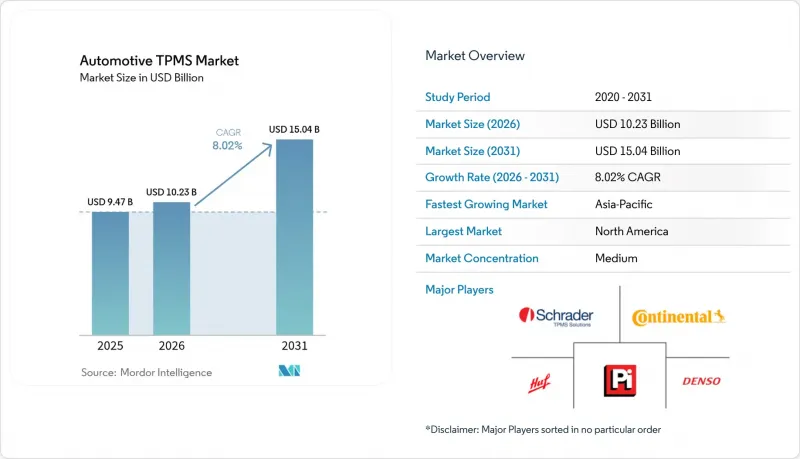
本報告按系統類型(直接式、間接式、混合式)、感測器技術(MEMS電容式、應變式等)、安裝方式(氣門嘴式、帶/輪圈式、輪胎整合式)、頻段(315 MHz以上)、車輛類型(乘用車等)、銷售管道(原廠安裝和售後改裝)以及地區進行細分。市場預測以美元計價。
全球汽車胎壓監測系統市場趨勢及洞察
新的車輛安全法規強制要求安裝胎壓監測系統 (TPMS)。
由於世界各國法規的差異,胎壓監測系統(TPMS)正從選用配置逐步過渡到強制性型式認證要求。法規的擴展範圍已從乘用車擴展到卡車、巴士和拖車,並將於2024年7月起根據歐盟通用安全法規強制安裝。在美國,FMVSS 138法規涵蓋所有售價低於10,000英鎊的輕型車輛,每輛車的安裝成本在48.44美元至69.89美元之間。同時,中國GB 26149標準的修訂已將摩托車和電動踏板車納入適用範圍。印度AIS 141草案將分階段在未來幾年內引入二輪車的直接測量。這些法規的協調一致確保了基本需求,使汽車TPMS市場不易受短期經濟波動的影響,並鼓勵感測器供應商儘早擴大產能。
與ADAS和聯網汽車遠端資訊處理平台的整合正在推進中。
新型車輛的集中式計算域現在可以收集胎壓監測系統 (TPMS) 的遙測數據,用於路線規劃、駕駛員警報和車隊儀表板。大陸集團在 2024 年法蘭克福車展 (IAA 2024) 上發布的 ContiConnect Pro 系統,可將壓力、溫度和胎面資料傳輸到雲端分析系統,該系統隨後發出服務工單。此類整合要求感測器支援乙太網路閘道和安全韌體,從而推動汽車 TPMS 市場朝更高頻寬的設計方向發展。雖然北美車隊引領著這一趨勢,但歐洲物流營運商也迅速將輪胎數據納入其每英里成本計算演算法中。
入門級產品中感測器和校準成本較高
對於入門級乘用車和摩托車而言,感測器成本和安裝費用是一筆不小的預算負擔,使得製造商難以提供經濟高效的解決方案。雖然間接演算法成本低廉,但卻無法滿足如今各地區為確保安全性和可靠性而日益嚴格的精度要求。儘管半導體小型化技術的進步正在逐步降低單位成本,但要達到與間接系統相同的成本水準仍然是長期目標。這種滯後性持續阻礙這項技術在價格敏感市場(尤其是印度農村和非洲部分地區)的普及,在這些地區,價格負擔能力是消費者購買決策的關鍵因素。
細分市場分析
預計到2025年,直接式感測器將佔總銷量的63.11%,並在2031年之前繼續以8.17%的複合年成長率成長,這主要得益於精準的胎壓測量和監管部門的批准。直接式感測器符合嚴格的公差要求,已成為歐洲、北美和中國乘用車的標準配備。間接式感測器仍用於價格較低的車輛,但它們無法同時檢測所有車輪的胎壓不足。對於必須應對負載負載容量注重成本的商用車隊而言,結合直接式感測器和間接式演算法的混合配置方案更受歡迎。
在亞太地區,新的摩托車法規強制要求提供即時胎壓數據,這顯著增加了對直接式感測器的需求。安全性的提升以及遵守不斷變化的標準的需要,是推動這項需求激增的主要原因。為了滿足這項需求,大陸集團推出了TPMS Go,這是一款入門級診斷工具,可幫助售後維修店有效地匹配感測器,從而降低安裝的複雜性和時間。雖然隨著感測器價格的下降,混合式系統的普及可能會趨於穩定,但許多大型車輛的營運商仍然重視雙模配置的穩健性和可靠性,尤其是在長途行駛中,耐用性至關重要。
MEMS電容式裝置因其低功耗和CMOS相容性而備受青睞,預計到2025年將佔據51.62%的市場佔有率。壓電感測器雖然尚未成為主流,但由於其能夠承受極端高溫和振動,因此非常適合重型卡車,預計將以8.23%的複合年成長率快速成長。應變計系統因其線性輸出優勢而被視為一種過渡方案,但其面臨的挑戰是高電流消耗。
大陸集團位於班加羅爾的生產線專注於生產專為輕型車輛最佳化的MEMS電容式裝置,而日本供應商則正在擴大壓電陶瓷的生產,以滿足嚴苛工作環境的需求。半導體供應狀況在決定技術選擇方面起著至關重要的作用。 MEMS元件受益於成熟的8吋晶圓製造程序,而壓電堆疊則依賴專業的陶瓷供應鏈。在預測期內,整合電容式和壓電元件的混合積體電路封裝有望成為兼顧耐用性和精度的理想解決方案。
區域分析
預計到2025年,北美將佔全球汽車胎壓監測系統(TPMS)市場銷售額的36.81%,反映了該地區長期完善的監管體系和龐大的車輛保有量。如今,該地區的成長更依賴與車載資訊系統捆綁銷售以及在商用車隊中的應用,而非乘用車的新車安裝量。美國售後市場受惠於車輛平均車齡超過12年,這一趨勢在加拿大輕型卡車市場也同樣存在。雖然聯合國歐洲經濟委員會(UNECE)第155號指令下的網路安全法規不適用於美國國內車型,但跨國汽車製造商(OEM)正在自願遵守該指令,以簡化出口合規流程。
歐洲也採取了類似措施,但方法有所不同。 《一般安全條例》擴大了胎壓監測系統(TPMS)的應用範圍,從2024年7月起,幾乎所有新型輕型和重型車輛都必須配備TPMS。對於2014年之前註冊的、未配備原廠感測器的乘用車,售後市場需求激增。德國、法國和英國的售後安裝量最高,這得益於保險公司對胎壓保持良好的車輛提供的保費折扣。該地區還在嵌入式感測器試點計畫中發揮主導作用,這些計畫旨在實現永續性目標,推廣輪胎循環管理方案。
亞太地區是成長最快的市場,預計到2031年將以8.35%的複合年成長率成長。在中國,GB 26149標準擴展至摩托車和電動踏板車領域,創造了每年數百萬輛的市場機會。大陸集團位於班加羅爾的工廠作為本地基地,旨在滿足不斷成長的OEM需求並出口到韓國。日本和韓國均符合聯合國歐洲經濟委員會(UNECE)的規定,並重視網路安全認證,因此能夠證明符合ISO/SAE 21434標準的供應商將獲得優先待遇。
其他好處:
- Excel格式的市場預測(ME)表
- 3個月的分析師支持
目錄
第1章:引言
- 研究假設和市場定義
- 調查範圍
第2章:調查方法
第3章執行摘要
第4章 市場狀況
- 市場概覽
- 市場促進因素
- 新的車輛安全法規強制要求安裝胎壓監測系統 (TPMS)。
- 與ADAS和聯網汽車遠端資訊處理平台整合的進展
- 電氣化的發展加劇了人們對續航里程的擔憂,而續航里程則很大程度上受重量影響。
- 向智慧輪胎健康分析生態系統轉型
- 低成本MEMS感測器在摩托車領域的普及
- 保險和遠端資訊獎勵,以促進正確的輪胎壓力管理
- 市場限制因素
- 入門級產品中感測器和校準成本較高
- 無線胎壓監測系統的網路安全漏洞
- 售後市場安裝的複雜性與維修挑戰
- 無氣防爆輪胎技術的出現
- 價值供應鏈分析
- 監理情勢
- 技術展望
- 波特五力分析
第5章 市場規模與成長預測
- 依系統類型
- 直接的
- 間接
- 混合
- 感測器技術
- MEMS電容式靜電
- 應變計
- 壓電
- 其他(光學、表面聲波等)
- 擬合方法
- 閥桿(卡入式和夾緊式)
- 附/圈安裝類型
- 輪胎整合模組
- 按頻段
- 315 MHz
- 433 MHz
- 2.4 GHz 以上頻段,以及超寬頻
- 車輛類型
- 搭乘用車
- 商用車輛
- 摩托車
- 按銷售管道
- 原廠安裝設備
- 改裝
- 地區
- 北美洲
- 美國
- 加拿大
- 其他北美國家
- 南美洲
- 巴西
- 阿根廷
- 其他南美國家
- 歐洲
- 德國
- 英國
- 法國
- 義大利
- 西班牙
- 俄羅斯
- 其他歐洲國家
- 亞太地區
- 中國
- 日本
- 印度
- 韓國
- 澳洲
- 其他亞太國家
- 中東和非洲
- 阿拉伯聯合大公國
- 沙烏地阿拉伯
- 土耳其
- 埃及
- 南非
- 其他中東和非洲國家
- 北美洲
第6章 競爭情勢
- 市場集中度
- 策略趨勢
- 市佔率分析
- 公司簡介
- Continental AG
- Sensata Technologies/Schrader
- Pacific Industrial Co. Ltd.
- Huf Hulsbeck & Furst
- DENSO Corporation
- ZF Friedrichshafen AG(incl. TRW)
- Valeo SA
- ALLIGATOR Ventilfabrik GmbH
- Alps Alpine Co. Ltd.
- Delphi/Aptiv plc
- PressurePro Enterprises Inc.
- Steelmate Co. Ltd.
- Orange Electronic Co. Ltd.
- Bartec USA LLC
第7章 市場機會與未來展望
According to Mordor Intelligence, the automotive TPMS market size is projected to expand from USD 9.47 billion in 2025 and USD 10.23 billion in 2026 to USD 15.04 billion by 2031, registering a CAGR of 8.02% between 2026 and 2031.
This report is Segmented by System Type (Direct, Indirect, and Hybrid), Sensor Technology (MEMS Capacitive, Strain-Gauge, and More), Fitting Method (Valve-Stem, Band/Rim-Mounted, and Embedded-Tire Module), Frequency Band (315 MHz and More), Vehicle Type (Passenger Cars and More), Sales Channel (OEM Factory-Fit and Aftermarket Retrofit), and Geography. The Market Forecasts are Provided in Terms of Value (USD).
Global Automotive TPMS Market Trends and Insights
Mandated TPMS Fitment in New-Vehicle Safety Regulations
Global legislation continues to make TPMS an optional item into a compulsory homologation item. Regulatory expansion is widening beyond passenger cars into trucks, buses, and trailers, now mandated by the EU's General Safety Regulation from July 2024. In the United States, rules under FMVSS 138 keep all light vehicles under 10,000 lb within scope and have demonstrated fitment costs of USD 48.44-69.89 per unit. At the same time, China's GB 26149 revision brings motorcycles and electric scooters into scope. India's draft AIS 141 phases in direct measurement for two-wheelers over a multi-year window. These synchronized rules guarantee baseline demand, shielding the Automotive TPMS market from short economic swings and prompting sensor suppliers to scale capacity early.
Rising Integration with ADAS and Connected-Car Telematics Platforms
Centralized compute domains inside new vehicles now harvest TPMS telemetry for route planning, driver alerts, and fleet dashboards. Continental's ContiConnect Pro, launched at IAA 2024, streams pressure, temperature, and tread data to cloud analytics that trigger maintenance work orders. Such integrations compel sensors to support Ethernet gateways and secure firmware, nudging the Automotive TPMS market toward higher-bandwidth designs. North American fleets lead adoption, yet European logistics operators are rapidly embedding tire data into cost-per-mile algorithms.
High Sensor and Calibration Cost in Entry-Level Segments
Entry-level cars and two-wheelers feel the pinch as sensor prices, along with installation labor, stretch budgets, making it challenging for manufacturers to offer cost-effective solutions. Though cheaper, indirect algorithms fail to meet the now-standard accuracy requirements, which are increasingly being enforced across various regions to ensure safety and reliability. While advancements in semiconductor scaling are gradually reducing unit costs, achieving cost parity with indirect systems remains a long-term goal. This delay continues to hinder widespread adoption in price-sensitive markets, particularly in rural India and certain regions of Africa, where affordability is a critical factor for consumers.
Other drivers and restraints analyzed in the detailed report include:
- Electrification Increasing Weight-Sensitive Range Anxiety
- Shift Toward Smart-Tire Health-Analytics Ecosystems
- Wireless TPMS Cybersecurity Vulnerabilities
For complete list of drivers and restraints, kindly check the Table Of Contents.
Segment Analysis
Direct architectures accounted for 63.11% of revenue in 2025 and continue to expand at an 8.17% CAGR through 2031, driven by accurate in-tire pressure readings and regulatory endorsement. Direct sensors meet stringent error margins, making them the default for passenger cars in Europe, North America, and China. Indirect systems remain in low-cost vehicles but cannot detect simultaneous under-inflation across all wheels. Hybrid configurations, blending direct sensors with indirect algorithms, appeal to cost-sensitive commercial fleets that juggle payload variability.
In the Asia-Pacific region, new motorcycle regulations mandate real-time pressure data, significantly increasing the demand for direct sensors. The need for enhanced safety and compliance with evolving standards drives this surge. To address this demand, Continental has introduced its entry-level TPMS Go diagnostic tool, which allows aftermarket shops to efficiently pair sensors, thereby reducing installation complexities and time. While the adoption of hybrid systems might stabilize as sensor prices decline, many heavy-duty operators continue to favor the robustness and reliability of dual-mode setups, particularly for extended long-haul routes where durability is critical.
MEMS capacitive devices held 51.62% share in 2025, prized for low power draw and CMOS compatibility. Piezoelectric sensors, although currently less dominant, are set to grow the fastest, at an 8.23% CAGR, as they can withstand extreme heat and vibration, making them ideal for heavy trucks. Strain-gauge solutions serve as a transitional option, appreciated for their linear output, though they face higher current consumption.
Continental's Bangalore production line focuses on MEMS capacitive formats tailored for light vehicles, while Japanese suppliers are scaling up piezoelectric ceramics to meet the demands of harsh operating environments. Semiconductor availability plays a critical role in determining technology choice. MEMS devices benefit from established 8-inch wafer fabrication processes, whereas piezoelectric stacks rely on specialized ceramic supply chains. Over the forecast period, hybrid IC packages that integrate capacitive and piezoelectric elements are expected to emerge as a promising solution, offering a balance of resilience and accuracy.
Complete Report Scope:
- By System Type
- Direct
- Indirect
- Hybrid
- By Sensor Technology
- MEMS Capacitive
- Strain-Gauge
- Piezoelectric
- Others (Optical, SAW, etc.)
- By Fitting Method
- Valve-Stem (Snap-In & Clamp-In)
- Band / Rim-Mounted
- Embedded-Tire Module
- By Frequency Band
- 315 MHz
- 433 MHz
- More than or equal to 2.4 GHz & UWB
- By Vehicle Type
- Passenger Cars
- Commercial Vehicle
- Two-Wheelers
- By Sales Channel
- OEM Factory-Fit
- Aftermarket Retrofit
- Geography
- North America
- United States
- Canada
- Rest of North America
- South America
- Brazil
- Argentina
- Rest of South America
- Europe
- Germany
- United Kingdom
- France
- Italy
- Spain
- Russia
- Rest of Europe
- Asia-Pacific
- China
- Japan
- India
- South Korea
- Australia
- Rest of Asia-Pacific
- Middle East and Africa
- United Arab Emirates
- Saudi Arabia
- Turkey
- Egypt
- South Africa
- Rest of Middle East and Africa
- North America
Geography Analysis
North America retained 36.81% of the Automotive TPMS market revenue in 2025, reflecting an entrenched regulatory history and high vehicle ownership. Growth in the region now depends on telematics bundling and commercial-fleet adoption rather than new passenger-car fitment. The U.S. aftermarket is buoyed by an average vehicle age exceeding 12 years, while Canada shows parallel patterns in light-truck segments. Cybersecurity provisions under UNECE 155 do not bind U.S. domestic models, yet multinational OEMs voluntarily align to simplify export compliance.
Europe follows closely but with different dynamics. The General Safety Regulation broadened TPMS coverage to virtually every new light and heavy vehicle from July 2024. Retrofit demand spikes among cars registered before 2014 that lack factory sensors. Germany, France, and the United Kingdom rank highest in retrofit volumes, thanks to insurance rebates for verified tire pressure compliance. The region also leads in embedded-sensor pilots, motivated by sustainability targets that encourage circular tire-management schemes.
Asia-Pacific is the fastest-growing arena, advancing at an 8.35% CAGR through 2031. China's extension of GB 26149 to motorcycles and electric scooters creates a multi-million-unit annual opportunity. Continental's Bangalore line gives the company a local hub to meet surging OEM demand and export to South Korea. Japan and South Korea, both aligned with UNECE rules, emphasize cybersecurity certifications, rewarding vendors that can document ISO/SAE 21434 conformance.
- Continental AG
- Sensata Technologies / Schrader
- Pacific Industrial Co. Ltd.
- Huf Hulsbeck & Furst
- DENSO Corporation
- ZF Friedrichshafen AG (incl. TRW)
- Valeo SA
- ALLIGATOR Ventilfabrik GmbH
- Alps Alpine Co. Ltd.
- Delphi / Aptiv plc
- PressurePro Enterprises Inc.
- Steelmate Co. Ltd.
- Orange Electronic Co. Ltd.
- Bartec USA LLC
Additional Benefits:
- The market estimate (ME) sheet in Excel format
- 3 months of analyst support
TABLE OF CONTENTS
1 Introduction
- 1.1 Study Assumptions & Market Definition
- 1.2 Scope of the Study
2 Research Methodology
3 Executive Summary
4 Market Landscape
- 4.1 Market Overview
- 4.2 Market Drivers
- 4.2.1 Mandated TPMS Fitment in New-Vehicle Safety Regulations
- 4.2.2 Rising Integration with ADAS & Connected-Car Telematics Platforms
- 4.2.3 Electrification Increasing Weight-Sensitive Range Anxiety
- 4.2.4 Shift Toward Smart-Tire Health-Analytics Ecosystems
- 4.2.5 Proliferation of Low-Cost MEMS Sensors for Two-Wheelers
- 4.2.6 Insurance-Telematics Incentives for Tire-Pressure Compliance
- 4.3 Market Restraints
- 4.3.1 High Sensor & Calibration Cost in Entry-Level Segments
- 4.3.2 Wireless TPMS Cybersecurity Vulnerabilities
- 4.3.3 Aftermarket Installation Complexity & Maintenance Issues
- 4.3.4 Advent of Airless & Run-Flat Tire Technologies
- 4.4 Value / Supply-Chain Analysis
- 4.5 Regulatory Landscape
- 4.6 Technological Outlook
- 4.7 Porter's Five Forces Analysis
- 4.7.1 Bargaining Power of Suppliers
- 4.7.2 Bargaining Power of Buyers/Consumers
- 4.7.3 Threat of New Entrants
- 4.7.4 Threat of Substitute Products
- 4.7.5 Intensity of Competitive Rivalry
5 Market Size & Growth Forecasts (Value (USD))
- 5.1 By System Type
- 5.1.1 Direct
- 5.1.2 Indirect
- 5.1.3 Hybrid
- 5.2 By Sensor Technology
- 5.2.1 MEMS Capacitive
- 5.2.2 Strain-Gauge
- 5.2.3 Piezoelectric
- 5.2.4 Others (Optical, SAW, etc.)
- 5.3 By Fitting Method
- 5.3.1 Valve-Stem (Snap-In & Clamp-In)
- 5.3.2 Band / Rim-Mounted
- 5.3.3 Embedded-Tire Module
- 5.4 By Frequency Band
- 5.4.1 315 MHz
- 5.4.2 433 MHz
- 5.4.3 More than or equal to 2.4 GHz & UWB
- 5.5 By Vehicle Type
- 5.5.1 Passenger Cars
- 5.5.2 Commercial Vehicle
- 5.5.3 Two-Wheelers
- 5.6 By Sales Channel
- 5.6.1 OEM Factory-Fit
- 5.6.2 Aftermarket Retrofit
- 5.7 Geography
- 5.7.1 North America
- 5.7.1.1 United States
- 5.7.1.2 Canada
- 5.7.1.3 Rest of North America
- 5.7.2 South America
- 5.7.2.1 Brazil
- 5.7.2.2 Argentina
- 5.7.2.3 Rest of South America
- 5.7.3 Europe
- 5.7.3.1 Germany
- 5.7.3.2 United Kingdom
- 5.7.3.3 France
- 5.7.3.4 Italy
- 5.7.3.5 Spain
- 5.7.3.6 Russia
- 5.7.3.7 Rest of Europe
- 5.7.4 Asia-Pacific
- 5.7.4.1 China
- 5.7.4.2 Japan
- 5.7.4.3 India
- 5.7.4.4 South Korea
- 5.7.4.5 Australia
- 5.7.4.6 Rest of Asia-Pacific
- 5.7.5 Middle East and Africa
- 5.7.5.1 United Arab Emirates
- 5.7.5.2 Saudi Arabia
- 5.7.5.3 Turkey
- 5.7.5.4 Egypt
- 5.7.5.5 South Africa
- 5.7.5.6 Rest of Middle East and Africa
- 5.7.1 North America
6 Competitive Landscape
- 6.1 Market Concentration
- 6.2 Strategic Moves
- 6.3 Market Share Analysis
- 6.4 Company Profiles (includes Global Level Overview, Market Level Overview, Core Segments, Financials as Available, Strategic Information, Market Rank/Share for Key Companies, Products and Services, SWOT Analysis, and Recent Developments)
- 6.4.1 Continental AG
- 6.4.2 Sensata Technologies / Schrader
- 6.4.3 Pacific Industrial Co. Ltd.
- 6.4.4 Huf Hulsbeck & Furst
- 6.4.5 DENSO Corporation
- 6.4.6 ZF Friedrichshafen AG (incl. TRW)
- 6.4.7 Valeo SA
- 6.4.8 ALLIGATOR Ventilfabrik GmbH
- 6.4.9 Alps Alpine Co. Ltd.
- 6.4.10 Delphi / Aptiv plc
- 6.4.11 PressurePro Enterprises Inc.
- 6.4.12 Steelmate Co. Ltd.
- 6.4.13 Orange Electronic Co. Ltd.
- 6.4.14 Bartec USA LLC
7 Market Opportunities & Future Outlook
- 7.1 White-Space & Unmet-Need Assessment

 亞太地區輪胎壓力監測系統(TPMS):市佔率分析、產業趨勢與統計及成長預測(2026-2031)售後市場胎壓監測系統:市場佔有率分析、產業趨勢與統計、成長預測(2026-2031 年)日本售後市場胎壓監測系統:市場佔有率分析、產業趨勢與統計、成長預測(2026-2031)
 輪胎壓力監測系統市場:2026-2032年全球市場預測(依產品類型、組件、驅動系統、運轉環境、最終用戶和車輛類型分類)
 胎壓監測系統 (TPMS) 市場分析及預測(至 2035 年):按類型、產品、技術、組件、應用、最終用戶、功能、安裝類型和解決方案分類
 胎壓監測系統電池市場:按類型、車輛、技術、銷售管道、國家及地區分類-全球產業分析、市場規模、市場佔有率及2026年至2033年預測輪胎壓力監測系統市場:依車輛類型、型號、銷售管道、國家及地區分類-全球產業分析、市場規模、市場佔有率及2026年至2033年預測
 汽車胎壓監測系統市場規模、佔有率和成長分析:按技術類型、組件、車輛應用和地區分類-2026-2033年產業預測
 美國拖車胎壓監測系統市場,2026-2030年汽車胎壓監測系統市場分析與預測(至2035年):按類型、產品、技術、組件、應用、最終用戶、功能、安裝方法、解決方案和模式分類