


 |
市場調查報告書
商品編碼
2113245
亞太地區輪胎壓力監測系統(TPMS):市佔率分析、產業趨勢與統計及成長預測(2026-2031)Asia-Pacific Tire Pressure Monitoring System (TPMS) - Market Share Analysis, Industry Trends & Statistics, Growth Forecasts (2026 - 2031) |
||||||

※ 本網頁內容可能與最新版本有所差異。詳細情況請與我們聯繫。
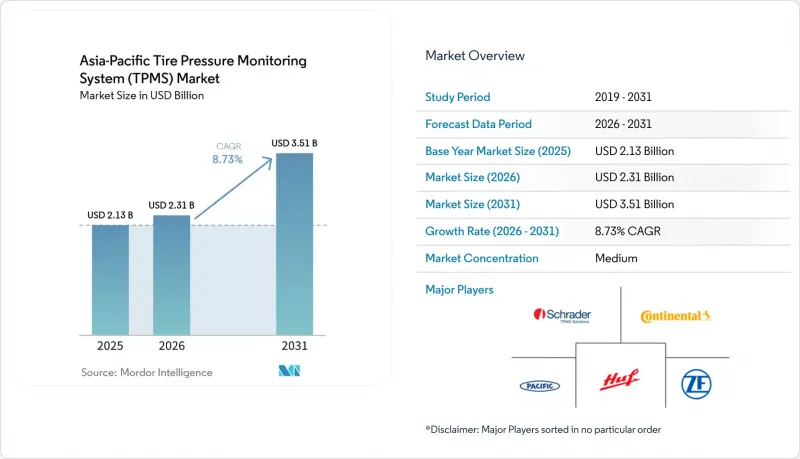
根據 Mordor Intelligence 預測,亞太地區輪胎壓力監測系統市場規模預計到 2025 年將達到 21.3 億美元,到 2026 年將達到 23.1 億美元,到 2031 年將達到 35.1 億美元,2026 年至 2031 年的複合成長率為 8.73%。
本報告按系統類型(直接式、間接式等)、感測器技術(MEMS電容式、應變式等)、安裝方式(閥桿式、帶/輪圈式等)、頻段(315 MHz、433 MHz等)、車輛類型(乘用車、商用車等)、銷售管道和國家/地區進行細分。市場預測以美元(USD)計價。
亞太地區輪胎壓力監測系統(TPMS)市場趨勢及洞察。
中國、印度和東協強制實施胎壓監測系統法規
The tire pressure monitoring system (TPMS) market in the Asia Pacific region is undergoing a gradual expansion of regulations rather than a temporary surge in demand. In China, GB 26149-2017, which mandated TPMS sll 20000 20000 200002 20202025555555 月表 高already established a 大規模 installation base, creating long-term OEM- 主導 demand and an expanding replacement cycle. Next, in India, the major automotive market will transition from optional to mandatory to Thillation from November 2025, 0. is significant because suppliers with the know-how to build low-cost sensor architectures for China will be in a more competitive position in Indian OEM programs, which still face tight cost targets. Japan will 70 2026. Meanwhile, 東南亞國協仍處於政策週期的早期擴張階段,但它們的車輛安全目標和監管大規模的車隊規模,都表明監管龐大設備的發展規模。
原始設備製造商 (OEM) 對最佳化燃油效率和電動車續航里程的需求
In the Asia Pacific tire pressure monitoring system (TPMS) market, OEMs are increasingly viewing TPMS not merely as safety equipment, but as a component for improving efficiency. This shift isost pronounced in bj 為 improving yiciency. This shift isost pronounced in 電池式電動車 is ostion rolling resistance and directly impacts usable range, making tire pressure visualization a critical operational indicator for both automakers and drivers. In June 2024, Continental launched its second-generation module from mod sooo plant. units per year. Furthermore, by linking pressure, temperature, and motion detection functions with smartphone-based data displays, the product is positioned not merely as a warning light, as s a connected value. vehicle (SDV) programs, where tire data can be incorporated into 底盤 control logic, diagnostic tools, and maintenance 提案 with minimal additional hardware load. Therefore, premium direct driive systems remain systemons recan 到already influence the option configuration. 因此,中國、印度、日本和韓國,特別是新型電動汽車,對引入更高價值的胎壓監測系統規格有著強烈的需求。
摩托車和入門級車輛的價格敏感性
在亞太地區,胎壓監測系統(TPMS)面臨價格承受能力不足的挑戰,尤其是在摩托車和低價乘用車領域。這個問題在印度尤為突出。例如,TVS摩托車公司僅透過高階動態套件引入了TPMS,這使得普通摩托車買家難以負擔這項功能。在摩托車通常以入門價格出售的大眾市場,推廣TPMS套件的合理性難以保證。如果沒有監管支援或更清晰的運作效益,許多消費者會猶豫是否採用。因此,儘管該地區一些國家的摩托車銷量高於汽車銷量,但摩托車TPMS的普及率卻遠低於乘用車。電動摩托車的情況略有不同。對於電動摩托車而言,由於胎壓監測對續航里程非常敏感,因此其經濟性至關重要。正因如此,採用低成本BLE帽式感測器的先導計畫更具吸引力,而這種感測器在傳統的內燃機車型中並未得到足夠的重視。然而,價格承受能力不足這一根本挑戰意味著目標市場的擴張速度仍然低於技術的發展速度。
細分市場分析
2025年、アジア太平洋地域のタイヤ空気圧監視システム市場において、ダイレクト型TPMSは68.55%のシェアを占めました。これは、同地域においてホイール内データやタイヤ位置の精度が重視されていること、および乗用車プログラムにおける規制順守への対応がより徹底されていることを反映したものです。中国はこの傾向の中心的な役割を果たし続けており、その理由は、規制対象となる大規模乗用車ベースにおいて、ホイールレベルで継続的な空気圧および温度情報を提供できるシステムが好まれているためです。また、ダイレクト方式は、OEMが航続距離管理、診断、およびソフトウェア定義の制御機能と連携可能な、信頼性の高いリアルタイムデータを求める電池式電動車(BEV)プログラムにも適しています。一方、間接式TPMSは、ABSの車輪速度信号を利用し、ホイール内の追加ハードウェアを必要としないため、エントリーモデルの部品原価を抑制できることから、コスト重視の車両プログラムにおいて依然として一定の地位を維持しています。NIRA Dynamicsなどのソフトウェアプロバイダーは、既存の汽車平臺上のアルゴリズムを通じて空気圧の推定をどのように処理できるかを示すことで、この価値提案を裏付けています。
混合式胎壓監測系統(TPMS)預計到2031年將以11.02%的複合年成長率成長,成為該系統類別中成長最快的架構。其優勢在於結合了間接式系統輕量化的硬體負擔和直接式感測的精準優勢,使其在電動車平台中尤為實用,因為電動車平台由於電池和電力電子成本高昂,預算本就十分緊張。新一代的爆胎預警概念也表明,直接式和混合式系統能夠在毫秒級時間內將資料傳輸至底盤控制器,從而擴展了其功能,使其不再局限於儀表板預警。這在豪華車專案中意義重大,因為胎壓監測正開始支援車輛穩定邏輯和高級駕駛輔助系統(ADAS)的功能。能夠獲得直接式或混合式輸出認證以滿足ADAS介面要求的供應商,相比只能提供基本合規產品的供應商,顯然更有可能提高平均售價。雖然間接式系統在低價位車型中仍然很重要,但產品層級正在轉向能夠提供更豐富數據和更好的整合度。
預計到2025年,MEMS電容式感測器將佔亞太地區胎壓監測系統(TPMS)市場銷售額的52.61%,並在2031年之前保持9.12%的最高成長率,從而在亞太地區TPMS市場佔據規模領先地位並擁有最強勁的成長勢頭。這一雙重優勢得益於中國和日本區域工廠產能的提升和成本差異的縮小,使得國內OEM廠商更容易在其量產車型系列中實現MEMS設計的標準化。隨著這些供應鏈的成熟,MEMS技術已從高階選項轉變為乘用車主流TPMS專案中的常見配置。當晶圓生產、模組組裝和最終車輛整合均在同一區域採購生態系統內完成時,經濟效益尤為顯著。這種本地化的規模優勢也給進口感測器設計帶來了壓力,這些進口感測器先前享有品牌溢價,如今面臨著更強大的國產替代品的挑戰。
在下一代電動車和聯網汽車應用中,感測器的性能、功耗和封裝尺寸仍然至關重要,因此投資的合理性仍然不容忽視。意法半導體在2025年12月的台灣科技日上概述了與汽車感測相關的MEMS技術的發展趨勢。這表明,低耗電量和提升輪胎整合功能仍在產品平臺中不斷推進。雖然應變計和壓電感測器的銷量仍然小規模其他感測器,但它們在能源採集、振動響應或替代測量格式等特殊應用場景中仍然發揮著重要作用。壓電技術的概念與無電池藍圖特別相關,全部區域的商業化仍處於早期階段。 「其他」類別(例如光學和表面聲波(SAW)方法)仍然是一個小眾領域,主要與那些優先考慮特定性能而非透過規模化降低成本的項目相關。目前,由於區域製造優勢和最廣泛的OEM需求,MEMS電容式感測器仍佔據核心地位。
其他好處:
- Excel格式的市場預測(ME)表
- 3個月的分析師支持
目錄
第1章:引言
第2章:調查方法
第3章執行摘要
第4章 市場狀況
- 市場概覽
- 市場促進因素
- 中國、印度和整個東協地區強制實施胎壓監測系統法規。
- 原始設備製造商 (OEM) 對最佳化燃油效率和電動車續航里程的需求
- 面向快速成長的電動車領域的無電池藍牙胎壓監測系統
- 車輛和遠端資訊處理整合用於預測性維護
- 日本向433 MHz標準過渡
- MEMS感測器的本地化生產降低了平均售價。
- 市場限制因素
- 摩托車和入門車型的價格敏感性
- 售後市場替換電池價格高昂
- 汽車半導體供應波動
- 射頻駭客攻擊與網路安全漏洞
- 監理情勢
- 價值供應鏈分析
- 技術展望
- 波特五力模型
第5章 市場規模與成長預測
- 依系統類型
- 直接的
- 間接
- 混合
- 感測器技術
- MEMS電容式靜電
- 應變計
- 壓電
- 其他(光學、表面聲波等)
- 擬合方法
- 閥桿(卡入式和夾緊式)
- 附/圈安裝類型
- 輪胎整合模組
- 按頻段
- 315 MHz
- 433 MHz
- 2.4 或更高版本以及超寬頻
- 車輛類型
- 搭乘用車
- 商用車輛
- 摩托車
- 按銷售管道
- 原廠安裝
- 改裝
- 國家
- 中國
- 日本
- 印度
- 韓國
- 澳洲
- 其他亞太國家
第6章 競爭情勢
- 市場集中度
- 策略趨勢
- 市佔率分析
- 公司簡介
- Schrader TPMS Solutions(Sensata Technologies)
- Continental AG
- Pacific Industrial Co., Ltd.
- Huf Hulsbeck & Furst GmbH & Co. KG
- ZF Friedrichshafen AG
- Denso Corporation
- Robert Bosch GmbH
- Valeo SA
- Shanghai Baolong Automotive Corporation
- CUB Elecparts Inc.
- Steelmate Co., Ltd
- Orange Electronic Co., Ltd.
- Manatec Mobility
第7章 市場機會與未來展望
According to Mordor Intelligence, the Asia-Pacific tire pressure monitoring system market was valued at USD 2.13 billion in 2025 and is expected to reach USD 2.31 billion in 2026 and USD 3.51 billion by 2031, at an 8.73% CAGR over 2026-2031.
This report is Segmented by System Type (Direct, Indirect, and More), Sensor Technology (MEMS Capacitive, Strain-Gauge, and More), Fitting Method (Valve-Stem, Band/Rim-Mounted, and More), Frequency Band (315 MHz, 433 MHz, and More), Vehicle Type (Passenger Cars, Commercial Vehicles, and More), Sales Channel, and Country. Market Forecasts are Provided in Value (USD).
Asia-Pacific Tire Pressure Monitoring System (TPMS) Market Trends and Insights
Mandatory TPMS Regulations Across China, India, and ASEAN
The Asia-Pacific tire pressure monitoring system market is moving through a staged regulatory expansion rather than a one-time jump in demand. China already created a large fitted base when GB 26149-2017 required TPMS on Category M passenger vehicles from January 2020, which established long-run OEM pull and a growing replacement cycle. India then shifted a major vehicle market from voluntary installation to mandatory compliance from November 2025, which added a fresh layer of rule-based demand to the region in 2026. This sequencing matters because suppliers that learned to build low-cost sensor architectures for China are now better placed to compete for Indian OEM programs that still face tight cost targets. Japan aligned the 433 MHz band in 2025, with full implementation completed in 2026, while South Korea already maintains an established fitment regime, and that combination is helping standardize sourcing across Northeast Asia. ASEAN remains earlier in the policy cycle, yet vehicle safety goals and larger fleets keep the rulemaking direction supportive for future fitment growth.
OEM Demand for Fuel Efficiency and EV Range Optimization
In the Asia-Pacific tire pressure monitoring system market, OEMs increasingly treat TPMS as an efficiency component rather than a narrow safety item. This shift is strongest in battery electric vehicles because under-inflation raises rolling resistance and directly affects usable range, which turns pressure visibility into an operating input for both automakers and drivers. Continental's second-generation module launch from its Bangalore plant in June 2024 expanded local production to 3.3 million wheel units per year and tied pressure, temperature, and motion sensing to smartphone-based data display, which shows how the product is being packaged as a connected function rather than a simple warning lamp. The value proposition also rises in software-defined vehicle programs because tire data can be routed into chassis-control logic, diagnostic tools, and maintenance alerts with little additional hardware burden. That is why premium direct systems continue to gain preference in passenger vehicle platforms where range performance and software integration already influence the option mix. The result is a stronger case for higher-value TPMS specifications across China, India, Japan, and South Korea, especially in new EV nameplates.
Price Sensitivity in Two-Wheelers and Entry-Level Cars
In the Asia-Pacific region, tire pressure monitoring systems (TPMS) face affordability challenges, particularly in two-wheelers and budget-friendly passenger vehicles. This issue is most pronounced in India. For instance, TVS Motor Company introduced TPMS exclusively through a premium dynamic kit, which positioned the feature beyond the reach of mainstream motorcycle buyers. In the mass market, where two-wheelers are typically priced at entry-level ranges, a TPMS package proves hard to justify. Without regulatory support or a clearer operational benefit, many consumers hesitate. Consequently, despite the region's higher sales of two-wheelers compared to cars in several countries, TPMS adoption in two-wheelers lags significantly behind that in passenger cars. The scenario shifts slightly with electric two-wheelers. Here, the sensitivity to range makes tire pressure monitoring economically vital. This relevance boosts the appeal of low-cost BLE cap-sensor pilots, a feature less emphasized in traditional internal combustion models. Yet, the overarching challenge of affordability continues to slow the expansion of the addressable market relative to the technology's growth.
Other drivers and restraints analyzed in the detailed report include:
- BLE-Enabled Battery-Less TPMS for Fast-Growing EV Segment
- Fleet-Telematics Integration for Predictive Maintenance
- High Replacement-Battery Cost in Aftermarket
For complete list of drivers and restraints, kindly check the Table Of Contents.
Segment Analysis
Direct TPMS held 68.55% of the Asia-Pacific tire pressure monitoring system market share in 2025, which reflected the region's preference for in-wheel data, tire-position accuracy, and stronger compliance alignment in passenger vehicle programs. China remained central to that pattern because its large regulated passenger-car base favored systems that could provide continuous pressure and temperature information at the wheel level. The direct format also fits better with battery electric vehicle programs where OEMs want reliable real-time data that can be tied to range management, diagnostics, and software-defined control functions. Indirect TPMS still kept a place in cost-sensitive vehicle programs because it uses ABS wheel-speed signals and avoids extra in-wheel hardware, which lowers the bill of materials for entry models. Software providers such as NIRA Dynamics support that value case by showing how pressure estimation can be handled through algorithms on existing vehicle platforms.
Hybrid TPMS is projected to grow at 11.02% CAGR through 2031, which makes it the fastest-rising architecture in this system split. Its appeal comes from balancing the low hardware burden of indirect systems with the accuracy benefits of direct sensing, which is useful in EV platforms already stretched by battery and power electronics cost. New-generation blowout-warning concepts also show how direct and hybrid layouts can push data to chassis controllers within milliseconds, which expands their role beyond dashboard alerts. That matters because pressure sensing is beginning to support stabilization logic and advanced driver-assistance functions in higher-end vehicle programs. Suppliers that can qualify direct or hybrid output against ADAS interface needs have a clearer path to higher average selling prices than suppliers limited to basic compliance products. Indirect systems will still remain relevant in lower-priced vehicles, but the product hierarchy is shifting toward architectures that can deliver richer data and better integration.
MEMS capacitive sensors captured 52.61% of revenue in 2025 and also posted the fastest projected CAGR at 9.12% through 2031, which gave them both scale leadership and the strongest growth profile in the Asia-Pacific tire pressure monitoring system market. That double position reflects how regional fabs in China and Japan have improved output, narrowed cost gaps, and made MEMS designs easier for domestic OEMs to standardize across high-volume vehicle lines. As those supply chains matured, the technology moved from a premium option into a more routine specification for direct TPMS programs in mainstream passenger vehicles. The economics are especially favorable when local wafer production, module assembly, and final vehicle integration take place within the same regional sourcing ecosystem. That local scale advantage also puts pressure on imported sensor designs that historically carried a brand premium but now face stronger domestic alternatives.
The investment case remains active because sensor performance, power use, and package size still matter in next-generation EV and connected-vehicle applications. STMicroelectronics used its Taiwan Tech Day in December 2025 to outline MEMS evolution relevant to automotive sensing, which signaled that low-power and in-tire capability upgrades are still moving through the product pipeline . Strain-gauge and piezoelectric sensors remain much smaller in revenue terms, but they still matter in specialized use cases where energy harvesting, vibration response, or alternative measurement formats are under evaluation. Piezoelectric concepts are particularly relevant to battery-less roadmaps, although commercial adoption across Asia-Pacific is still at an early stage. The "Others" category, including optical and SAW approaches, remains niche and is mainly tied to programs that value specialized performance more than scale cost. For now, MEMS capacitive remains the clear center of gravity because it matches regional manufacturing strength with the broadest OEM demand.
Complete Report Scope:
- By System Type
- Direct
- Indirect
- Hybrid
- By Sensor Technology
- MEMS Capacitive
- Strain-Gauge
- Piezoelectric
- Others (Optical, SAW, etc.)
- By Fitting Method
- Valve-Stem (Snap-In and Clamp-In)
- Band / Rim-Mounted
- Embedded-Tire Module
- By Frequency Band
- 315 MHz
- 433 MHz
- >=2.4 and UWB
- By Vehicle Type
- Passenger Cars
- Commercial Vehicles
- Two-Wheelers
- By Sales Channel
- OEM Factory-Fit
- Aftermarket Retrofit
- By Country
- China
- Japan
- India
- South Korea
- Australia
- Rest of Asia-Pacific
List of Companies Covered in this Report:
- Schrader TPMS Solutions (Sensata Technologies)
- Continental AG
- Pacific Industrial Co., Ltd.
- Huf Hulsbeck & Furst GmbH & Co. KG
- ZF Friedrichshafen AG
- Denso Corporation
- Robert Bosch GmbH
- Valeo SA
- Shanghai Baolong Automotive Corporation
- CUB Elecparts Inc.
- Steelmate Co., Ltd
- Orange Electronic Co., Ltd.
- Manatec Mobility
Additional Benefits:
- The market estimate (ME) sheet in Excel format
- 3 months of analyst support
TABLE OF CONTENTS
1 Introduction
2 Research Methodology
3 Executive Summary
4 Market Landscape
- 4.1 Market Overview
- 4.2 Market Drivers
- 4.2.1 Mandatory TPMS Regulations Across China, India, and ASEAN
- 4.2.2 OEM Demand for Fuel Efficiency and EV Range Optimization
- 4.2.3 BLE-Enabled Battery-Less TPMS for Fast-Growing EV Segment
- 4.2.4 Fleet-Telematics Integration for Predictive Maintenance
- 4.2.5 Shift to 433 MHz Harmonization in Japan
- 4.2.6 Localized MEMS Sensor Production Lowering ASPs
- 4.3 Market Restraints
- 4.3.1 Price Sensitivity in Two-Wheelers and Entry-Level Cars
- 4.3.2 High Replacement-Battery Cost in Aftermarket
- 4.3.3 Chip-Supply Volatility for Automotive-Grade Semis
- 4.3.4 RF-Hacking and Cyber-Security Vulnerabilities
- 4.4 Regulatory Landscape
- 4.5 Value / Supply-Chain Analysis
- 4.6 Technological Outlook
- 4.7 Porter's Five Forces
- 4.7.1 Threat of New Entrants
- 4.7.2 Bargaining Power of Suppliers
- 4.7.3 Bargaining Power of Buyers
- 4.7.4 Threat of Substitutes
- 4.7.5 Competitive Rivalry
5 Market Size & Growth Forecasts (Value, USD)
- 5.1 By System Type
- 5.1.1 Direct
- 5.1.2 Indirect
- 5.1.3 Hybrid
- 5.2 By Sensor Technology
- 5.2.1 MEMS Capacitive
- 5.2.2 Strain-Gauge
- 5.2.3 Piezoelectric
- 5.2.4 Others (Optical, SAW, etc.)
- 5.3 By Fitting Method
- 5.3.1 Valve-Stem (Snap-In and Clamp-In)
- 5.3.2 Band / Rim-Mounted
- 5.3.3 Embedded-Tire Module
- 5.4 By Frequency Band
- 5.4.1 315 MHz
- 5.4.2 433 MHz
- 5.4.3 >=2.4 and UWB
- 5.5 By Vehicle Type
- 5.5.1 Passenger Cars
- 5.5.2 Commercial Vehicles
- 5.5.3 Two-Wheelers
- 5.6 By Sales Channel
- 5.6.1 OEM Factory-Fit
- 5.6.2 Aftermarket Retrofit
- 5.7 By Country
- 5.7.1 China
- 5.7.2 Japan
- 5.7.3 India
- 5.7.4 South Korea
- 5.7.5 Australia
- 5.7.6 Rest of Asia-Pacific
6 Competitive Landscape
- 6.1 Market Concentration
- 6.2 Strategic Moves
- 6.3 Market Share Analysis
- 6.4 Company Profiles (includes Global Level Overview, Market Level Overview, Core Segments, Financials as Available, Strategic Information, Market Rank/Share for Key Companies, Products and Services, SWOT Analysis, and Recent Developments)
- 6.4.1 Schrader TPMS Solutions (Sensata Technologies)
- 6.4.2 Continental AG
- 6.4.3 Pacific Industrial Co., Ltd.
- 6.4.4 Huf Hulsbeck & Furst GmbH & Co. KG
- 6.4.5 ZF Friedrichshafen AG
- 6.4.6 Denso Corporation
- 6.4.7 Robert Bosch GmbH
- 6.4.8 Valeo SA
- 6.4.9 Shanghai Baolong Automotive Corporation
- 6.4.10 CUB Elecparts Inc.
- 6.4.11 Steelmate Co., Ltd
- 6.4.12 Orange Electronic Co., Ltd.
- 6.4.13 Manatec Mobility
7 Market Opportunities & Future Outlook
- 7.1 White-space & Unmet-Need Assessment

 售後市場胎壓監測系統:市場佔有率分析、產業趨勢與統計、成長預測(2026-2031 年)日本售後市場胎壓監測系統:市場佔有率分析、產業趨勢與統計、成長預測(2026-2031)汽車胎壓監測系統:市場佔有率分析、產業趨勢與統計、成長預測(2026-2031)
 胎壓監測系統 (TPMS) 市場分析及預測(至 2035 年):按類型、產品、技術、組件、應用、最終用戶、功能、安裝類型和解決方案分類
 胎壓監測系統電池市場:按類型、車輛、技術、銷售管道、國家及地區分類-全球產業分析、市場規模、市場佔有率及2026年至2033年預測汽車胎壓監測系統市場分析與預測(至2035年):按類型、產品、技術、組件、應用、最終用戶、功能、安裝方法、解決方案和模式分類歐洲售後市場胎壓監測系統:市場佔有率分析、產業趨勢與統計、成長預測(2026-2031 年)印度售後市場胎壓監測系統:市場佔有率分析、產業趨勢與統計、成長預測(2026-2031)美國售後市場胎壓監測系統:市場佔有率分析、行業趨勢和統計數據、成長預測(2026-2031 年)中國售後市場胎壓監測系統:市場佔有率分析、產業趨勢與統計、成長預測(2026-2031年)