


 |
市場調查報告書
商品編碼
2117399
售後市場胎壓監測系統:市場佔有率分析、產業趨勢與統計、成長預測(2026-2031 年)Aftermarket TPMS - Market Share Analysis, Industry Trends & Statistics, Growth Forecasts (2026 - 2031) |
||||||

※ 本網頁內容可能與最新版本有所差異。詳細情況請與我們聯繫。
根據 Mordor Intelligence 預測,售後市場胎壓監測系統 (TPMS) 的市場規模預計將從 2025 年的 32.7 億美元成長到 2026 年的 36.2 億美元,然後在 2031 年達到 56.3 億美元,2026 年至 2031 年的複合年成長率為 2031 年的複合年成長率為 2031 年。
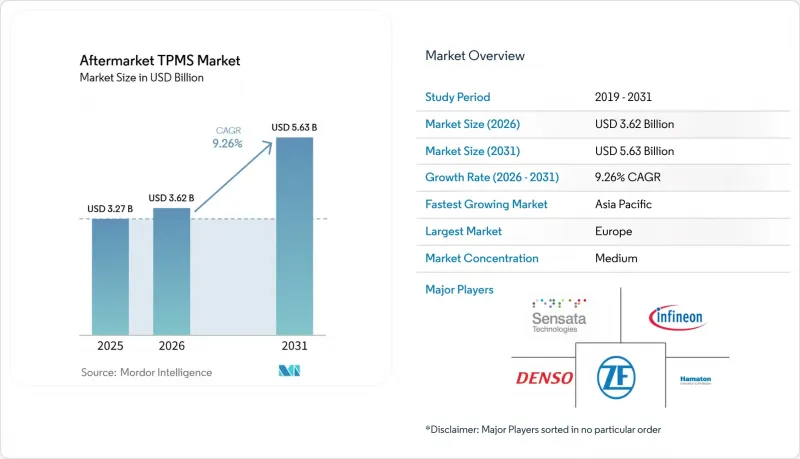
本報告按類型(直接式胎壓監測系統、間接式胎壓監測系統)、技術整合(獨立式胎壓監測系統、智慧/連網式胎壓監測系統)、車輛類型(乘用車、商用車)、銷售管道(線下、線上)和地區(北美、南美等)進行細分。市場預測以價值(美元)和銷售(輛)為單位呈現。
全球售後市場胎壓監測系統 (TPMS) 市場趨勢與洞察
聯網汽車架構的激增推動了智慧胎壓監測系統的發展。
諸如 Doran Connect 360 和 Phillips Connect 等雲端平台現在能夠接收配備低功耗藍牙和蜂窩晶片的智慧感測器的數據,從而推動售後市場胎壓監測系統 (TPMS) 向預測性服務轉型。英飛凌的 XENSIV™ SP49 展示了嵌入式處理器在負載感測方面的潛力,而大陸集團的 HT 5 掛車輪胎則展示了用於即時分析的 RFID 整合技術。
胎壓監測系統安裝的監管要求
為了遵守轉售法規並避免罰款,車主紛紛改裝車輛,這推動了售後市場胎壓監測系統(TPMS)的需求激增。印度的AIS-146和中國的GB/T 26149引領這一趨勢。同時,歐洲於2024年擴大了UN R141的適用範圍,將卡車和客車納入其中。此外,ISO 21750正在推進雙頻感測器的標準化,使跨區域分銷更加順暢。
在價格主導地區,對感測器和服務成本的敏感性
由於經銷商更換感測器成本較高,南美洲、中東和非洲的車主往往會推遲維修或選擇間接式胎壓監測系統。這種趨勢阻礙了這些地區售後胎壓監測系統市場的發展。雖然DIY套件有助於減輕經濟負擔,但人們普遍認為胎壓監測系統“並非強制性”,尤其是在法規較為寬鬆的地區,這仍然阻礙了其廣泛普及。
細分市場分析
預計到2025年,直接式感測器將佔售後市場胎壓監測系統(TPMS)銷售額的82.35%,並將以9.83%的複合年成長率超越間接式感測器,因為法規要求精度達到±1 psi。直接式感測器的售後市場TPMS市場規模受益於可程式設計EZ-sensor® SKU的普及,這些SKU增加了自動定位功能,同時減少了庫存。
在一些對成本較為敏感的小眾市場,間接式胎壓監測系統仍然十分重要,因為這些市場更重視的是前期硬體投入的減少,而非準確性。然而,當多個洩漏同時發生時,誤報和漏檢會限制其發展。隨著越來越多的地區正式強制要求使用「直接式」胎壓監測系統,間接式系統的市場佔有率將會萎縮,其應用範圍將主要局限於老款車型和尚未實施相關法規的新興市場。
2025年,獨立式胎壓監測系統仍將佔總銷售量的73.15%,但智慧/連網式胎壓監測系統的年複合成長率將達到13.17%,反映出車載資訊系統在售後胎壓監測系統市場的應用日益廣泛。由於保險公司的獎勵和藍牙晶片成本的下降,價格差異正在縮小,這表明市場將在2028年迎來轉折點。
智慧感測器透過將氣壓、溫度和電池狀態發送到雲端控制面板並啟用預測性警報,減少了路邊故障,並使訂閱模式的普及成為可能。隨著聯網硬體價格的日益接近,經銷商將從一次性銷售轉向在感測器整個生命週期內持續產生收益的服務包。
區域分析
預計到2025年,歐洲將佔全球售後胎壓監測系統(TPMS)市場收入的39.26%。這主要得益於嚴格的檢驗標準和成熟的更換週期。德國、英國、法國、義大利和西班牙是市場需求的主要驅動力,因為在技術檢驗中,故障感測器將被視為不合格。此外,隨著聯合國R141法規於2024年7月擴大適用範圍,卡車維修需求也隨之激增。荷蘭和西班牙在採用聯網TPMS方面處於領先,這反映了兩國密集的物流走廊和較高的車輛運轉率。
預計到2031年,亞太地區的複合年成長率將達到14.33%,位居全球之首。這主要得益於印度AIS-146標準的實施以及中國GB/T 26149標準的強制實施,這兩項措施正在重塑汽車產業。在印度,2025年之前生產的乘用車將不配備所需的感測器,這為售後市場胎壓監測系統(TPMS)市場創造了龐大的商機。在中國,龐大的車輛保有量意味著第一代感測器每5到10年就會達到使用壽命,產生了穩定的替換需求。同時,日本和韓國正致力於在物流車輛上推廣智慧胎壓監測系統,儘管目前仍處於自願階段,且推廣速度相對較慢。
在北美,由於相關法規實施時間最長,車輛老化程度也較高,因此對輪胎更換的需求持續強勁。高保有率使得透過保險遠端資訊處理技術享受折扣更具吸引力,從而推動了智慧感測器的升級。在加拿大,嚴寒的冬季導致季節性服務需求激增,尤其是當儀表板上出現胎壓警報時。南美洲與中東和非洲一樣,正處於這一發展的早期階段。在這些地區,由於缺乏相關法規,除非跨國車主和保險公司透過優惠項目證明能夠節省成本,否則消費者往往會延後購買。阿拉伯聯合大公國的試點折扣計畫顯示人們對胎壓監測系統(TPMS)的興趣正在萌芽,但巴西和阿根廷的政治和經濟動盪阻礙了標準化進程,並限制了目前TPMS售後市場的滲透率。
其他好處:
- Excel格式的市場預測(ME)表
- 3個月的分析師支持
目錄
第1章:引言
- 研究假設和市場定義
- 調查範圍
第2章:調查方法
第3章執行摘要
第4章 市場狀況
- 市場概覽
- 市場促進因素
- 聯網汽車架構的激增正在推動智慧胎壓監測系統的發展。
- 關於胎壓監測系統安裝的監理義務
- 全球汽車保有量和平均車齡均有所成長
- 針對採用改裝型胎壓監測系統的車隊的預測性維護計劃
- 透過電子商務促進售後市場管道的成長
- 基於即時輪胎資料的保險遠端資訊處理折扣
- 市場限制因素
- 價格主導地區感測器和服務的成本敏感性
- 與 V2C(車聯網)輪胎監測相關的技術快速過時。
- 透過整合智慧/無氣輪胎技術展開競爭
- 與聯網胎壓監測系統相關的網路安全與資料隱私問題
- 價值供應鏈分析
- 監理情勢
- 技術展望
- 波特五力模型
第5章 市場規模與成長預測
- 按類型
- 直接式胎壓監測系統
- 間接式胎壓監測系統
- 透過技術整合
- 獨立式胎壓監測系統
- 智慧型/連網胎壓監測系統
- 按車輛類型
- 搭乘用車
- 掀背車
- 轎車
- 運動型多用途車(SUV)和多用途車(MUV)
- 商用車輛
- 輕型商用車
- 中型和重型商用車輛
- 巴士和長途汽車
- 搭乘用車
- 透過分銷管道
- 線下通路-零件商店、專賣店、服務中心
- 線上平台 - OEM 網站/應用程式、電子商務平台
- 按地區
- 北美洲
- 美國
- 加拿大
- 其他北美國家
- 南美洲
- 巴西
- 阿根廷
- 其他南美國家
- 歐洲
- 德國
- 英國
- 西班牙
- 義大利
- 法國
- 荷蘭
- 其他歐洲國家
- 亞太地區
- 印度
- 中國
- 日本
- 韓國
- 印尼
- 其他亞太國家
- 中東和非洲
- 阿拉伯聯合大公國
- 沙烏地阿拉伯
- 土耳其
- 埃及
- 南非
- 其他中東和非洲國家
- 北美洲
第6章 競爭情勢
- 市場集中度
- 策略趨勢
- 市佔率分析
- 公司簡介
- Continental AG
- Sensata Technologies, Inc.(Schrader)
- Pacific Industrial Co. Ltd.
- Huf Hulsbeck & Furst
- CUB Elecparts Inc
- DENSO Corporation
- ZF Friedrichshafen AG
- Steelmate Company Limited
- Shanghai Baolong Automotive Corporation
- Orange Electronic Co, Ltd.
- Valeo SA
- Alps Alpine Co., Ltd
- Autel Intelligent Technology Corp Ltd.
- PressurePro
- ATEQ TPMS
- Bartec Auto ID Limited
- Hamaton Automotive Technology Co., Ltd.
- Bendix Commercial Vehicle Systems
- Infineon Technologies AG
第7章 市場機會與未來展望
According to Mordor Intelligence, the aftermarket TPMS market size is expected to grow from USD 3.27 billion in 2025 to USD 3.62 billion in 2026 and is forecast to reach USD 5.63 billion by 2031 at a 9.26% CAGR over 2026-2031.
This report is Segmented by Type (Direct TPMS, Indirect TPMS), Technology Integration (Stand-Alone TPMS Units, Smart/Connected TPMS), Vehicle Type (Passenger Cars, Commercial Vehicles), Distribution Channel (Offline, Online), and Geography (North America, South America, and More). Market Forecasts are Provided in Terms of Value (USD) and Volume (Units).
Global Aftermarket TPMS Market Trends and Insights
Surge in Connected-Vehicle Architectures Enabling Smart TPMS
Cloud platforms like Doran Connect 360 and Phillips Connect are now receiving data from smart sensors equipped with Bluetooth LE or cellular chips, steering the Aftermarket TPMS market towards predictive services. Infineon's XENSIV(TM) SP49 demonstrates the potential of embedded processors in load detection, and Continental's HT 5 trailer tire showcases the integration of RFID for real-time analytics.
Regulatory Mandates for TPMS Fitment
In a bid to comply with resale regulations and sidestep penalties, vehicle owners are retrofitting vehicles, spurring a surge in demand for the Aftermarket TPMS market. India's AIS-146 and China's GB/T 26149 are at the forefront of this movement . Meanwhile, in 2024, Europe expanded UN R141 to encompass trucks and buses. Concurrently, ISO 21750 is standardizing dual-frequency sensors, facilitating smoother cross-regional distribution.
Sensor and Service Cost Sensitivity in Price-Driven Regions
Dealership costs for sensor replacements prompt vehicle owners in South America, the Middle East, and Africa to either postpone repairs or opt for indirect systems. This trend is hindering the growth of the Aftermarket TPMS market in these regions. While DIY kits help ease the financial burden, the perception of non-criticality, especially in areas with lax enforcement, continues to hinder widespread adoption.
Other drivers and restraints analyzed in the detailed report include:
- Rising Global Vehicle Parc and Average Vehicle Age
- Fleet Predictive-Maintenance Programs Using Retrofit TPMS
- Rapid Tech-Obsolescence with Vehicle-to-Cloud Tire Monitoring
For complete list of drivers and restraints, kindly check the Table Of Contents.
Segment Analysis
Direct systems delivered 82.35% of 2025 revenue for the Aftermarket TPMS market and will outpace indirect alternatives at a 9.83% CAGR as mandates codify +-1 psi accuracy. The Aftermarket TPMS market size for direct sensors benefits from programmable EZ-sensor(R) SKUs that collapse inventory while adding auto-location functions .
Indirect TPMS maintains relevance in cost-sensitive niches where zero hardware outlay trumps precision, but false positives and simultaneous-leak blind spots limit growth. As more regions formalize direct-only requirements, indirect share will erode, keeping its role largely confined to legacy fleets or emerging markets without enforcement.
Stand-alone units still anchored 73.15% of total revenue in 2025, yet smart/connected units are expanding at 13.17% CAGR, reflecting rising telematics adoption inside the Aftermarket TPMS market. Insurance incentives and falling Bluetooth chip costs narrow the price gap, signaling an inflection point by 2028.
Smart sensors transmit pressure, temperature, and battery status to cloud dashboards, enabling predictive alerts that drop roadside failures and justify subscription models. As connected hardware reaches price parity, distributors will pivot from one-off sales to service bundles that extend revenue capture across the sensor life cycle.
Complete Report Scope:
- By Type
- Direct TPMS
- Indirect TPMS
- By Technology Integration
- Stand-alone TPMS Units
- Smart/Connected TPMS
- By Vehicle Type
- Passenger Cars
- Hatchbacks
- Sedans
- Sports Utility Vehicles (SUVs) and Multi-purpose Utility Vehicles (MUVs)
- Commercial Vehicles
- Light Commercial Vehicles
- Medium and Heavy Commercial Vehicles
- Buses and Coaches
- Passenger Cars
- By Distribution Channel
- Offline - Parts Stores, Specialty Shops, Service Centers
- Online - OEM Sites/Apps, E-commerce Platforms
- By Geography
- North America
- United States
- Canada
- Rest of North America
- South America
- Brazil
- Argentina
- Rest of South America
- Europe
- Germany
- United Kingdom
- Spain
- Italy
- France
- Netherlands
- Rest of Europe
- Asia-Pacific
- India
- China
- Japan
- South Korea
- Indonesia
- Rest of Asia-Pacific
- Middle East and Africa
- United Arab Emirates
- Saudi Arabia
- Turkey
- Egypt
- South Africa
- Rest of Middle East and Africa
- North America
Geography Analysis
Europe contributed 39.26% of 2025 revenue in the Aftermarket TPMS market, anchored by strict roadworthiness tests and mature replacement cycles. Germany, the United Kingdom, France, Italy, and Spain dominate demand as technical inspections treat failed sensors as non-compliant, while the July 2024 UN R141 expansion has sparked a truck retrofit wave . The Netherlands and Spain are first movers on connected TPMS, reflecting dense logistics corridors and high fleet utilization.
Asia-Pacific posts the strongest 14.33% CAGR to 2031, led by India's AIS-146 enforcement and China's GB/T 26149 mandate, which is reshaping the automotive landscape. In India, cars manufactured before 2025 lack essential sensors, presenting a vast opportunity for the Aftermarket TPMS market. In China, with a large vehicle parc, first-generation sensors are cycled out of service every 5-10 years, generating consistent replacement revenue. Meanwhile, Japan and South Korea, though adopting voluntarily and at a slower pace, are emphasizing smart TPMS for their logistics fleets.
North America, boasting the longest history with mandates and an aging fleet, sees steady replacements. With widespread vehicle ownership, the allure of insurance-telematics discounts drives upgrades to smart sensors. In Canada, the harsh winters lead to seasonal service spikes, especially as dashboard pressure warnings emerge. South America, along with the Middle East and Africa, finds itself in the nascent stages of this evolution. Here, the lack of regulation often postpones purchases, unless savings are showcased by multinational fleets or insurer programs. While pilot discounts in the United Arab Emirates hint at budding interest, the political and economic fluctuations in Brazil and Argentina hinder standardization efforts, limiting the current penetration of the Aftermarket TPMS market.
- Continental AG
- Sensata Technologies, Inc. (Schrader)
- Pacific Industrial Co. Ltd.
- Huf Hulsbeck & Furst
- CUB Elecparts Inc
- DENSO Corporation
- ZF Friedrichshafen AG
- Steelmate Company Limited
- Shanghai Baolong Automotive Corporation
- Orange Electronic Co, Ltd.
- Valeo SA
- Alps Alpine Co., Ltd
- Autel Intelligent Technology Corp Ltd.
- PressurePro
- ATEQ TPMS
- Bartec Auto ID Limited
- Hamaton Automotive Technology Co., Ltd.
- Bendix Commercial Vehicle Systems
- Infineon Technologies AG
Additional Benefits:
- The market estimate (ME) sheet in Excel format
- 3 months of analyst support
TABLE OF CONTENTS
1 Introduction
- 1.1 Study Assumptions & Market Definition
- 1.2 Scope of the Study
2 Research Methodology
3 Executive Summary
4 Market Landscape
- 4.1 Market Overview
- 4.2 Market Drivers
- 4.2.1 Surge in Connected-Vehicle Architectures Enabling Smart TPMS
- 4.2.2 Regulatory Mandates for TPMS Fitment
- 4.2.3 Rising Global Vehicle Parc and Average Vehicle Age
- 4.2.4 Fleet Predictive-Maintenance Programs Using Retrofit TPMS
- 4.2.5 Growth of E-commerce Aftermarket Channels
- 4.2.6 Insurance-Telematics Discounts Tied to Real-Time Tire Data
- 4.3 Market Restraints
- 4.3.1 Sensor and Service Cost Sensitivity in Price-Driven Regions
- 4.3.2 Rapid Tech-Obsolescence with Vehicle-to-Cloud Tire Monitoring
- 4.3.3 Competition from Integrated Smart/Airless Tire Technologies
- 4.3.4 Cyber-Security and Data-Privacy Concerns Around Connected TPMS
- 4.4 Value/Supply-Chain Analysis
- 4.5 Regulatory Landscape
- 4.6 Technological Outlook
- 4.7 Porter's Five Forces
- 4.7.1 Threat of New Entrants
- 4.7.2 Bargaining Power of Suppliers
- 4.7.3 Bargaining Power of Buyers
- 4.7.4 Threat of Substitutes
- 4.7.5 Competitive Rivalry
5 Market Size & Growth Forecasts (Value (USD) and Volume (Units))
- 5.1 By Type
- 5.1.1 Direct TPMS
- 5.1.2 Indirect TPMS
- 5.2 By Technology Integration
- 5.2.1 Stand-alone TPMS Units
- 5.2.2 Smart/Connected TPMS
- 5.3 By Vehicle Type
- 5.3.1 Passenger Cars
- 5.3.1.1 Hatchbacks
- 5.3.1.2 Sedans
- 5.3.1.3 Sports Utility Vehicles (SUVs) and Multi-purpose Utility Vehicles (MUVs)
- 5.3.2 Commercial Vehicles
- 5.3.2.1 Light Commercial Vehicles
- 5.3.2.2 Medium and Heavy Commercial Vehicles
- 5.3.2.3 Buses and Coaches
- 5.3.1 Passenger Cars
- 5.4 By Distribution Channel
- 5.4.1 Offline - Parts Stores, Specialty Shops, Service Centers
- 5.4.2 Online - OEM Sites/Apps, E-commerce Platforms
- 5.5 By Geography
- 5.5.1 North America
- 5.5.1.1 United States
- 5.5.1.2 Canada
- 5.5.1.3 Rest of North America
- 5.5.2 South America
- 5.5.2.1 Brazil
- 5.5.2.2 Argentina
- 5.5.2.3 Rest of South America
- 5.5.3 Europe
- 5.5.3.1 Germany
- 5.5.3.2 United Kingdom
- 5.5.3.3 Spain
- 5.5.3.4 Italy
- 5.5.3.5 France
- 5.5.3.6 Netherlands
- 5.5.3.7 Rest of Europe
- 5.5.4 Asia-Pacific
- 5.5.4.1 India
- 5.5.4.2 China
- 5.5.4.3 Japan
- 5.5.4.4 South Korea
- 5.5.4.5 Indonesia
- 5.5.4.6 Rest of Asia-Pacific
- 5.5.5 Middle East and Africa
- 5.5.5.1 United Arab Emirates
- 5.5.5.2 Saudi Arabia
- 5.5.5.3 Turkey
- 5.5.5.4 Egypt
- 5.5.5.5 South Africa
- 5.5.5.6 Rest of Middle East and Africa
- 5.5.1 North America
6 Competitive Landscape
- 6.1 Market Concentration
- 6.2 Strategic Moves
- 6.3 Market Share Analysis
- 6.4 Company Profiles (Includes Global Level Overview, Market Level Overview, Core Segments, Financials as Available, Strategic Information, Market Rank/Share for Key Companies, Products and Services, SWOT Analysis, and Recent Developments)
- 6.4.1 Continental AG
- 6.4.2 Sensata Technologies, Inc. (Schrader)
- 6.4.3 Pacific Industrial Co. Ltd.
- 6.4.4 Huf Hulsbeck & Furst
- 6.4.5 CUB Elecparts Inc
- 6.4.6 DENSO Corporation
- 6.4.7 ZF Friedrichshafen AG
- 6.4.8 Steelmate Company Limited
- 6.4.9 Shanghai Baolong Automotive Corporation
- 6.4.10 Orange Electronic Co, Ltd.
- 6.4.11 Valeo SA
- 6.4.12 Alps Alpine Co., Ltd
- 6.4.13 Autel Intelligent Technology Corp Ltd.
- 6.4.14 PressurePro
- 6.4.15 ATEQ TPMS
- 6.4.16 Bartec Auto ID Limited
- 6.4.17 Hamaton Automotive Technology Co., Ltd.
- 6.4.18 Bendix Commercial Vehicle Systems
- 6.4.19 Infineon Technologies AG
7 Market Opportunities & Future Outlook
- 7.1 White-space & Unmet-Need Assessment

 亞太地區輪胎壓力監測系統(TPMS):市佔率分析、產業趨勢與統計及成長預測(2026-2031)日本售後市場胎壓監測系統:市場佔有率分析、產業趨勢與統計、成長預測(2026-2031)汽車胎壓監測系統:市場佔有率分析、產業趨勢與統計、成長預測(2026-2031)
 輪胎壓力監測系統市場:2026-2032年全球市場預測(依產品類型、組件、驅動系統、運轉環境、最終用戶和車輛類型分類)
 胎壓監測系統 (TPMS) 市場分析及預測(至 2035 年):按類型、產品、技術、組件、應用、最終用戶、功能、安裝類型和解決方案分類
 胎壓監測系統電池市場:按類型、車輛、技術、銷售管道、國家及地區分類-全球產業分析、市場規模、市場佔有率及2026年至2033年預測輪胎壓力監測系統市場:依車輛類型、型號、銷售管道、國家及地區分類-全球產業分析、市場規模、市場佔有率及2026年至2033年預測
 汽車胎壓監測系統市場規模、佔有率和成長分析:按技術類型、組件、車輛應用和地區分類-2026-2033年產業預測
 美國拖車胎壓監測系統市場,2026-2030年汽車胎壓監測系統市場分析與預測(至2035年):按類型、產品、技術、組件、應用、最終用戶、功能、安裝方法、解決方案和模式分類