


 |
市場調查報告書
商品編碼
2121672
汽車輪胎:市場佔有率分析、產業趨勢與統計、成長預測(2026-2031)Automotive Tires - Market Share Analysis, Industry Trends & Statistics, Growth Forecasts (2026 - 2031) |
||||||

※ 本網頁內容可能與最新版本有所差異。詳細情況請與我們聯繫。
根據 Mordor Intelligence 估計,2026 年汽車輪胎市值將達到 1,902.2 億美元,高於 2025 年的 1,842 億美元,預計到 2031 年將達到 2,233.7 億美元。
預計從 2026 年到 2031 年,其複合年成長率將達到 3.27%。
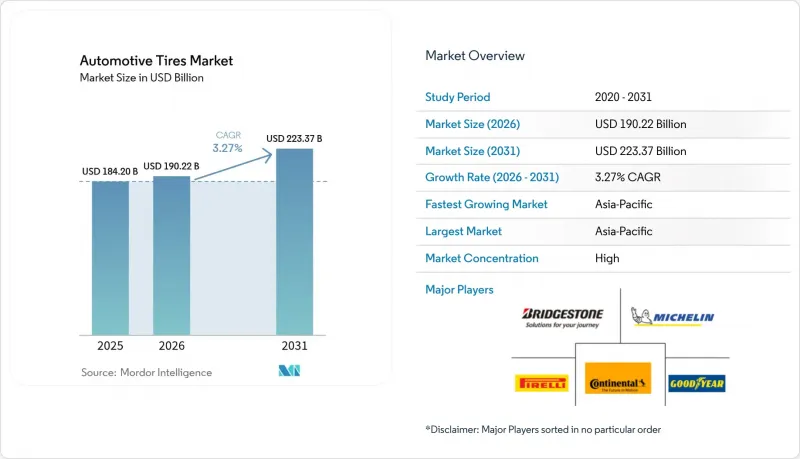
本報告按輪胎類型(夏季輪胎、冬季輪胎等)、輪胎結構(子午線輪胎、斜交輪胎等)、車輛類型(乘用車等)、應用領域(公路、越野)、最終用戶(原廠配套、售後市場)、輪圈尺寸(小於15英寸等)、驅動系統(內燃機、純電動等)和地區進行細分。市場預測以價值(美元)和銷售量(單位)表示。
全球汽車輪胎市場趨勢與洞察
電氣化推動了對超低噪音輪胎的需求。
由於電動驅動系統消除了引擎的噪音,輪胎與路面的相互作用成為主要的聲學來源。高階電動車製造商願意為降噪泡棉產品支付更高的溢價,這些產品可將車內噪音降低高達 20%,並最佳化胎面花紋。這一趨勢的驅動力是歐盟日益嚴格的外部噪音法規,而汽車輪胎市場的主流細分市場也開始要求採用類似技術,以在滿足法規要求的同時兼顧舒適性。供應商可以滿足性能要求和法規要求,在競爭激烈的市場中獲得原廠配套 (OE) 的認可,並在原料成本上漲的情況下保持價格穩定。
中國強制採用低滾動阻力輪胎
第六階段燃油效率法規要求燃油經濟性提高15%,其中滾動阻力特別重要。國內外品牌正將研發週期縮短至18個月,並開發富含二氧化矽的複合材料,以達到8%的燃油效率提升。在中國型式認證過程中所取得的成果正迅速推廣至亞洲各地的生產,在不增加重複研發成本的情況下,提升了整個汽車輪胎市場的基準。
橡膠樹葉病對東南亞的影響
印尼的橡膠樹病害(Pestalotiopsis)導致乳膠產量下降,天然橡膠現貨價格較去年同期上漲33%,對全球輪胎製造商的利潤率帶來壓力。由於受感染的橡膠樹可能需要長達10年的時間才能成熟採收,因此恢復過程十分緩慢。生產商正在尋求橡膠來源多元化,例如銀膠菊和俄羅斯蒲公英,但商業化生產仍需數個生長季,因此預計中期內成本壓力將持續存在。
細分市場分析
四季輪胎憑藉其在各種氣候條件下全年使用的便利性,繼續保持著汽車輪胎市場的領先地位,預計到2025年將佔據61.78%的市場佔有率。冬季輪胎雖然市佔率較小,但預計將保持最高的成長率,2026年至2031年的複合年成長率將達到4.12%,這主要得益於歐洲更嚴格的安全標準推動了冬季輪胎的普及。夏季輪胎在持續高溫地區仍然很受歡迎,而全地形/泥地輪胎則吸引了注重越野性能的SUV車主。製造商目前正將高矽配方與自適應溝槽結合,使單一胎面即可應對高溫環境和輕度積雪路面,從而降低經銷商庫存管理的複雜性。
研發投入也積極滿足電動車的需求。優質冬季輪胎憑藉其降低車廂噪音的發泡襯墊和即使在零下溫度下也能保持柔軟性的橡膠配方等特性,正成為電動車買家的理想選擇。此外,越來越多的車隊指定送貨車使用「三峰雪花」認證標誌,顯示相關法規的應用範圍正在不斷擴大。同時,數據驅動的輪胎換位服務正在延長輪胎壽命,並將收入轉向更高價值的冬季輪胎更換套餐。這些相互關聯的趨勢正推動季節性產品線的發展,使其遠遠超越簡單的溫度區域分類。
子午線輪胎憑藉其燃油效率高、操控穩定、胎面壽命長等優點,預計2025年將佔據汽車輪胎市場85.72%的佔有率。斜交輪胎在低速、高負載的細分市場仍佔有一席之地,但其影響力正在持續下降。最具創新性的發展體現在無氣輪胎領域。受工程、軍事和地面維護車輛對耐穿刺、運作長的輪胎的需求推動,預計到2031年,該細分市場將以每年5.49%的速度成長。熱塑性輻條和複合材料胎體正在縮小其與傳統子午線輪胎的滾動阻力差距。
試驗計畫表明,考慮到補胎和運作,無氣輪胎能夠降低生命週期成本,這促使汽車製造商計劃在下一個研發週期中對乘用車進行試點部署。子午線輪胎供應商則透過增強輪胎邊緣填充物來減輕重量而不影響強度,並採用更薄的鋼絲帶束層,力圖在電動車整車重量不斷增加的情況下維持市場佔有率。有關可回收性的法規進一步提升了人們對單一材料無氣輪胎設計的興趣,這種設計簡化了廢棄輪胎的處理。因此,一場創新競賽正在展開,兩條路徑並行發展,而非完全替代。
預計到2025年,乘用車將佔汽車總銷量的56.63%,鞏固其作為汽車輪胎市場核心的地位。 SUV和跨界車市場佔有率的持續成長正促使輪胎製造商開發載重指數更高、直徑更大的輪胎。電動車專用輪胎的成長尤為顯著,在全球電動車註冊量激增的背景下,預計將以10.63%的複合年成長率穩步成長。電池重量的增加和瞬時扭力的增加,推動了對更堅固的胎體、富含二氧化矽的胎面以及隔音減震器的需求。
在平台設計的早期階段,高階汽車製造商正日益合作開發純電動車專用輪胎,並採用品牌專屬尺寸以確保替換輪胎的銷售。在替換輪胎市場,強調續航里程最佳化的行銷策略使得即使是對價格敏感的消費者也願意接受15%至30%的溢價,只要他們能看到每次充電後行駛里程的增加。同時,隨著輕型商用車的電氣化,專為小包裹遞送作業設計的、具有加強型胎側的新型輪胎產品也應運而生。車輛配置的這些變化正在加速整個供應鏈產品的複雜性。
區域分析
預計到2025年,亞洲將佔全球汽車輪胎市場佔有率的54.12%,並在2031年之前保持6.31%的年複合成長率(CAGR)這一歷史新高。中國憑藉其龐大的整車製造商(OEM)群體,已確立了在該地區的優勢地位。而在印度,SUV的蓬勃發展正推動著對18-20吋輪胎和高階進口輪胎的需求。東南亞橡膠樹葉病導致天然橡膠供應受限,這促使當地轉向合成橡膠,並種植銀膠菊等替代作物。
北美位居第二,這得益於成熟的替換輪胎市場以及商用車隊對智慧輪胎平台的快速應用。美國《通膨控制法案》(IRA)的實施提升了國內合成橡膠的生產能力,降低了供應鏈風險;同時,電動車的普及也推動了對注重續航里程和降噪等特種輪胎的需求。
在歐洲,高級產品且永續的產品仍備受推崇。 2024年標籤檢視的調整促使消費者選擇更高品質的替換輪胎,這使得擁有技術先進產品線的品牌更具優勢。然而,炭黑的物流挑戰導致前置作業時間延長和庫存成本增加,從而引發了人們對再生炭黑的更多關注,並促使企業加強與供應商的合作。
其他好處:
- Excel格式的市場預測(ME)表
- 3個月的分析師支持
目錄
第1章:引言
- 調查範圍
第2章:調查方法
第3章執行摘要
第4章 市場狀況
- 市場促進因素
- 由於乘用車電氣化,歐盟對超低噪音輪胎的需求增加。
- 中國強制推行低滾動阻力輪胎,以滿足其「第六階段」燃油標準。
- 北美最後一公里配送車輛中物聯網智慧輪胎部署案例研究
- 根據《通膨控制法案》(IRA),合成橡膠生產能力回歸美國,正在增強區域供應穩定性。
- 印度SUV市場對18吋以上尺寸輪轂的需求激增,推高了每輛車的平均售價(ASP)。
- 歐盟2024年輪胎標籤制度的修訂正在提振A級替換輪胎的需求。
- 市場限制因素
- 東南亞橡膠樹葉病害導致原料成本上漲。
- 超重的電動車導致保固索賠增加。
- 歐洲炭黑運輸瓶頸
- 美國準備禁止使用含氟的 PFAS(無蛋白質釋放劑)。
- 價值供應鏈分析
- 監管和技術展望
- 波特五力模型
第5章 市場規模與成長預測
- 按輪胎類型
- 夏季輪胎
- 冬天
- 四季
- 全地形/土地地形
- 輪胎結構
- 徑向
- 偏見
- 非氣動/無氣式
- 車輛類型
- 搭乘用車
- SUV 與跨界車
- 輕型商用車
- 大型商用卡車和巴士
- 摩托車
- 越野車和特殊車輛(OTR、農車、礦業用車、賽車)
- 透過使用
- 公路
- 非公路用途(建築、礦業、農業)
- 最終用戶
- OEM
- 售後市場(替換/翻新)
- 按輪圈尺寸
- 小於15英寸
- 15-20英寸
- 20吋或更大
- 透過驅動系統
- 內燃機車
- 電池式電動車
- 混合動力汽車和燃料電池汽車
- 地區
- 北美洲
- 美國
- 加拿大
- 其他北美國家
- 歐洲
- 德國
- 英國
- 法國
- 義大利
- 其他歐洲國家
- 亞太地區
- 中國
- 日本
- 印度
- 韓國
- 其他亞太國家
- 南美洲
- 巴西
- 阿根廷
- 其他南美國家
- 中東
- GCC
- 土耳其
- 其他中東國家
- 非洲
- 南非
- 奈及利亞
- 其他非洲國家
- 北美洲
第6章 競爭情勢
- 策略趨勢
- 市佔率分析
- 公司簡介
- Bridgestone Corporation
- Michelin Group
- Goodyear Tire & Rubber Company
- Continental AG
- Pirelli & C. SpA
- Hankook Tire & Technology
- Yokohama Rubber Co., Ltd.
- Sumitomo Rubber Industries
- MRF Ltd.
- Apollo Tyres
- JK Tyre & Industries
- Kumho Tire
- Toyo Tire Corporation
- Nexen Tire
- Zhongce Rubber Group
- Linglong Tire
- CEAT Ltd.
- Sailun Group
- Nokian Tyres
- Triangle Tire
第7章 市場機會與未來展望
According to Mordor Intelligence, automotive tire market size market size in 2026 is estimated at USD 190.22 billion, growing from 2025 value of USD 184.20 billion with 2031 projections showing USD 223.37 billion, growing at 3.27% CAGR over 2026-2031.
This report is Segmented by Tire Type (Summer, Winter, and More), Tire Design (Radial, Bias, and More), Vehicle Type (Passenger Cars and More), Application (On-Road and Off-Road), End User (OEM and Aftermarket) Rim-Size (Less Than 15 Inches and More), Propulsion (ICE, BEV, and More) and Geography. The Market Forecasts are Provided in Terms of Value (USD) and Volume (Units).
Global Automotive Tires Market Trends and Insights
Electrification-Led Demand for Ultra-Low-Noise Tires
Electric drivetrains remove engine masking noise, placing tire-road interaction at the acoustic forefront. Premium EV makers pay more premiums for noise-canceling foam products and tuned tread patterns that cut in-cabin decibels by up to 20%.The European Union's stricter exterior-noise limits reinforce this trend, and the automotive tire market now sees mainstream segments requesting similar technology for compliance and comfort. Suppliers can meet performance and regulation, secure coveted OE fitments, and maintain price discipline despite higher raw-material costs.
Mandatory low-RRR Rire Adoption in China
Phase-6 fuel-efficiency rules mandate a 15% consumption improvement, spotlighting rolling resistance. Domestic and global brands are compressing R&D cycles to 18 months to deliver silica-rich compounds capable of 8% fuel-economy gains. Gains achieved for Chinese homologation rapidly cascade into broader Asian production, elevating baseline technology across the automotive tire market without duplicative R&D spend.
Southeast-Asian Rubber-Leaf Disease Impact
Pestalotiopsis infestation has cut latex yields in Indonesia, pushing natural-rubber spot prices up 33% year-on-year and squeezing margins for tire plants worldwide. Recovery is slow because affected trees need up to 10 years to reach tapping maturity. Producers diversify toward guayule and Russian dandelion sources, yet commercial scale remains several seasons away, sustaining cost pressure through the medium term.
Other drivers and restraints analyzed in the detailed report include:
- 18-inch-plus Rim Boom in Indian SUVs
- EU-2024 Tire-Label Revamp
- Excess EV Curb-Weight Accelerating Warranty Claims
For complete list of drivers and restraints, kindly check the Table Of Contents.
Segment Analysis
All-season products maintained leadership in 2025 with 61.78% of the automotive tire market share, helped by their year-round convenience in varied climates. Winter tires, although smaller, are projected to post the fastest 4.12% CAGR between 2026 and 2031 as safety mandates in Europe widen adoption. Summer lines remain popular in regions with consistently high temperatures, while all-terrain/mud-terrain patterns capture SUV owners who value off-road capability. Manufacturers now blend high-silica compounds with adaptive sipes so a single tread can tolerate both heat and light snow, lowering inventory complexity for dealers.
R&D spending also targets electric-vehicle needs: foam inserts reduce cabin noise and rubber chemistries hold flexibility below freezing, making premium winter SKUs attractive to EV buyers. More fleets specify three-peak-mountain-snowflake certification on delivery vans, underscoring growing regulatory reach. Meanwhile, data-driven tire rotation services lengthen tread life, shifting revenue toward value-added winter-changeover packages. These interplay trends ensure seasonal lines evolve well beyond simple temperature bands.
Radial construction captured 85.72% of the automotive tire market share in 2025, due to fuel efficiency, stable handling, and long tread life. Bias ply endures in low-speed, heavy-load niches, yet its influence keeps shrinking. The most disruptive advance is the non-pneumatic/airless segment, which is forecast to grow 5.49% annually through 2031 as construction, military, and grounds-maintenance fleets seek puncture-proof uptime. Thermoplastic spokes and composite webs are narrowing the rolling-resistance gap with conventional radials.
Pilot programs show airless tires delivering lifecycle cost savings once puncture repairs and downtime are factored in, persuading OEMs to schedule passenger-car trials in the next development cycle. Radial suppliers answer with reinforced bead fillers and slimmer steel belts that trim mass without sacrificing strength, aiming to defend share while EV curb weights climb. Regulations on recyclability further elevate interest in single-material airless designs that simplify end-of-life processing. The outcome is a two-track innovation race rather than an outright substitution.
Passenger cars accounted for 56.63% of the 2025 volume, cementing their place at the core of automotive tire market size. SUVs and crossovers continue encroaching, nudging tire makers toward higher load indices and taller diameters. The standout growth story is BEV-specific tires, slated for a robust 10.63% CAGR as global electric-vehicle registrations soar. Added battery mass and instant torque drive demand for stronger casings, silica-rich treads, and acoustic dampers.
During early platform engineering, premium automakers increasingly co-develop bespoke BEV tires, embedding brand-exclusive dimensions that lock in replacement revenue. In the replacement channel, range-optimization marketing persuades cost-sensitive buyers to accept 15-30% price premiums when they can verify extra miles per charge. Meanwhile, light-commercial-vehicle electrification sparks new SKUs with reinforced sidewalls for parcel-delivery duty. This vehicle-mix evolution accelerates product complexity throughout the supply chain.
Complete Report Scope:
- By Tire Type
- Summer
- Winter
- All-Season
- All-Terrain / Mud-Terrain
- By Tire Design
- Radial
- Bias
- Non-pneumatic / Airless
- By Vehicle Type
- Passenger Cars
- SUVs & Crossovers
- Light Commercial Vehicles
- Heavy Commercial Trucks & Buses
- Two-Wheelers
- Off-the-Road & Specialty (OTR, Agriculture, Mining, Racing)
- By Application
- On-Road
- Off-Road (Construction, Mining, Agriculture)
- By End User
- OEM
- Aftermarket (Replacement & Retread)
- By Rim Size
- Below 15 inches
- 15 - 20 inches
- Above 20 inches
- By Propulsion
- Internal-Combustion Vehicles
- Battery-Electric Vehicles
- Hybrid & Fuel-Cell Vehicles
- Geography
- North America
- United States
- Canada
- Rest of North America
- Europe
- Germany
- United Kingdom
- France
- Italy
- Rest of Europe
- Asia-pacific
- China
- Japan
- India
- South Korea
- Rest of Asia-Pacific
- South America
- Brazil
- Argentina
- Rest of South America
- Middle East
- GCC
- Turkey
- Rest of Middle East
- Africa
- South Africa
- Nigeria
- Rest of Africa
- North America
Geography Analysis
Asia held 54.12% of the automotive tire market in 2025 and sustained the highest 6.31% CAGR to 2031. China anchors regional dominance through its vast OEM base, while India's SUV boom fuels demand for 18-20-inch sizes and premium imports. Rubber-leaf disease in Southeast Asia constrains natural rubber supply, encouraging synthetic rubber diversification and alternative crops such as guayule.
North America ranks second, supported by mature replacement sales and rapid adoption of smart-tire platforms in commercial fleets. Domestic synthetic-rubber capacity fostered by the U.S. IRA reduces supply-chain risk, while rising EV penetration spurs specialized tire lines that prioritize range and noise reduction.
Europe continues to prioritize premium and sustainable products. The 2024 label overhaul guides consumers toward high-grade replacements, rewarding brands with technology-rich portfolios. Carbon-black logistics challenges, however, lengthen lead times and boost inventory costs, prompting interest in recovered carbon black and tighter supplier collaboration.
- Bridgestone Corporation
- Michelin Group
- Goodyear Tire & Rubber Company
- Continental AG
- Pirelli & C. SpA
- Hankook Tire & Technology
- Yokohama Rubber Co., Ltd.
- Sumitomo Rubber Industries
- MRF Ltd.
- Apollo Tyres
- JK Tyre & Industries
- Kumho Tire
- Toyo Tire Corporation
- Nexen Tire
- Zhongce Rubber Group
- Linglong Tire
- CEAT Ltd.
- Sailun Group
- Nokian Tyres
- Triangle Tire
Additional Benefits:
- The market estimate (ME) sheet in Excel format
- 3 months of analyst support
TABLE OF CONTENTS
1 Introduction
- 1.1 Scope of the Study
2 Research Methodology
3 Executive Summary
4 Market Landscape
- 4.1 Market Drivers
- 4.1.1 Electrification-led demand for ultra-low-noise tires in EU passenger cars
- 4.1.2 Mandatory low-RRR tire adoption to meet China Phase-6 fuel norms
- 4.1.3 IoT-enabled smart-tire contracts in North-American last-mile fleets
- 4.1.4 On-shored synthetic-rubber capacity under U.S. IRA boosting local supply security
- 4.1.5 18-inch-plus rim boom in Indian SUVs lifting ASP per unit
- 4.1.6 EU-2024 tyre-labelling revamp pushing A-rated replacement demand
- 4.2 Market Restraints
- 4.2.1 Southeast-Asian rubber-leaf disease inflating raw-material costs
- 4.2.2 Excess EV curb-weight accelerating warranty claims
- 4.2.3 Carbon-black shipping bottlenecks in Europe
- 4.2.4 Impending US PFAS ban on fluorinated mould-release agents
- 4.3 Value / Supply-Chain Analysis
- 4.4 Regulatory or Technological Outlook
- 4.5 Porter's Five Forces
- 4.5.1 Threat of New Entrants
- 4.5.2 Bargaining Power of Buyers / Consumers
- 4.5.3 Bargaining Power of Suppliers
- 4.5.4 Threat of Substitute Products
- 4.5.5 Intensity of Competitive Rivalry
5 Market Size & Growth Forecasts (Value & Volume)
- 5.1 By Tire Type
- 5.1.1 Summer
- 5.1.2 Winter
- 5.1.3 All-Season
- 5.1.4 All-Terrain / Mud-Terrain
- 5.2 By Tire Design
- 5.2.1 Radial
- 5.2.2 Bias
- 5.2.3 Non-pneumatic / Airless
- 5.3 By Vehicle Type
- 5.3.1 Passenger Cars
- 5.3.2 SUVs & Crossovers
- 5.3.3 Light Commercial Vehicles
- 5.3.4 Heavy Commercial Trucks & Buses
- 5.3.5 Two-Wheelers
- 5.3.6 Off-the-Road & Specialty (OTR, Agriculture, Mining, Racing)
- 5.4 By Application
- 5.4.1 On-Road
- 5.4.2 Off-Road (Construction, Mining, Agriculture)
- 5.5 By End User
- 5.5.1 OEM
- 5.5.2 Aftermarket (Replacement & Retread)
- 5.6 By Rim Size
- 5.6.1 Below 15 inches
- 5.6.2 15 - 20 inches
- 5.6.3 Above 20 inches
- 5.7 By Propulsion
- 5.7.1 Internal-Combustion Vehicles
- 5.7.2 Battery-Electric Vehicles
- 5.7.3 Hybrid & Fuel-Cell Vehicles
- 5.8 Geography
- 5.8.1 North America
- 5.8.1.1 United States
- 5.8.1.2 Canada
- 5.8.1.3 Rest of North America
- 5.8.2 Europe
- 5.8.2.1 Germany
- 5.8.2.2 United Kingdom
- 5.8.2.3 France
- 5.8.2.4 Italy
- 5.8.2.5 Rest of Europe
- 5.8.3 Asia-pacific
- 5.8.3.1 China
- 5.8.3.2 Japan
- 5.8.3.3 India
- 5.8.3.4 South Korea
- 5.8.3.5 Rest of Asia-Pacific
- 5.8.4 South America
- 5.8.4.1 Brazil
- 5.8.4.2 Argentina
- 5.8.4.3 Rest of South America
- 5.8.5 Middle East
- 5.8.5.1 GCC
- 5.8.5.2 Turkey
- 5.8.5.3 Rest of Middle East
- 5.8.6 Africa
- 5.8.6.1 South Africa
- 5.8.6.2 Nigeria
- 5.8.6.3 Rest of Africa
- 5.8.1 North America
6 Competitive Landscape
- 6.1 Strategic Moves
- 6.2 Market Share Analysis
- 6.3 Company Profiles (includes Global level Overview, Market level overview, Core Segments, Financials as available, Strategic Information, Market Rank / Share for key companies, Products & Services, and Recent Developments)
- 6.3.1 Bridgestone Corporation
- 6.3.2 Michelin Group
- 6.3.3 Goodyear Tire & Rubber Company
- 6.3.4 Continental AG
- 6.3.5 Pirelli & C. SpA
- 6.3.6 Hankook Tire & Technology
- 6.3.7 Yokohama Rubber Co., Ltd.
- 6.3.8 Sumitomo Rubber Industries
- 6.3.9 MRF Ltd.
- 6.3.10 Apollo Tyres
- 6.3.11 JK Tyre & Industries
- 6.3.12 Kumho Tire
- 6.3.13 Toyo Tire Corporation
- 6.3.14 Nexen Tire
- 6.3.15 Zhongce Rubber Group
- 6.3.16 Linglong Tire
- 6.3.17 CEAT Ltd.
- 6.3.18 Sailun Group
- 6.3.19 Nokian Tyres
- 6.3.20 Triangle Tire
7 Market Opportunities & Future Outlook
- 7.1 White-space & Unmet-Need Assessment

 歐洲輪胎市場:市場佔有率分析、產業趨勢與統計、成長預測(2026-2031)泰國輪胎市場:市佔率分析、產業趨勢與統計、成長預測(2026-2031)美國輪胎:市場佔有率分析、產業趨勢與統計、成長預測(2026-2031)越南輪胎市場:市場佔有率分析、產業趨勢與統計、成長預測(2026-2031)非洲輪胎:市場佔有率分析、產業趨勢與統計、成長預測(2026-2031)馬來西亞輪胎:市場佔有率分析、產業趨勢與統計、成長預測(2026-2031)印尼輪胎市場:市佔率分析、產業趨勢與統計、成長預測(2026-2031)
 寬基輪胎市場規模、佔有率和成長分析:按車輛類型、輪胎類型、輪圈尺寸、應用、分銷管道和地區分類 - 產業預測,2026-2033年
 充氣輪胎市場規模:依產品類型、車輛類型、銷售管道、地區及預測分類
 無內胎輪胎市場:2026-2032年全球市場預測(依輪胎結構、車輛類型、材料、應用及銷售管道)