


 |
市場調查報告書
商品編碼
2117448
馬來西亞輪胎:市場佔有率分析、產業趨勢與統計、成長預測(2026-2031)Malaysia Tire - Market Share Analysis, Industry Trends & Statistics, Growth Forecasts (2026 - 2031) |
||||||

※ 本網頁內容可能與最新版本有所差異。詳細情況請與我們聯繫。
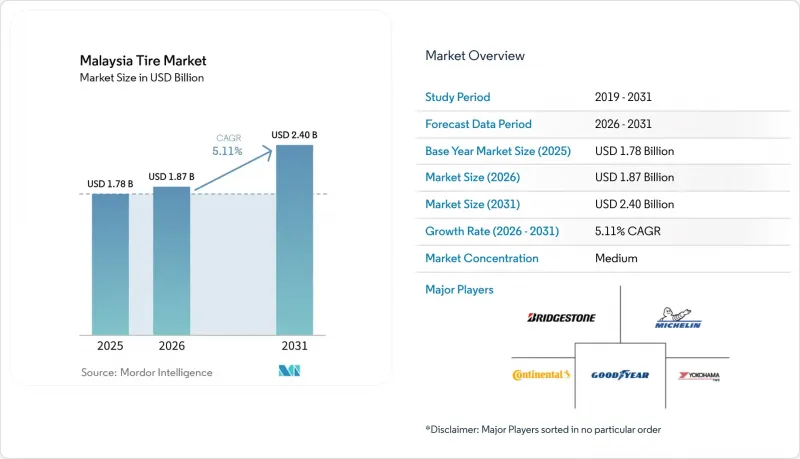
根據Mordor Intelligence的數據顯示,馬來西亞輪胎市場在2025年的價值為17.8億美元,預計到2026年將達到18.7億美元。預計從2026年到2031年,該市場將以5.11%的複合年成長率成長,到2031年將達到24億美元。
本報告按季節(例如夏季)、輪胎結構(子午線輪胎、斜交輪胎等)、車輛類型(摩托車、乘用車等)、應用領域(公路和越野)、最終用戶(原廠配套和售後市場)、輪圈尺寸(15英寸以下、15-20英寸、20英寸以上)以及驅動系統(例如內燃機車輛)進行細分。市場預測以價值(美元)和銷售量(單位)表示。
馬來西亞輪胎市場的趨勢和洞察
車輛擁有量正在擴大,這主要得益於汽車和摩托車擁有量的強勁成長。
馬來西亞乘用車數量的不斷成長和摩托車數量的龐大,造就了可預測的輪胎更換週期。摩托車輪胎平均每12至18個月更換一次,而乘用車則平均每3至5年更換一次。預計到2025年,馬來西亞國內汽車產業的總產量將逐步成長至約80萬輛。然而,預計更換需求將保持強勁,不受新車銷售波動的影響。由於公開市場價值計算公式的修訂,摩托車價格上漲,使用年限延長。這一趨勢也增加了輪胎更換的頻率。這些趨勢凸顯了售後市場的重要作用,售後市場佔整個市場的三分之二,並為在馬來西亞輪胎市場運營的零售商和服務連鎖店提供了穩定的收入來源。
政府基礎設施投資正在推動商用車輪胎的需求。
諸如耗資550億馬幣(約125億美元)的東海岸鐵路等大型基礎設施項目,預計將於2027年1月投入運營,這些項目在建設和物流階段都顯著推動了對重型輪胎的需求。此外,檳城正在建造的耗資100億馬幣的輕軌項目目前正在評估橡膠輪胎列車技術,這將進一步拓展特種輪胎的應用範圍。翻新輪胎的價格比新輪胎便宜約60%,目前已佔馬來西亞商用車輪胎市場的80%。預計這些輪胎將得到更廣泛的應用,尤其是在那些優先考慮成本最佳化的車隊營運商中。
天然橡膠價格波動及投入成本
生產者扶持計畫人為地設定了價格下限。同時,橡膠樹液採集(主要由小規模農戶承擔)經常受到天氣影響,導致供應衝擊,進而造成輪胎製造商利潤率的大幅波動。外匯波動進一步加劇了這種不確定性。馬幣走強會降低出口競爭力,而馬幣走弱會增加合成橡膠和添加劑的進口成本。此外,即將實施的生產者延伸責任制(EPR)預計將為製造商帶來合規成本。然而,這些法規也可能為利用再生輪胎材料創造新的收入來源提供機會。
細分市場分析
到2025年,全季輪胎將主導馬來西亞輪胎市場,佔高達71.28%的市場。這一趨勢反映了馬來西亞的熱帶氣候,減少了季節性更換輪胎的需求。全年穩定的需求使得製造商能夠最佳化生產計劃,經銷商能有效率地管理庫存。同時,夏季輪胎雖然市佔率較小,但預計到2031年將以5.13%的複合年成長率成長。這一成長主要得益於人們對賽車運動日益成長的興趣以及越來越多注重性能的消費者。此外,NSC 12/TC 11法規結構確保了所有類型輪胎的安全性,從而增強了消費者對市場的信心。
馬來西亞消費者在購買輪胎時,更注重便利性和整體擁有成本,而非輪胎的特定性能。因此,全季輪胎是馬來西亞輪胎市場的主要收入來源。為了應對馬來西亞的高濕度和高溫氣候,製造商正致力於提升輪胎的濕地抓地力和散熱性能等。這些努力確保了產品始終能夠滿足都市區和鄉村駕駛者的需求,並發揮其應有的作用。
預計到2025年,子午線輪胎將佔據馬來西亞輪胎市場87.27%的主導佔有率,這主要得益於其卓越的燃油效率和耐熱性。該行業的大規模生產體系確保了成本優勢,而斜交輪胎(目前主要用於農業和非公路等特定領域)的市場萎縮程度仍然有限。以米其林「Uptis」試點計畫為代表的無氣輪胎預計將以5.25%的複合年成長率成長。由於有望消除輪胎穿刺並減少停機時間,車隊管理人員對這些創新技術的興趣日益濃厚。
馬來西亞理科大學一項關於自修復天然橡膠化合物的研究凸顯了該國的創新能力,並表明無氣輪胎有望加速普及。隨著電子商務的蓬勃發展,商業運輸量不斷成長,預計馬來西亞企業將仔細權衡無氣輪胎帶來的營運成本節約與初始成本。
2025年,乘用車在馬來西亞輪胎市場佔據主導地位,市佔率高達54.52%。預計到2031年,該細分市場將以5.17%的複合年成長率成長,這主要得益於中產階級的壯大和A級車型的持續流行。然而,SUV和跨界車產量的增加正在改變市場需求趨勢,並推高了平均輪圈直徑和單價。此外,輕型商用車受益於「最後一公里」配送的擴張,而重型卡車則因基礎設施建設項目的推進而需求成長。
馬來西亞擁有龐大的摩托車保有量,每輛車平均每12至18個月就需要更換輪胎,這為售後市場提供了穩定的收入來源。同時,電動車(EV)目前僅佔新車註冊量的2.5%,但其數量的成長正在催生一個新興市場。這一細分市場需要低滾動阻力、高承載能力的專用輪胎。能夠有效滿足現有內燃機(ICE)汽車和不斷成長的電動車市場需求的供應商,將在馬來西亞輪胎市場的持續發展中佔據有利地位,從而獲得可觀的收益。
其他好處:
- Excel格式的市場預測(ME)表
- 3個月的分析師支持
目錄
第1章:引言
- 研究假設和市場定義
- 調查範圍
第2章:調查方法
第3章執行摘要
第4章 市場狀況
- 市場概覽
- 市場促進因素
- 汽車擁有量的擴張是由汽車和摩托車擁有量的穩定成長所推動的。
- 政府基礎設施投資正在提振商用車輪胎的需求。
- 轉向生產SUV和跨界車的OEM產品
- 海外擴張創造的生產能力
- 區域性電動車輪胎測試設施和標準的出現。
- 拓展數位化多品牌分銷/零售業務
- 市場限制因素
- 天然橡膠及投入成本的波動性
- 低價進口輪胎和翻新輪胎充斥市場。
- 當地工廠關閉
- 先進安全標籤法規的引入出現延誤
- 價值供應鏈分析
- 監理情勢
- 技術展望
- 波特五力模型
第5章 市場規模與成長預測
- 按季節
- 夏天
- 冬天
- 四季
- 輪胎設計
- 徑向
- 偏見
- 非氣動/無氣式
- 按車輛類型
- 摩托車
- 搭乘用車
- 輕型商用車
- 大型商用卡車和巴士
- 越野車和特殊車輛(OTR、農車、礦業用車、賽車)
- 透過使用
- 公路
- 越野
- 最終用戶
- OEM
- 售後市場
- 按輪圈尺寸
- 小於15英寸
- 15-20英寸
- 20吋或更大
- 透過推進力
- 內燃機車
- 電池式電動車
- 混合動力汽車和燃料電池汽車
第6章 競爭情勢
- 市場集中度
- 策略趨勢
- 市佔率分析
- 公司簡介
- Bridgestone Tyre Sales(Malaysia)Sdn Bhd
- Michelin Malaysia Sdn Bhd
- Continental Tyre PJ Malaysia Sdn Bhd
- Goodyear Malaysia Berhad
- Toyo Tyre Malaysia Sdn Bhd
- Hankook Tire Malaysia Sdn Bhd
- Pirelli Tyre(SE Asia)Pte Ltd(MY Ops)
- Kumho Tyre(Malaysia)Sdn Bhd
- Yokohama Tyre Sales Malaysia Sdn Bhd
- Giti Tire(Malaysia)
- Maxxis International(Malaysia)
- Silverstone Berhad
- Dunlop Tyre Malaysia
- Sumitomo Rubber(Falken)Malaysia
- Apollo Tyres(Malaysia)
- Cooperteams Distribution(Sunlun Group)
第7章 市場機會與未來展望
According to Mordor Intelligence, the malaysian tire market size was valued at USD 1.78 billion in 2025, is estimated at USD 1.87 billion in 2026, and is forecast to reach USD 2.40 billion by 2031 at a 5.11% CAGR over 2026-2031.
This report is Segmented by Season (Summer and More), Tire Design (Radial, Bias, and More), Vehicle Type (Two-Wheeler, Passenger Cars and More), Application (On-Road and Off-Road), End User (OEM and Aftermarket), Rim Size (Below 15 Inches, 15 To 20 Inches, and Above 20 Inches), and Propulsion (Internal-Combustion Vehicles and More). The Market Forecasts are Provided in Terms of Value (USD) and Volume (Units).
Malaysia Tire Market Trends and Insights
Expanding Vehicle Parc Driven by Strong Car and Motorcycle Ownership
Malaysia's expanding passenger car base and extensive motorcycle fleet drive predictable replacement cycles, with two-wheelers requiring replacements every 12-18 months and cars every 3-5 years. The total volume of the national vehicle industry is anticipated to moderate to approximately eight lakh units by 2025. However, replacement demand is expected to remain resilient, unaffected by fluctuations in new vehicle sales. The implementation of revisions to the open-market-value formula has resulted in higher motorcycle prices, prompting extended ownership durations. This trend has subsequently increased the frequency of tire replacements. These dynamics highlight the aftermarket's significant role, which accounts for two-thirds of the market, and ensure steady revenue streams for retailers and service chains operating within Malaysia's tire market.
Government Infrastructure Spend Spurring CV Tire Demand
Flagship infrastructure projects, such as the RM 55 billion (approximately USD 12.5 billion) East Coast Rail Link, which is scheduled to begin operations in January 2027, are significantly driving the demand for heavy-duty tires during both the construction and logistics phases. Additionally, the ongoing RM 10 billion Light Rail Transit project in Penang, where rubber-tired train technologies are currently under evaluation, is further broadening the scope of specialized tire applications. Retreaded tires, which are approximately 60% less expensive than new tires, already account for 80% of Malaysia's commercial vehicle segment. These tires are expected to witness increased adoption, particularly among fleet operators focused on cost optimization.
Natural-Rubber and Input-Cost Volatility
Farm gate support schemes establish artificial price floors. At the same time, weather-driven supply shocks, which are common in smallholder-dominated tapping, introduce significant volatility into the profit margins of tire manufacturers. Currency fluctuations further exacerbate this uncertainty. A stronger ringgit reduces export competitiveness, while a weaker currency increases the costs of importing synthetic rubber and additives. Additionally, the forthcoming extended producer responsibility regulations are expected to impose compliance costs on manufacturers. However, these regulations may also create opportunities for generating new revenue streams through the use of recycled tire materials.
Other drivers and restraints analyzed in the detailed report include:
- OEM Production Shift Toward SUVs and Crossovers
- Capacity Freed by Overseas Expansions
- Influx of Low-Priced Imports and Retreads
For complete list of drivers and restraints, kindly check the Table Of Contents.
Segment Analysis
In 2025, all-season tires dominated the Malaysian tire market, capturing a substantial 71.28% share. This trend reflects Malaysia's tropical climate, which reduces the necessity for seasonal tire changes. The consistent demand throughout the year allows producers to optimize their manufacturing schedules and enables distributors to maintain efficient inventories. At the same time, summer tires, despite their smaller market presence, are anticipated to grow at a CAGR of 5.13% through 2031. This growth is driven by increasing enthusiasm for motorsports and a rising number of performance-oriented consumers. Additionally, the NSC 12/TC 11 regulatory framework ensures safety consistency across all tire types, strengthening consumer confidence in the market.
When purchasing tires, consumers in Malaysia place greater importance on convenience and the overall cost of ownership rather than specialized performance features. Consequently, all-season tires have become the primary revenue contributors in the Malaysian tire market. Manufacturers are focusing on improving features such as wet grip and heat dissipation to address the country's high humidity and temperature conditions. This approach ensures that their products remain relevant and effective for drivers across both urban and rural areas.
In 2025, radial tires dominated the Malaysian tire market, capturing an impressive 87.27% share, driven by its advantages in fuel economy and heat resistance. The industry's large-scale production ensures cost benefits while limiting the shift from bias-ply tires, which remain primarily used for niche agricultural and off-road applications. Airless tire designs, led by Michelin's Uptis demonstrations, are anticipated to grow at a CAGR of 5.25%. Fleet managers are increasingly interested in these innovations due to their potential to eliminate punctures and reduce downtime.
Research conducted by Universiti Sains Malaysia on self-healing natural rubber compounds underscores the country's capacity for innovation and suggests a potential acceleration in the adoption of airless tires. With the expansion of e-commerce driving higher commercial delivery volumes, Malaysian operators are expected to carefully evaluate the operational savings offered by non-pneumatic tire options against their initial costs.
In 2025, passenger cars commanded a dominant 54.52% share of Malaysia's tire market. Projections indicate this segment will expand at a 5.17% CAGR through 2031, supported by a growing middle class and the continued appeal of A segment models. However, the increasing production of SUVs and crossovers is altering demand dynamics, pushing up average rim diameters and unit prices. Additionally, light commercial vehicles are benefiting from the growth in last-mile deliveries, while heavy-duty trucks are experiencing increased demand due to ongoing infrastructure projects.
Malaysia has a vast fleet of two-wheelers, each replacing tires every 12 to 18 months, ensuring a steady stream of aftermarket revenue. On another front, while electric vehicles (EVs) currently account for just 2.5% of new registrations, their rise is creating a niche market. This segment requires specialized tires that offer low rolling resistance and high load capacity. Suppliers who can effectively cater to both the established internal combustion engine (ICE) fleets and the growing EV market are well-positioned to capture significant value as Malaysia's tire landscape continues to evolve.
Complete Report Scope:
- By Season
- Summer
- Winter
- All-Season
- By Tire Design
- Radial
- Bias
- Non-Pneumatic/Airless
- By Vehicle Type
- Two-Wheelers
- Passenger Cars
- Light Commercial Vehicles
- Heavy Commercial Trucks and Buses
- Off-the-Road and Specialty (OTR, Agriculture, Mining, Racing)
- By Application
- On-Road
- Off-Road
- By End User
- OEM
- Aftermarket
- By Rim Size
- Below 15 inches
- 15 to 20 inches
- Above 20 inches
- By Propulsion
- Internal-Combustion Vehicles
- Battery-Electric Vehicles
- Hybrid and Fuel-Cell Vehicles
List of Companies Covered in this Report:
- Bridgestone Tyre Sales (Malaysia) Sdn Bhd
- Michelin Malaysia Sdn Bhd
- Continental Tyre PJ Malaysia Sdn Bhd
- Goodyear Malaysia Berhad
- Toyo Tyre Malaysia Sdn Bhd
- Hankook Tire Malaysia Sdn Bhd
- Pirelli Tyre (S.E. Asia) Pte Ltd (MY Ops)
- Kumho Tyre (Malaysia) Sdn Bhd
- Yokohama Tyre Sales Malaysia Sdn Bhd
- Giti Tire (Malaysia)
- Maxxis International (Malaysia)
- Silverstone Berhad
- Dunlop Tyre Malaysia
- Sumitomo Rubber (Falken) Malaysia
- Apollo Tyres (Malaysia)
- Cooperteams Distribution (Sunlun Group)
Additional Benefits:
- The market estimate (ME) sheet in Excel format
- 3 months of analyst support
TABLE OF CONTENTS
1 Introduction
- 1.1 Study Assumptions and Market Definition
- 1.2 Scope of the Study
2 Research Methodology
3 Executive Summary
4 Market Landscape
- 4.1 Market Overview
- 4.2 Market Drivers
- 4.2.1 Expanding Vehicle Parc Driven by Strong Car and Motorcycle Ownership
- 4.2.2 Government Infrastructure Spend Spurring CV Tire Demand
- 4.2.3 OEM Production Shift Toward SUVs and Crossovers
- 4.2.4 Capacity Freed by Overseas Expansions
- 4.2.5 Local EV-Tire Testing Labs and Standards Emergence
- 4.2.6 Digitalised Multi-Brand Distribution/Retail Expansion
- 4.3 Market Restraints
- 4.3.1 Natural-Rubber and Input-Cost Volatility
- 4.3.2 Influx of Low-Priced Imports and Retreads
- 4.3.3 Local Plant Closures
- 4.3.4 Slow Roll-Out of Advanced Safety Labelling Regulations
- 4.4 Value/Supply-Chain Analysis
- 4.5 Regulatory Landscape
- 4.6 Technological Outlook
- 4.7 Porter's Five Forces
- 4.7.1 Rivalry Among Existing Competitors
- 4.7.2 Threat of New Entrants
- 4.7.3 Bargaining Power of Suppliers
- 4.7.4 Bargaining Power of Buyers
- 4.7.5 Threat of Substitutes
5 Market Size and Growth Forecasts (Value (USD) and Volume (Units))
- 5.1 By Season
- 5.1.1 Summer
- 5.1.2 Winter
- 5.1.3 All-Season
- 5.2 By Tire Design
- 5.2.1 Radial
- 5.2.2 Bias
- 5.2.3 Non-Pneumatic/Airless
- 5.3 By Vehicle Type
- 5.3.1 Two-Wheelers
- 5.3.2 Passenger Cars
- 5.3.3 Light Commercial Vehicles
- 5.3.4 Heavy Commercial Trucks and Buses
- 5.3.5 Off-the-Road and Specialty (OTR, Agriculture, Mining, Racing)
- 5.4 By Application
- 5.4.1 On-Road
- 5.4.2 Off-Road
- 5.5 By End User
- 5.5.1 OEM
- 5.5.2 Aftermarket
- 5.6 By Rim Size
- 5.6.1 Below 15 inches
- 5.6.2 15 to 20 inches
- 5.6.3 Above 20 inches
- 5.7 By Propulsion
- 5.7.1 Internal-Combustion Vehicles
- 5.7.2 Battery-Electric Vehicles
- 5.7.3 Hybrid and Fuel-Cell Vehicles
6 Competitive Landscape
- 6.1 Market Concentration
- 6.2 Strategic Moves
- 6.3 Market Share Analysis
- 6.4 Company Profiles (Includes Global Level Overview, Market Level Overview, Core Segments, Financials as Available, Strategic Information, Market Rank/Share for Key Companies, Products and Services, SWOT Analysis, and Recent Developments)
- 6.4.1 Bridgestone Tyre Sales (Malaysia) Sdn Bhd
- 6.4.2 Michelin Malaysia Sdn Bhd
- 6.4.3 Continental Tyre PJ Malaysia Sdn Bhd
- 6.4.4 Goodyear Malaysia Berhad
- 6.4.5 Toyo Tyre Malaysia Sdn Bhd
- 6.4.6 Hankook Tire Malaysia Sdn Bhd
- 6.4.7 Pirelli Tyre (S.E. Asia) Pte Ltd (MY Ops)
- 6.4.8 Kumho Tyre (Malaysia) Sdn Bhd
- 6.4.9 Yokohama Tyre Sales Malaysia Sdn Bhd
- 6.4.10 Giti Tire (Malaysia)
- 6.4.11 Maxxis International (Malaysia)
- 6.4.12 Silverstone Berhad
- 6.4.13 Dunlop Tyre Malaysia
- 6.4.14 Sumitomo Rubber (Falken) Malaysia
- 6.4.15 Apollo Tyres (Malaysia)
- 6.4.16 Cooperteams Distribution (Sunlun Group)
7 Market Opportunities and Future Outlook
- 7.1 White-Space and Unmet-Need Assessment

 車輪擋塊市場:全球市場預測,2026-2032年零壓球囊市場:全球市場預測,2026-2032年乘用車替換輪胎市場:全球市場預測,2026-2032年乘用車輪胎售後市場:全球市場預測,2026-2032年
 歐洲輪胎市場:市場佔有率分析、產業趨勢與統計、成長預測(2026-2031)泰國輪胎市場:市佔率分析、產業趨勢與統計、成長預測(2026-2031)美國輪胎:市場佔有率分析、產業趨勢與統計、成長預測(2026-2031)越南輪胎市場:市場佔有率分析、產業趨勢與統計、成長預測(2026-2031)非洲輪胎:市場佔有率分析、產業趨勢與統計、成長預測(2026-2031)印尼輪胎市場:市佔率分析、產業趨勢與統計、成長預測(2026-2031)