


 |
市場調查報告書
商品編碼
2117442
歐洲輪胎市場:市場佔有率分析、產業趨勢與統計、成長預測(2026-2031)Europe Tire - Market Share Analysis, Industry Trends & Statistics, Growth Forecasts (2026 - 2031) |
||||||

※ 本網頁內容可能與最新版本有所差異。詳細情況請與我們聯繫。
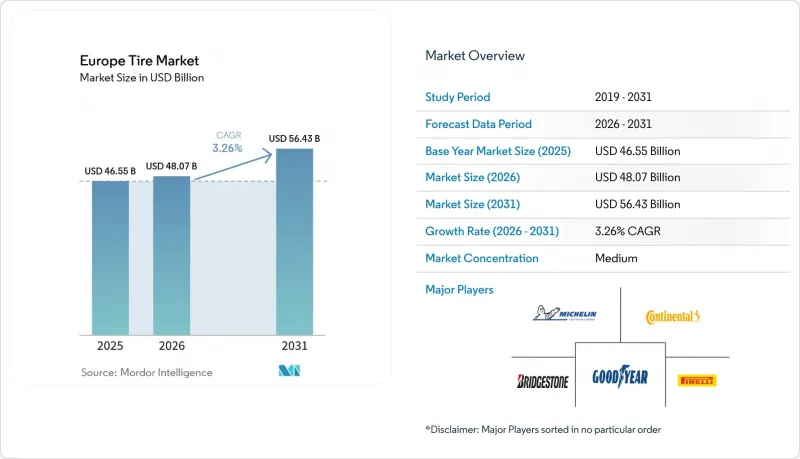
據 Mordor Intelligence 稱,2025 年歐洲輪胎市場價值 465.5 億美元,預計 2026 年將達到 480.7 億美元,預計到 2031 年將達到 564.3 億美元。
預計從 2026 年到 2031 年,其複合年成長率將達到 3.26%。
本報告按季節(夏季、冬季、其他)、輪胎結構(子午線輪胎、斜交輪胎、其他)、車輛類型(摩托車、乘用車、輕型商用車、其他)、應用領域(公路和越野)、最終用戶(原廠配套和售後市場)、輪圈尺寸(15英寸以下、15-20英寸、其他)、驅動系統和國家/地區進行細分。市場預測以價值(美元)和銷售量(單位)表示。
歐洲輪胎市場的趨勢和洞察
對專為電動車設計的輪胎(低噪音、高載重指數)的需求
電池組雖然會使車輛重量增加約 150-200 公斤,但其扭力的提升顯著提高了車輛性能。然而,使用傳統輪胎配方時,增加的扭力會使胎面壽命縮短高達 20%。為了應對這項挑戰,韓泰輪胎的「iON」系列採用了先進的隔音泡棉襯墊,可在不增加滾動阻力的前提下,有效降低 9.2 分貝的車內噪音。這項創新技術在提升整體駕駛體驗的同時,也維持了能源效率。此外,該細分市場採用的高階定價策略有助於抵消研發成本和生產所需的特殊成型製程所帶來的高昂成本。因此,該細分市場正經歷強勁成長,在所有動力系統類別中實現了最高的成長率。
推廣低滾動阻力輪胎的綠色新政
為配合歐盟的脫碳目標,實現低滾動阻力性能已成為輪胎製造商的基本要求。 A級輪胎旨在最佳化燃油效率,預計將大幅節省能源,到2030年,歐盟每年預計可節省高達57太瓦時(TWh)的燃油。這一趨勢凸顯了輪胎技術在支持歐盟永續性目標方面發揮的關鍵作用。為了達到這些性能標準,製造商正在採用創新方法,例如將先進的胎面花紋設計與源自稻殼灰的二氧化矽相結合。這種組合不僅提高了濕地抓地力,還延長了胎面壽命,從而確保了安全性和耐用性之間的平衡。倍耐力永續輪胎系列就是這項創新的傑出範例,該系列已將這項技術商業化,以滿足環保和性能方面的雙重要求。此外,車隊負責人在做出採購決策時越來越重視總擁有成本(TCO)。這種關注點的轉變正在推動A級輪胎的普及,尤其是在投資回收期小於兩年的情況下。對總擁有成本的重視反映了車隊營運商尋求平衡營運效率和永續性的日益成長的趨勢,進一步加速了向更節能的輪胎解決方案的過渡。
原料價格(天然橡膠和合成橡膠)劇烈波動
2024年,天然橡膠價格較上一季大幅上漲,反映出顯著的市場動態。 2025年2月,合成橡膠價格指數升至120.2,顯示價格趨勢有重大轉變。東南亞爆發的葉斑病擾亂了該地區的生產,嚴重限制了橡膠供應。同時,亞洲至歐洲航線的運費翻了三倍,進一步加劇了運輸成本,並對整個供應鏈造成衝擊。與目的地設備製造商(OEM)簽訂的價格協議限制了製造商將這些增加的成本完全轉嫁給最終用戶。這種限制擠壓了製造商的利潤空間,迫使他們尋求其他策略。為此,許多生產商實現了原料多元化,以降低風險並適應不斷變化的市場環境。這些趨勢凸顯了橡膠產業面臨的挑戰,並強調了進行策略調整以有效應對當前市場環境的必要性。
細分市場分析
預計到2025年,全季輪胎將佔歐洲輪胎市場47.15%的佔有率,到2031年年複合成長率(CAGR)將達到3.88%。德國、法國和波蘭等大都會圈的消費者越來越偏好選擇全季輪胎,這主要得益於其全年只需一套輪胎即可滿足各種需求,降低了倉儲成本。製造商正在利用先進的富矽自適應複合材料,使輪胎在7 度C以下保持柔軟性,並在30 度C以上保持抗變形能力。儘管全季輪胎的市佔率不斷擴大,但在西班牙和義大利,注重性能的消費者仍然非常青睞夏季輪胎,因為他們更重視輪胎在高溫條件下的卓越抓地力。同時,由於嚴格的法規和惡劣的氣候條件,北歐地區仍然強制使用冬季輪胎。全季輪胎日益普及簡化了零售商的庫存管理,這在電子商務持續發展的背景下尤其有利。這一趨勢也有助於穩定需求,使製造工廠能夠接近運作運轉,從而提高了市場領導者的成本效益和盈利。
原始設備製造商 (OEM) 在洽談供應合約時,會仔細分析全季輪胎產品線對歐洲輪胎市場整體規模的影響。諾記輪胎的「Seasonproof」系列輪胎表現出色,該系列輪胎採用 38% 的永續材料,實現了兩位數的成長。隨著雪花標誌和濕地抓地力評分等標籤要求在法律規範中日益重要,輪胎供應商正在改進胎面設計,以達到甚至超越這些標準。這些努力不僅確保了合規性,還有助於與競爭對手區分開來,使供應商能夠在競爭日益激烈的市場環境中鞏固其市場地位。
2025年,子午線輪胎繼續主導歐洲輪胎市場,佔高達94.16%的市場。這種鋼絲帶束層結構不僅增強了胎面穩定性,也提高了燃油效率,與歐盟的能源效率目標高度契合。同時,斜交輪胎也維持一定的市場佔有率,主要應用於農業領域,其低速行駛時發熱量低的優勢使其備受青睞。另一方面,米其林和通用汽車聯合開發的「UPTIS」等新型無氣輪胎原型正引起廣泛關注。這些無氣輪胎目前正在都市區穿梭巴士上進行實地測試,預計到2031年將以5.56%的複合年成長率成長。其關鍵特性,例如抗穿刺性和低維護成本,使其成為自動駕駛汽車開發商的理想選擇。
然而,仍存在一些技術挑戰。為了滿足乘坐舒適性標準,設計人員需要解決輻條結構引起的振動和噪音等問題。此外,能否實現與傳統子午線輪胎相當的成本,取決於複雜的聚氨酯複合材料成型過程能否成功實現大規模生產。儘管存在這些挑戰,但在2024年慕尼黑國際展覽會(IAA)上的公開演示表明,目的地設備製造商(OEM)對無氣輪胎的興趣日益濃厚。這種日益成長的關注度,是由技術進步和消費者偏好的轉變所驅動的,表明無氣輪胎的普及發展軌跡可能與電動車(EV)市場的擴張軌跡類似。
到2025年,在歐洲龐大的汽車保有量支撐下,乘用車將佔據歐洲輪胎市場58.33%的顯著佔有率。持續的電氣化轉型正在推動高階輪胎需求的顯著成長,因為電動車車主優先考慮低噪音、高承載能力且適合其車輛的輪胎。此外,電子商務的蓬勃發展也帶動了輕型商用車的需求,導致其輪胎更換週期比重型卡車更快。在義大利和西班牙等國家,摩托車仍然是重要的交通工具,對摩托車輪胎的需求保持穩定。
預計到2031年,歐洲乘用車輪胎市場將以4.11%的複合年成長率成長。原始設備製造商(OEM)擴大指定使用更大直徑的輪輞,輪胎製造商則透過採用先進的增強織物和輪胎邊緣輪廓等技術創新來滿足這些需求。車隊營運商,尤其是廂型車營運商,正致力於使用耐磨輪胎配方和支援RFID技術的追蹤系統來減少運作。大陸集團和Bridgestone等主要企業正在進入這一領域,並試行整合輪胎、感測器和維護服務的訂閱模式,為車隊買家提供全面的解決方案。
其他好處:
- Excel格式的市場預測(ME)表
- 3個月的分析師支持
目錄
第1章:引言
- 研究假設和市場定義
- 調查範圍
第2章:調查方法
第3章執行摘要
第4章 市場狀況
- 市場概覽
- 市場促進因素
- 電氣化所帶來的輪胎需求
- 透過綠色新政推廣低滾動阻力輪胎
- 四季輪胎在中歐和西歐的使用正在迅速增加。
- 透過電子商務和直接面對消費者的銷售方式促進輪胎零售市場的成長
- 原始設備製造商 (OEM) 對回收材料和生物衍生化合物的工廠填充義務
- 人工智慧驅動的預測性維護正在推動智慧輪胎的普及。
- 市場限制因素
- 原料價格波動很大(天然橡膠和合成橡膠)。
- 歐盟對中國製造的卡車和客車輪胎徵收反傾銷稅,給進口結構帶來了壓力。
- 由於電動車車身重量較大,人們對輪胎磨損的擔憂導致輪胎更換週期縮短。
- 新建熱解和RCB工廠的授權流程延誤,限制了再生原料的供應。
- 價值供應鏈分析
- 監理情勢
- 技術展望
- 波特五力模型
第5章 市場規模與成長預測
- 按季節
- 夏天
- 冬天
- 四季
- 輪胎設計
- 徑向
- 偏見
- 非氣動/無氣式
- 按車輛類型
- 摩托車
- 搭乘用車
- 輕型商用車
- 大型商用卡車和巴士
- 越野車和特殊車輛(OTR、農車、礦業用車、賽車)
- 透過使用
- 公路
- 非公路用途(建築、礦業、農業)
- 最終用戶
- OEM
- 售後市場(替換件和翻新件)
- 按輪圈尺寸
- 小於15英寸
- 15-20英寸
- 20吋或更大
- 透過推進力
- 內燃機車
- 電池式電動車
- 混合動力汽車和燃料電池汽車
- 國家
- 德國
- 英國
- 法國
- 義大利
- 西班牙
- 俄羅斯
- 其他歐洲國家
第6章 競爭情勢
- 市場集中度
- 策略趨勢
- 市佔率分析
- 公司簡介
- Michelin
- Continental AG
- Bridgestone Corporation
- The Goodyear Tire & Rubber Company
- Pirelli & CSpA
- Nokian Tyres plc
- Hankook Tire Europe
- Apollo Vredestein BV
- Yokohama Europe GmbH
- Toyo Tire Europe GmbH
- Sumitomo Rubber Europe(Falken)
- Kumho Tire Europe
- Giti Tire Deutschland GmbH
- Sailun Group Co. Ltd.
- Mitas as(Trelleborg)
- Triangle Tyre Co. Ltd.
- Titan International(Titan Europe)
- Nexen Tire Europe
- Prometeon Tyre Group
- Linglong Tire Europe
第7章 市場機會與未來展望
According to Mordor Intelligence, the european tire market size was valued at USD 46.55 billion in 2025, is estimated at USD 48.07 billion in 2026, and is projected to reach USD 56.43 billion by 2031, growing at a CAGR of 3.26% over 2026-2031.
This report is Segmented by Season (Summer, Winter, and More), Tire Design (Radial, Bias, and More), Vehicle Type (Two-Wheeler, Passenger Cars, Light Commercial Vehicles, and More), Application (On-Road and Off-Road), End User (OEM and Aftermarket), Rim Size (Below 15 Inches, 15 To 20 Inches, and More), Propulsion, and Country. The Market Forecasts are Provided in Terms of Value (USD) and Volume (Units).
Europe Tire Market Trends and Insights
Electrification-Specific Tire Demand (Low Noise, Higher Load Index)
Battery packs, which add approximately 150-200 kg to a vehicle's curb weight, significantly improve performance by increasing torque. This added torque, however, results in a reduction of tread life by up to 20% when using conventional tire compounds. To address such challenges, Hankook's iON series incorporates advanced acoustic foam liners that effectively reduce cabin noise levels by 9.2 dB, without compromising rolling resistance. This innovation enhances the overall driving experience while maintaining energy efficiency. Furthermore, the premium pricing strategy adopted in this segment helps offset the higher costs associated with research and development, as well as the specialized molding processes required for production. As a result, this segment is experiencing robust growth, marking the highest expansion rate among all propulsion categories in the market.
Green-Deal Push for Low-Rolling-Resistance Tires
In alignment with the European Union's decarbonization targets, achieving low-rolling-resistance performance has become a fundamental requirement for tire manufacturers. Class A tires, which are designed to optimize fuel efficiency, are anticipated to deliver significant energy savings, with projections estimating up to 57 TWh of annual fuel savings across the EU by 2030. This development underscores the critical role of tire technology in supporting the region's sustainability goals. To meet these performance standards, manufacturers are employing innovative approaches, such as integrating advanced tread designs with rice-husk-ash silica. This combination not only enhances wet grip but also extends tread life, ensuring a balance between safety and durability. A notable example of this innovation is Pirelli's sustainable tire range, which has already commercialized this technology to address both environmental and performance demands. Additionally, fleet buyers are increasingly prioritizing the total cost of ownership (TCO) when making purchasing decisions. This shift in focus is driving the adoption of Class A tires, particularly in scenarios where the payback period for the investment is less than two years. The emphasis on TCO reflects a broader trend among fleet operators to align operational efficiency with sustainability objectives, further accelerating the transition to energy-efficient tire solutions.
High Raw-Material Price Volatility (Natural and Synthetic Rubber)
In 2024, natural rubber prices experienced a significant quarter-on-quarter increase, reflecting notable market dynamics. By February 2025, synthetic rubber indices had climbed to 120.2, indicating a marked shift in pricing trends. The rubber supply faced substantial constraints due to a leaf-fall disease outbreak in Southeast Asia, which disrupted production in the region. Simultaneously, freight rates on Asia-to-Europe shipping lanes surged threefold, further exacerbating delivery costs and impacting the overall supply chain. Original equipment manufacturer (OEM) pricing contracts restricted producers from fully passing on these increased costs to end-users. This limitation resulted in compressed profit margins for producers, compelling them to explore alternative strategies. In response, many producers began diversifying their feedstocks to mitigate risks and adapt to the evolving market conditions. These developments underscore the challenges faced by the rubber industry and highlight the need for strategic adjustments to navigate the current market environment effectively.
Other drivers and restraints analyzed in the detailed report include:
- Surge in All-Season Tire Fitment Across Central and Western Europe
- E-Commerce and Direct-to-Consumer Tire Retail Growth
- EU Anti-Dumping Duties on Chinese Truck/Bus Tires Pressuring Import Mix
For complete list of drivers and restraints, kindly check the Table Of Contents.
Segment Analysis
In 2025, all-season tires accounted for a 47.15% share of the European tire market, with forecasts indicating a compound annual growth rate (CAGR) of 3.88% through 2031. The increasing preference for all-season tires among consumers in metropolitan areas of Germany, France, and Poland is driven by the convenience of using a single tire set throughout the year and the associated reduction in storage costs. Manufacturers are leveraging advanced adaptive silica-rich compounds that maintain flexibility at temperatures below 7 °C while resisting deformation at temperatures exceeding 30 °C. Despite the growing dominance of all-season tires, summer tires continue to hold significant appeal among performance-oriented consumers in Spain and Italy, who prioritize superior grip in high-temperature conditions. Meanwhile, winter tires remain mandatory in Nordic regions due to stringent regulations and extreme weather conditions. The widespread adoption of all-season tires simplifies inventory management for retailers, which is particularly advantageous as e-commerce continues to expand. This trend also contributes to demand stability, enabling manufacturing facilities to operate closer to their full capacity, thereby improving cost efficiency and profitability for leading market players.
Original equipment manufacturers (OEMs), when negotiating supply contracts, closely analyze the contributions of all-season tire lines to the overall size of the European tire market. Nokian Tyres has reported robust performance in its Seasonproof range, achieving double-digit growth following the incorporation of 38% sustainable material content. As regulatory frameworks increasingly emphasize labeling requirements, such as snowflake markings and wet-grip performance scores, tire suppliers are refining tread designs to meet and exceed these standards. These efforts not only ensure compliance but also enhance competitive differentiation, allowing suppliers to strengthen their market positioning in an increasingly competitive landscape.
In 2025, radial construction continued to dominate the European tire market, accounting for a significant 94.16% share. This steel-belted architecture not only enhances tread stability but also improves fuel efficiency, aligning closely with the European Union's energy efficiency objectives. Bias designs, on the other hand, have maintained their presence primarily in the agricultural sector, where their performance benefits from reduced heat build-up at lower operating speeds. Meanwhile, non-pneumatic prototypes, such as Michelin-GM's UPTIS, are gaining traction. These airless tires, currently undergoing pilot programs with urban shuttle fleets, are projected to grow at a CAGR of 5.56% through 2031. Their key features, including puncture immunity and reduced maintenance requirements, make them particularly appealing to developers of autonomous vehicles.
However, several technological challenges remain. Designers are tasked with addressing issues such as vibration and noise generated by spoke structures to ensure compliance with ride-comfort standards. Additionally, achieving cost parity with traditional radial alternatives depends on the successful scaling of complex polyurethane composite molding processes. Despite these hurdles, public demonstrations at the 2024 Munich IAA showcased increasing interest from original equipment manufacturers (OEMs). This growing attention suggests that the adoption of airless tires may follow a trajectory similar to the expansion of the electric vehicle (EV) market, driven by advancements in technology and evolving consumer preferences.
In 2025, passenger cars accounted for a significant 58.33% share of the European tire market, supported by the region's extensive car parc. The ongoing shift towards electrification has notably increased the demand for premium tires, as electric vehicle (EV) owners prioritize low-noise and high-load tire options to complement their vehicles. Additionally, the growth of e-commerce has driven the demand for light commercial vehicles, resulting in replacement cycles that surpass those of heavy trucks. In countries like Italy and Spain, motorcycles continue to serve as a critical mode of mobility, maintaining a consistent demand for two-wheeler tires.
Europe's passenger car tire market is anticipated to grow at a CAGR of 4.11% through 2031. Original equipment manufacturers (OEMs) are increasingly specifying larger rim diameters, prompting tire manufacturers to innovate with advanced reinforcing fabrics and bead profiles to meet these requirements. Fleet operators, particularly those managing van fleets, are focusing on high-wear tire compounds and RFID-enabled tracking systems to reduce operational downtime. This segment has attracted key players such as Continental and Bridgestone, who are piloting subscription-based models that integrate tires, sensors, and maintenance services, offering a comprehensive solution to fleet buyers.
Complete Report Scope:
- By Season
- Summer
- Winter
- All-Season
- By Tire Design
- Radial
- Bias
- Non-pneumatic/Airless
- By Vehicle Type
- Two-Wheelers
- Passenger Cars
- Light Commercial Vehicles
- Heavy Commercial Trucks and Buses
- Off-the-Road and Specialty (OTR, Agriculture, Mining, Racing)
- By Application
- On-Road
- Off-Road (Construction, Mining, Agriculture)
- By End User
- OEM
- Aftermarket (Replacement and Retread)
- By Rim Size
- Below 15 inches
- 15 - 20 inches
- Above 20 inches
- By Propulsion
- Internal-Combustion Vehicles
- Battery-Electric Vehicles
- Hybrid and Fuel-Cell Vehicles
- By Country
- Germany
- United Kingdom
- France
- Italy
- Spain
- Russia
- Rest of Europe
List of Companies Covered in this Report:
- Michelin
- Continental AG
- Bridgestone Corporation
- The Goodyear Tire & Rubber Company
- Pirelli & C. S.p.A.
- Nokian Tyres plc
- Hankook Tire Europe
- Apollo Vredestein B.V.
- Yokohama Europe GmbH
- Toyo Tire Europe GmbH
- Sumitomo Rubber Europe (Falken)
- Kumho Tire Europe
- Giti Tire Deutschland GmbH
- Sailun Group Co. Ltd.
- Mitas a.s. (Trelleborg)
- Triangle Tyre Co. Ltd.
- Titan International (Titan Europe)
- Nexen Tire Europe
- Prometeon Tyre Group
- Linglong Tire Europe
Additional Benefits:
- The market estimate (ME) sheet in Excel format
- 3 months of analyst support
TABLE OF CONTENTS
1 Introduction
- 1.1 Study Assumptions and Market Definition
- 1.2 Scope of the Study
2 Research Methodology
3 Executive Summary
4 Market Landscape
- 4.1 Market Overview
- 4.2 Market Drivers
- 4.2.1 Electrification-Specific Tire Demand
- 4.2.2 Green-Deal Push for Low-Rolling-Resistance Tires
- 4.2.3 Surge in All-Season Tire Fitment Across Central and Western Europe
- 4.2.4 E-Commerce and Direct-to-Consumer Tire Retail Growth
- 4.2.5 OEM Factory-Fill Mandates for Recycled and Bio-Based Compounds
- 4.2.6 AI-Enabled Predictive Maintenance Boosting Smart-Tire Adoption
- 4.3 Market Restraints
- 4.3.1 High Raw-Material Price Volatility (Natural and Synthetic Rubber)
- 4.3.2 EU Anti-Dumping Duties on Chinese Truck/Bus Tires Pressuring Import Mix
- 4.3.3 EV Curb-Weight Driven Tread-Wear Concerns Shortening Replacement Cycles
- 4.3.4 Slow Permitting for New Pyrolysis and RCB Plants Limiting Circular Feedstock
- 4.4 Value/Supply-Chain Analysis
- 4.5 Regulatory Landscape
- 4.6 Technological Outlook
- 4.7 Porter's Five Forces
- 4.7.1 Threat of New Entrants
- 4.7.2 Bargaining Power of Suppliers
- 4.7.3 Bargaining Power of Buyers
- 4.7.4 Threat of Substitutes
- 4.7.5 Competitive Rivalry
5 Market Size and Growth Forecasts (Value (USD) and Volume (Units))
- 5.1 By Season
- 5.1.1 Summer
- 5.1.2 Winter
- 5.1.3 All-Season
- 5.2 By Tire Design
- 5.2.1 Radial
- 5.2.2 Bias
- 5.2.3 Non-pneumatic/Airless
- 5.3 By Vehicle Type
- 5.3.1 Two-Wheelers
- 5.3.2 Passenger Cars
- 5.3.3 Light Commercial Vehicles
- 5.3.4 Heavy Commercial Trucks and Buses
- 5.3.5 Off-the-Road and Specialty (OTR, Agriculture, Mining, Racing)
- 5.4 By Application
- 5.4.1 On-Road
- 5.4.2 Off-Road (Construction, Mining, Agriculture)
- 5.5 By End User
- 5.5.1 OEM
- 5.5.2 Aftermarket (Replacement and Retread)
- 5.6 By Rim Size
- 5.6.1 Below 15 inches
- 5.6.2 15 - 20 inches
- 5.6.3 Above 20 inches
- 5.7 By Propulsion
- 5.7.1 Internal-Combustion Vehicles
- 5.7.2 Battery-Electric Vehicles
- 5.7.3 Hybrid and Fuel-Cell Vehicles
- 5.8 By Country
- 5.8.1 Germany
- 5.8.2 United Kingdom
- 5.8.3 France
- 5.8.4 Italy
- 5.8.5 Spain
- 5.8.6 Russia
- 5.8.7 Rest of Europe
6 Competitive Landscape
- 6.1 Market Concentration
- 6.2 Strategic Moves
- 6.3 Market Share Analysis
- 6.4 Company Profiles (Includes Global Level Overview, Market Level Overview, Core Segments, Financials as Available, Strategic Information, Market Rank/Share for Key Companies, Products and Services, SWOT Analysis, and Recent Developments)
- 6.4.1 Michelin
- 6.4.2 Continental AG
- 6.4.3 Bridgestone Corporation
- 6.4.4 The Goodyear Tire & Rubber Company
- 6.4.5 Pirelli & C. S.p.A.
- 6.4.6 Nokian Tyres plc
- 6.4.7 Hankook Tire Europe
- 6.4.8 Apollo Vredestein B.V.
- 6.4.9 Yokohama Europe GmbH
- 6.4.10 Toyo Tire Europe GmbH
- 6.4.11 Sumitomo Rubber Europe (Falken)
- 6.4.12 Kumho Tire Europe
- 6.4.13 Giti Tire Deutschland GmbH
- 6.4.14 Sailun Group Co. Ltd.
- 6.4.15 Mitas a.s. (Trelleborg)
- 6.4.16 Triangle Tyre Co. Ltd.
- 6.4.17 Titan International (Titan Europe)
- 6.4.18 Nexen Tire Europe
- 6.4.19 Prometeon Tyre Group
- 6.4.20 Linglong Tire Europe
7 Market Opportunities and Future Outlook
- 7.1 White-space and Unmet-Need Assessment

 車輪擋塊市場:全球市場預測,2026-2032年零壓球囊市場:全球市場預測,2026-2032年乘用車替換輪胎市場:全球市場預測,2026-2032年乘用車輪胎售後市場:全球市場預測,2026-2032年
 泰國輪胎市場:市佔率分析、產業趨勢與統計、成長預測(2026-2031)美國輪胎:市場佔有率分析、產業趨勢與統計、成長預測(2026-2031)越南輪胎市場:市場佔有率分析、產業趨勢與統計、成長預測(2026-2031)非洲輪胎:市場佔有率分析、產業趨勢與統計、成長預測(2026-2031)馬來西亞輪胎:市場佔有率分析、產業趨勢與統計、成長預測(2026-2031)印尼輪胎市場:市佔率分析、產業趨勢與統計、成長預測(2026-2031)