


 |
市場調查報告書
商品編碼
2117450
印尼輪胎市場:市佔率分析、產業趨勢與統計、成長預測(2026-2031)Indonesia Tire - Market Share Analysis, Industry Trends & Statistics, Growth Forecasts (2026 - 2031) |
||||||

※ 本網頁內容可能與最新版本有所差異。詳細情況請與我們聯繫。
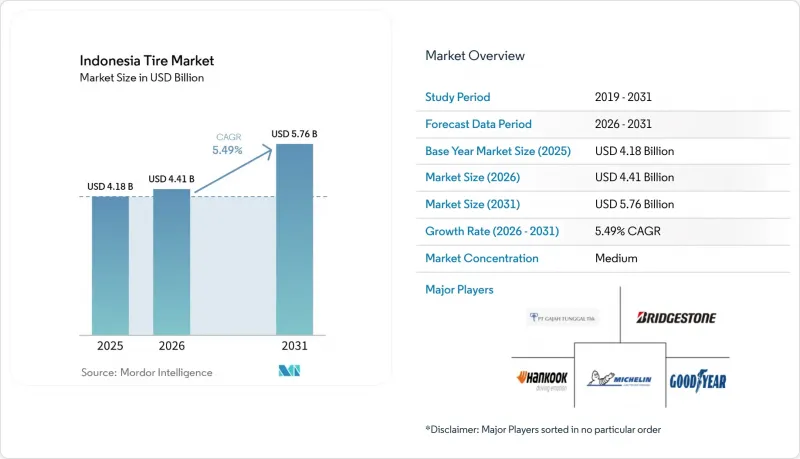
據 Mordor Intelligence 稱,2025 年印尼輪胎市場價值 41.8 億美元,2026 年預計為 44.1 億美元,預計到 2031 年將達到 57.6 億美元。
預計 2026 年至 2031 年的年複合成長率(CAGR)為 5.49%。
本報告按季節(夏季、冬季等)、輪胎結構(子午線輪胎、斜交輪胎等)、車輛類型(摩托車、乘用車等)、應用領域(公路和越野)、最終用戶(原廠配套和售後市場)、輪圈尺寸(15英寸以下、15-20英寸、其他)以及驅動系統(內燃機、其他)進行細分。市場預測以價值(美元)和銷售(單位)呈現。
印尼輪胎市場趨勢與洞察
疫情後摩托車擁有量激增
2025年12月,隨著通勤者尋求減少對大眾運輸的依賴,摩托車銷售量顯著回升。在印度尼西亞,2025年12月摩托車銷量達到461,925輛,較上年同期成長14.5%,這是該市場連續第五個月實現成長。輪胎磨損加劇,尤其是在使用大排氣量摩托車進行城際旅行的活躍騎士群中,導致輪胎更換週期約為12至18個月。此外,數位借貸平台的普及使叫車駕駛人更容易資金籌措,從而增加了運作車輛的數量,最終推動了印尼輪胎市場的成長。農村地區基礎設施的改善和道路網路連接的增強,促進了長途摩托車旅行,而長途摩托車旅行需要使用優質輪胎。因此,即使在乘用車市場滲透率不斷提高的情況下,擁有完善摩托車產品線的製造商仍能維持穩定的銷售量。
政府主導的道路基礎建設熱潮刺激了對子午線輪胎的需求。
年度公共支出主要集中於高速公路和港口道路的重組。基礎設施建設使得重型卡車能夠運行,並能持續高速行駛,這為子午線輪胎技術帶來了顯著優勢。爪哇島和蘇門答臘島交通走廊的建成,重振了貨運,並縮短了商用輪胎的更換週期,而商用輪胎在印尼輪胎市場需求中佔據主導地位。車輛車主在道路建設階段會消耗大量輪胎,之後則會轉向日常維護相關的輪胎採購,這有利於子午線輪胎的長期持續應用。加里曼丹島和蘇拉威西島的區域基礎設施項目也呈現類似的趨勢,加速了外島物流現代化進程。本地製造商透過整合橡膠原料採購能力,並嚴格遵守印尼國家輪胎協會(SNI)的品質標準,從而能夠更好地獲得初始契約,增強其市場競爭力。
重型卡車領域廣泛採用翻新輪胎技術。
長途運輸企業透過專業的翻新技術,將輪胎胎體壽命延長了高達 60%。此工藝的成本約為新輪胎價格的三分之一。在印尼輪胎市場,公路路況的改善使得多次翻新成為可能,導致高階替換輪胎的需求下降。符合印尼國家輪胎協會 (SNI) 規範的正規翻新企業正在為其翻新業務提供正當理由,並成功吸引了大規模車隊營運商。為了應對這一趨勢,高階輪胎品牌正在實施胎體回購計畫並提供延長的保固期,以增強客戶留存率和忠誠度。此外,整合翻新服務的新興市場參與企業正在擴展其服務範圍,以滿足注重成本的客戶的需求,從而加劇了市場競爭。
細分市場分析
到2025年,全天候輪胎將主導印尼輪胎市場,佔47.33%的市場。這一趨勢與印尼的熱帶氣候相符,印尼無需根據季節更換輪胎。這些全天候輪胎經過專門設計,可在雨季提供耐熱性和最佳抓地力,確保全年可靠的性能。同時,夏季輪胎正經歷快速成長,複合年成長率達7.13%。這一成長主要由都市區駕駛者推動,他們更注重在路況良好的道路上獲得精準的操控性能。輪胎製造商目前正致力於研發富含二氧化矽的配方和非對稱胎面花紋,以平衡抓地力和耐用性。另一方面,冬季輪胎主要進口給居住者的車輛,佔據小眾市場,在印尼輪胎市場的收入佔比很小。
鑑於預計未來幾天氣溫將持續偏高,研發工作正不斷推進,以提升全天候輪胎配方在高溫路面條件下的穩定性。夏季輪胎的成長與豪華車銷售的提升和賽車運動的興起密切相關,這兩者都推動了消費者對操控響應性的需求。供應商透過提供UTQG評級、進行濕地煞車測試以及強調抗水滑性能(尤其是在雨季)來凸顯自身優勢。零售商正利用輪圈尺寸增大的趨勢,巧妙地將夏季輪胎與合金輪圈升級產品一同展示。雖然冬季胎尚未佔據市場主導地位,但其技術進步也惠及熱帶輪胎產品,尤其是在提升濕地抓地力方面。
預計到2025年,子午線輪胎將憑藉其在各種地形上卓越的胎面壽命和燃油效率,以91.46%的市佔率主導印尼輪胎市場。斜交輪胎仍廣泛應用於農業車輛和主要低速行駛的老式越野車輛,但其市場佔有率正日益萎縮。同時,受物流公司對防刺穿解決方案的需求推動,無氣輪胎預計將以7.58%的複合年成長率穩步成長,以適應偏遠地區的作業需求。主要製造商正利用印尼的生產能力,在降低進口成本的同時,實現先進鋼絲帶束層技術的在地化生產。
擴大無氣輪胎產能需要創新的彈性體設計和專用成型設備,促使印尼與全球產業先驅建立策略夥伴關係。初期應用主要集中在堆高機、礦用多用途車輛和配送車輛領域,這些領域都優先考慮不間斷運作。子午線輪胎技術正透過奈米複合材料帶束層和低滾動阻力二氧化矽混合物的應用而不斷進步,以滿足原始設備製造商(OEM)的排放氣體目標。因此,印尼輪胎市場正處於十字路口,既要權衡子午線輪胎設計的優勢,也要考慮新興利基市場帶來的更高利潤率和更強大的技術品牌影響力。
到2025年,摩托車將佔印尼輪胎市場36.21%的佔有率,凸顯了摩托車在都市區和城際交通運輸中的重要角色。同時,在營收成長、融資管道暢通以及國內汽車組裝激勵政策的推動下,乘用車需求正以6.11%的複合年成長率快速成長。隨著電子商務物流的擴張,輕型商用車的需求也正在成長。此外,重型卡車在人工林和礦業供應鏈中發揮著至關重要的作用,支撐著印尼輪胎市場的規模。
摩托車輪胎持續發展,尤其注重電動車(EV)車型,其特點是加強胎側和胎面道路救援系統設計,旨在降低噪音。乘用車需求的成長為防爆輪胎和自修輪胎等技術創造了新的機遇,這些技術對於道路救援服務可能不便的居住者都市區重要。卡車輪胎供應商正在拓展產品線,包括採用可修復胎體,以滿足注重成本的車隊管理者的需求。整體而言,這些產業變革不僅使收入來源多元化,而且在廣泛細分市場的參與下,也增強了印尼輪胎市場的韌性。
其他好處:
- Excel格式的市場預測(ME)表
- 3個月的分析師支持
目錄
第1章:引言
- 研究假設和市場定義
- 調查範圍
第2章:調查方法
第3章執行摘要
第4章 市場狀況
- 市場概覽
- 市場促進因素
- 疫情後摩托車擁有量激增
- 政府主導的道路基礎建設熱潮刺激了對子午線輪胎的需求。
- 2026年綠色稅收改革中電動車專用輪胎的優惠待遇
- 汽車製造商正在為低成本SUV/MPV車型轉向使用15吋或更大的輪轂。
- 車輛數位化正在推動出於預測性維護目的而購買輪胎。
- 微型倉庫電子商務模式正在推動爪哇島以外輕型商用車輪胎的銷售成長。
- 市場限制因素
- 翻新輪胎在重型卡車領域越來越受歡迎。
- 低價進口輪胎正在擠壓國內輪胎製造商的利潤空間。
- 厄爾尼諾現像模式與天然橡膠價格波動
- 先進子午線輪胎生產領域熟練勞力短缺
- 價值供應鏈分析
- 監理情勢
- 技術展望
- 波特五力模型
第5章 市場規模與成長預測
- 按季節
- 夏天
- 冬天
- 四季
- 輪胎設計
- 徑向
- 偏見
- 非氣動/無氣式
- 按車輛類型
- 摩托車
- 搭乘用車
- 輕型商用車
- 大型商用卡車和巴士
- 越野車和特殊車輛(OTR、農車、礦業用車、賽車)
- 透過使用
- 公路
- 非公路用途(建築、礦業、農業)
- 最終用戶
- OEM
- 售後市場(替換件和翻新件)
- 按輪圈尺寸
- 小於15英寸
- 15-20英寸
- 20吋或更大
- 透過推進力
- 內燃機車
- 電池式電動車
- 混合動力汽車和燃料電池汽車
第6章 競爭情勢
- 市場集中度
- 策略趨勢
- 市佔率分析
- 公司簡介
- PT Gajah Tunggal Tbk
- Bridgestone Tire Indonesia
- Hankook Indonesia
- PT Multistrada Arah Sarana Tbk
- Michelin Indonesia
- Goodyear Indonesia
- PT Suryaraya Rubberindo Industries
- Yokohama Indonesia
- Continental Tire Indonesia
- Pirelli-PT Evoluzione Tire
- Sumitomo Rubber Indonesia
- Giti Tire Indonesia
- Apollo Tyres Limited
- Maxxis(Cheng Shin Rubber Industry Co.)
- Trelleborg Wheel Systems
- Balkrishna Industries Limited(BKT Tires)
- Sumitomo Rubber Industries(Dunlop)
- PT Elangperdana Tyre Industry
- Double Coin Tire Group Co., Ltd
第7章 市場機會與未來展望
According to Mordor Intelligence, the indonesian tire market size was valued at USD 4.18 billion in 2025 and is estimated at USD 4.41 billion in 2026, and is projected to reach USD 5.76 billion by 2031, registering a CAGR of 5.49% between 2026 and 2031.
This report is Segmented by Season (Summer, Winter, and More), Tire Design (Radial, Bias, and More), Vehicle Type (Two-Wheelers, Passenger Cars, and More), Application (On-Road and Off-Road), End User (OEM and Aftermarket), Rim Size (Below 15 Inches, 15-20 Inches, and More), and Propulsion (Internal-Combustion Vehicles, and More). The Market Forecasts are Provided in Terms of Value (USD) and Volume (Units).
Indonesia Tire Market Trends and Insights
Rapid Surge in Two-Wheeler Ownership Post-Pandemic
In December 2025, as commuters aimed to reduce their reliance on public transportation, motorcycle sales demonstrated a significant recovery. In Indonesia, motorcycle sales increased by 14.5% year-on-year, reaching 461,925 units in December 2025. This marked the fifth consecutive month of growth in the market. Active riders, particularly those utilizing higher displacement models for intercity travel, experienced accelerated tread wear, resulting in a replacement frequency of approximately 12 to 18 months. Additionally, digital financing platforms enhanced accessibility for ride-hailing drivers, which contributed to the expansion of the active fleet and subsequently supported the growth of the Indonesian tire market. Infrastructure improvements across secondary cities strengthened road connectivity, facilitating longer motorcycle journeys that necessitate the use of premium tires. Consequently, manufacturers with comprehensive two-wheeler portfolios have been able to maintain stable sales volumes, despite the increasing penetration of passenger cars in the market.
Government Road-Infrastructure Boom Unlocking Radial-Tire Demand
Annual public spending is concentrated on rebuilding highways and port access roads. These infrastructure improvements enable the operation of heavier trucks and sustained speeds, which provide significant advantages to radial technology. The completion of transportation corridors in Java and Sumatra has enhanced freight movement, resulting in shorter replacement cycles for commercial tires, a segment that constitutes a substantial portion of the demand in the Indonesian tire market. During the construction phase, fleets consume considerable volumes of tires, subsequently transitioning to maintenance-related purchases that support the continued adoption of radial tires over the long term. A similar trend is observed in regional infrastructure projects in Kalimantan and Sulawesi, as modernization efforts in logistics across the outer islands gain momentum. Local manufacturers with integrated rubber sourcing capabilities are well-positioned to secure initial contracts by complying with SNI quality standards, thereby strengthening their competitive advantage in the market.
Retread Proliferation Across Heavy-Truck Segment
Long-haul operators are increasing casing life by up to 60% through professional retreading, a process that costs approximately one-third of the price of a new tire. In the Indonesian tire market, advancements in highway surfaces are enabling multiple retread cycles, which in turn are reducing the demand for premium replacement tires. Organized retreaders, who comply with SNI regulations, are legitimizing the retreading practice and successfully attracting large fleet operators. In response to this trend, premium tire brands are implementing casing buyback programs and offering extended warranties to strengthen customer retention and loyalty. Additionally, new market entrants integrating retreading services are expanding their service portfolios to address the needs of cost-sensitive customers, thereby increasing competition within the market.
Other drivers and restraints analyzed in the detailed report include:
- EV-Specific Tire Incentives in 2026 Green Tax Reform
- OEM Shift to >=15-Inch Rims for Low-Cost SUVs/MPVs
- Imported Budget Tires Pressuring Margins of Local Makers
For complete list of drivers and restraints, kindly check the Table Of Contents.
Segment Analysis
In 2025, all-season products dominated the Indonesian tire market, capturing 47.33% of the market share. This trend aligns with Indonesia's tropical climate, which does not necessitate seasonal tire changes. These all-season tires are specially formulated for heat resistance and optimal traction during monsoons, ensuring dependable performance throughout the year. Meanwhile, summer tires are witnessing a surge, growing at a 7.13% CAGR. This growth is largely driven by urban drivers who prioritize sharper handling on well-maintained roads. Tire manufacturers are now emphasizing silica-rich compounds and asymmetric tread patterns, balancing grip and longevity. On the other hand, winter tires, primarily imported for expatriate vehicles, occupy a niche space and generate minimal revenue in Indonesia's tire market.
Given the forecasted continuation of warm weather, there is a sustained push in research and development to enhance the stability of all-season compounds at elevated pavement temperatures. The growth of summer tires is closely tied to the rising sales of premium passenger cars and an increase in motorsport events, both of which amplify consumer demand for responsive handling. Suppliers are differentiating themselves by highlighting UTQG ratings, conducting wet-brake tests, and emphasizing aquaplaning resistance, particularly during the monsoon. Retailers are strategically placing summer tires next to alloy-wheel upgrades, capitalizing on the trend of larger rim sizes. While winter tires may not dominate the market, their technological advancements are benefiting tropical tire lines, particularly in enhancing wet-grip features.
In 2025, radial construction dominated the Indonesian tire market, capturing a substantial 91.46% share, supported by its superior tread life and fuel efficiency across various terrains. While bias ply designs remain prevalent in low-speed agriculture and older off-road vehicles, they are increasingly facing cannibalization. Meanwhile, airless non-pneumatic formats are set to grow at a robust 7.58% CAGR, driven by logistics firms testing puncture-proof solutions for their remote operations. Major manufacturers are capitalizing on Indonesia's production capabilities, localizing advanced steel belt technology, and simultaneously reducing import costs.
Expanding airless tire capacity necessitates innovative elastomer designs and specialized molding machinery, leading to strategic partnerships with global pioneers. Initial applications are centered on forklifts, mining utility vehicles, and delivery fleets, all prioritizing uninterrupted operations. Radial technology is advancing with the integration of nanocomposite belts and low rolling resistance silica blends, aligning with OEM emissions objectives. Thus, the Indonesian tire market finds itself at a crossroads, balancing the dominance of radial designs with the allure of emerging niches that promise higher margins and a stronger technological brand presence.
In 2025, two-wheelers accounted for 36.21% of Indonesia's tire market, highlighting the significant role of motorcycles in both urban and intercity travel. Meanwhile, driven by rising incomes, accessible financing, and incentives for domestic vehicle assembly, the demand for passenger cars is surging at a 6.11% CAGR. As e-commerce logistics expand, light commercial vehicles are experiencing growth. At the same time, heavy trucks play a crucial role in the plantation and mining supply chains, supporting the size of Indonesia's tire market.
Motorcycle tires are evolving, focusing on electric vehicle (EV) models that feature reinforced sidewalls and tread blocks designed for reduced noise. The increasing demand for passenger cars creates opportunities for technologies such as run-flat and self-sealing tires. These are particularly beneficial for city dwellers, where roadside assistance might not be readily available. Suppliers in the truck segment are expanding their offerings to include retread-compatible casings, catering to budget-conscious fleet managers. Collectively, these industry shifts not only diversify revenue streams but also strengthen the resilience of Indonesia's tire market, supported by its broad multi-segment engagement.
Complete Report Scope:
- By Season
- Summer
- Winter
- All-Season
- By Tire Design
- Radial
- Bias
- Non-pneumatic/Airless
- By Vehicle Type
- Two-Wheelers
- Passenger Cars
- Light Commercial Vehicles
- Heavy Commercial Trucks and Buses
- Off-the-Road and Specialty (OTR, Agriculture, Mining, Racing)
- By Application
- On-Road
- Off-Road (Construction, Mining, Agriculture)
- By End User
- OEM
- Aftermarket (Replacement and Retread)
- By Rim Size
- Below 15 inches
- 15 - 20 inches
- Above 20 inches
- By Propulsion
- Internal-Combustion Vehicles
- Battery-Electric Vehicles
- Hybrid and Fuel-Cell Vehicles
List of Companies Covered in this Report:
- PT Gajah Tunggal Tbk
- Bridgestone Tire Indonesia
- Hankook Indonesia
- PT Multistrada Arah Sarana Tbk
- Michelin Indonesia
- Goodyear Indonesia
- PT Suryaraya Rubberindo Industries
- Yokohama Indonesia
- Continental Tire Indonesia
- Pirelli - PT Evoluzione Tire
- Sumitomo Rubber Indonesia
- Giti Tire Indonesia
- Apollo Tyres Limited
- Maxxis (Cheng Shin Rubber Industry Co.)
- Trelleborg Wheel Systems
- Balkrishna Industries Limited (BKT Tires)
- Sumitomo Rubber Industries (Dunlop)
- PT Elangperdana Tyre Industry
- Double Coin Tire Group Co., Ltd
Additional Benefits:
- The market estimate (ME) sheet in Excel format
- 3 months of analyst support
TABLE OF CONTENTS
1 Introduction
- 1.1 Study Assumptions and Market Definition
- 1.2 Scope of the Study
2 Research Methodology
3 Executive Summary
4 Market Landscape
- 4.1 Market Overview
- 4.2 Market Drivers
- 4.2.1 Rapid Surge in Two-Wheeler Ownership Post-Pandemic
- 4.2.2 Government Road-Infrastructure Boom Unlocking Radial-Tire Demand
- 4.2.3 EV-Specific Tire Incentives in 2026 Green Tax Reform
- 4.2.4 OEM Shift to >=15-Inch Rims for Low-Cost SUVs/MPVs
- 4.2.5 Fleet Digitalization Boosting Predictive-Maintenance Tire Purchases
- 4.2.6 Micro-Warehouse E-Commerce Model Driving LCV Tire Volumes Outside Java
- 4.3 Market Restraints
- 4.3.1 Retread Proliferation Across Heavy-Truck Segment
- 4.3.2 Imported Budget Tires Pressuring Margins of Local Makers
- 4.3.3 Natural-Rubber Price Volatility Tied to El Nino Patterns
- 4.3.4 Skilled-Labor Gap for Advanced Radial Production
- 4.4 Value/Supply-Chain Analysis
- 4.5 Regulatory Landscape
- 4.6 Technological Outlook
- 4.7 Porter's Five Forces
- 4.7.1 Threat of New Entrants
- 4.7.2 Bargaining Power of Suppliers
- 4.7.3 Bargaining Power of Buyers
- 4.7.4 Threat of Substitutes
- 4.7.5 Competitive Rivalry
5 Market Size and Growth Forecasts (Value (USD) and Volume (Units))
- 5.1 By Season
- 5.1.1 Summer
- 5.1.2 Winter
- 5.1.3 All-Season
- 5.2 By Tire Design
- 5.2.1 Radial
- 5.2.2 Bias
- 5.2.3 Non-pneumatic/Airless
- 5.3 By Vehicle Type
- 5.3.1 Two-Wheelers
- 5.3.2 Passenger Cars
- 5.3.3 Light Commercial Vehicles
- 5.3.4 Heavy Commercial Trucks and Buses
- 5.3.5 Off-the-Road and Specialty (OTR, Agriculture, Mining, Racing)
- 5.4 By Application
- 5.4.1 On-Road
- 5.4.2 Off-Road (Construction, Mining, Agriculture)
- 5.5 By End User
- 5.5.1 OEM
- 5.5.2 Aftermarket (Replacement and Retread)
- 5.6 By Rim Size
- 5.6.1 Below 15 inches
- 5.6.2 15 - 20 inches
- 5.6.3 Above 20 inches
- 5.7 By Propulsion
- 5.7.1 Internal-Combustion Vehicles
- 5.7.2 Battery-Electric Vehicles
- 5.7.3 Hybrid and Fuel-Cell Vehicles
6 Competitive Landscape
- 6.1 Market Concentration
- 6.2 Strategic Moves
- 6.3 Market Share Analysis
- 6.4 Company Profiles (Includes Global Level Overview, Market Level Overview, Core Segments, Financials as Available, Strategic Information, Market Rank/Share for Key Companies, Products and Services, SWOT Analysis, and Recent Developments)
- 6.4.1 PT Gajah Tunggal Tbk
- 6.4.2 Bridgestone Tire Indonesia
- 6.4.3 Hankook Indonesia
- 6.4.4 PT Multistrada Arah Sarana Tbk
- 6.4.5 Michelin Indonesia
- 6.4.6 Goodyear Indonesia
- 6.4.7 PT Suryaraya Rubberindo Industries
- 6.4.8 Yokohama Indonesia
- 6.4.9 Continental Tire Indonesia
- 6.4.10 Pirelli - PT Evoluzione Tire
- 6.4.11 Sumitomo Rubber Indonesia
- 6.4.12 Giti Tire Indonesia
- 6.4.13 Apollo Tyres Limited
- 6.4.14 Maxxis (Cheng Shin Rubber Industry Co.)
- 6.4.15 Trelleborg Wheel Systems
- 6.4.16 Balkrishna Industries Limited (BKT Tires)
- 6.4.17 Sumitomo Rubber Industries (Dunlop)
- 6.4.18 PT Elangperdana Tyre Industry
- 6.4.19 Double Coin Tire Group Co., Ltd
7 Market Opportunities and Future Outlook
- 7.1 White-space and Unmet-Need Assessment

 車輪擋塊市場:全球市場預測,2026-2032年零壓球囊市場:全球市場預測,2026-2032年乘用車替換輪胎市場:全球市場預測,2026-2032年乘用車輪胎售後市場:全球市場預測,2026-2032年
 歐洲輪胎市場:市場佔有率分析、產業趨勢與統計、成長預測(2026-2031)泰國輪胎市場:市佔率分析、產業趨勢與統計、成長預測(2026-2031)美國輪胎:市場佔有率分析、產業趨勢與統計、成長預測(2026-2031)越南輪胎市場:市場佔有率分析、產業趨勢與統計、成長預測(2026-2031)非洲輪胎:市場佔有率分析、產業趨勢與統計、成長預測(2026-2031)馬來西亞輪胎:市場佔有率分析、產業趨勢與統計、成長預測(2026-2031)