


 |
市場調查報告書
商品編碼
2117445
越南輪胎市場:市場佔有率分析、產業趨勢與統計、成長預測(2026-2031)Vietnam Tire - Market Share Analysis, Industry Trends & Statistics, Growth Forecasts (2026 - 2031) |
||||||

※ 本網頁內容可能與最新版本有所差異。詳細情況請與我們聯繫。
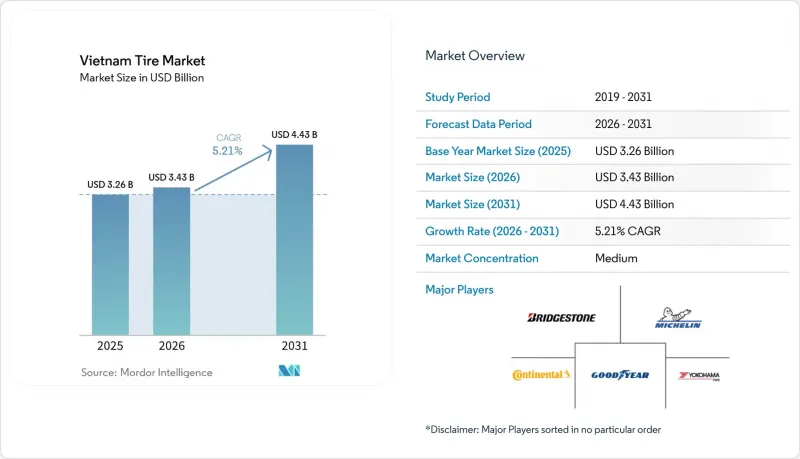
據 Mordor Intelligence 稱,越南輪胎市場在 2025 年的價值為 32.6 億美元,預計在 2026 年為 34.3 億美元,預計到 2031 年將達到 44.3 億美元。
預計 2026 年至 2031 年的年複合成長率(CAGR)為 5.21%。
本報告按季節(例如夏季)、輪胎結構(子午線輪胎、斜交輪胎等)、車輛類型(摩托車、乘用車等)、應用領域(公路和越野)、最終用戶(原廠配套和售後市場)、輪圈尺寸(15英寸以下、15-20英寸和20英寸以上)以及驅動系統(例如內燃機車輛)進行分類。市場預測以價值(美元)和銷售量(單位)表示。
越南輪胎市場趨勢與洞察
汽車擁有量增加和可支配收入成長
2024年,新車註冊量顯著成長,帶動車輛保有量上升,並持續推動售後市場穩定需求。隨著年GDP成長接近10%,家庭購買力提升,輪胎更換週期縮短,尤其對於高階品牌而言,在河內和胡志明市等主要都市區更是如此。儘管摩托車仍是個人出行市場的主流選擇,但乘用車的普及速度正在加快。融資管道的改善和都市區道路基礎設施的持續擴張都促進了這一趨勢。車輛使用量的增加導致輪胎磨損加劇,從而為經銷商網路和快修服務點帶來了穩定且可預測的高品質替換輪胎需求。
物流和電子商務的快速發展正在推動對商用車輪胎的需求。
越南電子商務產業正經歷顯著成長,為物流和運輸領域帶來了重大變革。這種擴張導致都市區末端配送車輛密度增加,區域間幹線公路不斷延伸。與普通乘用車相比,每天行駛里程較長的貨車和冷藏車輪胎磨損速度更快。此外,南北高速公路等基礎設施建設以及連接邊境口岸的在建高速公路項目正在改善道路通行狀況。這些改善促使營運商利用新開發的路線來最佳化燃油效率。在水產品出口產業,專用低溫運輸車輛擴大使用高負荷、低溫胎面配方。由於其卓越的性能,這些配方價格不菲。
天然橡膠價格波動
2024年,越南仍保持著世界領先橡膠生產國的地位,但面臨人工林老化和降雨模式不穩定等挑戰,導致橡膠供應緊張。僅靠越南橡膠集團本身的種植園不足以緩解全球價格波動的影響,迫使輪胎製造商採取避險和多元化生產策略,減少對合成橡膠的依賴。原料成本的急劇上漲顯著影響了消費者的行為。特別是,農村摩托車市場對價格的高彈性導致消費者購買決策顯著延遲。
細分市場分析
預計到2025年,四季輪胎將佔越南輪胎市場的43.47%。同時,夏季輪胎預計在預測期內將以5.23%的複合年成長率穩定成長。越南相對穩定的氣溫分佈支撐了對單一花紋輪胎的需求,使駕駛者能夠減少輪胎的存放和季節性更換。另一方面,冬季輪胎仍然是一個小眾市場,主要限於特定應用,例如行駛在氣溫偶爾會降至10度C以下的山區的巴士以及冷藏倉庫中的堆高機。這種氣候的穩定性為製造商提供了簡化其輪胎配方和最佳化分銷庫存管理的優勢。
高階輪胎品牌正積極開展消費者宣傳宣傳活動,重點推廣其專為夏季設計的輪胎卓越的抗水滑性能和煞車性能。這些努力正逐步促使消費者從入門級全季輪胎轉向更專業的輪胎選擇。峴港和芹苴等重點地區的零售商表示,提升銷售機會顯著增加,尤其是在雨季期間,透過訊息的宣傳訊息強調安全駕駛。此外,不斷發展的汽車租賃行業也越來越傾向於選擇速度等級更高的夏季輪胎,以滿足企業車輛保險的要求。這一趨勢正在推動新型企業對企業(B2B)管道的發展,這些管道的特點是訂單模式可預測且需求週期穩定。
到2025年,子午線輪胎將佔據越南輪胎市場89.73%的佔有率,預計到2031年將以5.32%的複合年成長率成長。這一成長主要得益於卡車低排放氣體標準的實施。車輛成本分析凸顯了子午線輪胎的優勢,例如更長的翻新週期和更低的油耗,這使其價格高於斜交輪胎也合理。此外,自2023年以來,汽車製造商已全面採用子午線輪胎,而製造商保固期的到期也導致售後市場更換需求顯著增加。
各大品牌已推出用於都市區末端配送貨車的非充氣輪胎原型,這類運作一旦發生爆胎,將造成巨大的營運成本。然而,這些原型輪胎的商業性預計仍需數年時間。同時,中國製造商正在推出採用石墨烯和再生橡膠的先進帶狀子午線輪胎。這些實用化不僅加強了永續性發展,也應對了日益成長的生產者延伸責任制(EPR)合規壓力。這些技術進步提高了競爭對手的門檻,也對旨在進入低價摩托車市場的國內二線製造商構成了重大挑戰。
2025年,摩托車輪胎繼續在越南輪胎市場佔據主導地位,市佔率高達43.35%。乘用車輪胎市場則展現出強勁的複合年成長率(CAGR),達到5.27%,這得益於經銷商積極的融資策略以及VinFast、現代和豐田等主要製造商不斷擴大的車型陣容。預計到2031年,乘用車輪胎市佔率將超過五分之二,這主要得益於越南快速發展的二線城市中多車家庭數量的成長。
輕型商用車和皮卡在支撐電子商務行業方面發揮著至關重要的作用,到2025年,它們將佔輪胎總銷量的近五分之一。這些車輛擴大採用適用於各種路況的全地形子午線輪胎。重型卡車和客車則受益於「一帶一路」舉措相關的基礎設施建設項目。然而,超重型車輛的成長仍然受到軸荷限制的限制。包括礦用卡車和聯合收割機等車輛在內的特種越野輪胎市場,正從一個相對較小的基數迅速擴張。該細分市場為國內製造商提供了高利潤機會,尤其是那些利用高效本地化供應鏈來滿足人工林客戶快速需求的製造商。
其他好處:
- Excel格式的市場預測(ME)表
- 3個月的分析師支持
目錄
第1章:引言
- 研究假設和市場定義
- 調查範圍
第2章:調查方法
第3章執行摘要
第4章 市場狀況
- 市場概覽
- 市場促進因素
- 汽車擁有量增加和可支配收入成長
- 物流和電子商務的快速發展增加了對商用車輪胎的需求。
- 政府對國內輪胎生產的獎勵措施
- 摩托車的快速電氣化
- 公部門綠色採購目標
- 收費和燃油效率政策促進了卡車和巴士向子午線輪胎的過渡。
- 市場限制因素
- 天然橡膠價格波動
- 來自中國低成本進口商品的價格競爭
- 遵守生產者延伸責任制(EPR)的成本
- 農村地區基礎設施的差距限制了銷售量。
- 價值供應鏈分析
- 監理情勢
- 技術展望
- 波特五力模型
第5章 市場規模與成長預測
- 按季節
- 夏天
- 冬天
- 四季
- 輪胎設計
- 徑向
- 偏見
- 非氣動/無氣式
- 按車輛類型
- 摩托車
- 搭乘用車
- 輕型商用車
- 大型商用卡車和巴士
- 越野車和特殊車輛(OTR、農車、礦業用車、賽車)
- 透過使用
- 公路
- 越野
- 最終用戶
- OEM
- 售後市場
- 按輪圈尺寸
- 小於15英寸
- 15-20英寸
- 20吋或更大
- 透過推進力
- 內燃機車
- 電池式電動車
- 混合動力汽車和燃料電池汽車
第6章 競爭情勢
- 市場集中度
- 策略趨勢
- 市佔率分析
- 公司簡介
- Bridgestone Corporation
- Michelin SCA
- Yokohama Rubber Co., Ltd.
- Kumho Tire Co., Inc.
- Sailun Group Co., Ltd.
- The Southern Rubber Industry JSC(Casumina)
- Danang Rubber Company(DRC)
- Pirelli & CSpA
- Goodyear Tire and Rubber Company
- Continental AG
- Apollo Tyres Ltd.
- Cheng Shin Rubber Ind. Co.(Maxxis)
- Hankook Tire and Technology
- Toyo Tire Corporation
- Triangle Tyre Co., Ltd.
- Double Coin Holdings Ltd.
- Linglong Tire Co., Ltd.
- JK Tyre & Industries Ltd.
- Giti Tire Pte. Ltd.
- Cheng Shin Rubber Vietnam(CST)
第7章 市場機會與未來展望
According to Mordor Intelligence, the Vietnam tire market size was valued at USD 3.26 billion in 2025, is estimated at USD 3.43 billion in 2026, and is projected to reach USD 4.43 billion by 2031, registering a CAGR of 5.21% between 2026 and 2031.
This report is Segmented by Season (Summer and More), Tire Design (Radial, Bias, and More), Vehicle Type (Two-Wheelers, Passenger Cars and More), Application (On-Road and Off-Road), End User (OEM and Aftermarket), Rim Size (Below 15 Inches, 15 To 20 Inches, and Above 20 Inches), and Propulsion (Internal-Combustion Vehicles and More). The Market Forecasts are Provided in Terms of Value (USD) and Volume (Units).
Vietnam Tire Market Trends and Insights
Rising Vehicle PARC and Disposable Income Growth
In 2024, vehicle registrations experienced significant growth, contributing to an expanding installed base of vehicles that continues to drive consistent demand in the aftermarket segment. The annual GDP growth rate of nearly 10% has enhanced household purchasing power, resulting in shorter replacement cycles, particularly for premium-branded tires in key urban centers such as Hanoi and Ho Chi Minh City. While motorcycles remain the dominant choice for individuals entering the personal mobility market, the adoption of passenger cars is accelerating. This trend is supported by improved access to financing options and the ongoing expansion of urban road infrastructure. Increased vehicle utilization has led to higher tread wear, which in turn is generating a steady and predictable demand for high-quality replacement tires across dealership networks and quick-fit service outlets..
Logistics and E-Commerce Boom Increasing CV Tire Demand
Vietnam's e-commerce sector has experienced significant growth, driving substantial changes in the logistics and transportation landscape. This expansion has resulted in the proliferation of dense urban last-mile delivery fleets and the extension of intra-regional trunk routes. Delivery vans and refrigerated trucks, which operate with high daily mileage, are experiencing accelerated tire wear compared to private vehicles. Additionally, infrastructure developments, such as the North-South Expressway and ongoing highway projects connecting to border gates, are enhancing road accessibility. These improvements are encouraging operators to optimize fuel efficiency by leveraging the newly developed routes. In the seafood export segment, specialized cold-chain vehicles are increasingly utilizing high-load, low-temperature tread compounds, which are priced at a premium due to their advanced performance characteristics.
Natural Rubber Price Volatility
In 2024, Vietnam, despite maintaining its position as a leading global player, faced challenges stemming from aging plantations and unpredictable rainfall patterns, which resulted in a tightened supply of rubber. The Vietnam Rubber Group's estate proved insufficient in mitigating the impact of global price volatility, prompting tire manufacturers to adopt strategies such as hedging or diversifying their reliance on synthetic rubber inputs. The sharp increase in raw material costs significantly influenced consumer behavior, particularly in the rural motorcycle segment, where high price elasticity led to a noticeable delay in purchase decisions.
Other drivers and restraints analyzed in the detailed report include:
- Government Incentives for Domestic Tire Manufacturing
- Rapid Electrification of Two-Wheelers
- Price Competition from Low-Cost Chinese Imports
For complete list of drivers and restraints, kindly check the Table Of Contents.
Segment Analysis
In 2025, all-season tires accounted for 43.47% of Vietnam's tire market share. Concurrently, summer tires are projected to experience steady growth, with a CAGR of 5.23% during the forecast period. Vietnam's relatively consistent temperature profile supports the preference for single-pattern tires, enabling motorists to reduce costs associated with storage and seasonal tire changes. Winter tire designs, however, remain niche, primarily serving specific applications such as mountain-pass buses and cold-storage forklifts, where temperatures occasionally fall below 10 °C. This climate uniformity provides manufacturers with the advantage of streamlining their compound portfolios and optimizing distribution inventory management.
Premium tire brands are actively conducting consumer education campaigns to highlight the superior hydroplaning resistance and braking performance of purpose-engineered summer tire patterns. These initiatives are gradually encouraging a shift among consumers from entry-level all-season stock-keeping units (SKUs) to more specialized options. Retailers in key regions such as Da Nang and Can Tho report increased opportunities for upselling, particularly through targeted safety messaging during the monsoon season. Furthermore, the expanding car-rental sector is increasingly favoring higher-speed-rated summer tires to meet the requirements of corporate fleet insurers. This trend is fostering the development of new business-to-business (B2B) channels, characterized by predictable ordering patterns and consistent demand cycles.
In 2025, radials accounted for 89.73% of Vietnam's tire market share and are anticipated to grow at a 5.32% CAGR by 2031. This growth is primarily attributed to the enforcement of low-emission truck standards. Fleet cost analyses emphasize the benefits of extended retread cycles and reduced fuel consumption, which justify the premium pricing of radials over bias alternatives. Furthermore, since 2023, OEMs have exclusively adopted radial fitments, driving a significant increase in aftermarket conversions as factory warranties expire.
Leading brands have introduced non-pneumatic prototypes targeting urban last-mile vans, where puncture-related downtimes result in substantial operational costs. However, the commercial viability of these prototypes is expected to take several years to materialize. Concurrently, Chinese manufacturers are launching advanced belt-package radials incorporating graphene and recycled rubber. These innovations not only enhance sustainability credentials but also align with the growing pressures of Extended Producer Responsibility (EPR) compliance. Such technological advancements are raising the competitive benchmark, presenting significant challenges for domestic second-tier producers aiming to penetrate the budget motorcycle segment.
In 2025, two-wheelers accounted for a significant 43.35% share of Vietnam's tire market, maintaining their dominance in the sector. Passenger cars, supported by aggressive dealer financing strategies and an expanding range of models from key players such as VinFast, Hyundai, and Toyota, exhibited a strong 5.27% CAGR. The tire market share for passenger cars is projected to exceed two-fifths by 2031, driven by the increasing prevalence of multi-car households, particularly in Vietnam's growing second-tier cities.
Light commercial vans and pickups, which play a critical role in sustaining the e-commerce sector, contributed to nearly one-fifth of tire sales in 2025. These vehicles are increasingly adopting all-terrain radial designs, which are well-suited for mixed-road conditions. Heavy trucks and buses are benefiting from infrastructure projects associated with the Belt and Road Initiative (BRI). However, the growth of ultra-heavy-spec vehicles remains constrained by axle-load restrictions. The specialty off-road tire segment, encompassing vehicles such as mining trucks and combine harvesters, is expanding from a relatively small base. This segment offers high-margin opportunities for domestic manufacturers, particularly those leveraging efficient and localized supply chains to meet the rapid demands of plantation clients.
Complete Report Scope:
- By Season
- Summer
- Winter
- All-Season
- By Tire Design
- Radial
- Bias
- Non-pneumatic/Airless
- By Vehicle Type
- Two-Wheelers
- Passenger Cars
- Light Commercial Vehicles
- Heavy Commercial Trucks and Buses
- Off-the-Road and Specialty (OTR, Agriculture, Mining, Racing)
- By Application
- On-Road
- Off-Road
- By End User
- OEM
- Aftermarket
- By Rim Size
- Below 15 inches
- 15 to 20 inches
- Above 20 inches
- By Propulsion
- Internal-Combustion Vehicles
- Battery-Electric Vehicles
- Hybrid and Fuel-Cell Vehicles
List of Companies Covered in this Report:
- Bridgestone Corporation
- Michelin SCA
- Yokohama Rubber Co., Ltd.
- Kumho Tire Co., Inc.
- Sailun Group Co., Ltd.
- The Southern Rubber Industry JSC (Casumina)
- Danang Rubber Company (DRC)
- Pirelli & C. S.p.A.
- Goodyear Tire and Rubber Company
- Continental AG
- Apollo Tyres Ltd.
- Cheng Shin Rubber Ind. Co. (Maxxis)
- Hankook Tire and Technology
- Toyo Tire Corporation
- Triangle Tyre Co., Ltd.
- Double Coin Holdings Ltd.
- Linglong Tire Co., Ltd.
- JK Tyre & Industries Ltd.
- Giti Tire Pte. Ltd.
- Cheng Shin Rubber Vietnam (CST)
Additional Benefits:
- The market estimate (ME) sheet in Excel format
- 3 months of analyst support
TABLE OF CONTENTS
1 Introduction
- 1.1 Study Assumptions and Market Definition
- 1.2 Scope of the Study
2 Research Methodology
3 Executive Summary
4 Market Landscape
- 4.1 Market Overview
- 4.2 Market Drivers
- 4.2.1 Rising Vehicle PARC and Disposable Income Growth
- 4.2.2 Logistics and E-Commerce Boom Increasing CV Tire Demand
- 4.2.3 Government Incentives for Domestic Tire Manufacturing
- 4.2.4 Rapid Electrification of Two-Wheelers
- 4.2.5 Green Public-Sector Procurement Targets
- 4.2.6 Truck and Bus Radialization Push by Toll/Fuel-Efficiency Policies
- 4.3 Market Restraints
- 4.3.1 Natural Rubber Price Volatility
- 4.3.2 Price Competition from Low-Cost Chinese Imports
- 4.3.3 Extended Producer Responsibility (EPR) Compliance Costs
- 4.3.4 Rural Infrastructure Gaps Limiting Off-Take
- 4.4 Value/Supply-Chain Analysis
- 4.5 Regulatory Landscape
- 4.6 Technological Outlook
- 4.7 Porter's Five Forces
- 4.7.1 Threat of New Entrants
- 4.7.2 Bargaining Power of Suppliers
- 4.7.3 Bargaining Power of Buyers
- 4.7.4 Threat of Substitutes
- 4.7.5 Competitive Rivalry
5 Market Size and Growth Forecasts (Value (USD) and Volume (Units))
- 5.1 By Season
- 5.1.1 Summer
- 5.1.2 Winter
- 5.1.3 All-Season
- 5.2 By Tire Design
- 5.2.1 Radial
- 5.2.2 Bias
- 5.2.3 Non-pneumatic/Airless
- 5.3 By Vehicle Type
- 5.3.1 Two-Wheelers
- 5.3.2 Passenger Cars
- 5.3.3 Light Commercial Vehicles
- 5.3.4 Heavy Commercial Trucks and Buses
- 5.3.5 Off-the-Road and Specialty (OTR, Agriculture, Mining, Racing)
- 5.4 By Application
- 5.4.1 On-Road
- 5.4.2 Off-Road
- 5.5 By End User
- 5.5.1 OEM
- 5.5.2 Aftermarket
- 5.6 By Rim Size
- 5.6.1 Below 15 inches
- 5.6.2 15 to 20 inches
- 5.6.3 Above 20 inches
- 5.7 By Propulsion
- 5.7.1 Internal-Combustion Vehicles
- 5.7.2 Battery-Electric Vehicles
- 5.7.3 Hybrid and Fuel-Cell Vehicles
6 Competitive Landscape
- 6.1 Market Concentration
- 6.2 Strategic Moves
- 6.3 Market Share Analysis
- 6.4 Company Profiles (Includes Global Level Overview, Market Level Overview, Core Segments, Financials as Available, Strategic Information, Market Rank/Share for Key Companies, Products and Services, SWOT Analysis, and Recent Developments)
- 6.4.1 Bridgestone Corporation
- 6.4.2 Michelin SCA
- 6.4.3 Yokohama Rubber Co., Ltd.
- 6.4.4 Kumho Tire Co., Inc.
- 6.4.5 Sailun Group Co., Ltd.
- 6.4.6 The Southern Rubber Industry JSC (Casumina)
- 6.4.7 Danang Rubber Company (DRC)
- 6.4.8 Pirelli & C. S.p.A.
- 6.4.9 Goodyear Tire and Rubber Company
- 6.4.10 Continental AG
- 6.4.11 Apollo Tyres Ltd.
- 6.4.12 Cheng Shin Rubber Ind. Co. (Maxxis)
- 6.4.13 Hankook Tire and Technology
- 6.4.14 Toyo Tire Corporation
- 6.4.15 Triangle Tyre Co., Ltd.
- 6.4.16 Double Coin Holdings Ltd.
- 6.4.17 Linglong Tire Co., Ltd.
- 6.4.18 JK Tyre & Industries Ltd.
- 6.4.19 Giti Tire Pte. Ltd.
- 6.4.20 Cheng Shin Rubber Vietnam (CST)
7 Market Opportunities and Future Outlook
- 7.1 White-space and Unmet-Need Assessment

 車輪擋塊市場:全球市場預測,2026-2032年零壓球囊市場:全球市場預測,2026-2032年乘用車替換輪胎市場:全球市場預測,2026-2032年乘用車輪胎售後市場:全球市場預測,2026-2032年
 歐洲輪胎市場:市場佔有率分析、產業趨勢與統計、成長預測(2026-2031)泰國輪胎市場:市佔率分析、產業趨勢與統計、成長預測(2026-2031)美國輪胎:市場佔有率分析、產業趨勢與統計、成長預測(2026-2031)非洲輪胎:市場佔有率分析、產業趨勢與統計、成長預測(2026-2031)馬來西亞輪胎:市場佔有率分析、產業趨勢與統計、成長預測(2026-2031)印尼輪胎市場:市佔率分析、產業趨勢與統計、成長預測(2026-2031)