


 |
市場調查報告書
商品編碼
2117449
非洲輪胎:市場佔有率分析、產業趨勢與統計、成長預測(2026-2031)Africa Tire - Market Share Analysis, Industry Trends & Statistics, Growth Forecasts (2026 - 2031) |
||||||

※ 本網頁內容可能與最新版本有所差異。詳細情況請與我們聯繫。
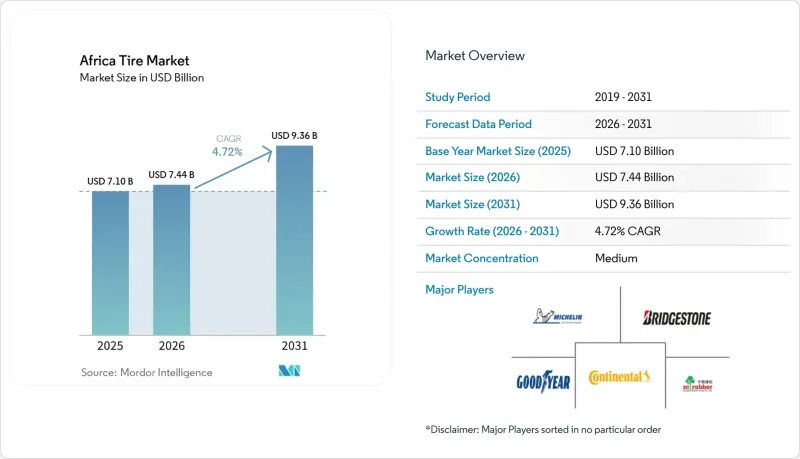
據 Mordor Intelligence 稱,2025 年非洲輪胎市場價值 71 億美元,預計 2026 年將達到 74.4 億美元,預計從 2026 年到 2031 年將以 4.72% 的複合年成長率成長,到 2031 年將達到 93.6 億美元。
本報告按季節(夏季、冬季等)、輪胎結構(子午線輪胎、斜交輪胎等)、車輛類型(摩托車、乘用車等)、應用領域(公路、越野)、最終用戶(原廠配套、售後市場)、輪圈尺寸(小於15英寸等)、驅動系統(內燃機等)和國家/地區進行細分。市場預測以價值(美元)和銷售量(單位)表示。
非洲輪胎市場的趨勢與洞察
非洲各地車輛擁有量和汽車擁有率不斷成長
預計到2025年,奈及利亞將進口價值1.58兆奈拉(約10.4億美元)的汽車,替換輪胎供應商正加緊生產以滿足此需求缺口。在阿爾及利亞和安哥拉等產油國,營收成長推動了汽車保有量的增加,進而顯著提升了對中低價位輪胎的需求。叫車和非正規計程車服務的擴張也增加了日常輪胎更換的需求。此外,摩托車在人口稠密的都市區日益普及,也大幅提升了對小尺寸輪圈的需求。隨著都市區交通的不斷發展,輪胎需求曾經明顯的季節性波動正在減弱,使得倉庫能夠全年保持穩定的庫存水準。有效實施庫存管理策略的經銷商正在這個瞬息萬變的市場環境中獲得競爭優勢。
中國輪胎製造商擴大經銷網路(價格競爭力)
青島世紀輪胎和玲瓏輪胎的肯亞工廠以及摩洛哥工廠正從純出口模式轉向在地化生產。這項策略轉變不僅能降低運輸成本,還能最大限度地減少外匯波動所帶來的風險。透過建立本地生產基地,這些公司可以享受區域貿易協定中的關稅減免,從而提供比歐洲同類產品更具競爭力的價格。一旦這些工廠投入運作,它們將能夠有效地向塞內加爾和烏干達等鄰近市場供貨。這種模式不僅能夠根據當地路況客製化胎面花紋,還能大幅縮短前置作業時間,進而提高整體市場應對力。
貨幣貶值與進口關稅波動
預計從2024年起,奈及利亞奈拉和埃及鎊將貶值超過50%,這將增加輪胎的採購成本,並抑制消費者的購買力。為了維持庫存,經銷商被迫增加營運資金,這給資金籌措能力帶來了巨大壓力。這些財務壓力促使一些進口商採取策略性措施,即在當地組裝部分產品。此舉凸顯了供應鏈正在經歷漸進但不可避免的變革,因為企業越來越重視本地運營,以降低風險並提高效率。這些變化強調了在面對財務和營運挑戰時,企業需要具備適應性和韌性,同時也凸顯了供應鏈格局的持續演變。
細分市場分析
在非洲輪胎市場,預計到2025年,全季輪胎將佔據55.13%的市場。然而,阿爾及利亞和摩洛哥的車隊管理人員正擴大選擇專為應對沙漠公路嚴苛環境而設計的耐熱輪胎。擁有極端溫度環境專業知識的供應商能夠設定更高的價格,從而有效抵消特殊橡膠配方帶來的成本增加。此外,夏季輪胎預計將以5.64%的複合年成長率成長,在預測期內高於非洲輪胎市場的整體成長率。
在其他地區,例如熱帶氣候區,人們更傾向於使用能夠應對偶發性降雨的高柔軟性全天候橡膠輪胎。因此,跨國經銷商會策略性地儲備兩條不同的產品線:一條是專為馬格里布地區調校的高矽含量夏季輪胎,另一條是旨在滿足撒哈拉以南地區道路需求的多功能輪胎。這種季節性細分策略更體現了對氣候帶的適應性,而非對經濟階層的適應性,凸顯了針對特定區域的研發活動對於尋求在市場中建立競爭優勢的企業的重要性。
2025年,子午線輪胎憑藉其低滾動阻力和長胎面壽命等優勢,將主導非洲輪胎市場,佔91.25%的市場佔有率。同時,南非和剛果民主共和國(剛果(金))的礦業集團正在試行無氣輪胎,預計到2031年,該市場將以6.71%的複合年成長率成長。無氣輪胎的顯著優勢在於消除了因輪胎爆胎造成的運作,這對於設備租賃成本極高的礦業而言至關重要。這一趨勢表明,礦業領域對創新輪胎解決方案的興趣日益濃厚。
對於普通乘用車和卡車營運商而言,子午線輪胎仍然是首選,這要歸功於完善的服務網路和翻新基礎設施。然而,正如原始設備製造商 (OEM) 與採石場卡車製造商之間的合作所表明的那樣,隨著規模經濟效益的提升,無氣輪胎技術的應用範圍可能會擴展到其他工程車輛。目前投資於聚合物鏈節結構的公司已佔據戰略優勢,能夠吸引早期用戶並在理念引領方面獲得競爭優勢。這一趨勢凸顯了無氣輪胎技術在未來幾年內為傳統輪胎市場帶來重大變革的潛力。
預計到2025年,乘用車輪胎將佔非洲輪胎市場佔有率的39.44%,複合年成長率(CAGR)為4.97%,主要得益於個人出行方式的日益普及。此外,電子商務和建設活動的活性化也推動了輕型商用車和重型卡車銷售的成長。不斷增加的軸荷也導致輪胎更換頻率的提高,為該領域的供應商創造了更大的成長機會。
在拉各斯、內羅畢和坎帕拉等城市,隨著叫車公司擴大摩托車計程車車隊,摩托車的需求顯著成長。挖土機和裝載機的越野輪胎雖然銷量較小,但利潤空間可觀。透過多元化發展,製造商可以降低乘用車較長的更換週期所帶來的風險,並充分利用商用車較頻繁的更換週期。
其他好處:
- Excel格式的市場預測(ME)表
- 3個月的分析師支持
目錄
第1章:引言
- 市場分析與定義的前提條件
- 分析範圍
第2章 分析方法
第3章執行摘要
第4章 市場狀況
- 市場概覽
- 市場促進因素
- 非洲各地汽車擁有量和汽車擁有率均有所成長
- 中國輪胎製造商擴大經銷網路(價格競爭力)
- 快速道路基礎設施發展計畫(例如,非洲大陸自由貿易區走廊)
- 透過非官方通路對價格實惠的替換輪胎的需求不斷成長。
- 政府獎勵措施促進國內輪胎生產能力(奈及利亞、埃及)
- 採礦和物流行業採用數位化車輛管理正在推動高階TBR的普及。
- 市場限制因素
- 貨幣貶值與進口關稅波動
- 天然橡膠和合成橡膠的價格波動
- 橡膠供應鏈分散,限制了在地採購。
- 主要國家加強對二手進口的監管
- 價值鍊和供應鏈分析
- 監理情勢
- 技術展望
- 波特五力分析
第5章:預測市場規模與成長率
- 季節性
- 夏天
- 冬天
- 四季
- 輪胎結構
- 徑向
- 偏見
- 非氣動/無氣式
- 按車輛類型
- 摩托車
- 搭乘用車
- 輕型商用車
- 大型商用卡車和巴士
- 越野車和特殊車輛(OTR、農業、礦業、賽車)
- 透過使用
- 公路
- 非公路用途(建築、礦業、農業)
- 最終用戶
- OEM
- 售後市場(替換件和翻新件)
- 按輪圈尺寸
- 小於15英寸
- 15-20英寸
- 20吋或更大
- 透過驅動系統
- 內燃機車
- 電池式電動車
- 混合動力汽車和燃料電池汽車
- 國家
- 南非
- 阿爾及利亞
- 奈及利亞
- 摩洛哥
- 埃及
- 肯亞
- 剛果民主共和國
- 其他非洲國家
第6章 競爭情勢
- 市場集中度
- 策略趨勢
- 市佔率分析
- 公司簡介
- Michelin
- Bridgestone Corporation
- The Goodyear Tire & Rubber Company
- Continental AG
- Pirelli & CSpA
- Sumitomo Rubber Industries
- Hankook Tire & Technology Co., Ltd.
- Zhongce Rubber Group Co., Ltd.
- Sailun Group
- Triangle Tyre Co., Ltd
- Apollo Tyres Limited
- MRF Tyres
- Kumho Tire
- Nokian Tyres
- Toyo Tire Corporation
- Yokohama Rubber Co., Ltd.
- Cheng Shin Rubber Industry Co.
- Qingdao Doublestar Group
- CEAT Limited
第7章 市場機會與未來展望
According to Mordor Intelligence, the african tire market size was valued at USD 7.10 billion in 2025 and is estimated at USD 7.44 billion in 2026, and is projected to reach USD 9.36 billion by 2031 at a 4.72% CAGR over 2026-2031.
This report is Segmented by Season (Summer, Winter, and More), Tire Design (Radial, Bias, and More), Vehicle Type (Two-Wheelers, Passenger Cars, and More), Application (On-Road, Off-Road), End User (OEM, Aftermarket), Rim Size (Below 15 Inches, and More), Propulsion (Internal-Combustion Vehicles and More), and Country. The Market Forecasts are Provided in Terms of Value (USD) and Volume (Units).
Africa Tire Market Trends and Insights
Increasing Vehicle Parc and Motorization Rate Across Africa
Nigeria imported automobiles valued at NGN 1.58 trillion (approximately USD 1.04 billion) in 2025, signaling a gap that replacement tire suppliers are rushing to fill . In oil-rich nations such as Algeria and Angola, increasing incomes have resulted in higher passenger-car ownership, which is driving significant demand for budget and mid-tier tires. The expansion of ride-hailing services and informal taxi operations is further contributing to the growing daily requirement for tire replacements. Furthermore, in densely populated urban areas, the rising adoption of two-wheelers is significantly boosting the demand for smaller rim sizes. As urban mobility continues to develop, the previously pronounced seasonality of tire demand is becoming less evident, enabling warehouses to maintain consistent stock levels throughout the year. Distributors who effectively manage their inventory policies are gaining a competitive advantage in this evolving market environment.
Expansion of Chinese Tire Makers' Distribution Networks (Price Competitiveness)
Qingdao Sentury Tire Co., Ltd. and Linglong's Kenya plant, along with a facility in Morocco, are transitioning from solely exporting to manufacturing regionally. This strategic shift not only reduces shipping costs but also minimizes exposure to currency fluctuations. By establishing local production facilities, these companies gain access to duty exemptions provided under regional trade agreements, enabling their products to be priced more competitively compared to European alternatives. Once these facilities become operational, they can efficiently supply nearby markets such as Senegal or Uganda. This approach allows for the customization of tread patterns to meet specific local road conditions while also significantly reducing lead times, thereby enhancing overall market responsiveness.
Currency Depreciation and Import-Duty Fluctuations
The Nigerian naira and Egyptian pound have each lost more than 50% of value since 2024, inflating landed tire costs and curbing consumer purchasing power . To maintain stock, distributors are compelled to hold higher working capital, which in turn places significant strain on their financing capabilities. This financial pressure has prompted several importers to adopt a strategic approach by committing to partial local assembly. This development highlights a gradual yet inevitable transformation within the supply chain, as companies increasingly prioritize localized operations to mitigate risks and optimize efficiency. Such a shift underscores the evolving dynamics of the supply chain landscape, driven by the need for adaptability and resilience in the face of financial and operational challenges.
Other drivers and restraints analyzed in the detailed report include:
- Rapid Road-Infrastructure Development Programs (e.g., AfCFTA Corridors)
- Growing Demand for Affordable Replacement Tires Through Informal Channels
- Volatile Natural-Rubber and Synthetic-Rubber Prices
For complete list of drivers and restraints, kindly check the Table Of Contents.
Segment Analysis
In the African tire market, all-season products hold a commanding 55.13% market share in 2025. However, fleet managers in Algeria and Morocco are increasingly opting for heat-resistant compounds that are specifically designed to endure the challenges posed by desert highways. Suppliers with expertise in addressing these temperature extremes are able to command premium prices, which effectively offset the higher costs associated with their specialized rubber mixes. Furthermore, summer tires are anticipated to grow at a CAGR of 5.64%, surpassing the overall growth rate of the African tire market during the forecast period.
In other regions, tropical climates exhibit a preference for flexible all-season rubbers that are capable of withstanding sporadic rainfall. Consequently, multinational distributors are strategically maintaining inventories of two distinct product assortments. These include high-silica summer tire lines that are specifically tailored for the Maghreb region and versatile multi-purpose treads that are designed to meet the demands of sub-Saharan roads. This approach to seasonal segmentation reflects a stronger alignment with climatic zones rather than economic tiers, thereby emphasizing the importance of regionalized research and development efforts for companies aiming to achieve a competitive advantage in the market.
In 2025, radials dominated the African tire market, accounting for 91.25% of the market share, owing to their advantages of lower rolling resistance and extended tread life. Meanwhile, mining conglomerates in South Africa and the DRC are experimenting with non-pneumatic or airless tire formats, which are projected to grow at a CAGR of 6.71% through 2031. These airless tires provide a significant advantage by eliminating downtime caused by punctures, a critical factor in an industry where equipment rental costs are substantially high on an hourly basis. This trend highlights the increasing focus on innovative tire solutions within the mining sector.
Mainstream passenger and truck operators continue to prefer radials, supported by well-established service networks and retreading infrastructure. However, partnerships between OEMs and quarry trucks indicate that as economies of scale improve, airless technology could expand its application to other utility vehicles. Companies investing in polymer link architectures at present are strategically positioned to attract early adopters and gain a competitive edge in thought leadership. This development emphasizes the potential for airless technology to significantly disrupt traditional tire markets in the coming years.
In 2025, passenger car fitments accounted for 39.44% of Africa's tire market share, with a projected CAGR of 4.97%, driven by increasing personal mobility. Additionally, e-commerce and construction activities are driving growth in light commercial and heavy-duty truck volumes. As axle loads increase, the frequency of replacements rises, creating larger value opportunities for suppliers in this segment.
In cities such as Lagos, Nairobi, and Kampala, the demand for two-wheelers grew significantly as ride-hailing companies expanded their motorcycle taxi fleets. Off-the-road lines catering to excavators and loaders, while niche in volume, offer attractive margins. By diversifying into these areas, manufacturers mitigate risks from slowing passenger car turnover and capitalize on higher-frequency commercial cycles.
Complete Report Scope:
- By Season
- Summer
- Winter
- All-Season
- By Tire Design
- Radial
- Bias
- Non-pneumatic/Airless
- By Vehicle Type
- Two-Wheelers
- Passenger Cars
- Light Commercial Vehicles
- Heavy Commercial Trucks and Buses
- Off-the-Road and Specialty (OTR, Agriculture, Mining, Racing)
- By Application
- On-Road
- Off-Road (Construction, Mining, Agriculture)
- By End User
- OEM
- Aftermarket (Replacement and Retread)
- By Rim Size
- Below 15 inches
- 15 to 20 inches
- Above 20 inches
- By Propulsion
- Internal-Combustion Vehicles
- Battery-Electric Vehicles
- Hybrid and Fuel-Cell Vehicles
- By Country
- South Africa
- Algeria
- Nigeria
- Morocco
- Egypt
- Kenya
- Democratic Republic of Congo
- Rest of Africa
List of Companies Covered in this Report:
- Michelin
- Bridgestone Corporation
- The Goodyear Tire & Rubber Company
- Continental AG
- Pirelli & C. S.p.A.
- Sumitomo Rubber Industries
- Hankook Tire & Technology Co., Ltd.
- Zhongce Rubber Group Co., Ltd.
- Sailun Group
- Triangle Tyre Co., Ltd
- Apollo Tyres Limited
- MRF Tyres
- Kumho Tire
- Nokian Tyres
- Toyo Tire Corporation
- Yokohama Rubber Co., Ltd.
- Cheng Shin Rubber Industry Co.
- Qingdao Doublestar Group
- CEAT Limited
Additional Benefits:
- The market estimate (ME) sheet in Excel format
- 3 months of analyst support
TABLE OF CONTENTS
1 Introduction
- 1.1 Study Assumptions and Market Definition
- 1.2 Scope of the Study
2 Research Methodology
3 Executive Summary
4 Market Landscape
- 4.1 Market Overview
- 4.2 Market Drivers
- 4.2.1 Increasing Vehicle Parc and Motorization Rate Across Africa
- 4.2.2 Expansion of Chinese Tire Makers' Distribution Networks (Price Competitiveness)
- 4.2.3 Rapid Road-Infrastructure Development Programs (e.g., AfCFTA Corridors)
- 4.2.4 Growing Demand for Affordable Replacement Tires Through Informal Channels
- 4.2.5 Government Incentives for Local Tire Manufacturing Capacity (Nigeria, Egypt)
- 4.2.6 Digital Fleet-Management Adoption in Mining/Logistics Driving Premium TBR Uptake
- 4.3 Market Restraints
- 4.3.1 Currency Depreciation and Import-Duty Fluctuations
- 4.3.2 Volatile Natural-Rubber and Synthetic-Rubber Prices
- 4.3.3 Fragmented Rubber Supply Chain Limiting Local Sourcing
- 4.3.4 Regulatory Clamp-Down on Used-Tire Imports in Key Countries
- 4.4 Value/Supply-Chain Analysis
- 4.5 Regulatory Landscape
- 4.6 Technological Outlook (Low-rolling-resistance, smart and airless tires)
- 4.7 Porter's Five Forces
- 4.7.1 Bargaining Power of Suppliers
- 4.7.2 Bargaining Power of Buyers
- 4.7.3 Threat of New Entrants
- 4.7.4 Threat of Substitutes
- 4.7.5 Competitive Rivalry
5 Market Size and Growth Forecasts (Value (USD) and Volume (Units))
- 5.1 By Season
- 5.1.1 Summer
- 5.1.2 Winter
- 5.1.3 All-Season
- 5.2 By Tire Design
- 5.2.1 Radial
- 5.2.2 Bias
- 5.2.3 Non-pneumatic/Airless
- 5.3 By Vehicle Type
- 5.3.1 Two-Wheelers
- 5.3.2 Passenger Cars
- 5.3.3 Light Commercial Vehicles
- 5.3.4 Heavy Commercial Trucks and Buses
- 5.3.5 Off-the-Road and Specialty (OTR, Agriculture, Mining, Racing)
- 5.4 By Application
- 5.4.1 On-Road
- 5.4.2 Off-Road (Construction, Mining, Agriculture)
- 5.5 By End User
- 5.5.1 OEM
- 5.5.2 Aftermarket (Replacement and Retread)
- 5.6 By Rim Size
- 5.6.1 Below 15 inches
- 5.6.2 15 to 20 inches
- 5.6.3 Above 20 inches
- 5.7 By Propulsion
- 5.7.1 Internal-Combustion Vehicles
- 5.7.2 Battery-Electric Vehicles
- 5.7.3 Hybrid and Fuel-Cell Vehicles
- 5.8 By Country
- 5.8.1 South Africa
- 5.8.2 Algeria
- 5.8.3 Nigeria
- 5.8.4 Morocco
- 5.8.5 Egypt
- 5.8.6 Kenya
- 5.8.7 Democratic Republic of Congo
- 5.8.8 Rest of Africa
6 Competitive Landscape
- 6.1 Market Concentration
- 6.2 Strategic Moves
- 6.3 Market Share Analysis
- 6.4 Company Profiles (Includes Global Level Overview, Market Level Overview, Core Segments, Financials as Available, Strategic Information, Market Rank/Share for Key Companies, Products and Services, SWOT Analysis, and Recent Developments)
- 6.4.1 Michelin
- 6.4.2 Bridgestone Corporation
- 6.4.3 The Goodyear Tire & Rubber Company
- 6.4.4 Continental AG
- 6.4.5 Pirelli & C. S.p.A.
- 6.4.6 Sumitomo Rubber Industries
- 6.4.7 Hankook Tire & Technology Co., Ltd.
- 6.4.8 Zhongce Rubber Group Co., Ltd.
- 6.4.9 Sailun Group
- 6.4.10 Triangle Tyre Co., Ltd
- 6.4.11 Apollo Tyres Limited
- 6.4.12 MRF Tyres
- 6.4.13 Kumho Tire
- 6.4.14 Nokian Tyres
- 6.4.15 Toyo Tire Corporation
- 6.4.16 Yokohama Rubber Co., Ltd.
- 6.4.17 Cheng Shin Rubber Industry Co.
- 6.4.18 Qingdao Doublestar Group
- 6.4.19 CEAT Limited
7 Market Opportunities and Future Outlook
- 7.1 White-space and Unmet-Need Assessment

 歐洲輪胎市場:市場佔有率分析、產業趨勢與統計、成長預測(2026-2031)泰國輪胎市場:市佔率分析、產業趨勢與統計、成長預測(2026-2031)美國輪胎:市場佔有率分析、產業趨勢與統計、成長預測(2026-2031)越南輪胎市場:市場佔有率分析、產業趨勢與統計、成長預測(2026-2031)馬來西亞輪胎:市場佔有率分析、產業趨勢與統計、成長預測(2026-2031)印尼輪胎市場:市佔率分析、產業趨勢與統計、成長預測(2026-2031)汽車輪胎:市場佔有率分析、產業趨勢與統計、成長預測(2026-2031)
 寬基輪胎市場規模、佔有率和成長分析:按車輛類型、輪胎類型、輪圈尺寸、應用、分銷管道和地區分類 - 產業預測,2026-2033年
 充氣輪胎市場規模:依產品類型、車輛類型、銷售管道、地區及預測分類
 無內胎輪胎市場:2026-2032年全球市場預測(依輪胎結構、車輛類型、材料、應用及銷售管道)