


 |
市場調查報告書
商品編碼
2117447
美國輪胎:市場佔有率分析、產業趨勢與統計、成長預測(2026-2031)United States Tire - Market Share Analysis, Industry Trends & Statistics, Growth Forecasts (2026 - 2031) |
||||||

※ 本網頁內容可能與最新版本有所差異。詳細情況請與我們聯繫。
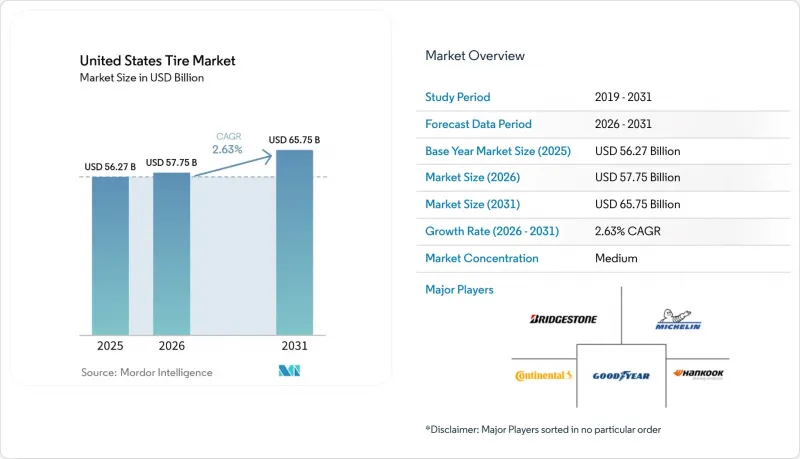
根據 Mordor Intelligence 的數據顯示,2025 年美國輪胎市場價值 562.7 億美元,預計 2026 年將達到 577.5 億美元。預計在預測期(2026-2031 年)內,該市場將以 2.63% 的複合年成長率成長,到 2031 年將達到 657.5 億美元。
本報告按季節(例如,夏季輪胎)、輪胎結構(例如,子午線輪胎)、車輛類型(例如,摩托車、乘用車)、應用領域(公路、越野)、最終用戶(原廠配套、售後市場)、輪圈尺寸(15英寸以下、15-20英寸、20英寸以上)以及驅動方式(例如,內燃機車輛)進行分類。市場預測以價值(美元)和銷售(單位)呈現。
美國輪胎市場的趨勢和洞察
車輛老化和行駛里程增加推高了車輛更換需求。
隨著車輛平均使用壽命達到12.5年,美國車輛保有量不斷成長,輪胎更換需求也隨之增加,因為懸吊磨損會加速胎面劣化。 2024年,車輛行駛里程呈指數級回升,達到與疫情前水平相當的水平,進一步推高了車輛使用量。美國聯邦公路管理局(FHWA)預測,2019年至2050年間,美國車輛總行駛里程將以每年0.5%至0.6%的速度成長,其中輕型車輛成長0.4%至0.5%,單體卡車成長1.9%至2.1%,鉸接式卡車成長1.1%至1.3%。這種差異意義重大,因為它造成了商用車領域輪胎更換週期的不平衡。單體貨車和8級牽引車的行駛里程是搭乘用轎車的3至5倍,這縮短了輪胎壽命,並使每年購車數量翻倍。同時,美國道路上行駛的輕型商用車的平均車齡超過12年。這一數字創歷史新高,原因是疫情期間供應鏈中斷、新車價格飆升以及車輛耐用性提高導致報廢時間推遲。
SUV 和輕型卡車的構成比不斷增加,推高了平均輪轂尺寸和平均售價 (ASP)。
目前,SUV 和輕型卡車占美國新車產量的五分之三,這些車型通常配備 17-20 吋的輪圈。而轎車則標配 15-16 吋的輪圈。這些更大的輪轂不僅提高了平均售價,也穩步提升了每輛車的銷售量。隨著汽車製造商不斷淘汰部分轎車車型,更大的輪轂尺寸已從高階配置轉變為新的標準配置。這種轉變顯著提高了製造商的利潤率,但也增加了消費者的更換成本,從而導致美國輪胎市場價值大幅成長。
天然橡膠和合成橡膠的價格波動
2026年2月至4月,天然橡膠現貨價格達到每公斤205-206美分,接近一年來的最高水準。這主要是由於天然橡膠生產國協會(ANRPC)預測,2026年全球天然橡膠供不應求,預計全球需求量為1,560萬噸,而產量僅1,520萬噸。東南亞地區2月至5月越冬期間的季節性供應限制、天氣干擾、葉枯病爆發以及老舊人工林產量下降等因素,進一步加劇了結構性失衡,而期貨市場的投機行為則加劇了價格波動。
細分市場分析
到2025年,全季輪胎將主導美國市場,佔61.28%的穩固佔有率。同時,冬季輪胎的銷量雖然佔有率較小,但預計仍將實現2.65%的顯著複合年成長率,這主要得益於消費者安全意識的提高以及暴風雪天氣日益頻繁,這些因素正在重塑消費者的偏好。
冬季輪胎的市場範圍正從傳統的「雪帶」地區擴展到氣候多變的溫帶地區。 2024年推出的「三峰雪花」認證,為產品線帶來了清晰的區分。隨著氣候變遷持續影響市場,全季輪胎製造商也開始在其產品中加入雪地駕駛功能。這一趨勢表明,輪胎市場的季節性界線正逐漸變得模糊。
到2025年,子午線輪胎將佔據美國輪胎市場89.92%的主導佔有率,這反映了數十年來戰略最佳化和全球擴張的成果。同時,無氣輪胎雖然市佔率不足1%,但正以2.67%的複合年成長率成長,主要針對耐穿刺性要求較高的商業應用領域。
米其林的「UPTIS」和Bridgestone的「Air Free」等概念展現了市場接受度的提昇路徑。儘管目前的製造成本和乘坐舒適性限制了其廣泛應用,但技術進步表明,從長遠來看,這些技術有望達到類似的水平。這項進展可能會為美國輪胎市場格局帶來重大變革。
到2025年,乘用車將佔據美國輪胎市場65.37%的主導佔有率,並以2.76%的複合年成長率實現顯著成長,這主要得益於電氣化和對高階售後輪胎需求的成長。同時,受電子商務物流的推動,商用輕型卡車也將成長,但成長速度將落後於乘用車。
隨著車輛電氣化程度的提高,高性能輪胎的需求顯著增加,以應對日益成長的重量和扭矩。同時,共享旅遊和訂閱服務的興起正在重新定義消費者的購車偏好,他們更加重視輪胎的耐用性,而非傳統的個人車主偏好。這些變化趨勢不僅會鞏固乘用車輪胎市場的主導地位,也將強化美國輪胎市場的模式。
其他好處:
- Excel格式的市場預測(ME)表
- 3個月的分析師支持
目錄
第1章:引言
- 市場分析與定義的前提條件
- 分析範圍
第2章 分析方法
第3章執行摘要
第4章 市場狀況
- 市場概覽
- 市場促進因素
- 車輛老化和行駛里程增加(VMT)正在推動更換的需求。
- SUV 和輕型卡車的構成比不斷增加,導致平均輪轂尺寸和平均售價上漲。
- 企業和聯邦燃油經濟法規有利於低捲繞率(L-RR)子午線輪胎。
- 輪胎電子商務和行動安裝服務的蓬勃發展正在擴大客戶群。
- 國內電動車輪胎生產能力(例如 Enso)開闢了一個利潤率高的利基市場。
- 國家層級強制使用再生橡膠正在促進永續產品線的發展。
- 市場限制因素
- 天然橡膠和合成橡膠的價格波動
- 進口關稅/貿易摩擦推高了到岸成本
- 電動車輪胎加速磨損會增加保固風險和品牌形象受損的風險。
- 都市區向共乘和微出行的轉變正在降低人均需求。
- 價值鍊和供應鏈分析
- 監理情勢
- 技術展望
- 波特五力分析
第5章:預測市場規模與成長率
- 季節性
- 夏天
- 冬天
- 四季
- 輪胎結構
- 徑向
- 偏見
- 非氣動/無氣式
- 按車輛類型
- 摩托車
- 搭乘用車
- 輕型商用車
- 大型商用卡車和巴士
- 越野車和特殊車輛(OTR、農業、礦業、賽車)
- 透過使用
- 公路
- 越野
- 最終用戶
- OEM
- 售後市場
- 按輪圈尺寸
- 小於15英寸
- 15-20英寸
- 20吋或更大
- 透過驅動系統
- 內燃機車
- 電池式電動車
- 混合動力汽車和燃料電池汽車
第6章 競爭情勢
- 市場集中度
- 策略趨勢
- 市佔率分析
- 公司簡介
- Michelin SCA
- Goodyear Tire & Rubber Co.
- Bridgestone Corp.
- Continental AG
- Hankook
- Yokohama Rubber Co.
- Pirelli & CSpA
- Sumitomo(Dunlop/Falken)
- Toyo Tire Corp.
- Kumho Tire Co.
- Cooper(Goodyear)
- BFGoodrich
- Nokian Tyres
- Nexen
- Giti Tire
- Sailun Group
- Titan International
- Carlisle Companies
- MRF Tyres
第7章 市場機會與未來展望
According to Mordor Intelligence, the United States tire market size was valued at USD 56.27 billion in 2025 and is estimated at USD 57.75 billion in 2026, and is projected to reach USD 65.75 billion by 2031, at a CAGR of 2.63% during the forecast period (2026-2031).
This report is Segmented by Season (Summer and More), Tire Design (Radial and More), Vehicle Type (Two-Wheeler, Passenger Cars and More), Application (On-Road and Off-Road), End User (OEM and Aftermarket), Rim Size (Below 15 Inches, 15 To 20 Inches, and Above 20 Inches), and Propulsion (Internal-Combustion Vehicles and More). The Market Forecasts are Provided in Terms of Value (USD) and Volume (Units).
United States Tire Market Trends and Insights
Aging Vehicle Fleet and Higher VMT Boost Replacement Demand
The climbing average vehicle age to 12.5 years extends the domestic parc, yet lifts tire turnover as suspension wear accelerates tread degradation. Vehicle miles traveled rebounded exponentially in 2024, matching pre-pandemic levels and compounding usage intensity. The Federal Highway Administration forecasts total United States vehicle miles traveled will grow 0.5-0.6% annually from 2019 through 2050, with light-duty vehicles advancing 0.4-0.5%, single-unit trucks 1.9-2.1%, and combination trucks 1.1-1.3%. This divergence matters because commercial segments generate disproportionate replacement cycles-a single-unit delivery van or Class 8 tractor accumulates mileage three to five times faster than a passenger sedan, compressing tire life and multiplying annual purchases per vehicle. Simultaneously, the average age of light-duty vehicles on United States roads has climbed past 12 years, a record driven by pandemic-era supply-chain disruptions, elevated new-vehicle prices, and improved durability that defers scrapping.
SUV and Light-Truck Mix Lifts Average Rim Size And ASP
Currently, three-fifths of new vehicles produced in the United States are SUVs and light trucks, which typically utilize 17 to 20-inch rims, compared to the 15 to 16-inch rims that are standard for sedans. These larger rim formats not only command higher average prices but also consistently contribute to increased revenue per unit. As automakers continue to phase out several sedan lines, the larger wheel size has shifted from being a premium feature to becoming the new standard. This transition has significantly improved manufacturer profit margins while also raising the replacement costs borne by consumers, thereby driving substantial value expansion within the United States tire market.
Natural and Synthetic-Rubber Price Volatility
Natural-rubber spot prices reached 205-206 U.S. cents per kilogram in February through April 2026, approaching one-year highs, as the Association of Natural Rubber Producing Countries projected 2026 global demand of 15.6 million tons against production of 15.2 million tons-the sixth consecutive annual deficit. Seasonal supply constraints during Southeast Asia's February-to-May wintering period, weather disruptions, leaf-blight disease outbreaks, and aging plantations with declining yields compound the structural imbalance, while speculative positioning in futures markets amplifies price swings.
Other drivers and restraints analyzed in the detailed report include:
- Corporate and Federal Fuel-Efficiency Rules Favor Low-RR Radials
- Surge of Tire E-Commerce and Mobile Installers Widens Reach
- Faster EV Tire Wear Raises Warranty and Brand-Image Risk
For complete list of drivers and restraints, kindly check the Table Of Contents.
Segment Analysis
In 2025, all-season tires dominated the United States market, capturing a robust 61.28% share. Meanwhile, winter tire units, although accounting for a smaller segment, are experiencing a notable CAGR of 2.65%, driven by heightened safety awareness and increasingly severe storms reshaping consumer preferences.
Winter tires are now expanding their presence beyond the traditional snowbelt regions, reaching temperate areas that are encountering unpredictable weather patterns. The introduction of the Three Peak Mountain Snowflake certification in 2024 has distinctly differentiated product offerings. As climate variability continues to influence the market, manufacturers of all-season tires are incorporating snow-capable features into their products. This trend indicates a gradual blurring of seasonal boundaries within the tire market.
In 2025, radials held a dominant 89.92% share of the United States tire market, which reflects decades of strategic optimization and global scaling. At the same time, airless tire models, despite maintaining a modest share of less than 1%, demonstrated growth with a CAGR of 2.67%, targeting commercial applications that emphasize puncture resilience.
Michelin's UPTIS and Bridgestone's Air Free concepts provide insights into the pathway toward market acceptance. Although current manufacturing costs and ride comfort limitations are restricting widespread adoption, advancements in technology indicate the potential for achieving long-term parity. This development could lead to a significant transformation in the United States tire market landscape.
In 2025, passenger cars commanded a dominant 65.37% share of the United States tire market, experiencing a surprising surge with a 2.76% CAGR, driven by the dual forces of electrification and a heightened demand for premium retrofits. While commercial light trucks, supported by e-commerce logistics, enjoyed growth, they lagged behind in pace.
As fleets electrify, there is a pronounced shift towards high-performance compounds, essential for handling added weight and torque. Meanwhile, ride-share and subscription services are redefining purchase priorities, placing a premium on longevity over traditional individual owner preferences. These evolving dynamics not only bolster the passenger segment's dominance but also strengthen the overall United States tire market landscape.
Complete Report Scope:
- By Season
- Summer
- Winter
- All-Season
- By Tire Design
- Radial
- Bias
- Non-pneumatic/Airless
- By Vehicle Type
- Two-Wheelers
- Passenger Cars
- Light Commercial Vehicles
- Heavy Commercial Trucks and Buses
- Off-the-Road and Specialty (OTR, Agriculture, Mining, Racing)
- By Application
- On-Road
- Off-Road
- By End User
- OEM
- Aftermarket
- By Rim Size
- Below 15 inches
- 15 to 20 inches
- Above 20 inches
- By Propulsion
- Internal-Combustion Vehicles
- Battery-Electric Vehicles
- Hybrid and Fuel-Cell Vehicles
List of Companies Covered in this Report:
- Michelin SCA
- Goodyear Tire & Rubber Co.
- Bridgestone Corp.
- Continental AG
- Hankook
- Yokohama Rubber Co.
- Pirelli & C. S.p.A.
- Sumitomo (Dunlop/Falken)
- Toyo Tire Corp.
- Kumho Tire Co.
- Cooper (Goodyear)
- BFGoodrich
- Nokian Tyres
- Nexen
- Giti Tire
- Sailun Group
- Titan International
- Carlisle Companies
- MRF Tyres
Additional Benefits:
- The market estimate (ME) sheet in Excel format
- 3 months of analyst support
TABLE OF CONTENTS
1 Introduction
- 1.1 Study Assumptions and Market Definition
- 1.2 Scope of the Study
2 Research Methodology
3 Executive Summary
4 Market Landscape
- 4.1 Market Overview
- 4.2 Market Drivers
- 4.2.1 Aging Vehicle Fleet and Higher VMT Boost Replacement Demand
- 4.2.2 SUV and Light-Truck Mix Lifts Average Rim Size And ASP
- 4.2.3 Corporate and Federal Fuel-Efficiency Rules Favor Low-RR Radials
- 4.2.4 Surge of Tire E-Commerce and Mobile Installers Widens Reach
- 4.2.5 Domestic EV-Tire Capacity (E.G., Enso) Unlocks High-Margin Niche
- 4.2.6 State-Level Recycled-Rubber Mandates Spur Sustainable Lines
- 4.3 Market Restraints
- 4.3.1 Natural and Synthetic-Rubber Price Volatility
- 4.3.2 Import Tariffs/Trade Frictions Inflate Landed Costs
- 4.3.3 Faster EV Tire Wear Raises Warranty and Brand-Image Risk
- 4.3.4 Urban Shift to Ride-Sharing and Micromobility Trims Per-Capita Demand
- 4.4 Value/Supply-Chain Analysis
- 4.5 Regulatory Landscape
- 4.6 Technological Outlook
- 4.7 Porter's Five Forces
- 4.7.1 Threat of New Entrants
- 4.7.2 Bargaining Power of Suppliers
- 4.7.3 Bargaining Power of Buyers
- 4.7.4 Threat of Substitutes
- 4.7.5 Competitive Rivalry
5 Market Size and Growth Forecasts (Value (USD) and Volume (Units))
- 5.1 By Season
- 5.1.1 Summer
- 5.1.2 Winter
- 5.1.3 All-Season
- 5.2 By Tire Design
- 5.2.1 Radial
- 5.2.2 Bias
- 5.2.3 Non-pneumatic/Airless
- 5.3 By Vehicle Type
- 5.3.1 Two-Wheelers
- 5.3.2 Passenger Cars
- 5.3.3 Light Commercial Vehicles
- 5.3.4 Heavy Commercial Trucks and Buses
- 5.3.5 Off-the-Road and Specialty (OTR, Agriculture, Mining, Racing)
- 5.4 By Application
- 5.4.1 On-Road
- 5.4.2 Off-Road
- 5.5 By End User
- 5.5.1 OEM
- 5.5.2 Aftermarket
- 5.6 By Rim Size
- 5.6.1 Below 15 inches
- 5.6.2 15 to 20 inches
- 5.6.3 Above 20 inches
- 5.7 By Propulsion
- 5.7.1 Internal-Combustion Vehicles
- 5.7.2 Battery-Electric Vehicles
- 5.7.3 Hybrid and Fuel-Cell Vehicles
6 Competitive Landscape
- 6.1 Market Concentration
- 6.2 Strategic Moves
- 6.3 Market Share Analysis
- 6.4 Company Profiles (Includes Global Level Overview, Market Level Overview, Core Segments, Financials as Available, Strategic Information, Market Rank/Share for Key Companies, Products and Services, SWOT Analysis, and Recent Developments)
- 6.4.1 Michelin SCA
- 6.4.2 Goodyear Tire & Rubber Co.
- 6.4.3 Bridgestone Corp.
- 6.4.4 Continental AG
- 6.4.5 Hankook
- 6.4.6 Yokohama Rubber Co.
- 6.4.7 Pirelli & C. S.p.A.
- 6.4.8 Sumitomo (Dunlop/Falken)
- 6.4.9 Toyo Tire Corp.
- 6.4.10 Kumho Tire Co.
- 6.4.11 Cooper (Goodyear)
- 6.4.12 BFGoodrich
- 6.4.13 Nokian Tyres
- 6.4.14 Nexen
- 6.4.15 Giti Tire
- 6.4.16 Sailun Group
- 6.4.17 Titan International
- 6.4.18 Carlisle Companies
- 6.4.19 MRF Tyres
7 Market Opportunities and Future Outlook
- 7.1 White-Space and Unmet-Need Assessment

 歐洲輪胎市場:市場佔有率分析、產業趨勢與統計、成長預測(2026-2031)泰國輪胎市場:市佔率分析、產業趨勢與統計、成長預測(2026-2031)越南輪胎市場:市場佔有率分析、產業趨勢與統計、成長預測(2026-2031)非洲輪胎:市場佔有率分析、產業趨勢與統計、成長預測(2026-2031)馬來西亞輪胎:市場佔有率分析、產業趨勢與統計、成長預測(2026-2031)印尼輪胎市場:市佔率分析、產業趨勢與統計、成長預測(2026-2031)汽車輪胎:市場佔有率分析、產業趨勢與統計、成長預測(2026-2031)
 寬基輪胎市場規模、佔有率和成長分析:按車輛類型、輪胎類型、輪圈尺寸、應用、分銷管道和地區分類 - 產業預測,2026-2033年
 充氣輪胎市場規模:依產品類型、車輛類型、銷售管道、地區及預測分類
 無內胎輪胎市場:2026-2032年全球市場預測(依輪胎結構、車輛類型、材料、應用及銷售管道)