


 |
市場調查報告書
商品編碼
2117446
泰國輪胎市場:市佔率分析、產業趨勢與統計、成長預測(2026-2031)Thailand Tire - Market Share Analysis, Industry Trends & Statistics, Growth Forecasts (2026 - 2031) |
||||||

※ 本網頁內容可能與最新版本有所差異。詳細情況請與我們聯繫。
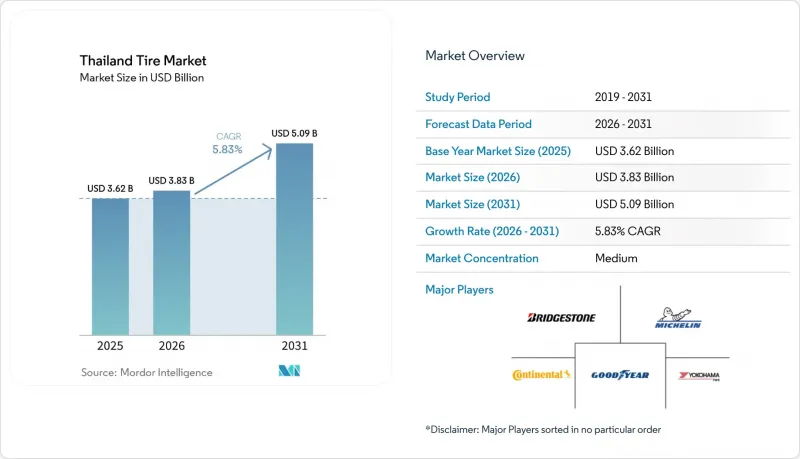
根據 Mordor Intelligence 估計,泰國輪胎市場在 2025 年的價值為 36.2 億美元,在 2026 年的價值為 38.3 億美元。
此外,預計到 2031 年將達到 50.9 億美元,2026 年至 2031 年的複合年成長率為 5.83%。
本報告按季節(夏季、其他)、輪胎結構(子午線輪胎、斜交輪胎、其他)、車輛類型(摩托車、乘用車、其他)、應用領域(公路、越野)、最終用戶(原廠配套、售後市場)、輪圈尺寸(15英寸以下、15-20英寸、20英寸以上)和驅動系統(內燃機等)進行分類。市場預測以價值(美元)和銷售量(單位)表示。
泰國輪胎市場趨勢與洞察
政府電動車補貼計畫提振了對純電動汽車輪胎的需求
泰國的「EV 3.5」政策提供5萬泰銖(約1500美元)至10萬泰銖(約3000美元)不等的補貼,並將消費稅降至最低水平,預計將使電動車註冊量增加40%。由於電池組重量增加,汽車製造商被迫採用載重能力提高40%的輪胎以及超低滾動阻力配方,以滿足性能和效率要求。此外,到2026年12月,泰國組裝規定每進口一輛汽車,就必須在國內生產多輛汽車,這吸引了比亞迪和廣汽集團等主要企業。這些公司在泰國的總產能總合20萬輛。生產設施集中在春武里府和羅勇府,確保了附近輪胎製造商的穩定和可預測的需求。此外,公共快速充電基礎設施的持續擴張將是決定曼谷以外地區電動車普及率的關鍵因素,預計將對全國電動車的普及產生重大影響。
電子商務的快速成長正在推動最後一公里輕型商用車輪胎的銷售量。
泰國的電子商務銷售額持續以兩位數的速度成長,Grab 和 Skootar 等平台正透過引進摩托車和小型貨車來拓展業務。這些車輛通常每天運作8 至 12 小時,在曼谷擁擠的交通中平均行駛 43 公里。如此高的運轉率導致輪胎更換週期加快,增加了對輕型商用車和摩托車輪胎的需求。車隊營運商越來越重視耐用的輪胎配方和更長的里程質保,以最佳化營運效率。然而,營運商對價格的敏感度限制了他們對超高階輪胎的採用。因此,城市物流為中型子午線輪胎製造商提供了巨大的成長機會。同時,這也為高階輪胎品牌提供了一個試驗車隊服務合約的機會,並能有效地向車隊營運商展示其降低總體擁有成本 (TCO) 的能力。
天然橡膠價格波動加劇
2025年初,隨著生產商加快步伐以遵守歐盟的森林砍伐法規(該法規限制從新開墾的土地進口橡膠),基準RSS-3橡膠的價格達到了12年來的最高點。泰國輪胎製造商雖然受益於其與橡膠種植園的地理鄰近性,但仍面臨著原料成本飆升的困境。這項挑戰源自於合成替代品無法完全取代天然橡膠,尤其是在重型卡車和飛機等關鍵應用領域。領先的高階品牌正透過簽訂長期供應合約和實施先進的數位化溯源工具來降低這些風險。儘管採取了這些措施,但對價格敏感的國內市場將上漲的成本轉嫁給消費者的空間有限,導致利潤率面臨巨大壓力。此外,匯率波動加劇了市場波動。泰銖貶值增加了以美元計價的原物料發票成本,進一步增加了供應鏈的複雜性。
細分市場分析
到2025年,四季輪胎將佔泰國輪胎市場53.24%的佔有率。這要歸功於泰國穩定的熱帶氣候,無需根據季節更換輪胎。同時,預計到2031年,冬季輪胎的出貨量將以5.85%的複合年成長率成長。這一成長主要由面向歐洲和北美市場的出口合約推動。產量的增加不僅擴大了泰國輪胎市場規模,還提高了工廠的運轉率,並刺激了對先進專用硫化機的投資。特別是,大陸集團已擴建了位於羅勇府的工廠,並增設了多條硫化生產線,用於生產符合歐盟法規要求的可安裝防滑釘的冬季輪胎。
出口主導的冬季輪胎生產凸顯了泰國製造企業如何有效地利用規模經濟,而國內消費者仍然更青睞四季輪胎。一部分汽車愛好者和豪華進口車車主則選擇夏季高性能輪胎,形成了一個規模雖小但盈利豐厚的市場管道。此外,泰國製造的四季輪胎採用高矽含量的雨季專用配方,即使在油膩濕滑的路面上也能提供卓越的抓地力,從而脫穎而出。穩定的國內需求和出口多元化結合,支撐了各類四季輪胎產能的韌性和高效利用。
到2025年,子午線汽車胎體將佔泰國輪胎市場87.65%的佔有率,這反映了泰國在鋼絲帶、簾布和精密成型方面的強大基礎設施。預計到2031年,無氣輪胎的複合年成長率將達到5.87%。Bridgestone已在曼谷的快速公車(BRT)線路上啟動了無氣公車輪胎的試驗計畫,米其林正在測試其用於農業領域的「Tweel」平台。斜交輪胎在一些細分農業和採礦領域仍然佔有一席之地,在這些領域,成本效益和易於維修比高速性能更為重要。
對高強度芳香聚醯胺和環保樹脂基體的投資,正使泰國製造企業具備擴大下一代無氣輪胎生產規模的能力,前提是它們能夠克服目前的商業化障礙。同時,子午線輪胎製造商正致力於開發更輕、更環保的複合材料,以降低高達15%的滾動阻力,從而符合原始設備製造商(OEM)的碳減排目標。國內大學與供應商的研發合作,正著重利用泰國乳膠出口作為原料,開發生物基彈性體。這些努力旨在顯著降低整個生命週期的排放,同時提高供應鏈的自給自足能力。
2025年,乘用車輪胎在泰國輪胎市場佔了45.54%的顯著佔有率。預計到2031年,該細分市場將以5.91%的複合年成長率成長,鞏固其作為市場擴張主要驅動力的地位。儘管受銀行信貸政策收緊的影響,2024年汽車組裝下降了20%,但該細分市場仍展現出卓越的韌性。電子商務的興起顯著提振了輕型商用車的需求,而重型卡車則受益於與馬來西亞和柬埔寨跨境貿易活動的復甦。
摩托車輪胎仍然是一個至關重要的細分市場,這得益於泰國摩托車產量的擴張,預計到2025年將實現顯著成長。越野輪胎的需求持續受到產品週期趨勢的驅動。披集府採礦業的復甦和那空沙旺府農業機械化的進步正在推動這些特殊細分市場的成長。輪胎製造商正在產品系列進行策略性調整,力求在大量生產的乘用車輪胎產品線和高利潤率的特殊產品之間取得平衡。這種策略將使他們能夠在市場低迷時期穩定收入並保持盈利。
其他好處:
- Excel格式的市場預測(ME)表
- 3個月的分析師支持
目錄
第1章:引言
- 市場分析與定義的前提條件
- 分析範圍
第2章 分析方法
第3章執行摘要
第4章 市場狀況
- 市場概覽
- 市場促進因素
- 政府電動車補貼計畫提振了對純電動汽車輪胎的需求
- 電子商務的快速成長正在推動最後一公里輕型商用車輪胎的銷售。
- 旅遊業的復甦正在加速租賃車輛的更新換代。
- 原廠製造商正轉向為SUV和皮卡車採用更大尺寸的輪轂
- 用於共享出行服務的摩托車數量不斷增加,推高了對高耐用性輪胎的需求。
- 強制性輪胎標籤法規(2025 年)將促進高階子午線輪胎的發展。
- 市場限制因素
- 天然橡膠價格波動加劇
- 假輪胎和平行輸入輪胎正在蠶食品牌輪胎的市場佔有率。
- 對特種工程機械輪胎徵收高額進口關稅
- 公共快速充電基礎設施建設的滯後阻礙了純電動車輪胎的廣泛應用。
- 價值鍊和供應鏈分析
- 監理情勢
- 技術展望
- 波特五力分析
第5章:預測市場規模與成長率
- 按季節
- 夏天
- 冬天
- 四季
- 輪胎結構
- 徑向
- 偏見
- 非氣動/無氣式
- 按車輛類型
- 摩托車
- 搭乘用車
- 輕型商用車
- 大型商用卡車和巴士
- 越野車和特殊車輛(OTR、農業、礦業、賽車)
- 透過使用
- 公路
- 越野
- 最終用戶
- OEM
- 售後市場
- 按輪圈尺寸
- 小於15英寸
- 15-20英寸
- 20吋或更大
- 透過驅動系統
- 內燃機車
- 電池式電動車
- 混合動力汽車和燃料電池汽車
第6章 競爭情勢
- 市場集中度
- 策略趨勢
- 市佔率分析
- 公司簡介
- Bridgestone Corp.
- Michelin SCA
- Goodyear Tire & Rubber Co.
- Yokohama Rubber Co.
- Sumitomo Rubber Industries(Dunlop/Falken)
- Pirelli & CSpA
- Continental AG
- Hankook Tire & Technology
- Kumho Tire Co.
- Toyo Tire Corp.
- Maxxis International(Cheng Shin)
- Giti Tire Pte.
- Apollo Tyres Ltd.
- Nokian Tyres
- Triangle Tyre Co.
- Linglong Tire
- CEAT Ltd.
- Balkrishna Industries(BKT)
- Titan International
- Zhongce Rubber(Westlake)
- PT Multistrada Arah Sarana(Achilles)
第7章 市場機會與未來展望
According to Mordor Intelligence, the Thailand tire market size was valued at USD 3.62 billion in 2025 and is estimated at USD 3.83 billion in 2026, and is projected to reach USD 5.09 billion by 2031, growing at a CAGR of 5.83% from 2026 to 2031.
This report is Segmented by Season (Summer and More), Tire Design (Radial, Bias, and More), Vehicle Type (Two-Wheelers, Passenger Cars and More), Application (On-Road and Off-Road), End User (OEM and Aftermarket), Rim Size (Below 15 Inches, 15 To 20 Inches, and Above 20 Inches), and Propulsion (Internal-Combustion Vehicles and More). The Market Forecasts are Provided in Terms of Value (USD) and Volume (Units).
Thailand Tire Market Trends and Insights
Government EV-Subsidy Program Boosting BEV Tire Demand
Thailand's EV 3.5 policy, which provides subsidies ranging from THB 50,000 (approximately USD 1,500) to THB 100,000 (approximately USD 3,000) and reduces excise taxes to their minimum levels, is anticipated to drive a 40% increase in EV registrations. The growing weight of battery packs has compelled automakers to adopt tires with a 40% higher load rating and ultra-low rolling resistance compounds to meet performance and efficiency requirements. Additionally, the local-assembly mandate, which stipulates that multiple vehicles must be manufactured domestically for every imported unit by December 2026, has attracted key players such as BYD and GAC Aion. These companies have collectively established a production capacity of nearly 200,000 units in Thailand. The concentration of production facilities in Chonburi and Rayong ensures a steady and predictable demand for nearby tire manufacturing plants. Furthermore, the ongoing expansion of public fast-charging infrastructure will be a critical factor in determining the extent of EV penetration beyond Bangkok, influencing the broader adoption of electric vehicles across the country.
Rapid E-Commerce Growth Driving Last-Mile LCV Tire Volumes
Thailand's e-commerce turnover continues to grow at double-digit rates, driving platforms such as Grab and Skootar to expand their operations by deploying motorcycles and small vans. These vehicles typically operate for 8-12 hours daily and cover an average of 43 kilometers in Bangkok's congested traffic conditions. This high level of utilization accelerates replacement cycles, thereby increasing demand for light commercial and two-wheeler tires. Fleet operators are progressively prioritizing high-durability tire compounds and extended mileage warranties to optimize operational efficiency. However, price sensitivity among operators limits the widespread adoption of ultra-premium tire options. As a result, urban logistics provides substantial growth opportunities for medium-tier radial tire manufacturers. Simultaneously, it enables premium tire brands to test fleet-service contracts, effectively demonstrating potential savings in total cost-of-ownership to fleet operators.
Elevated Natural-Rubber Price Volatility
In early 2025, benchmark RSS-3 rubber prices reached a 12-year high as producers accelerated efforts to comply with the European Union's deforestation regulations, which restrict imports sourced from newly cleared lands. Thai tire manufacturers benefit from their geographical proximity to rubber plantations; however, they continue to face elevated feedstock costs. This challenge arises because synthetic alternatives are unable to fully replace natural rubber, particularly in critical applications such as heavy-duty truck and aviation sectors. Leading premium brands mitigate these risks through long-term supply contracts and the implementation of advanced digital traceability tools. Despite these measures, margin pressures remain significant in price-sensitive domestic markets, where the ability to pass on increased costs to consumers is limited. Furthermore, currency fluctuations exacerbate market volatility, as a weakening baht inflates the cost of dollar-denominated raw material invoices, adding another layer of complexity to the supply chain dynamics.
Other drivers and restraints analyzed in the detailed report include:
- Tourism Rebound Accelerating Rental-Car Fleet Renewals
- OEM Shifts to Larger Rim Sizes for SUVs and Pickups
- Counterfeit and Grey-Market Tires Eroding Branded Sales
For complete list of drivers and restraints, kindly check the Table Of Contents.
Segment Analysis
In 2025, all-season tires accounted for 53.24% of the Thailand tire market, driven by the country's consistent tropical climate, which eliminates the necessity for seasonal tire changes. Conversely, winter tire shipments are projected to grow at a CAGR of 5.85% through 2031. This growth is primarily attributed to export contracts targeting markets in Europe and North America. The increase in production not only contributes to the expansion of Thailand's tire market size but also enhances factory load factors and supports investments in advanced, specialized curing presses. Notably, Continental has expanded its Rayong facility, dedicating multiple curing lines to the production of studdable winter tire designs that comply with EU regulatory mandates.
Export-driven winter tire production highlights how Thai manufacturing facilities effectively leverage economies of scale, while domestic consumers continue to favor all-season tires. A niche segment comprising automotive enthusiasts and luxury import owners opts for summer performance tires, representing a small yet profitable market channel. Additionally, Thai all-season tires distinguish themselves with monsoon-grade compounds featuring high silica content, which deliver superior wet grip performance on oil-slick roads. This combination of stable domestic demand and export diversification underpins the resilience and efficient utilization of production capacity across various seasonal tire categories.
In 2025, radial casings accounted for 87.65% of Thailand's tire market, underscoring the country's robust infrastructure in steel belts, cord fabric, and precision molding. Non-pneumatic airless designs are anticipated to grow at a CAGR of 5.87% through 2031. Bridgestone has initiated pilot programs for airless bus tires on Bangkok's BRT routes, while Michelin is conducting tests on Tweel platforms for agricultural applications. Bias-ply formats continue to maintain relevance in niche agriculture and mining sectors, where cost-effectiveness and repairability remain more critical than high-speed performance.
Investments in high-strength aramid and eco-friendly resin matrices are positioning Thai manufacturing facilities to scale up production of next-generation airless tires, contingent on overcoming current commercialization barriers. Simultaneously, radial tire producers are focusing on developing lighter, environmentally friendly composites that can reduce rolling resistance by up to 15%, aligning with the carbon-reduction objectives of original equipment manufacturers (OEMs). Domestic R&D collaborations between universities and suppliers are emphasizing the development of bio-based elastomers derived from Thailand's latex exports. These initiatives aim to enhance supply chain independence while significantly reducing lifecycle emissions.
In 2025, passenger-car fitments accounted for a significant 45.54% share of Thailand's tire market. The segment is projected to grow at a 5.91% CAGR through 2031, reinforcing its position as the primary contributor to the market's expansion. This segment has demonstrated notable resilience, even amidst a 20% decline in auto assemblies in 2024, driven by tightened credit policies from banks. The rise of e-commerce has significantly boosted demand for light commercial vehicles, while heavy trucks have benefited from the recovery of cross-border trade activities with Malaysia and Cambodia.
Motorcycle tires remain a critical segment, supported by Thailand's growing two-wheeler production, which is anticipated to experience exponential growth in 2025. The demand for off-the-road tires continues to align with commodity cycles; the mining recovery in Phichit and increased agricultural mechanization in Nakhon Sawan are sustaining growth in these specialty segments. Tire manufacturers are strategically refining their product portfolios, balancing high-volume passenger tire lines with higher-margin specialty products. This approach enables them to stabilize earnings and maintain profitability during periods of market downturns.
Complete Report Scope:
- By Season
- Summer
- Winter
- All-Season
- By Tire Design
- Radial
- Bias
- Non-pneumatic/Airless
- By Vehicle Type
- Two-Wheelers
- Passenger Cars
- Light Commercial Vehicles
- Heavy Commercial Trucks and Buses
- Off-the-Road and Specialty (OTR, Agriculture, Mining, Racing)
- By Application
- On-Road
- Off-Road
- By End User
- OEM
- Aftermarket
- By Rim Size
- Below 15 inches
- 15 - 20 inches
- Above 20 inches
- By Propulsion
- Internal-Combustion Vehicles
- Battery-Electric Vehicles
- Hybrid and Fuel-Cell Vehicles
List of Companies Covered in this Report:
- Bridgestone Corp.
- Michelin SCA
- Goodyear Tire & Rubber Co.
- Yokohama Rubber Co.
- Sumitomo Rubber Industries (Dunlop/Falken)
- Pirelli & C. S.p.A.
- Continental AG
- Hankook Tire & Technology
- Kumho Tire Co.
- Toyo Tire Corp.
- Maxxis International (Cheng Shin)
- Giti Tire Pte.
- Apollo Tyres Ltd.
- Nokian Tyres
- Triangle Tyre Co.
- Linglong Tire
- CEAT Ltd.
- Balkrishna Industries (BKT)
- Titan International
- Zhongce Rubber (Westlake)
- PT Multistrada Arah Sarana (Achilles)
Additional Benefits:
- The market estimate (ME) sheet in Excel format
- 3 months of analyst support
TABLE OF CONTENTS
1 Introduction
- 1.1 Study Assumptions and Market Definition
- 1.2 Scope of the Study
2 Research Methodology
3 Executive Summary
4 Market Landscape
- 4.1 Market Overview
- 4.2 Market Drivers
- 4.2.1 Government EV-Subsidy Program Boosting BEV Tire Demand
- 4.2.2 Rapid E-Commerce Growth Driving Last-Mile LCV Tire Volumes
- 4.2.3 Tourism Rebound Accelerating Rental-Car Fleet Renewals
- 4.2.4 OEM Shift to Larger Rim Sizes for SUVs and Pickups
- 4.2.5 Rise of Ride-Hailing Two-Wheeler Fleets Demanding High-Durability Tires
- 4.2.6 Mandatory Tire-Labeling Regulations (2025) Favoring Premium Radials
- 4.3 Market Restraints
- 4.3.1 Elevated Natural-Rubber Price Volatility
- 4.3.2 Counterfeit and Grey-Market Tires Eroding Branded Sales
- 4.3.3 High Import Duty on Specialty OTR Tires
- 4.3.4 Slow Deployment of Public Fast-Charging Limiting BEV Tire Uptake
- 4.4 Value/Supply-Chain Analysis
- 4.5 Regulatory Landscape
- 4.6 Technological Outlook
- 4.7 Porter's Five Forces
- 4.7.1 Threat of New Entrants
- 4.7.2 Bargaining Power of Suppliers
- 4.7.3 Bargaining Power of Buyers
- 4.7.4 Threat of Substitutes
- 4.7.5 Competitive Rivalry
5 Market Size and Growth Forecasts (Value (USD) and Volume (Units))
- 5.1 By Season
- 5.1.1 Summer
- 5.1.2 Winter
- 5.1.3 All-Season
- 5.2 By Tire Design
- 5.2.1 Radial
- 5.2.2 Bias
- 5.2.3 Non-pneumatic/Airless
- 5.3 By Vehicle Type
- 5.3.1 Two-Wheelers
- 5.3.2 Passenger Cars
- 5.3.3 Light Commercial Vehicles
- 5.3.4 Heavy Commercial Trucks and Buses
- 5.3.5 Off-the-Road and Specialty (OTR, Agriculture, Mining, Racing)
- 5.4 By Application
- 5.4.1 On-Road
- 5.4.2 Off-Road
- 5.5 By End User
- 5.5.1 OEM
- 5.5.2 Aftermarket
- 5.6 By Rim Size
- 5.6.1 Below 15 inches
- 5.6.2 15 - 20 inches
- 5.6.3 Above 20 inches
- 5.7 By Propulsion
- 5.7.1 Internal-Combustion Vehicles
- 5.7.2 Battery-Electric Vehicles
- 5.7.3 Hybrid and Fuel-Cell Vehicles
6 Competitive Landscape
- 6.1 Market Concentration
- 6.2 Strategic Moves
- 6.3 Market Share Analysis
- 6.4 Company Profiles (Includes Global Level Overview, Market Level Overview, Core Segments, Financials as Available, Strategic Information, Market Rank/Share for Key Companies, Products and Services, SWOT Analysis, and Recent Developments)
- 6.4.1 Bridgestone Corp.
- 6.4.2 Michelin SCA
- 6.4.3 Goodyear Tire & Rubber Co.
- 6.4.4 Yokohama Rubber Co.
- 6.4.5 Sumitomo Rubber Industries (Dunlop/Falken)
- 6.4.6 Pirelli & C. S.p.A.
- 6.4.7 Continental AG
- 6.4.8 Hankook Tire & Technology
- 6.4.9 Kumho Tire Co.
- 6.4.10 Toyo Tire Corp.
- 6.4.11 Maxxis International (Cheng Shin)
- 6.4.12 Giti Tire Pte.
- 6.4.13 Apollo Tyres Ltd.
- 6.4.14 Nokian Tyres
- 6.4.15 Triangle Tyre Co.
- 6.4.16 Linglong Tire
- 6.4.17 CEAT Ltd.
- 6.4.18 Balkrishna Industries (BKT)
- 6.4.19 Titan International
- 6.4.20 Zhongce Rubber (Westlake)
- 6.4.21 PT Multistrada Arah Sarana (Achilles)
7 Market Opportunities and Future Outlook
- 7.1 White-space and Unmet-Need Assessment

 歐洲輪胎市場:市場佔有率分析、產業趨勢與統計、成長預測(2026-2031)美國輪胎:市場佔有率分析、產業趨勢與統計、成長預測(2026-2031)越南輪胎市場:市場佔有率分析、產業趨勢與統計、成長預測(2026-2031)非洲輪胎:市場佔有率分析、產業趨勢與統計、成長預測(2026-2031)馬來西亞輪胎:市場佔有率分析、產業趨勢與統計、成長預測(2026-2031)印尼輪胎市場:市佔率分析、產業趨勢與統計、成長預測(2026-2031)汽車輪胎:市場佔有率分析、產業趨勢與統計、成長預測(2026-2031)
 寬基輪胎市場規模、佔有率和成長分析:按車輛類型、輪胎類型、輪圈尺寸、應用、分銷管道和地區分類 - 產業預測,2026-2033年
 充氣輪胎市場規模:依產品類型、車輛類型、銷售管道、地區及預測分類
 無內胎輪胎市場:2026-2032年全球市場預測(依輪胎結構、車輛類型、材料、應用及銷售管道)