


 |
市場調查報告書
商品編碼
2119865
德國資料中心儲存:市場佔有率分析、行業趨勢和統計數據以及成長預測(2026-2031 年)Germany Data Center Storage - Market Share Analysis, Industry Trends & Statistics, Growth Forecasts (2026 - 2031) |
||||||

※ 本網頁內容可能與最新版本有所差異。詳細情況請與我們聯繫。
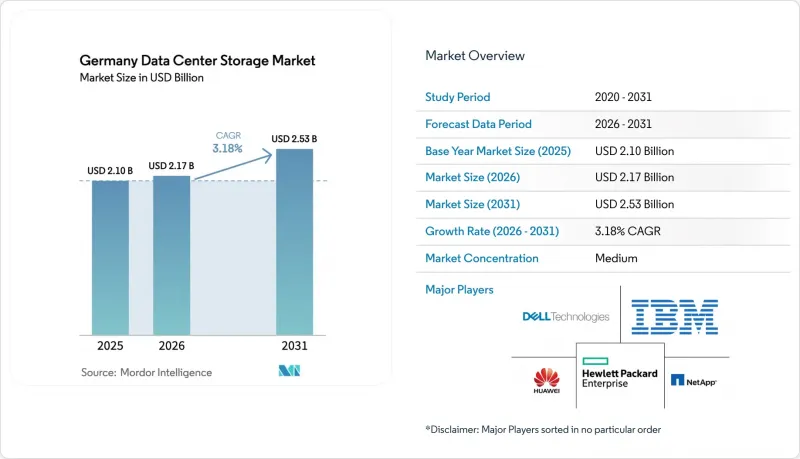
根據 Mordor Intelligence 估計,德國資料中心儲存市場在 2026 年的價值將達到 21.7 億美元,高於 2025 年的 21 億美元,預計到 2031 年將達到 25.3 億美元。
預計 2026 年至 2031 年的複合年成長率為 3.18%。
本報告按儲存技術(網路附加儲存、儲存區域網路等)、儲存類型(傳統硬碟陣列等)、資料中心類型(託管機房等)、最終用戶(IT/電信、銀行、金融服務和保險等)、外形規格(機架式等)和介面(SAS/SATA、NVMe、光纖通道、iSCSI)進行分類。市場預測以美元計價。
德國資料中心和儲存市場的趨勢和洞察。
德國公司雲端運算的蓬勃發展
德國企業正以可控的速度將工作負載遷移到雲端平台,以利用彈性運算環境進行分析,同時保留其本地投資。弗勞恩霍夫IESE研究所的研究表明,系統工程複雜度目前為7.6,預計五年內將上升至8.7,這表明傳統架構已無法滿足即時整合需求。因此,連接資料中心、託管機房和符合Gaia-X標準的自主雲端的混合儲存方案正日益普及,支援分階段重構,且不違反資料居住法規。法蘭克福、慕尼黑和柏林憑藉對延遲敏感的銀行、金融和保險(BFSI)以及軟體即服務(SaaS)工作負載,繼續保持其中心地位。 2024年預算提案(Haushaltsplan)中詳述的聯邦數位化獎勵,透過對雲端支出的稅收優惠,進一步降低了採用雲端技術的門檻。
向綠色/節能型資料中心轉型
為了實現德國在2045年之前達到碳中和的目標,電源使用效率(PUE)和可回收性已成為採購評估標準的首要考量。營運商正在採用液冷和浸沒式冷卻來溫度控管,因為空氣冷卻已達到其物理極限。像戴爾科技的Concept Astro這樣的AI驅動的編配平台,可以在數位孿生體上模擬伺服器和儲存負載,透過調整風扇轉速和CPU狀態,在現場測試中將功耗降低高達14%。此外,市場對採用可回收合金製成的模組化機殼的需求也在不斷成長,這種機箱允許在無需耗費大量能源的維修工作的情況下更換組件。
初始資本支出(Capex)和嚴格的數據主權審計
在採購新的陣列之前,銀行和政府機構必須完成全面的隱私影響評估,這可能會使專案週期延長六個月。 Palantir 在黑森州提起的訴訟表明,該平台正因潛在的大規模監控風險而受到密切審查,加密、金鑰管理和審計日誌功能被視為基本要求。客製化的安全配置會導致材料清單(BOM) 成本高於標準 SKU,從而減緩短期銷售量成長。
細分市場分析
儲存區域網路(SAN) 為關鍵任務型 SAP HANA 和核心銀行工作負載提供所需的穩健性,預計到 2025 年將佔總收入的 26.95%。同時,在軟體定義檔服務的推動下,NAS 系統預計將實現 3.58% 的複合年成長率。成長最快的採用者是那些優先考慮簡化橫向擴展和 REST API 整合的 SaaS 供應商。直接附加儲存(DAS) 在生產線旁機器人單元中仍然發揮著至關重要的作用,在這些單元中,確定性延遲比共用架構的便利性更為重要。物件儲存與磁帶的結合對於合規性歸檔至關重要,可確保滿足德國聯邦金融監管局 (BaFin) 保留規定的不可更改副本。
德國電信業者傾向於分階段更新。弗勞恩霍夫IESE研究所指出,整個產業正在向模型驅動開發轉型,這減少了對自訂腳本的需求。因此,平台團隊傾向於選擇具有熟悉的NFS和SMB語義的NAS叢集,這減少了重新培訓的需求,並使有限的儲存工程師能夠專注於最佳化工作。
硬碟陣列仍將主導高容量儲存市場,預計2025年將佔據43.05%的市場佔有率。然而,隨著NVMe價格的下降和人工智慧推理技術的普及,全Flash陣列的複合年成長率將達到4.12%。混合陣列發揮風險對沖的作用,能夠自動將熱點資料集儲存在TLC或QLC NAND快閃記憶體上,將冷檔案儲存在高容量磁碟上,既滿足合規性儲存要求,又能滿足效能服務等級協定(SLA)。硬碟廠商正計劃推出充氦30TB硬碟以應對這項挑戰,預計將於2026年上市,這將延緩備份儲存市場的全面轉型。
其他好處:
- Excel格式的市場預測(ME)表
- 3個月的分析師支持
目錄
第1章:引言
- 研究假設和市場定義
- 調查範圍
第2章:調查方法
第3章執行摘要
第4章 市場狀況
- 市場概覽
- 市場促進因素
- 德國公司雲端運算的蓬勃發展
- 向綠色、高效資料中心轉型
- 人工智慧的加速發展和生成式人工智慧(Gen-AI)工作負載的成長正在推動快閃記憶體儲存的普及。
- 工業4.0/5G邊緣位置的開發
- 德國對廢熱再利用的補貼(新法將於2025年生效)
- 德國聯邦銀行支持推廣主權雲端服務(Gaia-X)。
- 市場限制因素
- 初始資本投資和嚴格的數據主權審計
- 能源轉型導致電力價格波動
- 接入電網的前置作業時間很長。
- 熟練的倉儲工程師短缺
- 供應鏈分析
- 監理情勢
- 技術展望
- 波特五力模型
- 市場宏觀經濟趨勢的評估
第5章 市場規模與成長預測
- 儲存技術
- 網路附加儲存 (NAS)
- 儲存區域網路(SAN)
- 直接連接儲存(DAS)
- 物件存儲和磁帶存儲
- 依儲存類型
- 傳統硬碟陣列
- 全Flash陣列(AFA)
- 混合儲存
- 依資料中心類型
- 託管設施
- 超大規模資料中心業者雲端服務供應商/雲端服務供應商
- 企業和邊緣運算
- 最終用戶
- 資訊科技/通訊
- BFSI
- 政府/公共部門
- 媒體與娛樂
- 醫療保健和生命科學
- 製造業
- 按外形規格
- 機架安裝型
- 刀片和模組化
- 細分/可組合
- 透過介面
- SAS/SATA
- NVMe
- 光纖通道和 iSCSI
第6章 競爭情勢
- 市場集中度
- 策略性舉措(併購、合資、資料中心即服務)
- 市佔率分析
- 公司簡介
- Dell Technologies
- Hewlett Packard Enterprise
- NetApp
- IBM
- Huawei Technologies
- Hitachi Vantara
- Lenovo
- Pure Storage
- Fujitsu
- Nutanix
- Oracle
- Commvault
- Cisco Systems
- Western Digital
- Seagate Technology
- VAST Data
- Infinidat
- Qumulo
- NEC
- Samsung Electronics(Flash)
第7章 市場機會與未來展望
According to Mordor Intelligence, Germany data center storage market size in 2026 is estimated at USD 2.17 billion, growing from 2025 value of USD 2.10 billion with 2031 projections showing USD 2.53 billion, growing at 3.18% CAGR over 2026-2031.
This report is Segmented by Storage Technology (Network-Attached Storage, Storage Area Network, and More), Storage Type (Traditional HDD Arrays and More ), Data Center Type (Colocation Facilities and More), End User (IT and Telecommunication, BFSI and More), Form Factor (Rack-Mounted and More), Interface(sas / SATA, Nvme, Fibre Channel and ISCSI). The Market Forecasts are Provided in Terms of Value (USD).
Germany Data Center Storage Market Trends and Insights
Cloud-Computing Boom Among German Enterprises
German firms are migrating workloads to cloud platforms at a controlled pace that preserves on-premises investments while unlocking elastic compute for analytics. A Fraunhofer IESE survey shows systems-engineering complexity scoring 7.6 today and rising to 8.7 within five years, revealing that legacy stacks can no longer cope with real-time integration demands. Hybrid storage that bridges data center, colocation and Gaia-X compliant sovereign clouds, therefore finds favor, supporting gradual refactoring without breaching residency rules. Frankfurt, Munich and Berlin remain hubs thanks to latency-sensitive BFSI and SaaS workloads. Federal incentives for digitalization, detailed in the 2024 Haushaltsplan, are further lowering adoption barriers through tax breaks on cloud spending.
Shift to Green / Energy-Efficient Data-Centres
Germany's carbon-neutrality target for 2045 has moved PUE and recyclability to the top of procurement scorecards. Operators are adopting liquid and immersion cooling to manage thermals in high-density racks where air cooling hits physical limits. AI-driven orchestration platforms, such as Dell Technologies' Concept Astro, now simulate server and storage loads in a digital twin to modulate fan speeds and CPU states, cutting power draw up to 14% in field tests. Demand is rising for modular enclosures built from recyclable alloys so components can be swapped without energy-intensive refits.
Up-Front Capex & Stringent Data-Sovereignty Audits
Before procuring new arrays, banks and ministries must complete exhaustive privacy impact assessments that can extend project cycles by six months. The Palantir litigation in Hesse shows how platforms face scrutiny for potential mass-surveillance risk, elevating encryption, key custody and audit log features as must-haves. Custom secure configurations push bill-of-materials costs above standard SKUs, dampening short-term volume.
Other drivers and restraints analyzed in the detailed report include:
- Accelerated AI / Gen-AI Workloads Driving Flash Adoption
- Edge-Location Build-Out for Industry 4.0 / 5G
- Volatile Electricity Prices Linked to Energiewende
For complete list of drivers and restraints, kindly check the Table Of Contents.
Segment Analysis
Storage Area Networks provided the robustness that mission-critical SAP HANA and core-banking workloads demanded, holding 26.95% revenue in 2025. Yet NAS systems, helped by software-defined file services, are projected to record 3.58% CAGR. Adoption is strongest among software-as-a-service vendors that value simplified scale-out and REST-API integration. Direct-attached storage retains a role in line-side robotics cells where deterministic latency trumps shared fabric convenience. Object storage paired with tape remains vital for compliance archives, ensuring immutable copies that satisfy BaFin retention rules.
German operators favor iterative refresh cycles. Fraunhofer IESE notes a sector-wide pivot toward model-driven development that reduces bespoke scripting. Consequently, platform teams gravitate to NAS clusters with familiar NFS and SMB semantics, limiting retraining and freeing scarce storage engineers for optimization work.
HDD arrays continued to dominate capacity-oriented tiers, representing 43.05% share in 2025. However, all-flash arrays will expand at 4.12% CAGR as NVMe pricing falls and AI inference gains traction. Hybrid arrays provide a hedge, enabling automatic placement of hot datasets on TLC or QLC NAND and cold files on high-capacity disks, supporting compliance retention yet satisfying performance SLAs. HDD vendors counter with helium-filled 30 TB drives shipping in 2026, delaying full conversion in backup tiers.
Complete Report Scope:
- By Storage Technology
- Network Attached Storage (NAS)
- Storage Area Network (SAN)
- Direct Attached Storage (DAS)
- Object and Tape Storage
- By Storage Type
- Traditional HDD Arrays
- All-Flash Arrays (AFA)
- Hybrid Storage
- By Data Center Type
- Colocation Facilities
- Hyperscalers/Cloud Service Providers
- Enterprise and Edge
- By End User
- IT and Telecommunication
- BFSI
- Government and Public Sector
- Media and Entertainment
- Healthcare and Life Sciences
- Manufacturing
- By Form Factor
- Rack-mounted
- Blade and Modular
- Disaggregated / Composable
- By Interface
- SAS / SATA
- NVMe
- Fibre Channel and iSCSI
List of Companies Covered in this Report:
- Dell Technologies
- Hewlett Packard Enterprise
- NetApp
- IBM
- Huawei Technologies
- Hitachi Vantara
- Lenovo
- Pure Storage
- Fujitsu
- Nutanix
- Oracle
- Commvault
- Cisco Systems
- Western Digital
- Seagate Technology
- VAST Data
- Infinidat
- Qumulo
- NEC
- Samsung Electronics (Flash)
Additional Benefits:
- The market estimate (ME) sheet in Excel format
- 3 months of analyst support
TABLE OF CONTENTS
1 INTRODUCTION
- 1.1 Study Assumptions and Market Definition
- 1.2 Scope of the Study
2 RESEARCH METHODOLOGY
3 EXECUTIVE SUMMARY
4 MARKET LANDSCAPE
- 4.1 Market Overview
- 4.2 Market Drivers
- 4.2.1 Cloud-computing boom among German enterprises
- 4.2.2 Shift to green/energy-efficient data-centres
- 4.2.3 Accelerated AI/Gen-AI workloads driving flash adoption
- 4.2.4 Edge-location build-out for Industry 4.0/5G
- 4.2.5 Germany's surplus-heat re-use subsidies (new 2025 law)
- 4.2.6 Bundesbank-backed sovereign cloud push (Gaia-X)
- 4.3 Market Restraints
- 4.3.1 Up-front capex and stringent data-sovereignty audits
- 4.3.2 Volatile electricity prices linked to Energiewende
- 4.3.3 Lengthy power-grid connection lead times
- 4.3.4 Scarcity of skilled storage engineers
- 4.4 Supply-Chain Analysis
- 4.5 Regulatory Landscape
- 4.6 Technological Outlook
- 4.7 Porter's Five Forces
- 4.7.1 Threat of New Entrants
- 4.7.2 Bargaining Power of Buyers
- 4.7.3 Bargaining Power of Suppliers
- 4.7.4 Threat of Substitutes
- 4.7.5 Competitive Rivalry
- 4.8 Assessment of Macroeconomic Trends on the Market
5 MARKET SIZE AND GROWTH FORECASTS (VALUE)
- 5.1 By Storage Technology
- 5.1.1 Network Attached Storage (NAS)
- 5.1.2 Storage Area Network (SAN)
- 5.1.3 Direct Attached Storage (DAS)
- 5.1.4 Object and Tape Storage
- 5.2 By Storage Type
- 5.2.1 Traditional HDD Arrays
- 5.2.2 All-Flash Arrays (AFA)
- 5.2.3 Hybrid Storage
- 5.3 By Data Center Type
- 5.3.1 Colocation Facilities
- 5.3.2 Hyperscalers/Cloud Service Providers
- 5.3.3 Enterprise and Edge
- 5.4 By End User
- 5.4.1 IT and Telecommunication
- 5.4.2 BFSI
- 5.4.3 Government and Public Sector
- 5.4.4 Media and Entertainment
- 5.4.5 Healthcare and Life Sciences
- 5.4.6 Manufacturing
- 5.5 By Form Factor
- 5.5.1 Rack-mounted
- 5.5.2 Blade and Modular
- 5.5.3 Disaggregated / Composable
- 5.6 By Interface
- 5.6.1 SAS / SATA
- 5.6.2 NVMe
- 5.6.3 Fibre Channel and iSCSI
6 COMPETITIVE LANDSCAPE
- 6.1 Market Concentration
- 6.2 Strategic Moves (MandA, JVs, DC-as-a-Service)
- 6.3 Market Share Analysis
- 6.4 Company Profiles (includes Global level Overview, Market level overview, Core Segments, Financials as available, Strategic Information, Market Rank/Share for key companies, Products and Services, and Recent Developments)
- 6.4.1 Dell Technologies
- 6.4.2 Hewlett Packard Enterprise
- 6.4.3 NetApp
- 6.4.4 IBM
- 6.4.5 Huawei Technologies
- 6.4.6 Hitachi Vantara
- 6.4.7 Lenovo
- 6.4.8 Pure Storage
- 6.4.9 Fujitsu
- 6.4.10 Nutanix
- 6.4.11 Oracle
- 6.4.12 Commvault
- 6.4.13 Cisco Systems
- 6.4.14 Western Digital
- 6.4.15 Seagate Technology
- 6.4.16 VAST Data
- 6.4.17 Infinidat
- 6.4.18 Qumulo
- 6.4.19 NEC
- 6.4.20 Samsung Electronics (Flash)
7 MARKET OPPORTUNITIES AND FUTURE OUTLOOK
- 7.1 White-Space and Unmet-Need Assessment

 中國資料中心儲存:市場佔有率分析、產業趨勢與統計及成長預測(2026-2031)印尼資料中心儲存:市場佔有率分析、產業趨勢與統計及成長預測(2026-2031)印度資料中心儲存:市場佔有率分析、產業趨勢與統計及成長預測(2026-2032)新加坡資料中心儲存:市場佔有率分析、產業趨勢與統計及成長預測(2026-2031 年)菲律賓資料中心儲存:市場佔有率分析、產業趨勢與統計及成長預測(2026-2031 年)越南資料中心儲存:市場佔有率分析、產業趨勢與統計及成長預測(2026-2031)馬來西亞資料中心儲存:市場佔有率分析、產業趨勢與統計及成長預測(2026-2031 年)
 2026-2030年全球伺服器儲存市場
 資料中心儲存市場-2026-2032年全球市場預測
 2026年全球儲存架構市場報告