


 |
市場調查報告書
商品編碼
2119813
中國資料中心儲存:市場佔有率分析、產業趨勢與統計及成長預測(2026-2031)China Data Center Storage - Market Share Analysis, Industry Trends & Statistics, Growth Forecasts (2026 - 2031) |
||||||

※ 本網頁內容可能與最新版本有所差異。詳細情況請與我們聯繫。
根據 Mordor Intelligence 預測,中國資料中心儲存市場規模將從 2025 年的 29.5 億美元成長到 2026 年的 30.8 億美元,然後在 2031 年達到 38.1 億美元,2026 年至 2031 年的複合年成長率為 4.38%。
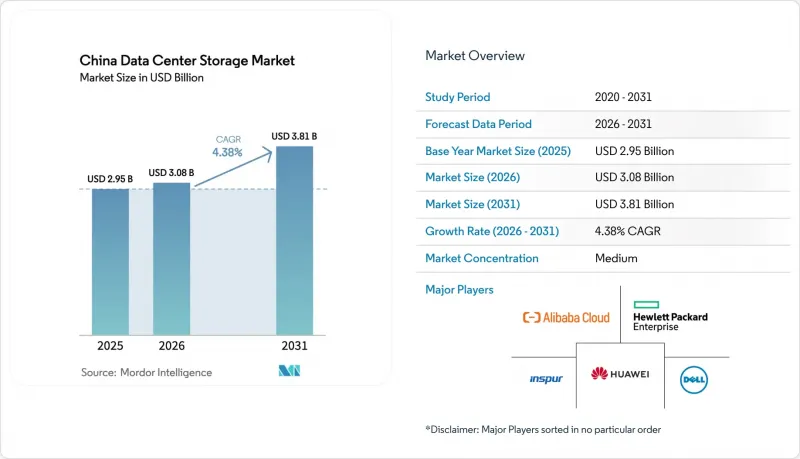
本報告將產業細分為以下幾類:儲存技術(網路附加儲存、儲存區域網路等)、儲存類型(傳統硬碟陣列等)、資料中心類型(託管機房等)、外形規格(機架式等)、介面(SAS/SATA、NVMe 等)以及最終用戶(IT 和電信等)。市場預測以美元計價。
中國資料中心儲存市場趨勢及洞察。
國營企業與網路巨頭的「雲端優先」策略
為滿足數位轉型的需求,國有企業和阿里巴巴等大型平台正在提高資本支出上限。光是阿里巴巴就承諾在三年內投資530億美元用於人工智慧和雲端硬體,這將推動對支援分析、訓練和備份的多層儲存的短期需求。中國電信的醫療健康子公司正在部署省級資料池,需要可擴展的區塊儲存和物件儲存容量來處理影像和基因組分析工作負載。公私合作模式正在推動對兼具NVMe效能和Petabyte級物件儲存庫的系統訂單成長。這正是中國資料中心儲存市場的“黃金地帶”,能夠合理平衡延遲和成本的供應商將獲得豐厚回報。此外,國營企業的採購指南優先考慮國產控制器,這為當地企業提高物料清單(BOM)佔比鋪平了道路。
「東方數據,西方計算」樞紐部署
「東數據西算」計畫投資約330億美元,興建8個國家級樞紐節點和10個叢集區域,將運算流量從電網密集的沿海地區轉移到可再生能源豐富的內陸地區。營運商正在將西部叢集設計為用於批次和歸檔工作負載,這推動了高密度硬碟籠和大容量物件儲存系統的採購。電網資產的數位孿生體正在向這些樞紐節點發送即時遙測數據,凸顯了智慧分層引擎的必要性,該引擎可以將冷數據遷移到節能型儲存池。硬體選配現在需要考慮海拔、冷卻需求和自動化遠端管理等因素,這導致中國資料中心儲存市場對人工智慧編配軟體的需求不斷成長。
一級都會大都會圈電源使用效率 (PUE) 上限
在北京、上海和廣州,新建機房的PUE值必須低於1.3,現有設施的維修也已設定了期限,同時機架級功耗預算和冷卻密度也受到限制。營運商正在用快閃機架替換HDD JBOD,從而降低80%的功耗,但初始資本投入(Capex)仍然是中小企業面臨的一大障礙。安裝在海南島近海的水下模組和水下儲存設備,每個機架可吸收高達100kW的功率,同時符合城市規劃標準。儘管這些限制將限制短期內的出貨量,但中國的資料中心儲存市場正朝向節能架構轉型,並採用具備精細功率限制功能的韌體。
細分市場分析
預計到2025年,SAN部署將佔中國資料中心儲存市場收入的45.83%,反映出國營銀行、電信核心網路和ERP工作負載對集中式區塊儲存的持續需求。儘管軟體定義儲存方案日趨成熟,但成熟的光纖通道架構、高可用性和認證互通性仍然使採購週期與SAN的更換緊密相關。在整個預測期內,大多數SAN升級將包括升級到NVMe-FC和智慧分層到物件儲存庫,從而幫助資訊長在不改變現有工作流程的情況下管理激增的AI訓練資料集。
同時,物件儲存和磁帶儲存解決方案的複合年成長率 (CAGR) 達到 6.05%,在所有技術中成長最高。訓練人工智慧模型需要消耗Petabyte級影像和文字語料庫,這非常適合基於成本最佳化型硬碟或容量為每碟 1.6 PB 的下一代光碟的 S3 相容平台。隨著冷歸檔法規要求對關鍵資料進行離線複製,磁帶庫的重要性也再次提升。在中國資料中心儲存市場,能夠提供 SAN 和物件叢集之間無縫命名空間共用的供應商正逐漸獲得優勢,因為企業都在以自己的步調進行現代化改造。
在中國資料中心儲存市場,到2025年,機械硬碟陣列仍將佔據47.10%的收入佔有率,但逐年成長趨勢表明,固態硬碟(SSD)將逐漸佔據主導地位。隨著人工智慧推理、即時分析和高頻交易中機械延遲的消除,全Flash陣列複合成長率(CAGR)將達到7.55%,直至2031年。長江儲存(YMTC)QLC快閃記憶體壽命的提升正在縮小價格差距,促使銀行和雲端服務供應商在系統更新周期中將關聯資料庫遷移到快閃記憶體層。此外,能源效率法規的推出也進一步推動了SSD的採購趨勢,其每Terabyte的功耗僅為15K RPM SAS硬碟的五分之一。
對於需要經濟高效、高容量儲存且前端配備快閃記憶體快取的中階工作負載而言,混合式儲存系統仍然至關重要。廠商正在將QLC固態硬碟、PMR機械硬碟和壓縮ASIC晶片整合到單一底盤中,為客戶提供逐步遷移的路線圖。因此,純機械硬碟機箱的出貨量正在下降,但用於冷歸檔設施單次寫入儲存的多TB級氦氣硬碟仍然被廣泛採購。由此可見,中國資料中心儲存市場正在演變為一種雙層模型:快閃記憶體用於儲存活躍資料集,高密度機械硬碟或磁帶用於長期歸檔。
其他好處
- Excel格式的市場預測(ME)表
- 3個月的分析師支持
目錄
第1章:引言
- 研究假設和市場定義
- 調查範圍
第2章:調查方法
第3章執行摘要
第4章 市場狀況
- 市場概覽
- 市場促進因素
- 國營企業與網路巨頭的「雲端優先」策略
- 「東方數據,西方計算」樞紐部署
- AI/LLM 工作負載的激增催生了對高 IOPS 快閃記憶體陣列的需求。
- 在二線城市的託管設施中推廣SDS和HCI的應用
- 5G邊緣雲端整合用於低延遲服務
- 為實現半導體自給自足而做出的努力正在推動國內NAND快閃記憶體的供應。
- 市場限制因素
- 一級都會大都會圈電源使用效率 (PUE) 上限
- 對先進控制器的進口限制超過了供應風險。
- 新建人工智慧資料中心的運轉率較低。
- 沿海地區以外地區熟練資料儲存架構師短缺
- 價值供應鏈分析
- 監理情勢
- 技術展望
- 波特五力分析
- 評估宏觀經濟趨勢對市場的影響
第5章 市場規模與成長預測
- 儲存技術
- 網路附加儲存 (NAS)
- 儲存區域網路(SAN)
- 直接附加儲存(DAS)
- 物件存儲/磁帶存儲
- 依儲存類型
- 傳統硬碟陣列
- 全Flash陣列(AFA)
- 混合儲存
- 依資料中心類型
- 託管設施
- 超大規模資料中心業者雲端服務供應商
- 企業邊緣
- 最終用戶
- 資訊科技/通訊
- BFSI
- 政府/公共部門
- 媒體與娛樂
- 醫療保健和生命科學
- 製造業
- 按外形規格
- 機架安裝型
- 刀片模組化
- 可分離和可組合
- 透過介面
- SAS/SATA
- NVMe
- 光纖通道 iSCSI
第6章 競爭情勢
- 市場集中度
- 策略趨勢
- 市佔率分析
- 公司簡介
- Alibaba Cloud Computing Co., Ltd.
- Baidu AI Cloud Computing Ltd.
- China Telecom Corporation Limited
- China Unicom Ltd.
- Dell Technologies Inc.
- Fujitsu Limited
- Hewlett Packard Enterprise Company
- Hitachi Vantara LLC
- H3C Technologies Co., Limited
- Huawei Technologies Co., Ltd.
- Inspur Electronic Information Industry Co., Ltd.
- Kingston Technology Company, Inc.
- Lenovo Group Limited
- NetApp Inc.
- Oracle Corporation
- Pure Storage, Inc.
- Seagate Technology LLC
- Tencent Cloud Computing(Beijing)Co., Ltd.
- Western Digital Corporation
- Yangtze Memory Technologies Co., Ltd.
第7章 市場機會與未來展望
According to Mordor Intelligence, the China data center storage market size is expected to grow from USD 2.95 billion in 2025 to USD 3.08 billion in 2026 and is forecast to reach USD 3.81 billion by 2031 at 4.38% CAGR over 2026-2031.
This report Segments the Industry Into Storage Technology (Network Attached Storage, Storage Area Network, and More), Storage Type (Traditional Storage, and More), Data Center Type (Colocation Facilities and More), , Form Factor(Rack-Mounted and More), Interface(sas / SATA, Nvme and More), and End User (IT and Telecommunication, and More). The Market Forecasts are Provided in Terms of Value (USD).
China Data Center Storage Market Trends and Insights
Cloud-First Strategies of SOEs and Internet Giants
State-owned enterprises and leading platforms such as Alibaba are raising capital-expenditure ceilings to meet digital-transformation mandates. Alibaba alone pledged USD 53 billion over three years for AI and cloud hardware, lifting near-term demand for multi-tier storage that supports analytics, training, and backup in a single stack. China Telecom's healthcare subsidiary is rolling out provincial data pools that require scalable block and object capacity for imaging and genomic workloads. Unified public-and-private strategies increase orders for systems that combine NVMe performance with petabyte-scale object repositories, a sweet spot where the China data center storage market rewards vendors able to balance latency and cost. Procurement guidelines from SOEs also give preference to domestic controllers, offering local firms a route to higher bill-of-materials share.
National East-Data-West-Compute Hub Rollout
The East-Data-West-Compute program has committed almost USD 33 billion to build eight national hub nodes and 10 cluster zones, routing compute traffic away from grid-strained coastlines to renewable-rich inland sites. Operators design western clusters for batch processing and archival workloads, spurring purchases of dense HDD cages and high-capacity object systems. Digital twins of grid assets feed real-time telemetry into these hubs, underscoring the need for intelligent tiering engines that migrate cold data to energy-efficient pools. Hardware selection now factors altitude, cooling requirements, and remote-management automation, which in turn elevates the China data center storage market's appetite for AI-enabled orchestration software.
Power-Use-Efficiency Caps in Tier-1 Metros
Beijing, Shanghai, and Guangzhou mandate PUE below 1.3 for new halls and impose retrofit timelines on legacy sites, restricting rack-level watt budgets and cooling density. Operators replace HDD JBODs with flash shelves, drawing 80% less power, yet initial capex remains a hurdle for smaller enterprises. Liquid-immersion pods and underwater modules off Hainan absorb up to 100 kW per rack while meeting urban planning codes. These constraints moderate near-term shipment volumes but shift the China data center storage market toward energy-efficient architectures with granular power-capping firmware.
Other drivers and restraints analyzed in the detailed report include:
- AI/LLM Workload Surge Demanding High-IOPS Flash Arrays
- Semiconductor Self-Reliance Push Boosting Domestic NAND Supply
- Import Restrictions on Advanced Controllers > Supply Risk
For complete list of drivers and restraints, kindly check the Table Of Contents.
Segment Analysis
SAN deployments accounted for 45.83% of 2025 revenue within the China data center storage market, reflecting entrenched demand for centralized block storage from state banks, telecom core networks, and ERP workloads. Established Fibre-Channel fabrics, high availability, and certified interoperability keep procurement cycles locked into SAN replacements even as software-defined options mature. Over the forecast window, most SAN refreshes include NVMe-FC upgrades and intelligent tiering to object repositories, helping CIOs manage surging AI training datasets without abandoning existing workflows.
At the same time, object and tape solutions post a 6.05% CAGR, the fastest among all technologies. AI model training consumes petabyte-scale image and text corpora, well suited to S3-compatible platforms backed by cost-optimized HDDs or next-generation optical media capable of 1.6 Pb per platter. Tape libraries also regain relevance because cold-archive regulations require offline copies for critical data. Vendors that offer seamless namespace sharing between SAN and object clusters gain an advantage as enterprises modernize at their own pace across the China data center storage market.
HDD arrays still delivered 47.10% of 2025 revenue in the China data center storage market size, yet year-on-year trendlines favor solid-state drives. All-flash arrays expand at 7.55% CAGR to 2031 as AI inference, realtime analytics, and high-frequency trading reject mechanical latency. YMTC's QLC endurance improvements narrow the price gap, encouraging banks and cloud providers to migrate relational databases to flash tiers during refresh cycles. Power-efficiency mandates further tilt procurement toward SSDs that draw one-fifth the watts per terabyte compared to 15 K RPM SAS drives.
Hybrid systems remain essential for mid-tier workloads needing cost-effective bulk capacity with a flash cache front end. Vendors mix QLC SSDs, PMR HDDs, and compression ASICs in a single chassis, providing a glide path for customers to transition gradually. As a result, shipments of pure HDD enclosures decline, yet cold-archive vaults continue purchasing multi-TB helium drives for write-once storage. The China data center storage market therefore evolves into a two-tier model-flash for active datasets and high-density HDD or tape for deep archives.
Complete Report Scope:
- By Storage Technology
- Network Attached Storage (NAS)
- Storage Area Network (SAN)
- Direct Attached Storage (DAS)
- Object and Tape Storage
- By Storage Type
- Traditional HDD Arrays
- All-Flash Arrays (AFA)
- Hybrid Storage
- By Data Center Type
- Colocation Facilities
- Hyperscalers/Cloud Service Providers
- Enterprise and Edge
- By End User
- IT and Telecommunication
- BFSI
- Government and Public Sector
- Media and Entertainment
- Healthcare and Life Sciences
- Manufacturing
- By Form Factor
- Rack-mounted
- Blade and Modular
- Disaggregated / Composable
- By Interface
- SAS / SATA
- NVMe
- Fibre Channel and iSCSI
List of Companies Covered in this Report:
- Alibaba Cloud Computing Co., Ltd.
- Baidu AI Cloud Computing Ltd.
- China Telecom Corporation Limited
- China Unicom Ltd.
- Dell Technologies Inc.
- Fujitsu Limited
- Hewlett Packard Enterprise Company
- Hitachi Vantara LLC
- H3C Technologies Co., Limited
- Huawei Technologies Co., Ltd.
- Inspur Electronic Information Industry Co., Ltd.
- Kingston Technology Company, Inc.
- Lenovo Group Limited
- NetApp Inc.
- Oracle Corporation
- Pure Storage, Inc.
- Seagate Technology LLC
- Tencent Cloud Computing (Beijing) Co., Ltd.
- Western Digital Corporation
- Yangtze Memory Technologies Co., Ltd.
Additional Benefits:
- The market estimate (ME) sheet in Excel format
- 3 months of analyst support
TABLE OF CONTENTS
1 INTRODUCTION
- 1.1 Study Assumptions and Market Definition
- 1.2 Scope of the Study
2 RESEARCH METHODOLOGY
3 EXECUTIVE SUMMARY
4 MARKET LANDSCAPE
- 4.1 Market Overview
- 4.2 Market Drivers
- 4.2.1 Cloud-first strategies of SOEs and internet giants
- 4.2.2 National East-Data-West-Compute hub rollout
- 4.2.3 AI/LLM workload surge demanding high-IOPS flash arrays
- 4.2.4 Growing adoption of SDS & HCI in Tier-2 city colos
- 4.2.5 5 G edge-cloud integration for low-latency services
- 4.2.6 Semiconductor self-reliance push boosting domestic NAND supply
- 4.3 Market Restraints
- 4.3.1 Power-use efficiency caps in Tier-1 metros
- 4.3.2 Import restrictions on advanced controllers greater than supply risk
- 4.3.3 Under-utilization of newly built AI data centers
- 4.3.4 Shortage of skilled data-storage architects outside coastal regions
- 4.4 Value / Supply-Chain Analysis
- 4.5 Regulatory Landscape
- 4.6 Technological Outlook
- 4.7 Porter's Five Forces Analysis
- 4.7.1 Threat of New Entrants
- 4.7.2 Bargaining Power of Buyers
- 4.7.3 Bargaining Power of Suppliers
- 4.7.4 Threat of Substitutes
- 4.7.5 Competitive Rivalry
- 4.8 Assessment of the impact of Macro Economic Trends on the Market
5 MARKET SIZE AND GROWTH FORECASTS (VALUE)
- 5.1 By Storage Technology
- 5.1.1 Network Attached Storage (NAS)
- 5.1.2 Storage Area Network (SAN)
- 5.1.3 Direct Attached Storage (DAS)
- 5.1.4 Object and Tape Storage
- 5.2 By Storage Type
- 5.2.1 Traditional HDD Arrays
- 5.2.2 All-Flash Arrays (AFA)
- 5.2.3 Hybrid Storage
- 5.3 By Data Center Type
- 5.3.1 Colocation Facilities
- 5.3.2 Hyperscalers/Cloud Service Providers
- 5.3.3 Enterprise and Edge
- 5.4 By End User
- 5.4.1 IT and Telecommunication
- 5.4.2 BFSI
- 5.4.3 Government and Public Sector
- 5.4.4 Media and Entertainment
- 5.4.5 Healthcare and Life Sciences
- 5.4.6 Manufacturing
- 5.5 By Form Factor
- 5.5.1 Rack-mounted
- 5.5.2 Blade and Modular
- 5.5.3 Disaggregated / Composable
- 5.6 By Interface
- 5.6.1 SAS / SATA
- 5.6.2 NVMe
- 5.6.3 Fibre Channel and iSCSI
6 COMPETITIVE LANDSCAPE
- 6.1 Market Concentration
- 6.2 Strategic Moves
- 6.3 Market Share Analysis
- 6.4 Company Profiles (includes Global-level Overview, Market-level Overview, Core Segments, Financials, Strategic Information, Market Rank/Share, Products & Services, Recent Developments)
- 6.4.1 Alibaba Cloud Computing Co., Ltd.
- 6.4.2 Baidu AI Cloud Computing Ltd.
- 6.4.3 China Telecom Corporation Limited
- 6.4.4 China Unicom Ltd.
- 6.4.5 Dell Technologies Inc.
- 6.4.6 Fujitsu Limited
- 6.4.7 Hewlett Packard Enterprise Company
- 6.4.8 Hitachi Vantara LLC
- 6.4.9 H3C Technologies Co., Limited
- 6.4.10 Huawei Technologies Co., Ltd.
- 6.4.11 Inspur Electronic Information Industry Co., Ltd.
- 6.4.12 Kingston Technology Company, Inc.
- 6.4.13 Lenovo Group Limited
- 6.4.14 NetApp Inc.
- 6.4.15 Oracle Corporation
- 6.4.16 Pure Storage, Inc.
- 6.4.17 Seagate Technology LLC
- 6.4.18 Tencent Cloud Computing (Beijing) Co., Ltd.
- 6.4.19 Western Digital Corporation
- 6.4.20 Yangtze Memory Technologies Co., Ltd.
7 MARKET OPPORTUNITIES & FUTURE OUTLOOK
- 7.1 White-space and Unmet-need Assessment

 印尼資料中心儲存:市場佔有率分析、產業趨勢與統計及成長預測(2026-2031)印度資料中心儲存:市場佔有率分析、產業趨勢與統計及成長預測(2026-2032)德國資料中心儲存:市場佔有率分析、行業趨勢和統計數據以及成長預測(2026-2031 年)新加坡資料中心儲存:市場佔有率分析、產業趨勢與統計及成長預測(2026-2031 年)菲律賓資料中心儲存:市場佔有率分析、產業趨勢與統計及成長預測(2026-2031 年)越南資料中心儲存:市場佔有率分析、產業趨勢與統計及成長預測(2026-2031)馬來西亞資料中心儲存:市場佔有率分析、產業趨勢與統計及成長預測(2026-2031 年)
 2026-2030年全球伺服器儲存市場
 資料中心儲存市場-2026-2032年全球市場預測
 2026年全球儲存架構市場報告