


 |
市場調查報告書
商品編碼
2119861
馬來西亞資料中心儲存:市場佔有率分析、產業趨勢與統計及成長預測(2026-2031 年)Malaysia Data Center Storage - Market Share Analysis, Industry Trends & Statistics, Growth Forecasts (2026 - 2031) |
||||||

※ 本網頁內容可能與最新版本有所差異。詳細情況請與我們聯繫。
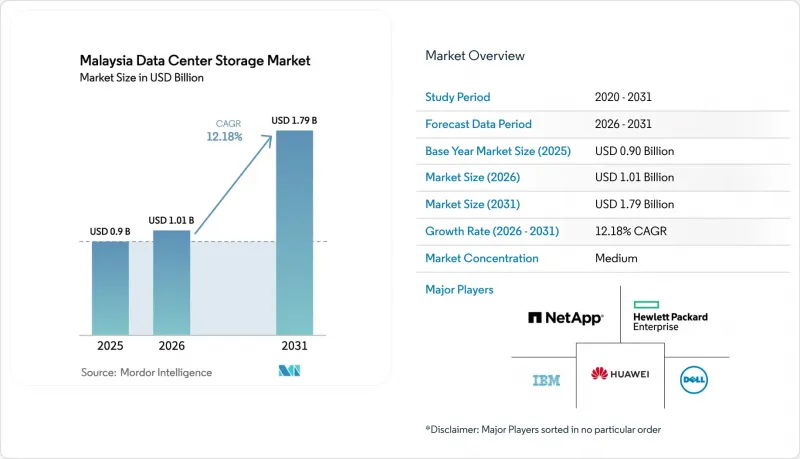
根據 Mordor Intelligence 預測,馬來西亞資料中心儲存市場規模將從 2025 年的 9 億美元成長到 2026 年的 10.1 億美元,然後在 2031 年達到 17.9 億美元,2026 年至 2031 年的複合年成長率為 12.18%。
本報告將產業細分為以下幾類:儲存技術(網路附加儲存 (NAS) 及其他)、儲存類型(傳統儲存及其他)、資料中心類型(託管機房及其他)、外形規格(機架式及其他)、介面(SAS/SATA 及其他)和最終用戶(IT/電信及其他)。市場預測以美元計價。
馬來西亞資料中心儲存市場趨勢及洞察。
超大規模資料中心和託管資料中心的快速擴張
柔佛新山的資料中心在2024年實現了運作容量翻番,目前已超過1.6吉瓦。 Google、微軟、甲骨文和NTT等公司承諾投資超過100億美元新建園區。甲骨文65億美元的投資計畫、普林斯頓數位集團150兆瓦的人工智慧設施以及柔佛-新加坡經濟特區都表明,市場對能夠維持人工智慧訓練吞吐量的Petabyte級全Flash陣列的需求日益成長。這種需求的湧入正推動馬來西亞資料中心儲存市場向兼具低延遲和高頻寬的NVMe架構轉型,從而使提供人工智慧最佳化產品的供應商獲得競爭優勢。
JENDELA 第二階段纖維主幹擴張
到2024年初,價值210億馬幣的JENDELA項目已覆蓋81.5%的人口,升級了約4萬個發送器,並為750萬棟建築提供了Gigabit連接。這一擴展後的網路骨幹使檳城半導體叢集的中小型企業能夠部署分散式儲存節點,用於對延遲敏感的製程控制。位於棕櫚油人工林的農村邊緣節點正在利用JENDELA的網路覆蓋,在本地儲存物聯網感測器數據,然後再將其複製到託管資料中心,從而將馬來西亞的資料中心儲存市場擴展到先前服務不足的地區。
對三/四級基礎設施的高額資本投資
滿足三級冗餘要求將使初始儲存成本增加 40% 至 60%,這對檳城 3000 家馬來西亞中小企業來說構成了一大障礙,因為這些企業很少有企業能為每個項目預留 50 萬馬幣的累計。儘管 Industry4WRD 基金正在津貼升級成本,但許多公司仍在推遲遷移,這限制了馬來西亞資料中心儲存市場短期內採用先進的全Flash陣列。
細分市場分析
2025年,儲存區域網路(SAN)將佔據馬來西亞資料中心儲存市場佔有率的38.05%,這主要得益於金融服務和智慧工廠的ERP叢集對區塊級效能的強勁需求。在賽城和柔佛兩地同步的高可用性SAN架構能夠滿足監管機構的災害復原(DR)要求。網路附加儲存(NAS)以15.72%的複合年成長率成長,深受優先考慮簡化文件共用和可擴展容量且無需FC許可的中小型企業的青睞。預計到2030年,受創新內容工作負載和協作套件擴展的推動,馬來西亞資料中心儲存市場中NAS解決方案的市場規模將翻倍。
軟體定義儲存疊加技術的引入進一步增強了SAN和NAS的柔軟性。戴爾公司的PowerScale已在全球超過16,000個GPU用戶中部署,並在旨在實現Petabyte級整合而無需大規模系統替換的AI新創公司中廣受歡迎。 NetApp與Google雲端合作推出的分散式雲端架構,為資訊長們提供了一個涵蓋本地、柔佛超大規模節點和獨立AI叢集的單一命名空間,鞏固了其在馬來西亞資料中心儲存市場混合解決方案領域的領先地位。
截至2025年,傳統硬碟陣列將佔據馬來西亞資料中心儲存市場46.55%的佔有率,主要用於對延遲接受度高的視訊監控存檔以及儲存不常用的醫學影像。同時,由於人工智慧訓練、即時支付和高頻分析等領域對亞毫秒延遲的需求,全Flash陣列正以16.92%的複合年成長率快速成長。儘管面臨宏觀經濟逆風,預計到2031年,馬來西亞資料中心儲存市場的快閃記憶體市場規模將超過7.826億美元。
這種混合平台緩和了性價比方面的權衡。自動分層儲存技術將熱資料存儲在 NVMe SSD 池中,而將冷資料區塊儲存在近線 HDD 上。希捷的 40TB HAMR 硬碟和 NVMe HDD 原型機預計將進一步降低整體擁有成本 (TCO),並擴大馬來西亞資料中心儲存市場的總Terabyte貨量,同時延緩全面過渡到全快閃儲存的進程。
其他好處
- Excel格式的市場預測(ME)表
- 3個月的分析師支持
目錄
第1章:引言
- 研究假設和市場定義
- 調查範圍
第2章:調查方法
第3章執行摘要
第4章 市場狀況
- 市場概覽
- 市場促進因素
- 超大規模資料中心和託管資料中心的快速擴張
- JENDELA 第二階段纖維主幹擴張
- 5G SA核心網路與私有5G園區的部署
- 政府推行「雲端優先」與「數位民族主義」的舉措
- 對邊緣運算棕櫚油人工林和智慧製造的需求(未充分通報)。
- 嚴格遵守《個人資料保護法》修訂後的資料居住要求(少報)
- 市場限制因素
- 三級/四級儲存基礎設備的高額資本支出
- 熟練的倉儲建築師短缺
- 全球NAND/HDD供應鏈的波動性
- 進口數組中馬幣美元外匯風險(未充分報告)
- 價值供應鏈分析
- 監理情勢
- 技術展望
- 波特五力模型
- 評估宏觀經濟趨勢對市場的影響
第5章 市場規模與成長預測
- 儲存技術
- 網路附加儲存 (NAS)
- 儲存區域網路(SAN)
- 直接附加儲存(DAS)
- 物件存儲/磁帶存儲
- 依儲存類型
- 傳統硬碟陣列
- 全Flash陣列(AFA)
- 混合儲存
- 依資料中心類型
- 託管設施
- 超大規模資料中心業者雲端服務供應商
- 企業邊緣
- 最終用戶
- 資訊科技/通訊
- BFSI
- 政府/公共部門
- 媒體與娛樂
- 醫療保健和生命科學
- 製造業
- 按外形規格
- 機架安裝型
- 刀片模組化
- 可分離類型/可組合類型
- 透過介面
- SAS/SATA
- NVMe
- 光纖通道 iSCSI
第6章 競爭情勢
- 市場集中度
- 策略趨勢
- 市佔率分析
- 公司簡介
- Dell Technologies Inc.
- Hewlett Packard Enterprise Co.
- NetApp Inc.
- Huawei Technologies Co., Ltd.
- Kingston Technology Co., Inc.
- Lenovo Group Ltd.
- Fujitsu Ltd.
- Oracle Corp.
- Seagate Technology plc
- Western Digital Corp.
- IBM Corp.
- Hitachi Vantara LLC
- Pure Storage Inc.
- NEC Corp.
- Inspur Group Co., Ltd.
- Cisco Systems Inc.
- Super Micro Computer Inc.
- QNAP Systems Inc.
- Synology Inc.
- Acronis International GmbH
第7章 市場機會與未來展望
According to Mordor Intelligence, the Malaysia data center storage market size is expected to grow from USD 0.90 billion in 2025 to USD 1.01 billion in 2026 and is forecast to reach USD 1.79 billion by 2031 at 12.18% CAGR over 2026-2031.
This report Segments the Industry Into Storage Technology (Network Attached Storage (NAS), and More), Storage Type (Traditional Storage, and More), Data Center Type (Colocation Facilities and More), Form Factor(Rack-Mounted and More), Interface(sas / SATA, and More)and End User (IT and Telecommunication, and More). The Market Forecasts are Provided in Terms of Value (USD).
Malaysia Data Center Storage Market Trends and Insights
Rapid Hyperscale and Colocation Build-outs
Johor Bahru doubled operational capacity in 2024 and now exceeds 1.6 GW, attracting Google, Microsoft, Oracle, and NTT to commit more than USD 10 billion to new campuses. Oracle's USD 6.5 billion plan, Princeton Digital Group's 150 MW AI-ready facility, and the Johor-Singapore Special Economic Zone signal an escalating need for petabyte-scale all-flash arrays that can sustain AI training throughput. This influx drives the Malaysia data center storage market toward NVMe architectures that synthesize low latency with high bandwidth, giving vendors with AI-optimized offerings a competitive edge
JENDELA Phase 2 Fiber Backbone Expansion
By early 2024, 81.5% population coverage and nearly 40,000 upgraded transmitters under the RM 21 billion JENDELA program produced gigabit links to 7.5 million premises. The extended backbone empowers SMEs in Penang's semiconductor cluster to adopt distributed storage nodes for latency-sensitive process control. Rural edge nodes in palm-oil plantations leverage JENDELA's reach to stage IoT sensor data locally before replicating to colocation hubs, stretching the Malaysia data center storage market into previously underserved districts.
High Capex for Tier III/IV Infrastructure
Meeting Tier III redundancy elevates initial storage costs by 40-60%, a hurdle for Malaysia's 3,000 Penang-based SMEs that rarely budget RM 500,000 per project. Although the Industry4WRD fund subsidizes upgrades, many firms delay transitions, limiting near-term penetration of advanced all-flash arrays within the Malaysia data center storage market
Other drivers and restraints analyzed in the detailed report include:
- 5G Stand-Alone Core and Private 5G Campuses
- Government Cloud-First and Digital Nasional Initiatives
- Global NAND/HDD Supply-Chain Volatility
For complete list of drivers and restraints, kindly check the Table Of Contents.
Segment Analysis
Storage Area Networks captured 38.05% of Malaysia data center storage market share in 2025, confirming entrenched demand for block-level performance in financial services and smart-factory ERP clusters. High-availability SAN fabrics synchronized across Cyberjaya and Johor underpin regulatory DR mandates. Network Attached Storage, growing at a 15.72% CAGR, appeals to SMEs that prioritize simplified file shares and scalable capacity without FC licensing. The Malaysia data center storage market size for NAS solutions is projected to double by 2030, aligning with expanding creative-content workloads and collaboration suites.
Adoption of software-defined storage overlays amplifies both SAN and NAS flexibility. Dell's PowerScale, already deployed by more than 16,000 GPU users globally, gains traction among AI start-ups seeking petabyte consolidation without forklift migrations. NetApp's distributed cloud fabric with Google Cloud grants CIOs a single namespace across on-prem, Johor hyperscale nodes, and sovereign AI clusters, reinforcing hybrid leadership in the Malaysia data center storage market.
Conventional HDD arrays held 46.55% share of the Malaysia data center storage market in 2025, leveraged for video surveillance archives and low-frequency medical images that tolerate higher latency. Yet all-flash arrays are sprinting at 16.92% CAGR as AI training, real-time payments, and high-frequency analytics dictate sub-millisecond latency. The Malaysia data center storage market size for flash is forecast to surpass USD 782.6 million by 2031, despite macro headwinds.
Hybrid platforms mitigate cost and performance tension: automatic tiering drives hot data onto NVMe SSD pools while cold blocks remain on nearline HDD. Seagate's 40 TB HAMR drives and NVMe HDD prototypes could further compress TCO, delaying full flash substitution but expanding total terabytes shipped within the Malaysia data center storage market.
Complete Report Scope:
- By Storage Technology
- Network Attached Storage (NAS)
- Storage Area Network (SAN)
- Direct Attached Storage (DAS)
- Object and Tape Storage
- By Storage Type
- Traditional HDD Arrays
- All-Flash Arrays (AFA)
- Hybrid Storage
- By Data Center Type
- Colocation Facilities
- Hyperscalers/Cloud Service Providers
- Enterprise and Edge
- By End User
- IT and Telecommunication
- BFSI
- Government and Public Sector
- Media and Entertainment
- Healthcare and Life Sciences
- Manufacturing
- By Form Factor
- Rack-mounted
- Blade and Modular
- Disaggregated / Composable
- By Interface
- SAS / SATA
- NVMe
- Fibre Channel and iSCSI
List of Companies Covered in this Report:
- Dell Technologies Inc.
- Hewlett Packard Enterprise Co.
- NetApp Inc.
- Huawei Technologies Co., Ltd.
- Kingston Technology Co., Inc.
- Lenovo Group Ltd.
- Fujitsu Ltd.
- Oracle Corp.
- Seagate Technology plc
- Western Digital Corp.
- IBM Corp.
- Hitachi Vantara LLC
- Pure Storage Inc.
- NEC Corp.
- Inspur Group Co., Ltd.
- Cisco Systems Inc.
- Super Micro Computer Inc.
- QNAP Systems Inc.
- Synology Inc.
- Acronis International GmbH
Additional Benefits:
- The market estimate (ME) sheet in Excel format
- 3 months of analyst support
TABLE OF CONTENTS
1 INTRODUCTION
- 1.1 Study Assumptions and Market Definition
- 1.2 Scope of the Study
2 RESEARCH METHODOLOGY
3 EXECUTIVE SUMMARY
4 MARKET LANDSCAPE
- 4.1 Market Overview
- 4.2 Market Drivers
- 4.2.1 Rapid hyperscale and colocation build-outs
- 4.2.2 JENDELA Phase 2 fibre backbone expansion
- 4.2.3 Roll-out of 5G SA core and private 5G campuses
- 4.2.4 Government cloud-first and Digital Nasional initiatives
- 4.2.5 Edge--ready palm-oil plantations and smart manufacturing demand (under-reported)
- 4.2.6 Strict data-residency compliance under PDPA amendments (under-reported)
- 4.3 Market Restraints
- 4.3.1 High capex for Tier III/IV storage infrastructure
- 4.3.2 Skilled storage-architect talent shortage
- 4.3.3 Global NAND / HDD supply-chain volatility
- 4.3.4 Ringgit-dollar exchange risk on imported arrays (under-reported)
- 4.4 Value / Supply-Chain Analysis
- 4.5 Regulatory Landscape
- 4.6 Technological Outlook
- 4.7 Porter's Five Forces
- 4.7.1 Threat of New Entrants
- 4.7.2 Bargaining Power of Buyers
- 4.7.3 Bargaining Power of Suppliers
- 4.7.4 Threat of Substitutes
- 4.7.5 Intensity of Competitive Rivalry
- 4.8 Assessment of the impact of Macro Economic Trends on the Market
5 Market Size and Growth Forecasts (Value)
- 5.1 By Storage Technology
- 5.1.1 Network Attached Storage (NAS)
- 5.1.2 Storage Area Network (SAN)
- 5.1.3 Direct Attached Storage (DAS)
- 5.1.4 Object and Tape Storage
- 5.2 By Storage Type
- 5.2.1 Traditional HDD Arrays
- 5.2.2 All-Flash Arrays (AFA)
- 5.2.3 Hybrid Storage
- 5.3 By Data Center Type
- 5.3.1 Colocation Facilities
- 5.3.2 Hyperscalers/Cloud Service Providers
- 5.3.3 Enterprise and Edge
- 5.4 By End User
- 5.4.1 IT and Telecommunication
- 5.4.2 BFSI
- 5.4.3 Government and Public Sector
- 5.4.4 Media and Entertainment
- 5.4.5 Healthcare and Life Sciences
- 5.4.6 Manufacturing
- 5.5 By Form Factor
- 5.5.1 Rack-mounted
- 5.5.2 Blade and Modular
- 5.5.3 Disaggregated / Composable
- 5.6 By Interface
- 5.6.1 SAS / SATA
- 5.6.2 NVMe
- 5.6.3 Fibre Channel and iSCSI
6 COMPETITIVE LANDSCAPE
- 6.1 Market Concentration
- 6.2 Strategic Moves
- 6.3 Market Share Analysis
- 6.4 Company Profiles (includes Global level Overview, Market level overview, Core Segments, Financials as available, Strategic Information, Market Rank/Share for key companies, Products and Services, and Recent Developments)
- 6.4.1 Dell Technologies Inc.
- 6.4.2 Hewlett Packard Enterprise Co.
- 6.4.3 NetApp Inc.
- 6.4.4 Huawei Technologies Co., Ltd.
- 6.4.5 Kingston Technology Co., Inc.
- 6.4.6 Lenovo Group Ltd.
- 6.4.7 Fujitsu Ltd.
- 6.4.8 Oracle Corp.
- 6.4.9 Seagate Technology plc
- 6.4.10 Western Digital Corp.
- 6.4.11 IBM Corp.
- 6.4.12 Hitachi Vantara LLC
- 6.4.13 Pure Storage Inc.
- 6.4.14 NEC Corp.
- 6.4.15 Inspur Group Co., Ltd.
- 6.4.16 Cisco Systems Inc.
- 6.4.17 Super Micro Computer Inc.
- 6.4.18 QNAP Systems Inc.
- 6.4.19 Synology Inc.
- 6.4.20 Acronis International GmbH
7 MARKET OPPORTUNITIES and FUTURE OUTLOOK
- 7.1 White-space and Unmet-Need Assessment

 中國資料中心儲存:市場佔有率分析、產業趨勢與統計及成長預測(2026-2031)印尼資料中心儲存:市場佔有率分析、產業趨勢與統計及成長預測(2026-2031)印度資料中心儲存:市場佔有率分析、產業趨勢與統計及成長預測(2026-2032)德國資料中心儲存:市場佔有率分析、行業趨勢和統計數據以及成長預測(2026-2031 年)新加坡資料中心儲存:市場佔有率分析、產業趨勢與統計及成長預測(2026-2031 年)菲律賓資料中心儲存:市場佔有率分析、產業趨勢與統計及成長預測(2026-2031 年)越南資料中心儲存:市場佔有率分析、產業趨勢與統計及成長預測(2026-2031)
 2026-2030年全球伺服器儲存市場
 資料中心儲存市場-2026-2032年全球市場預測
 2026年全球儲存架構市場報告