


 |
市場調查報告書
商品編碼
2119747
馬來西亞資料中心伺服器:市場佔有率分析、產業趨勢與統計及成長預測(2026-2031 年)Malaysia Data Center Server - Market Share Analysis, Industry Trends & Statistics, Growth Forecasts (2026 - 2031) |
||||||

※ 本網頁內容可能與最新版本有所差異。詳細情況請與我們聯繫。
據 Mordor Intelligence 稱,馬來西亞資料中心伺服器市場在 2025 年的價值為 22.2 億美元,預計到 2031 年將從 2026 年的 25.9 億美元成長到 55.3 億美元,在預測期(2026-2031 年)內的複合年成長率為 16.42%。
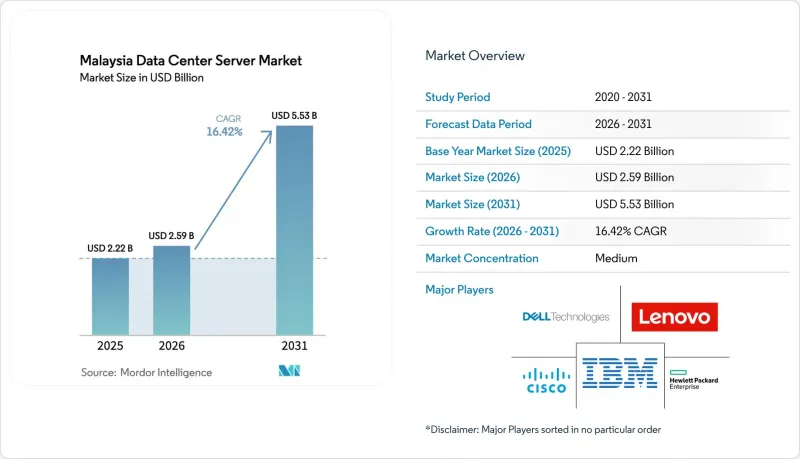
本報告按資料中心層級(Tier 1 和 Tier 2、Tier 3、Tier 4)、外形規格(半高刀片、全高刀片等)、應用領域(虛擬化和私有雲端、高效能運算等)、資料中心類型(超大規模資料中心業者供應商等)以及最終用戶產業(銀行、金融服務和保險等)進行細分。以上所有細分市場的規模和預測均以美元(USD)計價。
馬來西亞資料中心伺服器市場趨勢與洞察
對超大規模和託管資料中心的投資激增
主要雲端服務供應商承諾僅在2024年就將投資超過150億美元,其中大都會圈的投資額高達20億美元,領先訂單。
政府獎勵「雲端優先」模式和數位經濟的發展
「MyDIGITAL」藍圖的目標是到2025年使數位活動佔GDP的22.6%,並呼籲將80%的公共部門工作負載遷移到混合雲端環境。價值120億至150億馬幣的有條件批准將使超大規模資料中心業者企業能夠在本地進行建設,而「雲端框架協議」則指導採購工作優先向國內合作夥伴進行。已從傳統三層架構升級到超融合架構的政府部門報告稱,資料存取速度更快,容錯能力更強,持續的伺服器升級週期正在逐步建立。
網路基礎設施擴建及新建海底電纜
馬來西亞參與SEA-ME-WE 6及其他海底光纜系統,正在增強該國的互聯互通,並催生對傳輸流量伺服器和CDN節點的需求。馬來西亞電信的光纖網路擴展和DE-CIX的網際網路架構,正在提昇路由多樣性,並促進採購流量聚合所需的高吞吐量網路伺服器。
細分市場分析
到2025年,Tier 3資料中心將佔據馬來西亞資料中心伺服器市場佔有率的70.92%,這主要得益於銀行業、電信業和公共部門等產業對高可用性工作負載的需求。同時,Tier 4資料中心以18.33%的複合年成長率(CAGR)高速成長,遠超整體市場,反映出超大規模資料中心業者對人工智慧訓練叢集「99.999%」運轉率的強勁需求。 Vantage的賽城資料中心和Princeton Digital的JH1園區是Tier 4資料中心的典範,它們配備了冗餘電源和冷水循環系統,以維持超過70kW機架的正常運作。
因此,馬來西亞資料中心伺服器市場正日益兩極化。一級和二級資料中心滿足邊緣運算和災害復原的需求,而三級和四級資料中心則滿足長期、關鍵任務型需求。此外,四級資料中心的發展動能與2026年即將實施的綠色稅額扣抵相契合,該政策旨在獎勵高效硬體,從而推動企業採用最新一代處理器和散熱技術。
到2025年,半高刀鋒伺服器將佔總銷售量的62.54%,這得益於其方便用戶使用性、均衡的散熱設計以及易於整合到現有機架中。同時,受5G回程傳輸和區域MEC節點部署的推動,四分之一高微型刀鋒伺服器的年複合成長率(CAGR)正以16.61%的速度成長,這些部署需要緊湊而強大的伺服器。在英特爾部署於檳城的「5G數位學校」計畫中,微型刀片邊緣叢集以極低的延遲提供人工智慧驅動的教育內容。
在超大規模資料中心中,全高刀片伺服器和GPU托架是人工智慧訓練的主流選擇,但電信業者也開始採購微型刀片伺服器來執行延遲要求較高的推理任務。因此,伺服器供應商擴大銷售可容納不同高度刀片伺服器的整合式底盤,從而減少備件庫存並加快部署速度。這為馬來西亞資料中心伺服器市場的採購週期帶來了顯著優勢。
其他好處:
- Excel格式的市場預測(ME)表
- 3個月的分析師支持
目錄
第1章:引言
- 研究假設和市場定義
- 調查範圍
第2章:調查方法
第3章執行摘要
第4章 市場狀況
- 市場概覽
- 市場促進因素
- 對超大規模和託管資料中心的投資正在激增。
- 網路基礎設施擴建及新建海底電纜
- 政府「雲端優先」政策與數位經濟激勵措施(馬來西亞數位經濟,MyDIGITAL)
- 雲端運算、人工智慧/機器學習和物聯網主導的工作負載的廣泛應用
- 主權財富基金支持的邊緣微型中心進入二線城市。
- 2026年推出高效節能伺服器綠色稅額扣抵政策
- 市場限制因素
- 購置設施和伺服器需要大量資金投入。
- 進口硬體面臨的匯率外匯成本風險。
- 2027年電費改革將減少工業補貼
- 吉隆坡大都會圈土地短缺推高了房地產價格。
- 供應鏈分析
- 監理情勢
- 技術趨勢(水冷、基於 ARM 的伺服器、DPU)
- 波特五力分析
- 對影響市場的宏觀經濟因素進行評估
第5章 市場規模與成長預測
- 資料中心層級
- 一級和二級
- 三級
- 第四級
- 按外形規格
- 半高刀片
- 全高刀片
- 四分之一高度/微刀片
- 按應用程式/工作負載
- 虛擬化和私有雲端
- 高效能運算(HPC)
- 人工智慧/機器學習和數據分析
- 以儲存為中心
- 邊緣/物聯網閘道器
- 依資料中心類型
- 超大規模資料中心業者雲端服務供應商/雲端服務供應商
- 託管設施
- 企業和邊緣運算
- 按最終用途行業分類
- BFSI
- 資訊科技/通訊
- 醫療保健和生命科學
- 製造業和工業4.0
- 能源公用事業
- 政府/國防
- 其他最終用戶
第6章 競爭情勢
- 市場集中度
- 策略趨勢
- 市佔率分析
- 公司簡介
- Dell Technologies
- Hewlett Packard Enterprise
- Cisco Systems
- Huawei Technologies
- Lenovo Group
- Super Micro Computer
- IBM Corp.
- Nvidia Corp.
- Inspur Information
- Fujitsu Ltd.
- NEC Corp.
- Oracle Corp.
- Atos SE
- Quanta Cloud Technology(QCT)
- ASUS(Enterprise Server BU)
- Kingston Technology
- Seagate Technology(Server platforms)
- Hyve Solutions
- Wistron(Wiwynn)
- Gigabyte Technology
第7章 市場機會與未來展望
According to Mordor Intelligence, the Malaysia data center server market size was valued at USD 2.22 billion in 2025 and estimated to grow from USD 2.59 billion in 2026 to reach USD 5.53 billion by 2031, at a CAGR of 16.42% during the forecast period (2026-2031).
This report is Segmented by Data Center Tier(Tier 1 and 2, Tier 3, Tier 4), Form Factor(Half-Height Blades, Full-Height Blades and More), Application (Virtualisation and Private Cloud, High-Performance Computing and More), Data Center Type(Hyperscalers Provider and More), End User Industry(BFSI and More). The Market Sizes and Forecasts are Provided in Terms of Value (USD) for all the Above Segments.
Malaysia Data Center Server Market Trends and Insights
Surge in Hyperscale & Colocation Data-Center Investments
Major cloud providers pledged more than USD 15 billion in 2024 alone, led by Google's USD 2 billion first Malaysian region in Greater Kuala Lumpur and Microsoft's three-site rollout scheduled for Q2 2025.Johor's comparative land affordability and close distance to Singapore accelerate campus-scale builds such as Vantage's 256 MW Cyberjaya complex and Princeton Digital Group's 150 MW AI-ready JH1 site. The resulting spike in rack demand concentrates orders for liquid-cooled GPU servers optimized for AI inference, reinforcing the Malaysia data center server market.
Government Cloud-First & Digital-Economy Incentives
The MyDIGITAL blueprint targets a 22.6% GDP share from digital activities by 2025 and requires 80% of public-sector workloads to migrate to hybrid cloud environments. Conditional approvals worth RM 12-15 billion allow hyperscalers to build locally, while the Cloud Framework Agreement steers procurement toward domestic partners. Ministries upgrading from legacy three-tier stacks to hyper-converged architectures report faster data access and stronger resiliency, cementing ongoing server refresh cycles.
Expansion of Internet Infrastructure and New Submarine Cables
Malaysia's participation in SEA-ME-WE 6 and other cable systems strengthens its interconnection profile, creating server demand for transit traffic and CDN nodes.Telekom Malaysia's fiber expansion and DE-CIX's peering fabric enhance route diversity and drive purchases of high-throughput network servers needed for traffic aggregation
Other drivers and restraints analyzed in the detailed report include:
- Rising Adoption of Cloud, AI/ML and IoT-Driven Workloads
- 2027 Electricity-Tariff Reform Cutting Industrial Subsidies
- High CapEx for Facility & Server Procurement
For complete list of drivers and restraints, kindly check the Table Of Contents.
Segment Analysis
Tier 3 facilities dominated the Malaysia data center server market share at 70.92% in 2025, supported by banking, telecom, and public-sector workloads that demand high availability. Parallelly, Tier 4 sites are outpacing overall growth at an 18.33% CAGR, reflecting hyperscaler insistence on five-nines uptime for AI training clusters. Vantage's Cyberjaya and Princeton Digital's JH1 campuses exemplify the Tier 4 blueprint, featuring redundant power and chilled-water loops to sustain racks exceeding 70 kW.
The Malaysia data center server market is thus bifurcating: Tier 1-2 footprints meet edge and disaster-recovery needs, whereas Tier 3-4 facilities capture long-term, mission-critical demand. Tier 4's momentum also aligns with the 2026 green-tax credit that rewards high-efficiency hardware, nudging enterprises toward the latest processor generations and cooling techniques.
Half-height blades held 62.54% revenue in 2025 courtesy of their familiarity, balanced thermals, and integration ease into legacy racks. Yet quarter-height micro-blades are expanding at a 16.61% CAGR, propelled by 5G backhaul rollouts and regional MEC nodes that require compact, ruggedised servers. Intel's 5G Digital School venture in Penang showcases micro-blade edge clusters providing AI-enabled educational content with minimal latency.
Within hyperscale halls, full-height blades and GPU trays dominate AI training, but operators simultaneously procure micro-blades for latency-sensitive inference tasks. Consequently, server vendors increasingly market unified chassis able to host mixed-blade heights, lowering spares inventories and accelerating deployment-an advantage in Malaysia data center server market procurement cycles.
Complete Report Scope:
- By Data-Center Tier
- Tier 1 and 2
- Tier 3
- Tier 4
- By Form Factor
- Half-height Blades
- Full-height Blades
- Quarter-height / Micro-blades
- By Application / Workload
- Virtualisation and Private Cloud
- High-Performance Computing (HPC)
- Artificial Intelligence/Machine Learning and Data Analytics
- Storage-centric
- Edge / IoT Gateways
- By Data Center Type
- Hyperscalers/Cloud Service Provider
- Colocation Facilities
- Enterprise and Edge
- By End-use Industry
- BFSI
- IT and Telecom
- Healthcare and Life-Sciences
- Manufacturing and Industry 4.0
- Energy and Utilities
- Government and Defence
- Other End Users
List of Companies Covered in this Report:
- Dell Technologies
- Hewlett Packard Enterprise
- Cisco Systems
- Huawei Technologies
- Lenovo Group
- Super Micro Computer
- IBM Corp.
- Nvidia Corp.
- Inspur Information
- Fujitsu Ltd.
- NEC Corp.
- Oracle Corp.
- Atos SE
- Quanta Cloud Technology (QCT)
- ASUS (Enterprise Server BU)
- Kingston Technology
- Seagate Technology (Server platforms)
- Hyve Solutions
- Wistron (Wiwynn)
- Gigabyte Technology
Additional Benefits:
- The market estimate (ME) sheet in Excel format
- 3 months of analyst support
TABLE OF CONTENTS
1 INTRODUCTION
- 1.1 Study Assumptions and Market Definition
- 1.2 Scope of the Study
2 RESEARCH METHODOLOGY
3 EXECUTIVE SUMMARY
4 MARKET LANDSCAPE
- 4.1 Market Overview
- 4.2 Market Drivers
- 4.2.1 Surge in hyperscale?and?colocation data-center investments
- 4.2.2 Expansion of internet infrastructure and new submarine cables
- 4.2.3 Government cloud-first and Digital Economy incentives (Malaysia Digital, MyDIGITAL)
- 4.2.4 Rising adoption of cloud, AI/ML and IoT-driven workloads
- 4.2.5 Entry of sovereign-fund-backed edge micro-hubs in Tier-2 cities
- 4.2.6 Introduction of 2026 green-tax credit for high-efficiency servers
- 4.3 Market Restraints
- 4.3.1 High CapEx for facility and server procurement
- 4.3.2 FX-linked cost risk from imported hardware
- 4.3.3 2027 electricity-tariff reform cutting industrial subsidies
- 4.3.4 Land scarcity in Greater Kuala Lumpur inflating real-estate costs
- 4.4 Supply-Chain Analysis
- 4.5 Regulatory Landscape
- 4.6 Technological Outlook (liquid cooling, ARM-based servers, DPUs)
- 4.7 Porter's Five Forces Analysis
- 4.7.1 Threat of New Entrants
- 4.7.2 Bargaining Power of Buyers
- 4.7.3 Bargaining Power of Suppliers
- 4.7.4 Threat of Substitutes
- 4.7.5 Intensity of Competitive Rivalry
- 4.8 Assessment of Macroeconomic Factors on the Market
5 MARKET SIZE and GROWTH FORECASTS (VALUE)
- 5.1 By Data-Center Tier
- 5.1.1 Tier 1 and 2
- 5.1.2 Tier 3
- 5.1.3 Tier 4
- 5.2 By Form Factor
- 5.2.1 Half-height Blades
- 5.2.2 Full-height Blades
- 5.2.3 Quarter-height / Micro-blades
- 5.3 By Application / Workload
- 5.3.1 Virtualisation and Private Cloud
- 5.3.2 High-Performance Computing (HPC)
- 5.3.3 Artificial Intelligence/Machine Learning and Data Analytics
- 5.3.4 Storage-centric
- 5.3.5 Edge / IoT Gateways
- 5.4 By Data Center Type
- 5.4.1 Hyperscalers/Cloud Service Provider
- 5.4.2 Colocation Facilities
- 5.4.3 Enterprise and Edge
- 5.5 By End-use Industry
- 5.5.1 BFSI
- 5.5.2 IT and Telecom
- 5.5.3 Healthcare and Life-Sciences
- 5.5.4 Manufacturing and Industry 4.0
- 5.5.5 Energy and Utilities
- 5.5.6 Government and Defence
- 5.5.7 Other End Users
6 COMPETITIVE LANDSCAPE
- 6.1 Market Concentration
- 6.2 Strategic Moves
- 6.3 Market Share Analysis
- 6.4 Company Profiles (includes Global level Overview, Market level overview, Core Segments, Financials as available, Strategic Information, Market Rank/Share for key companies, Products and Services, and Recent Developments)
- 6.4.1 Dell Technologies
- 6.4.2 Hewlett Packard Enterprise
- 6.4.3 Cisco Systems
- 6.4.4 Huawei Technologies
- 6.4.5 Lenovo Group
- 6.4.6 Super Micro Computer
- 6.4.7 IBM Corp.
- 6.4.8 Nvidia Corp.
- 6.4.9 Inspur Information
- 6.4.10 Fujitsu Ltd.
- 6.4.11 NEC Corp.
- 6.4.12 Oracle Corp.
- 6.4.13 Atos SE
- 6.4.14 Quanta Cloud Technology (QCT)
- 6.4.15 ASUS (Enterprise Server BU)
- 6.4.16 Kingston Technology
- 6.4.17 Seagate Technology (Server platforms)
- 6.4.18 Hyve Solutions
- 6.4.19 Wistron (Wiwynn)
- 6.4.20 Gigabyte Technology
7 MARKET OPPORTUNITIES and FUTURE OUTLOOK
- 7.1 White-space and Unmet-need Assessment

 2026年全球資料中心和伺服器半導體市場報告
 中國資料中心伺服器:市場佔有率分析、產業趨勢與統計及成長預測(2026-2031)北美資料中心伺服器:市佔率分析、產業趨勢與統計及成長預測(2026-2031 年)印度資料中心伺服器:市場佔有率分析、產業趨勢與統計及成長預測(2026-2032 年)日本資料中心伺服器:市佔率分析、產業趨勢與統計及成長預測(2026-2031)歐洲資料中心伺服器:市場佔有率分析、產業趨勢與統計及成長預測(2026-2031 年)美國資料中心伺服器:市場佔有率分析、產業趨勢與統計及成長預測(2026-2031 年)越南資料中心伺服器:市場佔有率分析、產業趨勢與統計及成長預測(2026-2031)
 資料中心和伺服器半導體市場報告:趨勢、預測和競爭分析(至2035年)
 資料中心伺服器市場規模、佔有率、成長率、全球產業分析、區域趨勢以及 2026 年至 2034 年的預測。