


 |
市場調查報告書
商品編碼
2119742
印度資料中心伺服器:市場佔有率分析、產業趨勢與統計及成長預測(2026-2032 年)India Data Center Server - Market Share Analysis, Industry Trends & Statistics, Growth Forecasts (2026 - 2032) |
||||||

※ 本網頁內容可能與最新版本有所差異。詳細情況請與我們聯繫。
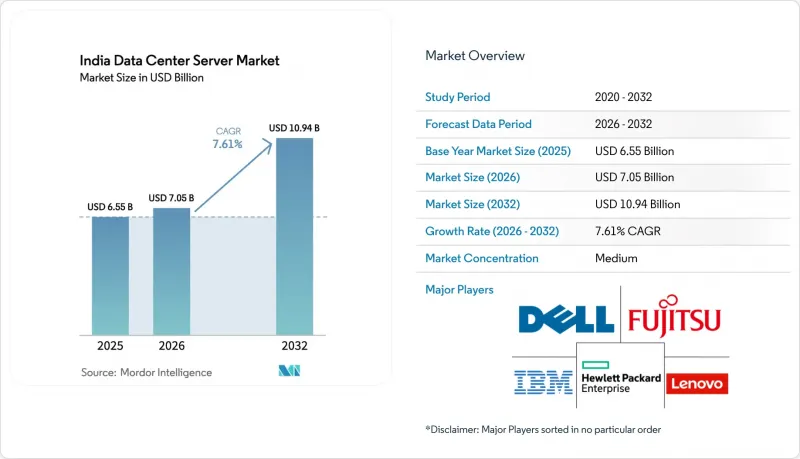
根據 Mordor Intelligence 預測,印度資料中心伺服器市場規模將從 2025 年的 65.5 億美元成長到 2026 年的 70.5 億美元,然後在 2032 年達到 109.4 億美元,2026 年至 2032 年的複合年成長率為 7.61%。
本報告外形規格(刀片伺服器、機架伺服器等)、處理器架構(x86、ARM等)、部署模式(超大規模雲端、託管等)、最終用戶產業(IT和電信、銀行、金融服務和保險等)以及地區(印度北部、印度南部等)進行細分。市場預測以美元計價。
印度資料中心伺服器市場趨勢與洞察
超大規模資料中心業者和託管資料中心的資本支出(CAPEX)正在激增。
信實工業宣布將在古吉拉突邦興建一座3吉瓦的資料中心園區。這將使印度的現有資料中心容量增加兩倍,並將採用英偉達的AI半導體,並由可再生能源運作。託管專家CtrlS正在部署350兆瓦的「AI就緒」閒置頻段,並新增20億美元的投資。政府政策現已允許資料中心基礎設施100%外商直接投資,這將加速雲端區域的推出並縮短硬體更新周期。設施設計方案擴大採用高密度機架、液冷和針對GPU叢集最佳化的資料中心基礎設施管理(DCIM)系統。多家業者競相以優惠條件獲取土地和電力,將伺服器、網路設備和配電設備的採購週期從12個月縮短至6個月,大幅提升了印度資料中心伺服器市場的整體需求。
5G部署正在推動對邊緣節點微型伺服器的需求。
印度電信業者需要2,200萬名技術純熟勞工才能在2025年前建成覆蓋全國的5G網路,這意味著安裝過程中需要大量塔側運算設備。微型伺服器節點機殼,搭載基於ARM架構的電路板,可在網路邊緣提供足夠的AI推理處理能力,同時功耗低於250瓦。 Bharti Airtel和Reliance Jio已下達多年訂單,訂單中包含整合冷卻、分散式UPS和零接觸配置等功能。開放的光纖網路和改進後的頻率政策使回程傳輸成本保持在可控範圍內,而各邦的生產連結獎勵計畫計劃(PLI)則為本地製造的最佳化邊緣系統提供4-6%的出廠價補貼。因此,邊緣微型資料中心的複合年成長率預計將達到8.1%,並繼續蠶食印度資料中心伺服器市場中集中式超大規模機架的市場佔有率。
孟買電力供不應求和電費飆升
孟買仍然是印度的主要金融中心,但其電網不堪重負,大規模資料中心擴建計畫有時需要長達18個月才能連接新的變電站。目前,營運商正與古吉拉突邦的太陽能發電廠簽訂可再生能源購電協議,電價為每千瓦時3.1印度盧比,從而避開了孟買每千瓦時超過8.0印度盧比的電費。馬哈拉斯特拉邦的政策為在專用科技園區內建設的設施提供印花稅退稅和快速核准,但這些設施要到2027年或更晚才能投入運作。同時,超大規模資料中心業者正將其擴張計畫轉移到新孟買和普納,這將減少短期內運往這些城市的伺服器數量,但將維持印度資料中心伺服器市場的整體成長。
細分市場分析
預計到2032年,微型伺服器、模組化伺服器和邊緣伺服器將為印度資料中心伺服器市場貢獻15.9億美元,複合年成長率達7.76%。 2025年,機架式伺服器的出貨量將佔37.45%,但其市佔率正逐漸被可直接安裝在塔式機房中的2U微型節點蠶食。此舉將降低影片、擴增實境和工業IoT的延遲,並降低回程傳輸成本。阿波羅醫院已在其72家醫療機構中採用Nutanix超融合叢集,在增強即時監控的同時,將IT相關能耗降低了80%。塔式伺服器在沒有機架基礎架構的中小型企業中仍然很受歡迎,而刀鋒式伺服器正逐漸成為需要高密度虛擬化的金融工作負載的標準配置。
隨著邊緣機櫃功率密度的提高,直接晶片冷卻板和可降低銅損耗的 48V 直流匯流排的需求日益成長。供應商提供的密封模組伺服器可在 55 度C的環境溫度下運行,並採用無風扇對流冷卻,這對於在農村地區部署至關重要。矽光電等技術的進步進一步整合了功能,並提高了每公升晶片的運算能力。這些變化鞏固了微型伺服器在印度資料中心伺服器市場中成長最快的地位。
在印度資料中心伺服器市場,x86架構預計到2025年將達到40.1億美元,但ARM節點成長速度更快,預計2032年將佔據19.60%的市場佔有率。由於採用「印度製造」激勵政策,Netweb Technologies擁有足夠的經濟實力來交付配備192個核心、熱設計功耗為225瓦的Tyrone ARM伺服器。與x86架構相比,ARM系統可降低25-30%的功耗,這在散熱能力有限的邊緣環境中是一項顯著優勢。 RISC/Power架構在「國家超級運算任務」下繼續佔據科學運算工作負載的細分市場,該任務已在34個設施中部署了總計35 PF的運算能力。
軟體棧正在快速成熟。 Red Hat 和 Canonical 都在對基於 ARM 的核心銀行、ERP 和分析框架進行認證,降低了遷移門檻。 x86 在 Microsoft Windows 環境和傳統 VMware 環境中仍然佔據主導地位,這得益於 Intel 和 AMD 可預測的藍圖。總體而言,架構選擇現在取決於總成本的運算,需要考慮功耗、授權和供應鏈風險,從而確保印度資料中心伺服器市場的健康共存。
其他好處:
- Excel格式的市場預測(ME)表
- 3個月的分析師支持
目錄
第1章:引言
- 研究假設和市場定義
- 調查範圍
第2章:調查方法
第3章執行摘要
第4章 市場狀況
- 市場概覽
- 市場促進因素
- 超大規模資料中心業者和託管設施的資本投資激增(2025-2030 年)
- 5G 的部署正在推動對邊緣節點微型伺服器的需求。
- 面向銀行、金融服務和網際網路(BFSI/OTT)工作負載的 Gen-AI GPU 伺服器叢集
- 《資料保護和資料保護法》規定的資料在地化義務正在鼓勵在國內安裝機架。
- 印度的綠色開放取用政策正在降低可再生能源的PUE成本。
- 印度政府為組裝ARM伺服器提供「印度製造」激勵措施
- 市場限制因素
- 孟買電力供不應求和公用事業收費價格上漲
- 進口關稅和印度盧比(INR)的波動推高了伺服器的物料清單(BOM)。
- HBM/先進包裝供應鏈中的瓶頸
- 一線城市以外地區資料中心專業人員短缺
- 價值供應鏈分析
- 監理情勢
- 技術展望
- 波特五力模型
第5章 市場規模與成長預測
- 按外形規格
- 刀鋒伺服器
- 機架式伺服器
- 塔式伺服器
- 微型/模組化/邊緣伺服器
- 依處理器架構
- x86
- ARM
- RISC/Power
- 按部署模式
- 超大規模/雲端服務供應商
- 共置/批發
- 企業本地部署
- 按最終用戶行業分類
- 資訊科技/通訊
- BFSI
- 政府/公共部門
- 媒體與娛樂
- 電子商務與零售
- 醫療保健和生命科學
- 其他最終用戶
第6章 競爭情勢
- 市佔率分析
- 公司簡介
- Dell Technologies
- Hewlett Packard Enterprise
- Lenovo Group
- Cisco Systems
- Inspur Group
- Super Micro Computer
- Quanta Computer
- Wistron Corporation
- Huawei Technologies
- International Business Machines(IBM)
- Advanced Micro Devices(AMD)
- Intel Corporation
- NVIDIA Corporation
- Ampere Computing
- Fujitsu Limited
- Oracle Corporation
- NEC Corporation
- Gigabyte Technology
- ASUStek Computer
- Atos SE(Bull Servers)
- Netweb Technologies
- Acer Inc.
- Tata Consultancy Services-IaaS Platforms
- Reliance Jio Platforms-Edge DC Hardware
第7章 市場機會與未來展望
According to Mordor Intelligence, the India data center server market size is expected to grow from USD 6.55 billion in 2025 to USD 7.05 billion in 2026 and is forecast to reach USD 10.94 billion by 2032 at 7.61% CAGR over 2026-2032.
This report is Segmented by Form Factor (Blade Server, Rack Server, and More), Processor Architecture (x86, ARM, and More), Deployment Model (Hyperscale Cloud, Colocation, and More), End-User Industry (IT and Telecommunications, BFSI, and More), and Geography (North India, South India, and More). Market Forecasts are Provided in Terms of Value (USD).
India Data Center Server Market Trends and Insights
Hyperscaler and Colocation CAPEX Surge
Reliance Industries has announced a 3 GW data-center campus in Gujarat that will triple current national capacity and employ NVIDIA AI semiconductors powered by renewable energy. Colocation specialist CtrlS is rolling out 350 MW of "AI-ready" white space buffered by USD 2 billion of fresh investment. Government policy now allows 100% foreign direct investment in data-center infrastructure, which has accelerated cloud-region launches and deepened hardware refresh cycles. Facility blueprints increasingly specify high-density racks, liquid cooling, and DCIM systems calibrated for GPU clusters. With multiple operators racing to lock in land and power at favorable rates, procurement cycles for servers, networking, and power distribution units have shortened from twelve to six months, dramatically lifting baseline demand across the India data center server market.
5G Roll-out Driving Edge-Node Micro-Server Demand
Indian telecom operators will need 22 million skilled workers by 2025 to complete nationwide 5G, underlining the vast scale of tower-side compute that must be installed. Micro-server nodes with ruggedized, low-footprint enclosures house ARM-based boards that consume less than 250 W yet deliver adequate AI inference at the network edge. Bharti Airtel and Reliance Jio have issued multi-year purchase orders that bundle integrated cooling, distributed UPS, and zero-touch provisioning. Open-access fiber and renewed spectrum policies keep backhaul costs manageable, while state PLI schemes reimburse 4-6% of factory gate value for optimized edge systems manufactured locally. The resulting 8.1% CAGR uplift for edge micro-data centers will continue to pull share from centralized hyperscale racks inside the India data center server market.
Grid-Power Scarcity and Rising Utility Tariffs in Mumbai
Mumbai remains India's prime financial hub yet faces a stressed grid where large data-center additions can wait up to 18 months for new substation tie-ins. Operators now lock renewable power purchase agreements for solar farms in Gujarat at INR 3.1 per kWh, circumventing city tariffs that exceed INR 8.0 per kWh. Maharashtra's policy offers stamp-duty rebates and fast-track approvals for facilities built in dedicated technology parks, though capacity will come online only after 2027. In the interim, hyperscalers pivot expansions toward Navi Mumbai and Pune, diluting near-term server shipments into the city while sustaining national growth in the India data center server market.
Other drivers and restraints analyzed in the detailed report include:
- Gen-AI GPU Server Clusters for BFSI and OTT Workloads
- Data-Localization Mandates Under DPDP Act
- Import Duties and INR Volatility Inflating Server BoM
For complete list of drivers and restraints, kindly check the Table Of Contents.
Segment Analysis
Micro, modular, and edge servers will contribute USD 1.59 billion to the India data center server market size by 2032, expanding at an 7.76% CAGR. Rack designs still house 37.45% of 2025 shipments but lose incremental share to 2U micro-nodes that mount directly at tower shelters. The move shortens latency and lowers backhaul costs for video, AR, and industrial IoT. Apollo Hospitals uses Nutanix hyper-converged clusters across 72 facilities, boosting real-time monitoring while cutting IT energy by 80%. Tower servers keep traction among SMEs that lack rack infrastructure, while blade frames remain staples for finance workloads requiring dense virtualization.
Heightened power density within edge cabinets raises demand for direct-to-chip cooling plates and 48 V DC bus bars that reduce copper losses. Vendors package sealed module servers rated for 55 °C ambient operation with fan-less convection, essential for rural deployments. Engineering advances such as silicon photonics further consolidate functions, allowing even higher compute per liter. These shifts cement micro-servers as the fastest unit vector inside the India data center server market.
The India data center server market size attributable to x86 reached USD 4.01 billion in 2025, but ARM nodes grow faster toward 19.60% share by 2032. Make-in-India incentives give Netweb Technologies the economics to ship Tyrone ARM servers hosting 192 cores at 225 W TDP. ARM systems trim power by 25-30% relative to x86, a key advantage for edge locales with limited cooling. RISC/Power stays a niche for scientific workloads under the National Supercomputing Mission that has installed 35 PF of compute across 34 facilities.
Software stacks mature quickly: Red Hat and Canonical both certify core banking, ERP, and analytics frameworks on ARM, reducing migration friction. x86 maintains primacy in Microsoft Windows environments and legacy VMware estates, helped by predictable roadmaps from Intel and AMD. Overall, architectural choice now hinges on total-cost calculations that factor electricity, licensing, and supply-chain risk, ensuring healthy coexistence inside the India data center server market.
Complete Report Scope:
- By Form Factor
- Blade Server
- Rack Server
- Tower Server
- Micro / Modular / Edge Server
- By Processor Architecture
- x86
- ARM
- RISC / Power
- By Deployment Model
- Hyperscale/ Cloud Service Provider
- Colocation / Wholesale
- Enterprise On-premise
- By End-User Industry
- IT and Telecommunications
- BFSI
- Government and Public Sector
- Media and Entertainment
- E-commerce and Retail
- Healthcare and Life Sciences
- Other End Users
List of Companies Covered in this Report:
- Dell Technologies
- Hewlett Packard Enterprise
- Lenovo Group
- Cisco Systems
- Inspur Group
- Super Micro Computer
- Quanta Computer
- Wistron Corporation
- Huawei Technologies
- International Business Machines (IBM)
- Advanced Micro Devices (AMD)
- Intel Corporation
- NVIDIA Corporation
- Ampere Computing
- Fujitsu Limited
- Oracle Corporation
- NEC Corporation
- Gigabyte Technology
- ASUStek Computer
- Atos SE (Bull Servers)
- Netweb Technologies
- Acer Inc.
- Tata Consultancy Services - IaaS Platforms
- Reliance Jio Platforms - Edge DC Hardware
Additional Benefits:
- The market estimate (ME) sheet in Excel format
- 3 months of analyst support
TABLE OF CONTENTS
1 INTRODUCTION
- 1.1 Study Assumptions and Market Definition
- 1.2 Scope of the Study
2 RESEARCH METHODOLOGY
3 EXECUTIVE SUMMARY
4 MARKET LANDSCAPE
- 4.1 Market Overview
- 4.2 Market Drivers
- 4.2.1 Hyperscaler and colocation capex surge (2025-30)
- 4.2.2 5G roll-out driving edge-node micro-server demand
- 4.2.3 Gen-AI GPU server clusters for BFSI and OTT workloads
- 4.2.4 Data-localisation mandates under DPDP Act boosting in-country racks
- 4.2.5 India's Green Open-Access policy lowering renewable PUE costs
- 4.2.6 State incentives for Make-in-India ARM server assembly
- 4.3 Market Restraints
- 4.3.1 Grid-power scarcity and rising utility tariffs in Mumbai
- 4.3.2 Import duties and INR volatility inflating server BOM
- 4.3.3 Supply-chain bottlenecks for HBM/advanced packaging
- 4.3.4 Shortage of data-center-skilled workforce outside Tier-1 cities
- 4.4 Value / Supply-Chain Analysis
- 4.5 Regulatory Landscape
- 4.6 Technological Outlook
- 4.7 Porter's Five Forces
- 4.7.1 Threat of New Entrants
- 4.7.2 Bargaining Power of Buyers/Consumers
- 4.7.3 Bargaining Power of Suppliers
- 4.7.4 Threat of Substitute Products
- 4.7.5 Intensity of Competitive Rivalry
5 MARKET SIZE AND GROWTH FORECASTS
- 5.1 By Form Factor
- 5.1.1 Blade Server
- 5.1.2 Rack Server
- 5.1.3 Tower Server
- 5.1.4 Micro / Modular / Edge Server
- 5.2 By Processor Architecture
- 5.2.1 x86
- 5.2.2 ARM
- 5.2.3 RISC / Power
- 5.3 By Deployment Model
- 5.3.1 Hyperscale/ Cloud Service Provider
- 5.3.2 Colocation / Wholesale
- 5.3.3 Enterprise On-premise
- 5.4 By End-User Industry
- 5.4.1 IT and Telecommunications
- 5.4.2 BFSI
- 5.4.3 Government and Public Sector
- 5.4.4 Media and Entertainment
- 5.4.5 E-commerce and Retail
- 5.4.6 Healthcare and Life Sciences
- 5.4.7 Other End Users
6 COMPETITIVE LANDSCAPE
- 6.1 Market Share Analysis
- 6.2 Company Profiles (includes Global level Overview, Market level overview, Core Segments, Financials as available, Strategic Information, Market Rank/Share for key companies, Products and Services, and Recent Developments)
- 6.2.1 Dell Technologies
- 6.2.2 Hewlett Packard Enterprise
- 6.2.3 Lenovo Group
- 6.2.4 Cisco Systems
- 6.2.5 Inspur Group
- 6.2.6 Super Micro Computer
- 6.2.7 Quanta Computer
- 6.2.8 Wistron Corporation
- 6.2.9 Huawei Technologies
- 6.2.10 International Business Machines (IBM)
- 6.2.11 Advanced Micro Devices (AMD)
- 6.2.12 Intel Corporation
- 6.2.13 NVIDIA Corporation
- 6.2.14 Ampere Computing
- 6.2.15 Fujitsu Limited
- 6.2.16 Oracle Corporation
- 6.2.17 NEC Corporation
- 6.2.18 Gigabyte Technology
- 6.2.19 ASUStek Computer
- 6.2.20 Atos SE (Bull Servers)
- 6.2.21 Netweb Technologies
- 6.2.22 Acer Inc.
- 6.2.23 Tata Consultancy Services - IaaS Platforms
- 6.2.24 Reliance Jio Platforms - Edge DC Hardware
7 MARKET OPPORTUNITIES AND FUTURE OUTLOOK
- 7.1 White-space and Unmet-Need Assessment

 2026年全球資料中心和伺服器半導體市場報告
 中國資料中心伺服器:市場佔有率分析、產業趨勢與統計及成長預測(2026-2031)北美資料中心伺服器:市佔率分析、產業趨勢與統計及成長預測(2026-2031 年)日本資料中心伺服器:市佔率分析、產業趨勢與統計及成長預測(2026-2031)歐洲資料中心伺服器:市場佔有率分析、產業趨勢與統計及成長預測(2026-2031 年)美國資料中心伺服器:市場佔有率分析、產業趨勢與統計及成長預測(2026-2031 年)越南資料中心伺服器:市場佔有率分析、產業趨勢與統計及成長預測(2026-2031)馬來西亞資料中心伺服器:市場佔有率分析、產業趨勢與統計及成長預測(2026-2031 年)
 資料中心和伺服器半導體市場報告:趨勢、預測和競爭分析(至2035年)
 資料中心伺服器市場規模、佔有率、成長率、全球產業分析、區域趨勢以及 2026 年至 2034 年的預測。