


 |
市場調查報告書
商品編碼
2119725
越南資料中心伺服器:市場佔有率分析、產業趨勢與統計及成長預測(2026-2031)Vietnam Data Center Server - Market Share Analysis, Industry Trends & Statistics, Growth Forecasts (2026 - 2031) |
||||||

※ 本網頁內容可能與最新版本有所差異。詳細情況請與我們聯繫。
根據 Mordor Intelligence 預測,越南資料中心伺服器市場規模將從 2025 年的 4.97 億美元成長到 2026 年的 5.4023 億美元,然後在 2031 年達到 8.1089 億美元,2026 年至 2031 年的複合年成長率為 8.48%。
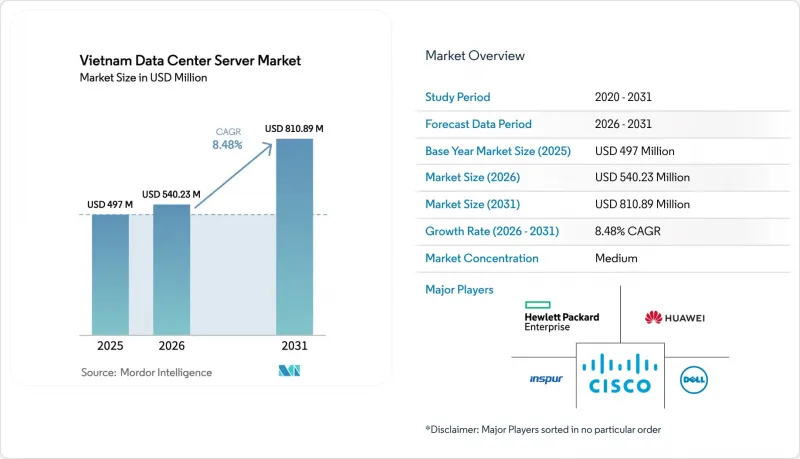
本報告以「類型」(一級、二級等)、「外形尺寸」(半高刀片、全高刀片等)、「最終用戶產業」(銀行、金融服務和保險、製造業等)、「資料中心類型」(超大規模資料中心業者資料中心/雲端服務供應商等)和「應用程式/工作負載」(虛擬化和私有雲端、以儲存為中心等)對產業進行分類。市場預測以美元計價。
越南資料中心伺服器市場趨勢與洞察
新建資料中心及網際網路基礎設施數量增加
越南的建設熱潮正在重塑伺服器需求。 Viettel位於胡志明市的資料中心(140兆瓦)是全國首個容量超過100兆瓦的設施,這促進了針對熱帶氣流和可可再生能源供電系統最佳化的定製刀片伺服器配置的採用。省會城市的邊緣站點正在迅速增加,以支援回程傳輸和對延遲敏感的工作負載。西貢資產管理公司等外國投資者承諾投資15億美元在平陽省建造一個150兆瓦的資料中心,這將推動對本地組裝夥伴關係的需求,以縮短交付時間。
雲端服務和物聯網服務的廣泛應用
2025年實現450億美元的數位經濟目標正推動企業遷移到雲端。在譚團的製造區,企業正在部署高耐環境性能的邊緣伺服器進行預測性維護分析;與此同時,富士康位於北江的「燈塔工廠」正在運作基於GPU的數位孿生工作負載,從而推動了對高階伺服器的需求。此外,隨著北梅醫院在其全國醫療網路中推廣電子健康記錄,醫療數位化進程也正在加速推進。
資料中心建置需要高額的初始資本投入。
即使每兆瓦的成本高達690萬美元,資金籌措障礙仍然限制了中小企業的參與。由於電力系統佔據了預算的大部分,買家往往傾向於選擇能夠最大限度地提高每瓦運算能力的標準化機架式伺服器。雖然資產管理基金正在湧現,用於為資本投資成本提供融資,但採購部門仍優先考慮最佳化生命週期成本,而非單純的績效。
細分市場分析
到2025年,三級資料中心將佔越南資料中心伺服器市場的71.45%。這反映出企業正在接受經濟高效的冗餘方案。此級資料中心支援銀行、電信和公共部門等需要99.982%可用性的工作負載。營運商正在指定使用配備雙電源、熱插拔硬碟和電池輔助模組的刀片伺服器,以縮短平均修復時間(MTTR)。四級資料中心以16.08%的複合年成長率成長,其成長動力來自於建構需要並發維護的AI叢集的超大規模資料中心業者營運商。
由於高密度部署GPU的機架需要容錯散熱,越南資料中心的Tier 4伺服器市場預計將快速成長。 Tier 1和Tier 2設施仍然是可行的選擇,它們可以作為分散式邊緣節點,容納成本最佳化的1U和2U伺服器。 NTT位於胡志明市的1號設施(6兆瓦)就是一個典型的例子,說明外國參與企業如何瞄準區域雲租戶的Tier 3規格。人工智慧賦能的設計正在加速Tier 4的普及,目前一些設施已能為每個機架提供100千瓦的散熱能力,用於Blackwell級GPU。
即使到了2025年,半高刀鋒伺服器仍將維持47.98%的市場佔有率,憑藉其密度和散熱裕度的平衡,成為最佳選擇。企業正在利用整合式底盤管理來最佳化韌體更新和電源分配。四分之一高和微型刀片伺服器平台的複合年成長率為14.87%,這反映了邊緣站點受限於有限的占地面積和電源供應。
越南資料中心微型刀鋒伺服器市場正受益於通訊業5G的部署,5G將運算能力整合到無線網路基地台。在越南國家大學計劃津貼的研究機構中,高效能運算叢集正在使用全高刀片伺服器。電信營運商,特別是Viettel,正在將微型刀片伺服器標準化,以最大限度地減少每個儲存單元(RU)的發熱量,從而支援在35 度C的環境溫度下運行。
其他好處:
- Excel格式的市場預測(ME)表
- 3個月的分析師支持
目錄
第1章:引言
- 研究假設和市場定義
- 調查範圍
第2章:調查方法
第3章執行摘要
第4章 市場狀況
- 市場概覽
- 市場促進因素
- 新建資料中心及網際網路基礎設施數量增加
- 雲端服務和物聯網服務的廣泛應用
- 政府關於數據本地化和數位經濟的法規
- 「中國+1」策略正在推動越南伺服器組裝的發展。
- 二線城市的稅收優惠政策正在刺激第二波資料中心建設浪潮。
- 面向越南的LLM的AI/GPU叢集的興起
- 市場限制因素
- 資料中心建置需要高額的初始資本投入。
- 電網可靠性低和電費上漲
- 認證資料中心工程師短缺
- 先進零件供應鏈的區域化
- 價值供應鏈分析
- 監理情勢
- 技術展望
- 波特五力模型
- 評估宏觀經濟趨勢對市場的影響
第5章 市場規模與成長預測
- 資料中心層級
- 一級和二級
- 三級
- 第四級
- 按外形規格
- 半高刀片
- 全高刀片
- 四分之一高度/微刀片
- 按應用程式/工作負載
- 虛擬化和私有雲端
- 高效能運算(HPC)
- 人工智慧/機器學習和數據分析
- 以儲存為中心
- 邊緣/物聯網閘道器
- 依資料中心類型
- 超大規模資料中心業者雲端服務供應商/雲端服務供應商
- 託管設施
- 企業和邊緣運算
- 按最終用途行業分類
- BFSI
- 資訊科技/通訊
- 醫療保健和生命科學
- 製造業和工業4.0
- 能源公用事業
- 政府/國防
第6章 競爭情勢
- 市場集中度
- 策略趨勢
- 市佔率分析
- 公司簡介
- Dell Inc.
- Cisco Systems Inc.
- Kingston Technology Company Inc.
- Inspur Group
- Fujitsu Limited
- NEC Corporation
- Oracle Corporation
- Huawei Technologies Co. Ltd.
- International Business Machines(IBM)Corporation
- Hewlett Packard Enterprise
- Super Micro Computer Inc.
- Lenovo Group Ltd.
- xFusion Digital Technologies Co. Ltd.
- Viettel Group(Viettel IDC)
- VNPT Technology(VNPT IDC)
- FPT Telecom(FPT Data Center)
- CMC Telecom
- VNG Corporation
- ST Telemedia Global Data Centres(STT GDC)
- MiTAC Holdings Corp.(TYAN)
第7章 市場機會與未來展望
According to Mordor Intelligence, the Vietnam data center server market size is expected to grow from USD 497 million in 2025 to USD 540.23 million in 2026 and is forecast to reach USD 810.89 million by 2031 at 8.48% CAGR over 2026-2031.
This report Segments the Industry Into Type (Tier 1, Tier 2, and More), Form Factor(Half-Height Blades, Full-Height Blades, and More), End-User Verticals (BFSI, Manufacturing, and More), Data Center Type(Hyperscalers/Cloud Service Provider, and More) and by Application / Workload (Virtualisation and Private Cloud, Storage-Centric and More). The Market Forecasts are Provided in Terms of Value (USD).
Vietnam Data Center Server Market Trends and Insights
Increase in construction of new data centers and internet infrastructure
Vietnam's construction boom is redefining server demand. Viettel's 140 MW Ho Chi Minh City campus is the first domestic site to break the 100 MW threshold, prompting bespoke blade configurations optimized for tropical airflow and renewable-ready power systems. Secondary-city edge sites are multiplying to support 5G backhaul and latency-sensitive workloads. Foreign investors such as Saigon Asset Management have committed USD 1.5 billion for a 150 MW campus in Binh Duong Province, intensifying requirements for local assembly partnerships that shorten delivery cycles.
Increasing adoption of cloud and IoT services
A USD 45 billion digital-economy target for 2025 stimulates enterprise cloud migration. Manufacturing zones in Tan Thuan deploy ruggedized edge servers for predictive-maintenance analytics, while Foxconn's Lighthouse Factory in Bac Giang runs GPU-enabled digital-twin workloads that drive premium server demand. Healthcare digitization adds further momentum as Bach Mai Hospital scales electronic medical records across a nationwide care network.
High initial capex for data-center construction
Even at USD 6.9 million per MW, financing hurdles constrain small-to-mid-size firms. Electrical systems absorb a disproportionate share of budgets, steering buyers to standardized rack-mount servers that maximize watt-per-compute ratios. Asset-management funds are emerging to defray capex, yet procurement teams still favor lifecycle-cost optimization over raw performance.
Other drivers and restraints analyzed in the detailed report include:
- Government data-localization and digital-economy mandates
- China + 1 shift catalyzing server assembly in Vietnam
- Limited grid reliability and rising electricity tariffs
For complete list of drivers and restraints, kindly check the Table Of Contents.
Segment Analysis
Tier 3 facilities held 71.45% share of the Vietnam data center server market in 2025, mirroring enterprise tolerance for cost-balanced redundancy. This tier underpins banking, telecom and public-sector workloads that stipulate 99.982% availability. Operators specify dual-power blades, hot-swappable drives and battery-assisted modules to control Mean-Time-To-Repair. Tier 4 sites, growing 16.08% CAGR, are propelled by hyperscalers building AI clusters that require concurrent maintainability.
Vietnam data center server market size within Tier 4 is projected to expand sharply as GPU-dense racks demand fault-tolerant cooling. Tier 1 and Tier 2 venues remain viable for distributed edge nodes, housing cost-optimized 1U and 2U servers. NTT's 6 MW Ho Chi Minh City 1 facility exemplifies how foreign entrants target Tier 3 specifications for regional cloud tenancy. AI-ready blueprinting accelerates Tier 4 adoption, with facilities provisioning 100 kW per rack for Blackwell-class GPUs.
Half-height blades retained 47.98% share in 2025, delivering a sweet spot of density versus thermal headroom. Enterprises leverage integrated chassis management to streamline firmware updates and power budgeting. Quarter-height and micro-blade platforms rise at 14.87% CAGR, reflecting edge-site constraints where floor space and power feeds are limited.
Vietnam data center server market size for micro-blade deployments benefits from telecom 5G rollouts that embed compute at radio access points. Full-height blades serve HPC clusters in research institutes funded under the Vietnam National University program. Telecommunications players, notably Viettel, standardize micro-blades to minimize heat per RU, aiding operations in 35 °C ambient climates.
Complete Report Scope:
- By Data-Center Tier
- Tier 1 and 2
- Tier 3
- Tier 4
- By Form Factor
- Half-height Blades
- Full-height Blades
- Quarter-height / Micro-blades
- By Application / Workload
- Virtualisation and Private Cloud
- High-Performance Computing (HPC)
- Artificial Intelligence/Machine Learning and Data Analytics
- Storage-centric
- Edge / IoT Gateways
- By Data Center Type
- Hyperscalers/Cloud Service Provider
- Colocation Facilities
- Enterprise and Edge
- By End-use Industry
- BFSI
- IT and Telecom
- Healthcare and Life-Sciences
- Manufacturing and Industry 4.0
- Energy and Utilities
- Government and Defence
List of Companies Covered in this Report:
- Dell Inc.
- Cisco Systems Inc.
- Kingston Technology Company Inc.
- Inspur Group
- Fujitsu Limited
- NEC Corporation
- Oracle Corporation
- Huawei Technologies Co. Ltd.
- International Business Machines (IBM) Corporation
- Hewlett Packard Enterprise
- Super Micro Computer Inc.
- Lenovo Group Ltd.
- xFusion Digital Technologies Co. Ltd.
- Viettel Group (Viettel IDC)
- VNPT Technology (VNPT IDC)
- FPT Telecom (FPT Data Center)
- CMC Telecom
- VNG Corporation
- ST Telemedia Global Data Centres (STT GDC)
- MiTAC Holdings Corp. (TYAN)
Additional Benefits:
- The market estimate (ME) sheet in Excel format
- 3 months of analyst support
TABLE OF CONTENTS
1 INTRODUCTION
- 1.1 Study Assumptions and Market Definition
- 1.2 Scope of the Study
2 RESEARCH METHODOLOGY
3 EXECUTIVE SUMMARY
4 MARKET LANDSCAPE
- 4.1 Market Overview
- 4.2 Market Drivers
- 4.2.1 Increase in construction of new data centers and internet infrastructure
- 4.2.2 Increasing adoption of cloud and IoT services
- 4.2.3 Government data-localization and digital-economy mandates
- 4.2.4 China + 1 shift catalyzing server assembly in Vietnam
- 4.2.5 Tier-2 city tax abatements attracting second-wave data-center builds
- 4.2.6 Emergence of AI/GPU clusters for Vietnamese LLMs
- 4.3 Market Restraints
- 4.3.1 High initial capex for data-center construction
- 4.3.2 Limited grid reliability and rising electricity tariffs
- 4.3.3 Shortage of certified data-center engineers
- 4.3.4 Fragmented local supply chain for advanced components
- 4.4 Value / Supply-Chain Analysis
- 4.5 Regulatory Landscape
- 4.6 Technological Outlook
- 4.7 Porter's Five Forces
- 4.7.1 Threat of New Entrants
- 4.7.2 Bargaining Power of Buyers
- 4.7.3 Bargaining Power of Suppliers
- 4.7.4 Threat of Substitutes
- 4.7.5 Intensity of Competitive Rivalry
- 4.8 Assessment of the Impact on Macro Economic Trends on the Market
5 MARKET SIZE AND GROWTH FORECASTS (VALUES)
- 5.1 By Data-Center Tier
- 5.1.1 Tier 1 and 2
- 5.1.2 Tier 3
- 5.1.3 Tier 4
- 5.2 By Form Factor
- 5.2.1 Half-height Blades
- 5.2.2 Full-height Blades
- 5.2.3 Quarter-height / Micro-blades
- 5.3 By Application / Workload
- 5.3.1 Virtualisation and Private Cloud
- 5.3.2 High-Performance Computing (HPC)
- 5.3.3 Artificial Intelligence/Machine Learning and Data Analytics
- 5.3.4 Storage-centric
- 5.3.5 Edge / IoT Gateways
- 5.4 By Data Center Type
- 5.4.1 Hyperscalers/Cloud Service Provider
- 5.4.2 Colocation Facilities
- 5.4.3 Enterprise and Edge
- 5.5 By End-use Industry
- 5.5.1 BFSI
- 5.5.2 IT and Telecom
- 5.5.3 Healthcare and Life-Sciences
- 5.5.4 Manufacturing and Industry 4.0
- 5.5.5 Energy and Utilities
- 5.5.6 Government and Defence
6 COMPETITIVE LANDSCAPE
- 6.1 Market Concentration
- 6.2 Strategic Moves
- 6.3 Market Share Analysis
- 6.4 Company Profiles (includes Global level Overview, Market level overview, Core Segments, Financials as available, Strategic Information, Market Rank/Share for key companies, Products and Services, and Recent Developments)
- 6.4.1 Dell Inc.
- 6.4.2 Cisco Systems Inc.
- 6.4.3 Kingston Technology Company Inc.
- 6.4.4 Inspur Group
- 6.4.5 Fujitsu Limited
- 6.4.6 NEC Corporation
- 6.4.7 Oracle Corporation
- 6.4.8 Huawei Technologies Co. Ltd.
- 6.4.9 International Business Machines (IBM) Corporation
- 6.4.10 Hewlett Packard Enterprise
- 6.4.11 Super Micro Computer Inc.
- 6.4.12 Lenovo Group Ltd.
- 6.4.13 xFusion Digital Technologies Co. Ltd.
- 6.4.14 Viettel Group (Viettel IDC)
- 6.4.15 VNPT Technology (VNPT IDC)
- 6.4.16 FPT Telecom (FPT Data Center)
- 6.4.17 CMC Telecom
- 6.4.18 VNG Corporation
- 6.4.19 ST Telemedia Global Data Centres (STT GDC)
- 6.4.20 MiTAC Holdings Corp. (TYAN)
7 MARKET OPPORTUNITIES and FUTURE OUTLOOK
- 7.1 White-space and Unmet-Need Assessment

 2026年全球資料中心和伺服器半導體市場報告
 中國資料中心伺服器:市場佔有率分析、產業趨勢與統計及成長預測(2026-2031)北美資料中心伺服器:市佔率分析、產業趨勢與統計及成長預測(2026-2031 年)印度資料中心伺服器:市場佔有率分析、產業趨勢與統計及成長預測(2026-2032 年)日本資料中心伺服器:市佔率分析、產業趨勢與統計及成長預測(2026-2031)歐洲資料中心伺服器:市場佔有率分析、產業趨勢與統計及成長預測(2026-2031 年)美國資料中心伺服器:市場佔有率分析、產業趨勢與統計及成長預測(2026-2031 年)馬來西亞資料中心伺服器:市場佔有率分析、產業趨勢與統計及成長預測(2026-2031 年)
 資料中心和伺服器半導體市場報告:趨勢、預測和競爭分析(至2035年)
 資料中心伺服器市場規模、佔有率、成長率、全球產業分析、區域趨勢以及 2026 年至 2034 年的預測。