


 |
市場調查報告書
商品編碼
2119732
歐洲資料中心機櫃:市場佔有率分析、產業趨勢與統計及成長預測(2026-2031 年)Europe Data Center Rack - Market Share Analysis, Industry Trends & Statistics, Growth Forecasts (2026 - 2031) |
||||||

※ 本網頁內容可能與最新版本有所差異。詳細情況請與我們聯繫。
據 Mordor Intelligence 稱,歐洲資料中心機櫃市場預計到 2026 年價值 8.917 億美元,高於 2025 年的 7.9 億美元,預計到 2031 年將達到 16.3 億美元。
預計 2026 年至 2031 年的複合年成長率為 12.87%。
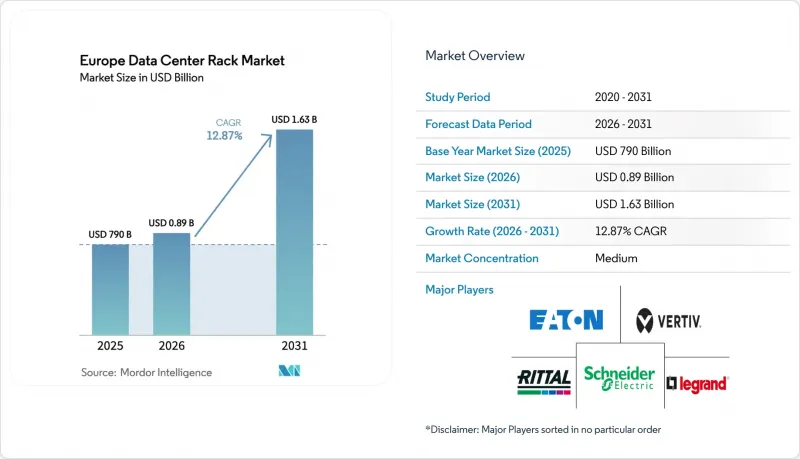
本報告按機架尺寸(四分之一機架、半機架、全機架)、機架高度(42U、45U、48U 及其他)、機架類型(機櫃式(密封)機架、開放式機櫃、壁掛式機架)、資料中心類型(託管機房、企業級和邊緣資料中心及其他)、壁掛式機架)、資料中心類型(託管機房、企業級和邊緣資料中心及其他)、材質(國家鋼、鋁等)以及鋼品(國家/地區進行細分、鋼等)、材質(國家/地區。市場預測以美元(USD)計價。
歐洲資料中心機櫃市場的趨勢與洞察
超大規模的快速擴張
歐洲超大規模營運商正以前所未有的速度擴張容量,標準的1MW機架不再是實驗性的,而是已成為標配。工程週期縮短至數月,供應商被要求預先設計可交付液冷功能的模組化機架。資料主權法規進一步加速了這一趨勢,因為全球雲端服務供應商必須將處理業務在地化在其境內。數萬台設備的大量訂單帶來了規模經濟效益,使超大規模業者能夠主導設計參數,而這些參數正逐漸成為事實上的歐洲標準。因此,歐洲資料中心機櫃市場正在擴張,現有園區的升級週期加快,新建待開發區的面積也加倍。
高密度計算的廣泛應用
目前,人工智慧 (AI) 和機器學習叢集每個機架的功耗高達 500 kW,遠遠超過傳統機架的氣流限制。歐洲的資料中心正在透過採用可直接安裝到新型機架中的晶片級 (DTC) 或浸沒式冷卻模組來解決這個問題。隨著散熱性能成為一項主要指標,製造商正在將冷卻液歧管、熱交換器和冗餘泵套件整合到機架機箱中。高密度部署不再侷限於超大規模環境。研究機構、汽車設計公司和金融交易商也在採購專用機架,擴大了目標市場。由於 GPU 的藍圖超過了前幾代伺服器的更新換代速度,這些部署正在縮短伺服器的更新週期,從而推動歐洲資料中心機櫃市場銷售額的成長。
先進機架的初始資本支出(CAPEX)較高
整合歧管和冗餘匯流排的液冷機櫃成本是傳統風冷機櫃的三到四倍。中小企業不願承擔如此高昂的成本,尤其是在每個機架的工作負載低於 50 kW 的情況下,除非能夠明確預測投資報酬率 (ROI)。託管服務提供者必須平衡高階產品需求與對價格敏感的租戶需求,通常會推遲全面部署,直到與關鍵客戶的合約最終敲定。各國獎勵政策的顯著差異以及不同的資格要求也使預算編制變得複雜。這些財務障礙正在減緩液冷機櫃的普及速度,預計未來兩年歐洲資料中心機櫃市場的複合年成長率 (CAGR) 將下降幾個百分點。
細分市場分析
到2025年,整機架將佔據大部分的機架需求,市佔率高達74.88%。隨著企業將分散的半機架安裝空間整合到更小、密度更高的機櫃中,整機架的領先地位將持續下去。這種規格目前已成為託管資料中心和超大規模園區大規模訂單的基礎,這些設施都希望採用統一的機架排列方式,以簡化電源佈線和冷卻歧管的安裝。更寬的機架可以容納橫向冷卻迴路和大型浸沒式冷卻水箱,這些特性對於人工智慧叢集至關重要。同時,由於占地面積成本高昂,四分之一機架仍然是零售商店和微型邊緣運算設施的首選。供應商大規模生產專為整機架設計的配件、電纜配線架和後門熱交換器,進一步提高了供應鏈效率,鞏固了整機架在歐洲資料中心機櫃市場的主導地位。
從生命週期成本的角度來看,業者也十分重視整機機架。其標準化的尺寸使其在資料中心機房維修期間可以重複使用,從而降低資本投入。維護團隊需要攜帶的備件更少,監控軟體也可以將單一模板應用於數千個相同的機櫃。歐洲資料中心機櫃產業非常重視這些特性,因為他們預測未來五年內工作負載可能會加倍,尤其是在新晶片藍圖推動下,每平方公尺功耗不斷提高的情況下。因此,即使小尺寸機架繼續發揮其特殊作用,整機機架仍將是主要的成長引擎。
儘管預計到2025年,傳統的42U機櫃仍將維持60.95%的市場佔有率,但目前市場需求正轉向48U機型。 48U機型在不增加層高要求的情況下,可提供額外的六個U的空間。機房業主傾向於這種逐步提升密度的方式,因為它允許他們在無需進行結構維修的情況下,為配電單元和流體歧管托盤騰出空間。汽車設計、基因組學研究和金融分析等高成長產業正在部署高負載GPU節點,這些節點可以充分利用增加的垂直空間。預計歐洲資料中心48U機櫃市場將以17.05%的複合年成長率成長,高於其他任何高度等級。
此外,更高的機架尺寸簡化了線纜管理,允許將網路線纜、電源線和冷卻線纜束分別放置在不同的垂直區域。製造商正在透過增強機架的抗扭性能來應對這一需求,以解決機架部分安裝時重量分佈不均的問題。隨著機架功率負載接近 1 MW,振動和熱膨脹下的穩定性變得至關重要。因此,機架高度的演變反映了向更高密度和整合液冷散熱的整體趨勢,推動了 48U 機架在新專案和維修專案中的廣泛應用。
其他好處:
- Excel格式的市場預測(ME)表
- 3個月的分析師支持
目錄
第1章:引言
- 研究假設和市場定義
- 調查範圍
第2章:調查方法
第3章執行摘要
第4章 市場狀況
- 市場概覽
- 市場促進因素
- 超大規模快速擴張
- 高密度運算的日益普及
- 政府的數位化努力
- 託管服務的成長
- 過渡到符合OCP標準的開放式機架設計
- 歐洲二線城市邊緣微型資料中心激增
- 市場限制因素
- 先進機架的初始資本支出(CAPEX)較高。
- 供應鏈中斷與鋼鐵價格波動
- 嚴格的能源效率法規
- 找到技術嫻熟的機架整合技術人員很困難。
- 產業價值鏈分析
- 監理情勢
- 技術展望
- 波特五力分析
- 市場宏觀經濟趨勢的評估
第5章 市場規模與成長預測
- 按機架尺寸
- 四分之一架
- 半架
- 全機架
- 貨架高度
- 42U
- 45U
- 48U
- 其他機架高度
- 按機架類型
- 櫃式(密封型)機架
- 開放式機架
- 壁掛式機架
- 依資料中心類型
- 託管設施
- 超大規模和雲端服務供應商的資料中心
- 企業和邊緣運算
- 材料
- 鋼
- 鋁
- 其他材料
- 國家
- 德國
- 英國
- 法國
- 荷蘭
- 愛爾蘭
- 瑞士
- 丹麥
- 瑞典
- 義大利
- 西班牙
- 波蘭
- 挪威
- 奧地利
- 其他歐洲國家
第6章 競爭情勢
- 市場集中度
- 策略趨勢
- 市佔率分析
- 公司簡介
- Schneider Electric SE
- Rittal GmbH and Co. KG
- Vertiv Group Corporation
- Eaton Corporation plc
- Legrand SA
- nVent Electric plc
- Dell Technologies Inc.
- Hewlett Packard Enterprise Co.
- Fujitsu Ltd.
- Cisco Systems Inc.
- Lenovo Group Ltd.
- Huawei Technologies Co. Ltd.
- International Business Machines Corp.
- Panduit Corp.
- Super Micro Computer Inc.
- Tripp Lite(Eaton)
- Chatsworth Products Inc.
- Black Box Corp.
- APC by Schneider Electric
- Vertiv(Geist)
第7章 市場機會與未來展望
According to Mordor Intelligence, the Europe data center rack market size in 2026 is estimated at USD 891.7 million, growing from 2025 value of USD 790 million with 2031 projections showing USD 1.63 billion, growing at 12.87% CAGR over 2026-2031.
This report is Segmented by Rack Size (Quarter Rack, Half Rack, Full Rack), by Rack Height (42U, 45U, 48U, and More), Rack Type (Cabinet (Closed) Racks, Open-Frame Racks, Wall-Mount Racks), Data Center Type (Colocation Facilities, Enterprise and Edge, and More), Material (Steel, Aluminum, and More) and Country. The Market Forecasts are Provided in Terms of Value (USD).
Europe Data Center Rack Market Trends and Insights
Rapid Hyperscale Expansion
Hyperscale operators are rolling out capacity at an unprecedented cadence across the continent, making standard 1 MW racks commonplace instead of experimental. Project timelines now compress to months, compelling suppliers to pre-engineer modular frames that arrive ready for liquid cooling. Sovereign data rules amplify this momentum because global cloud providers must localize processing inside national borders. Bulk orders in the tens of thousands of units drive economies of scale, allowing hyperscalers to dictate design parameters that become de facto European benchmarks. The resulting volume lifts the Europe data center rack market by accelerating replacement cycles at existing campuses and doubling footprints at new greenfield sites.
Rising Adoption of High-Density Computing
Artificial intelligence and machine-learning clusters now consume up to 500 kW per rack, far exceeding the airflow limits of legacy frames. European facilities respond by adopting direct-to-chip or immersion cooling modules that bolt into new rack designs. Thermal performance becomes a lead specification, prompting manufacturers to embed coolant manifolds, heat exchangers, and redundant pump kits within the rack envelope. High-density rollouts no longer stay inside hyperscale walls; research labs, automotive design houses, and financial traders also procure specialized frames, expanding the addressable market. These deployments shorten refresh intervals because GPU roadmaps outpace earlier server generations, pushing the Europe data center rack market toward higher unit sales.
High Initial CAPEX of Advanced Racks
Liquid-cooled frames with integrated manifolds and redundant busbars cost three to four times more than traditional air-cooled cabinets. Smaller enterprises hesitate to absorb this premium without clear return-on-investment projections, especially when workloads remain below 50 kW per rack. Colocation operators must balance premium SKU demand with price-sensitive tenants, often delaying full-scale rollouts until anchor customers sign. National incentive programs vary widely, creating a patchwork of subsidy eligibility that complicates budgeting. These financial hurdles slow adoption velocity and shave points off the Europe data center rack market CAGR during the next two years.
Other drivers and restraints analyzed in the detailed report include:
- Government Digitalisation Initiatives
- Growth of Colocation Services
- Limited Availability of Skilled Rack-Integration Technicians
For complete list of drivers and restraints, kindly check the Table Of Contents.
Segment Analysis
Full racks generated the bulk of unit demand and captured 74.88% share in 2025, a dominance that continues as enterprises consolidate scattered half-rack footprints into fewer, denser enclosures. This format now anchors large orders from colocation and hyperscale campuses, each seeking uniform rows that simplify power whips and cooling manifolds. Wider frames support side-to-side cooling loops and heavy immersion tanks, features essential for AI clusters. At the opposite end, quarter racks remain favored in retail branches and micro-edge shelters where floor space is expensive. Supply-chain efficiencies accrue because vendors mass-produce accessories, cable trays, and rear-door heat exchangers sized for full racks, further reinforcing their leadership in the Europe data center rack market.
Operators also appreciate full racks for lifecycle economics. Uniform dimensions allow reuse during data hall revamps, reducing capital outlay. Service teams carry fewer spare kits, and monitoring software can apply one template across thousands of identical cabinets. The Europe data center rack industry views these attributes as critical when forecasting workloads that may double inside five years, especially as new chip roadmaps demand ever greater wattage per square meter. Consequently, full racks will remain the primary growth engine even as niche sizes sustain specialized roles.
While the legacy 42U height retained 60.95% share in 2025, demand now swings toward 48U alternatives that yield six extra unit positions without raising ceiling height requirements. Facility owners prefer this incremental density gain because it avoids structural renovation yet creates room for power distribution units and liquid manifold trays. High-growth sectors such as automotive design, genomic research, and financial analytics load heavy GPU nodes that benefit from the added vertical clearance. The Europe data center rack market size for 48U models is projected to expand at 17.05% CAGR, outpacing every other height category.
The taller format also simplifies cable management by separating network, power, and cooling bundles into distinct vertical zones. Manufacturers respond by reinforcing frame torsion tolerance to counterbalance uneven weight distribution in partially populated cabinets. As racks approach 1 MW power loads, stability under vibration and thermal expansion becomes critical. Height evolution thus mirrors the overall trajectory toward higher density and integrated fluid cooling, reinforcing 48U's ascent throughout new build and retrofit programs.
Complete Report Scope:
- By Rack Size
- Quarter Rack
- Half Rack
- Full Rack
- By Rack Height
- 42U
- 45U
- 48U
- Other Rack Height
- By Rack Type
- Cabinet (Closed) Racks
- Open-Frame Racks
- Wall-Mount Racks
- By Data Center Type
- Colocation Facilities
- Hyperscale and Cloud Service Provider DCs
- Enterprise and Edge
- By Material
- Steel
- Aluminum
- Other Material
- By Country
- Germany
- United Kingdom
- France
- Netherlands
- Ireland
- Switzerland
- Denmark
- Sweden
- Italy
- Spain
- Poland
- Norway
- Austria
- Rest of Europe
List of Companies Covered in this Report:
- Schneider Electric SE
- Rittal GmbH and Co. KG
- Vertiv Group Corporation
- Eaton Corporation plc
- Legrand SA
- nVent Electric plc
- Dell Technologies Inc.
- Hewlett Packard Enterprise Co.
- Fujitsu Ltd.
- Cisco Systems Inc.
- Lenovo Group Ltd.
- Huawei Technologies Co. Ltd.
- International Business Machines Corp.
- Panduit Corp.
- Super Micro Computer Inc.
- Tripp Lite (Eaton)
- Chatsworth Products Inc.
- Black Box Corp.
- APC by Schneider Electric
- Vertiv (Geist)
Additional Benefits:
- The market estimate (ME) sheet in Excel format
- 3 months of analyst support
TABLE OF CONTENTS
1 INTRODUCTION
- 1.1 Study Assumptions and Market Definition
- 1.2 Scope of the Study
2 RESEARCH METHODOLOGY
3 EXECUTIVE SUMMARY
4 MARKET LANDSCAPE
- 4.1 Market Overview
- 4.2 Market Drivers
- 4.2.1 Rapid Hyperscale Expansion
- 4.2.2 Rising Adoption of High-Density Computing
- 4.2.3 Government Digitalisation Initiatives
- 4.2.4 Growth of Colocation Services
- 4.2.5 Shift To OCP-Compliant Open-Rack Designs
- 4.2.6 Surging Edge Micro-Data Centres in Tier-2 European Cities
- 4.3 Market Restraints
- 4.3.1 High Initial CAPEX of Advanced Racks
- 4.3.2 Supply-Chain Disruptions and Steel Price Volatility
- 4.3.3 Stringent Energy-Efficiency Regulations
- 4.3.4 Limited Availability of Skilled Rack-Integration Technicians
- 4.4 Industry Value Chain Analysis
- 4.5 Regulatory Landscape
- 4.6 Technological Outlook
- 4.7 Porters Five Forces Analysis
- 4.7.1 Bargaining Power of Buyers
- 4.7.2 Bargaining Power of Suppliers
- 4.7.3 Threat of New Entrants
- 4.7.4 Threat of Substitutes
- 4.7.5 Intensity of Competitive Rivalry
- 4.8 Assessment of Macro Economic Trends on the Market
5 MARKET SIZE AND GROWTH FORECASTS (VALUE)
- 5.1 By Rack Size
- 5.1.1 Quarter Rack
- 5.1.2 Half Rack
- 5.1.3 Full Rack
- 5.2 By Rack Height
- 5.2.1 42U
- 5.2.2 45U
- 5.2.3 48U
- 5.2.4 Other Rack Height
- 5.3 By Rack Type
- 5.3.1 Cabinet (Closed) Racks
- 5.3.2 Open-Frame Racks
- 5.3.3 Wall-Mount Racks
- 5.4 By Data Center Type
- 5.4.1 Colocation Facilities
- 5.4.2 Hyperscale and Cloud Service Provider DCs
- 5.4.3 Enterprise and Edge
- 5.5 By Material
- 5.5.1 Steel
- 5.5.2 Aluminum
- 5.5.3 Other Material
- 5.6 By Country
- 5.6.1 Germany
- 5.6.2 United Kingdom
- 5.6.3 France
- 5.6.4 Netherlands
- 5.6.5 Ireland
- 5.6.6 Switzerland
- 5.6.7 Denmark
- 5.6.8 Sweden
- 5.6.9 Italy
- 5.6.10 Spain
- 5.6.11 Poland
- 5.6.12 Norway
- 5.6.13 Austria
- 5.6.14 Rest of Europe
6 COMPETITIVE LANDSCAPE
- 6.1 Market Concentration
- 6.2 Strategic Moves
- 6.3 Market Share Analysis
- 6.4 Company Profiles (includes Global level Overview, Market level overview, Core Segments, Financials, Strategic Information, Market Rank/Share, Products and Services, Recent Developments)
- 6.4.1 Schneider Electric SE
- 6.4.2 Rittal GmbH and Co. KG
- 6.4.3 Vertiv Group Corporation
- 6.4.4 Eaton Corporation plc
- 6.4.5 Legrand SA
- 6.4.6 nVent Electric plc
- 6.4.7 Dell Technologies Inc.
- 6.4.8 Hewlett Packard Enterprise Co.
- 6.4.9 Fujitsu Ltd.
- 6.4.10 Cisco Systems Inc.
- 6.4.11 Lenovo Group Ltd.
- 6.4.12 Huawei Technologies Co. Ltd.
- 6.4.13 International Business Machines Corp.
- 6.4.14 Panduit Corp.
- 6.4.15 Super Micro Computer Inc.
- 6.4.16 Tripp Lite (Eaton)
- 6.4.17 Chatsworth Products Inc.
- 6.4.18 Black Box Corp.
- 6.4.19 APC by Schneider Electric
- 6.4.20 Vertiv (Geist)
7 MARKET OPPORTUNITIES and FUTURE OUTLOOK
- 7.1 White-space and Unmet-Need Assessment

 OCP機架市場規模、佔有率和趨勢分析報告:按組件、機架類型、冷卻技術、最終用途和細分市場預測(2026-2033年)
 中東資料中心機櫃:市場佔有率分析、產業趨勢與統計及成長預測(2026-2031)印度資料中心機櫃:市場佔有率分析、產業趨勢與統計及成長預測(2026-2032 年)德國資料中心機櫃:市場佔有率分析、產業趨勢與統計及成長預測(2026-2031 年)法國資料中心機櫃:市場佔有率分析、產業趨勢與統計及成長預測(2026-2031 年)英國資料中心機櫃:市場佔有率分析、產業趨勢與統計及成長預測(2026-2031 年)西班牙資料中心機櫃:市場佔有率分析、產業趨勢與統計及成長預測(2026-2031 年)馬來西亞資料中心機櫃:市場佔有率分析、產業趨勢與統計及成長預測(2026-2031)資料中心機櫃電源分配單元(PDU):市場佔有率分析、行業趨勢和統計數據以及成長預測(2026-2031 年)
 資料中心機架市場-2026-2032年全球市場預測