


 |
市場調查報告書
商品編碼
2119705
中東資料中心機櫃:市場佔有率分析、產業趨勢與統計及成長預測(2026-2031)Middle East Data Center Rack - Market Share Analysis, Industry Trends & Statistics, Growth Forecasts (2026 - 2031) |
||||||

※ 本網頁內容可能與最新版本有所差異。詳細情況請與我們聯繫。
據 Mordor Intelligence 稱,中東資料中心機架市場預計在 2026 年價值 2.2451 億美元,預計在預測期(2026-2031 年)內將以 14.73% 的複合年成長率成長,到 2031 年達到 4.4633 億美元。
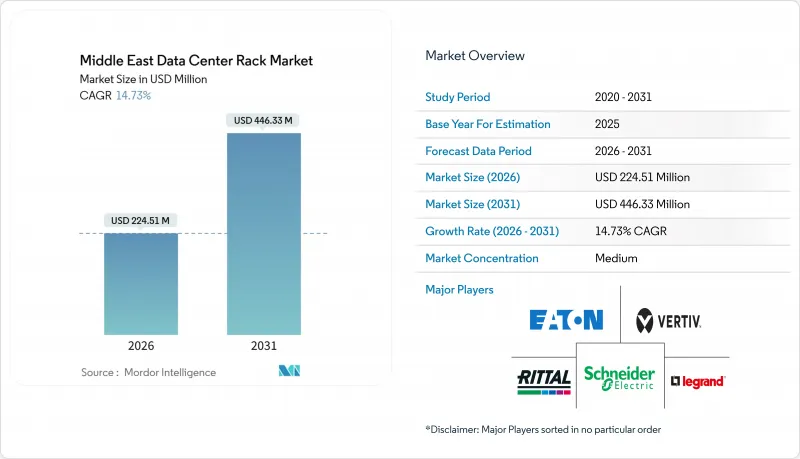
本報告按機架尺寸(四分之一機架、半機架、全機架)、機架類型(封閉式機櫃、開放式機架、壁掛式機架、微邊緣機架)、存儲級別(一級和二級、三級、四級)、資料中心規模(小規模、中型、大型、超大規模)、資料中心類型(託管、超大規模資料中心業者、企業級和邊緣計算)以及國家/地區進行細分。市場預測以美元 (USD) 為單位。
中東資料中心機架市場趨勢與洞察
沙烏地阿拉伯和阿拉伯聯合大公國領先的雲端公司正在拓展超大規模業務
為了滿足資料主權法規的要求,雲端平台供應商正在波斯灣沿岸地區擴展其多區域部署。每個新的可用區都新增了數千個高密度密封機櫃,這些機櫃的設計負載可達 20 千瓦或更高。人工智慧訓練叢集會增加熱輸出,因此機架需要整合佈線、後門熱交換器和感測器控制的氣流管理系統。模組化艙體佈局可擴展至 5 兆瓦至 50 兆瓦,縮短了建造時間,並透過提供預組裝套件為機架供應商帶來競爭優勢。
在地採購需求的加速成長正在推動國內資料中心託管需求。
根據沙烏地阿拉伯的IKTVA和阿拉伯聯合大公國的ICV框架,技術項目必須達到30-40%的國內增值標準,因此全球供應商現在要么將散件機架運往國內進行最終組裝,要么與當地鋼鐵工人合作。這些認證方案雖然會帶來溢價,但能確保在競標評估中享有優先權。在約旦,隨著當地法規的日益普及,供應鏈正從以進口為中心的模式轉向混合模式,將製造、粉末塗裝和最終組裝等工序分散到沿岸地區的多個工廠。
細分市場分析
到2025年,整機架將佔據中東資料中心機櫃市場74.32%的佔有率,凸顯了42U機架在託管和企業機房領域長期以來的主導地位。然而,受5G邊緣部署的推動,半機架預計將在2031年之前以15.53%的複合年成長率成長,因為5G邊緣部署需要將運算設備安裝在較小的機房中。諾基亞在阿布達比興建的2025年雲端無線接取網路(Cloud RAN)採用了12U和18U的防風雨機房,顯示無線接取網路正在從集中式機房轉移到分散式節點。雖然四分之一機架在遠端辦公室領域擁有一定的市場需求,但預計大眾市場的需求仍將集中在這兩種主要尺寸上。
電信業者傾向於採用兩種產品組合:一種用於容納數千個相同 42U 機櫃的超大規模機房,另一種用於配備完整整合電源、散熱和安全功能的半高機櫃。這種方法簡化了採購流程,同時也能適應不同的散熱環境。具體來說,支援 20 千瓦功率的全機架用於 GPU叢集,而半機架則用於運行功率為 5 千瓦或更低的邊緣應用。能夠同時涵蓋這兩種極端情況的供應商佔據了最大的市場佔有率,但他們必須平衡不同的供應鏈和定價模式。
到2025年,封閉式機櫃將佔據中東資料中心機櫃市場79.33%的佔有率,預計到2031年將成長15.67%。此偏好主要源自於其防塵效能,符合IP54標準的機櫃門可有效保護伺服器免受沙漠顆粒的侵害,而正壓氣流則能提升可靠性。開放式機架目前仍用於測試實驗室和一級資料中心,但隨著營運商在追求運作和更嚴格的環境控制之間尋求平衡,其市場佔有率正在下降。
熱管理也在影響市場趨勢。後門式熱交換器和插口式冷卻器易於改裝到封閉式機櫃中,使設施能夠在不更換冷凍水設備的情況下提高功率密度。位於杜拜的 Moro Hub 太陽能資料中心於 2025 年竣工,採用後門式熱交換器的封閉式機櫃,利用被動式能源管理白天的熱能。由於人工智慧產生的負載為 30-50 千瓦,封閉式機櫃的優勢日益凸顯,即使面臨超大規模資料中心業者的價格壓力,也能維持較高的平均售價 (ASP)。
其他好處:
- Excel格式的市場預測(ME)表
- 3個月的分析師支持
目錄
第1章:引言
- 研究假設和市場定義
- 調查範圍
第2章:調查方法
第3章執行摘要
第4章 市場狀況
- 市場概覽
- 市場促進因素
- 雲端巨頭在沙烏地阿拉伯和阿拉伯聯合大公國擴大超大規模基礎設施。
- 對本地內容日益成長的需求正在推動國內資料中心託管市場的發展。
- 5G主導的邊緣站點需要微模組機架。
- 對海灣國家主權人工智慧和高效能運算的投資
- 可再生能源購電協議的獎勵可降低因提高裝置容量密度而產生的營運成本。
- 適用於沙漠環境的微氣候耐受型外殼
- 市場限制因素
- 對非自由貿易協定成員國徵收高額鋼製機殼進口關稅。
- 海灣合作理事會地區以外的Tier-IV占地面積供不應求。
- 刀鋒伺服器和執行緒伺服器的需求不斷成長,導致可用機架數量減少。
- 由於缺水應對措施,對液體冷卻系統維修受到限制。
- 宏觀經濟因素對市場的影響
- 產業價值鏈分析
- 監理情勢
- 技術展望
- 波特五力分析
第5章 市場規模與成長預測
- 按機架尺寸
- 四分之一機架(小於11U)
- 半機架(12-22U)
- 整機架(42U 或以上)
- 按機架類型
- 密封櫃
- 開放式框架
- 壁掛式和微邊框外殼
- 層級特定
- 一級和二級
- 三級
- 第四級
- 按資料中心規模
- 小規模資料中心
- 中型資料中心
- 大型資料中心
- 超大規模資料中心
- 依資料中心類型
- 託管資料中心
- 超大規模資料中心業者資料中心/雲端服務供應商
- 企業和邊緣資料中心
- 國家
- 沙烏地阿拉伯
- 阿拉伯聯合大公國
- 阿曼
- 約旦
- 其他中東國家
第6章 競爭情勢
- 市場集中度
- 策略趨勢
- 市佔率分析
- 公司簡介
- Schneider Electric SE
- Vertiv Group Corp.
- Rittal GmbH & Co. KG
- Eaton Corporation plc
- Legrand SA
- nVent Electric plc
- Panduit Corp.
- Huawei Technologies Co., Ltd.
- Black Box Corporation
- Chatsworth Products, Inc.
- Middle East Fiber Cable Manufacturing Co.
- Great Lakes Data Racks & Cabinets Inc.
- Delta Electronics, Inc.
- ABB Ltd.
- Belden Inc.
- Canovate Group
第7章 市場機會與未來展望
According to Mordor Intelligence, the Middle East data center rack market size is estimated at USD 224.51 million in 2026, and is expected to reach USD 446.33 million by 2031, at a CAGR of 14.73% during the forecast period (2026-2031).
This report is Segmented by Rack Size (Quarter Rack, Half Rack, and Full Rack), Rack Type (Enclosed Cabinet, Open-Frame, Wall-Mount and Micro-Edge Enclosure), Tier Type (Tier 1 and 2, Tier 3, and Tier 4), Data Center Size (Small, Medium, Large and Hyperscale), Data Center Type (Colocation, Hyperscalers, and Enterprise and Edge), and Country. Market Forecasts are Provided in Terms of Value (USD).
Middle East Data Center Rack Market Trends and Insights
Hyperscale Build-Outs by Cloud Majors in Saudi Arabia and UAE
Cloud platforms are rolling out multi-region footprints inside the Gulf to satisfy data-sovereignty rules, and every new availability zone translates into thousands of high-density, enclosed cabinets engineered for 20 kilowatt or higher loads. Racks must integrate cable-routing, rear-door heat exchangers, and sensor-driven airflow because AI training clusters intensify thermal output. Modular pod layouts that scale from 5 megawatts to 50 megawatts are shortening construction schedules, giving rack vendors that deliver pre-assembled kits an edge.
Accelerated Local-Content Requirements Driving On-Shore Colocation Demand
Saudi Arabia's IKTVA and the UAE's ICV frameworks impose 30%-40% domestic-value thresholds on technology projects, so global vendors now ship knock-down racks for final assembly in-country or partner with regional steel fabricators. Certification under these schemes commands price premiums yet ensures priority in bid evaluations. As local compliance expands to Jordan, the supply chain is moving from import-centric to hybrid models that split fabrication, powder coating, and final integration across multiple Gulf plants.
Other drivers and restraints analyzed in the detailed report include:
- 5G-Led Edge Sites Requiring Micro-Module Racks
- Sovereign-AI and HPC Investments in Gulf States
- High Import Tariffs on Steel Enclosures in Non-FTA Countries
- Water-Scarcity Regulations Limiting Liquid-Cooling Retrofits
For complete list of drivers and restraints, kindly check the Table Of Contents.
Segment Analysis
Full racks command 74.32% of Middle East data center rack market share in 2025, underscoring the historical dominance of 42U footprints for colocation and enterprise halls. Yet half racks expand at a 15.53% CAGR through 2031, propelled by 5G edge rollouts that install compute in small shelters. Nokia's 2025 Cloud RAN build in Abu Dhabi used 12U and 18U weatherized enclosures, proving how radio access networks shift away from centralized halls toward distributed nodes. Quarter racks see niche uptake for remote offices, but bulk demand will continue to cluster around the two leading sizes.
Operators favor dual portfolios, one for hyperscale halls that absorb thousands of identical 42U cabinets and another for half-height enclosures that ship fully integrated with power, cooling, and security. The approach simplifies procurement while meeting divergent thermals, with GPU clusters leaning on full racks that support 20 kilowatt power and half racks targeting edge applications running at 5 kilowatt or lower. Vendors that span both ends capture the widest wallet share, but must juggle distinct supply chains and pricing models.
Enclosed cabinets held 79.33% of Middle East data center rack market share in 2025 and are projected to grow 15.67% through 2031. Dust ingress protection drives the preference, as IP54-rated doors shield servers from desert particulates while positive-pressure airflow improves reliability. Open-frame racks linger in test labs or Tier 1 halls, yet their share is eroding because operators pair uptime targets with stricter environmental controls.
Thermal strategies also tilt the field. Rear-door heat exchangers and in-row chillers retrofit smoothly onto sealed cabinets, letting facilities step up power density without replacing chilled-water plants. The Moro Hub solar data center in Dubai completed in 2025 and adopted sealed enclosures with rear-door exchangers to manage daytime heat using passive energy. As AI drives 30-50 kilowatt loads, the enclosed format cements its edge, sustaining premium ASPs despite hyperscaler price pressure.
Complete Report Scope:
- By Rack Size
- Quarter Rack (Below 11U)
- Half Rack (12 to 22U)
- Full Rack (Above 42U)
- By Rack Type
- Enclosed Cabinet
- Open-Frame
- Wall-Mount and Micro-Edge Enclosure
- By Tier Type
- Tier 1 and 2
- Tier 3
- Tier 4
- By Data Center Size
- Small Data Center
- Medium Data Center
- Large Data Center
- Hyperscale Data Center
- By Data Center Type
- Colocation Data Center
- Hyperscalers Data Center/CSPs
- Enterprise and Edge Data Center
- By Country
- Saudi Arabia
- United Arab Emirates
- Oman
- Jordan
- Rest of Middle East
List of Companies Covered in this Report:
- Schneider Electric SE
- Vertiv Group Corp.
- Rittal GmbH & Co. KG
- Eaton Corporation plc
- Legrand SA
- nVent Electric plc
- Panduit Corp.
- Huawei Technologies Co., Ltd.
- Black Box Corporation
- Chatsworth Products, Inc.
- Middle East Fiber Cable Manufacturing Co.
- Great Lakes Data Racks & Cabinets Inc.
- Delta Electronics, Inc.
- ABB Ltd.
- Belden Inc.
- Canovate Group
Additional Benefits:
- The market estimate (ME) sheet in Excel format
- 3 months of analyst support
TABLE OF CONTENTS
1 INTRODUCTION
- 1.1 Study Assumptions and Market Definition
- 1.2 Scope of the Study
2 RESEARCH METHODOLOGY
3 EXECUTIVE SUMMARY
4 MARKET LANDSCAPE
- 4.1 Market Overview
- 4.2 Market Drivers
- 4.2.1 Hyperscale Build-Outs by Cloud Majors in Saudi Arabia and UAE
- 4.2.2 Accelerated Local-Content Requirements Driving On-Shore Colocation Demand
- 4.2.3 5G-Led Edge Sites Requiring Micro-Module Racks
- 4.2.4 Sovereign-AI and HPC Investments in Gulf States
- 4.2.5 Renewable-Energy PPA Incentives Lowering Opex for Rack Densification
- 4.2.6 Micro-Climate Resistant Enclosures for Desert Environments
- 4.3 Market Restraints
- 4.3.1 High Import Tariffs on Steel Enclosures in Non-FTA Countries
- 4.3.2 Limited Availability of Tier-IV Colocation Floor Space Outside GCC
- 4.3.3 Growing Preference for Blade and Sled Servers Reduces Rack Count
- 4.3.4 Water-Scarcity Regulations Limiting Liquid-Cooling Retrofits
- 4.4 Impact of Macroeconomic Factors on the Market
- 4.5 Industry Value Chain Analysis
- 4.6 Regulatory Landscape
- 4.7 Technological Outlook
- 4.8 Porter's Five Forces Analysis
- 4.8.1 Bargaining Power of Buyers
- 4.8.2 Bargaining Power of Suppliers
- 4.8.3 Threat of New Entrants
- 4.8.4 Threat of Substitute Products
- 4.8.5 Intensity of Competitive Rivalry
5 MARKET SIZE AND GROWTH FORECASTS (VALUE)
- 5.1 By Rack Size
- 5.1.1 Quarter Rack (Below 11U)
- 5.1.2 Half Rack (12 to 22U)
- 5.1.3 Full Rack (Above 42U)
- 5.2 By Rack Type
- 5.2.1 Enclosed Cabinet
- 5.2.2 Open-Frame
- 5.2.3 Wall-Mount and Micro-Edge Enclosure
- 5.3 By Tier Type
- 5.3.1 Tier 1 and 2
- 5.3.2 Tier 3
- 5.3.3 Tier 4
- 5.4 By Data Center Size
- 5.4.1 Small Data Center
- 5.4.2 Medium Data Center
- 5.4.3 Large Data Center
- 5.4.4 Hyperscale Data Center
- 5.5 By Data Center Type
- 5.5.1 Colocation Data Center
- 5.5.2 Hyperscalers Data Center/CSPs
- 5.5.3 Enterprise and Edge Data Center
- 5.6 By Country
- 5.6.1 Saudi Arabia
- 5.6.2 United Arab Emirates
- 5.6.3 Oman
- 5.6.4 Jordan
- 5.6.5 Rest of Middle East
6 COMPETITIVE LANDSCAPE
- 6.1 Market Concentration
- 6.2 Strategic Moves
- 6.3 Market Share Analysis
- 6.4 Company Profiles (includes Global Level Overview, Market Level Overview, Core Segments, Financials as available, Strategic Information, Market Rank/Share, Products and Services, Recent Developments)
- 6.4.1 Schneider Electric SE
- 6.4.2 Vertiv Group Corp.
- 6.4.3 Rittal GmbH & Co. KG
- 6.4.4 Eaton Corporation plc
- 6.4.5 Legrand SA
- 6.4.6 nVent Electric plc
- 6.4.7 Panduit Corp.
- 6.4.8 Huawei Technologies Co., Ltd.
- 6.4.9 Black Box Corporation
- 6.4.10 Chatsworth Products, Inc.
- 6.4.11 Middle East Fiber Cable Manufacturing Co.
- 6.4.12 Great Lakes Data Racks & Cabinets Inc.
- 6.4.13 Delta Electronics, Inc.
- 6.4.14 ABB Ltd.
- 6.4.15 Belden Inc.
- 6.4.16 Canovate Group
7 MARKET OPPORTUNITIES AND FUTURE OUTLOOK
- 7.1 White-Space and Unmet-Need Assessment

 OCP機架市場規模、佔有率和趨勢分析報告:按組件、機架類型、冷卻技術、最終用途和細分市場預測(2026-2033年)
 印度資料中心機櫃:市場佔有率分析、產業趨勢與統計及成長預測(2026-2032 年)德國資料中心機櫃:市場佔有率分析、產業趨勢與統計及成長預測(2026-2031 年)歐洲資料中心機櫃:市場佔有率分析、產業趨勢與統計及成長預測(2026-2031 年)法國資料中心機櫃:市場佔有率分析、產業趨勢與統計及成長預測(2026-2031 年)英國資料中心機櫃:市場佔有率分析、產業趨勢與統計及成長預測(2026-2031 年)西班牙資料中心機櫃:市場佔有率分析、產業趨勢與統計及成長預測(2026-2031 年)馬來西亞資料中心機櫃:市場佔有率分析、產業趨勢與統計及成長預測(2026-2031)資料中心機櫃電源分配單元(PDU):市場佔有率分析、行業趨勢和統計數據以及成長預測(2026-2031 年)
 資料中心機架市場-2026-2032年全球市場預測