


 |
市場調查報告書
商品編碼
2119722
英國資料中心機櫃:市場佔有率分析、產業趨勢與統計及成長預測(2026-2031 年)UK Data Center Rack - Market Share Analysis, Industry Trends & Statistics, Growth Forecasts (2026 - 2031) |
||||||

※ 本網頁內容可能與最新版本有所差異。詳細情況請與我們聯繫。
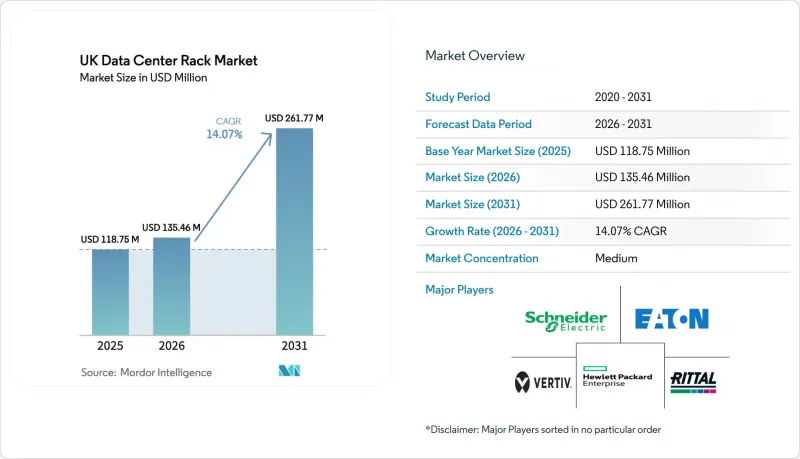
根據 Mordor Intelligence 預測,英國資料中心機櫃市場規模將從 2025 年的 1.1875 億美元成長到 2026 年的 1.3546 億美元,然後在 2031 年達到 2.6177 億美元,2026 年至 2031 年的複合年成長率為 14.07%。
本報告按機架尺寸(四分之一機架、半機架、全機架)、機架高度(42U、45U、48U)、其他高度(52U以上,以及客製化高度)、機架類型(機櫃式開放式機櫃、開放式機架、壁掛式機架)、資料中心類型(託管機房等)和材料(鋼材等)和材質(鋼材等)細分。所有細分市場的規模和預測均以美元(USD)計價。
英國資料中心機櫃市場的趨勢與洞察
快速採用主權雲和混合雲區域
隨著企業努力滿足本地資料儲存要求,主權雲端計畫正在重塑機架部署模式。在人工智慧成長領域,簡化的核准流程正在加速配備增強型鎖定機制的機櫃安裝,以滿足金融業的審計追蹤要求。混合架構也有助於降低持續雲端市場研究中強調的供應商鎖定風險,並推動對整合佈線和配電單元、支援多重雲端遷移的機架的需求。金融機構透過指定符合開放銀行監管規定的英國本土託管機架,進一步加快了部署速度。
提高超大規模和託管環境中 AI/ML 機架的密度
隨著人工智慧訓練叢集的功率輸出超過 90 kW,營運商被迫採用 48U 和客製化高度的機架,以容納浸沒式冷卻盤、後門式熱交換器和高容量匯流排。像 Telehouse 的液冷實驗室這樣的夥伴關係,體現了機架、冷卻和監控領域的融合,為能夠提供預設計液冷機櫃的供應商創造了新的機會。超大規模資料中心業者正在採用更高的機架,以最佳化每平方公尺的運算能力,這推動了英國資料中心機櫃市場的大量需求。
電網接入等候名單(延遲24個月或更久)
在倫敦地區,總合400吉瓦的積壓計畫意味著開發商必須等待兩年多才能併網發電。許多開發商正將資金轉移到曼徹斯特和卡迪夫,而其他開發商則在探索現場燃氣渦輪機、電池儲能系統或小型模組化核子反應爐。人工智慧能源委員會的成立凸顯了情勢的迫切性,但冗長的核准流程仍阻礙短期機組部署。
細分市場分析
預計到2025年,全尺寸機架將佔英國資料中心機櫃市場的71.58%。這反映了市場對標準化600毫米 x 1200毫米尺寸機架的偏好,這種尺寸有利於氣流流通和線纜管理。隨著超大規模資料中心業者和託管服務供應商追求規模經濟,預計該細分市場將以15.86%的複合年成長率成長。四分之一尺寸機架預計仍將用於邊緣擴展艙,但在英國整體資料中心機櫃市場的銷售量仍不高。
全機架配置日益普及,人工智慧運算叢集數量的成長進一步推動了這一趨勢。這是因為叢集GPU托架佔據了連續的垂直和水平空間,降低了部分機架的供電和冷卻迴路效率。因此,供應商正將研發重點放在增強機架剛性、減震以及整合式冷卻液歧管上,這些歧管與整個機架的冷板網格相連。這些特性在設計全高機殼時更容易整合。
儘管42U機架仍佔據英國資料中心機櫃市場55.82%的佔有率,但隨著48U系統以每年14.92%的速度成長,其主導地位正逐漸減弱。更高的機架可提供額外的6U空間,操作員通常將其用於機架內UPS抽屜、機架頂部交換器或流體循環迴路的歧管接頭。機櫃高度的增加也需要考慮重心問題,因此供應商紛紛從低碳鋼框架轉向更輕的鋁製框架,這些鋁製框架無需額外的地面錨固即可滿足抗震標準。
由於像 NVIDIA DGX SuperPOD 這樣的 GPU叢集每個伺服器執行緒佔用多個框架單位,因此向 48U 和客製化 52U 配置的轉變正在加速,這使得營運商能夠最大限度地提高每千瓦的節點數量。因此,位於倫敦碼頭區的傳統 42U 機房正在進行維修,並加裝後門式熱交換器,以便在電網升級完成之前釋放額外的容量。
其他好處:
- Excel格式的市場預測(ME)表
- 3個月的分析師支持
目錄
第1章:引言
- 研究假設和市場定義
- 調查範圍
第2章:調查方法
第3章執行摘要
第4章 市場狀況
- 市場概覽
- 市場促進因素
- 主權雲和混合雲端區域的快速擴散
- 提高超大規模和託管資料中心中 AI/ML 機架的密度
- 5G邊緣基礎設施的快速發展需要微型機架
- 政府強制推行碳中和政策,推動了液冷機架的普及。
- 金融科技和開放銀行交易的激增
- 英國上市房地產投資信託基金(REITs)模組化資料大廳的維修
- 市場限制因素
- 電網連接候機名單(延遲24個月)
- 三級/四級安裝人員短缺
- 對於老舊設施而言,機架內超過 70 kW 的熱量集中是一個挑戰。
- 高密度大廳保險費上漲
- 供應鏈分析
- 監管情況(就 NIS 2、Ofgem 和 DSIT 徵求意見)
- 技術趨勢(水冷、匯流排式直流電源)
- 波特五力分析
- 市場宏觀經濟趨勢的評估
第5章 市場規模與成長預測
- 按機架尺寸
- 四分之一架
- 半架
- 全機架
- 貨架高度
- 42U
- 45U
- 48U
- 其他高度(52U 以上,以及客製訂單)
- 按機架類型
- 櫃式(密封型)機架
- 開放式機架
- 壁掛式機架
- 依資料中心類型
- 託管設施
- 超大規模和雲端服務供應商的資料中心
- 企業和邊緣運算
- 材料
- 鋼
- 鋁
- 其他合金和複合材料
第6章 競爭情勢
- 市場集中度
- 策略性舉措(併購、設施運作、綠色電力購電協議)
- 市佔率分析
- 公司簡介
- Schneider Electric SE
- Vertiv Group Corp.
- Eaton Corporation plc
- Rittal GmbH and Co. KG
- Hewlett Packard Enterprise Co.
- Black Box(BB Technologies Inc.)
- Cannon Technologies Ltd
- Dataracks(Stagwood Industries Ltd)
- Rainford Solutions Ltd
- Orion Rack Cabinets Ltd
- Chatsworth Products Inc.
- Legrand Data Center Solutions
- Subzero Engineering(PDU Cabling)
- Panduit Corp.
- Dell Technologies Inc.
- IBM Corp.(iDataPlex Racks)
- Huawei Technologies Co., Ltd.
- Cisco Systems Inc.
- Tripp Lite by Eaton
- Great Lakes Case and Cabinet
第7章 市場機會與未來展望
According to Mordor Intelligence, the United Kingdom data center rack market size is expected to grow from USD 118.75 million in 2025 to USD 135.46 million in 2026 and is forecast to reach USD 261.77 million by 2031 at 14.07% CAGR over 2026-2031.
This report is Segmented by Rack Size (Quarter Rack, Half Rack, Full Rack), by Rack Height (42U, 45U, 48U), Other Heights (>=52U and Custom), Rack Type (Cabinet (Closed) Racks, Open-Frame Racks, Wall-Mount Rack), Data Center Type (Colocation Facilities and More), Material (Steel and More). The Market Sizes and Forecasts are Provided in Terms of Value (USD) for all the Segments.
UK Data Center Rack Market Trends and Insights
Rapid Adoption of Sovereign and Hybrid Cloud Zones
The sovereign-cloud agenda is redrawing rack-deployment patterns as enterprises seek local data-residency compliance. AI Growth Zones streamline approvals, enabling faster cabinet installations with enhanced locking mechanisms that meet financial-sector audit trails. Hybrid architectures also mitigate vendor lock-in risk highlighted by the ongoing cloud-market investigation, spurring demand for racks with integrated cabling and power-distribution units that support multi-cloud switching. Financial institutions further accelerate deployments by specifying British-hosted racks that satisfy open-banking regulations.
AI/ML Rack-Density Upgrades Across Hyperscale and Colocation
AI training clusters are pushing per-rack loads above 90 kW, forcing operators to adopt 48U and custom heights to accommodate immersion trays, rear-door heat exchangers, and high-capacity busbars. Partnerships such as Telehouse's liquid-cooling laboratory illustrate the convergence of rack, cooling, and monitoring domains, opening opportunities for suppliers able to offer pre-engineered, liquid-ready cabinets. Hyperscalers standardize on taller frames to optimize compute-per-square-meter, strengthening volume demand for the United Kingdom data center rack market.
Power-Grid Connection Queues (>= 24-Month Delays)
Backlogs totaling 400 GW in the London region force developers to wait two years or more for grid hookups. Many operators redirect capital to Manchester or Cardiff, while others install on-site gas turbines, battery storage, or explore small modular reactors. The AI Energy Council's formation underscores official urgency; however, long approval cycles still curb near-term rack deployments.
Other drivers and restraints analyzed in the detailed report include:
- Accelerated 5G Edge Build-Outs Needing Micro-Racks
- Government Carbon-Neutral Mandates Driving Liquid-Cool Ready Racks
- Tight Labour Pool for Tier 3/Tier 4 Installers
For complete list of drivers and restraints, kindly check the Table Of Contents.
Segment Analysis
Full racks held 71.58% of the United Kingdom data center rack market share in 2025, reflecting the preference for standardized 600 mm X 1,200 mm footprints that streamline airflow and cable management. The segment is projected to expand at 15.86% CAGR as hyperscalers and colocation landlords chase economies of scale. Quarter racks will persist in edge pods, but volume remains modest in the overall United Kingdom data center rack market.
Rising AI compute clusters further cement full-rack popularity because clustered GPU trays consume contiguous vertical and horizontal space, making partial frames inefficient for power and cooling loops. Therefore, suppliers concentrate R&D on strengthening frame rigidity, vibration isolation, and built-in coolant manifolds that serve rack-wide cold-plate grids-features easier to integrate when designing full-height enclosures.
The 42U format still accounts for 55.82% of the United Kingdom data center rack market size, but its dominance is eroding as 48U systems grow 14.92% per year. Taller frames provide an extra 6U that operators allocate to in-rack UPS drawers, top-of-rack switches, or manifold headers for liquid loops. Taller enclosures also raise center-of-gravity considerations, prompting vendors to switch from mild steel to lighter aluminum frames that meet seismic standards without adding floor anchoring.
GPU clusters like NVIDIA DGX SuperPOD occupy multiple rack units per server sled, accelerating the shift to 48U and custom 52U configurations so operators can maximize nodes per kilowatt. Legacy 42U sites in London's Docklands are therefore retrofitting with rear-door heat exchangers to squeeze incremental capacity until grid upgrades arrive
Complete Report Scope:
- By Rack Size
- Quarter Rack
- Half Rack
- Full Rack
- By Rack Height
- 42U
- 45U
- 48U
- Other Heights (?52U and Custom)
- By Rack Type
- Cabinet (Closed) Racks
- Open-Frame Racks
- Wall-Mount Racks
- By Data Center Type
- Colocation Facilities
- Hyperscale and Cloud Service Provider DCs
- Enterprise and Edge
- By Material
- Steel
- Aluminum
- Other Alloys and Composites
List of Companies Covered in this Report:
- Schneider Electric SE
- Vertiv Group Corp.
- Eaton Corporation plc
- Rittal GmbH and Co. KG
- Hewlett Packard Enterprise Co.
- Black Box (BB Technologies Inc.)
- Cannon Technologies Ltd
- Dataracks (Stagwood Industries Ltd)
- Rainford Solutions Ltd
- Orion Rack Cabinets Ltd
- Chatsworth Products Inc.
- Legrand Data Center Solutions
- Subzero Engineering (PDU Cabling)
- Panduit Corp.
- Dell Technologies Inc.
- IBM Corp. (iDataPlex Racks)
- Huawei Technologies Co., Ltd.
- Cisco Systems Inc.
- Tripp Lite by Eaton
- Great Lakes Case and Cabinet
Additional Benefits:
- The market estimate (ME) sheet in Excel format
- 3 months of analyst support
TABLE OF CONTENTS
1 INTRODUCTION
- 1.1 Study Assumptions and Market Definition
- 1.2 Scope of the Study
2 RESEARCH METHODOLOGY
3 EXECUTIVE SUMMARY
4 MARKET LANDSCAPE
- 4.1 Market Overview
- 4.2 Market Drivers
- 4.2.1 Rapid adoption of sovereign and hybrid cloud zones
- 4.2.2 AI/ML rack-density upgrades across hyperscale and colocation
- 4.2.3 Accelerated 5G edge build-outs needing micro-racks
- 4.2.4 Government carbon-neutral mandates driving liquid-cool ready racks
- 4.2.5 Surge in fintech and Open-Banking transactions
- 4.2.6 Modular data-hall retrofits in listed U.K. real-estate trusts
- 4.3 Market Restraints
- 4.3.1 Power-grid connection queues (24-month delays)
- 4.3.2 Tight labour pool for Tier 3/Tier 4 installers
- 4.3.3 In-rack thermal hotspots above 70 kW challenging legacy sites
- 4.3.4 Rising insurance premiums on high-density halls
- 4.4 Supply-Chain Analysis
- 4.5 Regulatory Landscape (NIS 2, Ofgem, DSIT consultation)
- 4.6 Technological Outlook (liquid cooling, busbar DC power)
- 4.7 Porters Five Forces Analysis
- 4.7.1 Bargaining Power of Buyers
- 4.7.2 Bargaining Power of Suppliers
- 4.7.3 Threat of New Entrants
- 4.7.4 Threat of Substitutes
- 4.7.5 Intensity of Competitive Rivalry
- 4.8 Assessment of Macro Economic Trends on the Market
5 MARKET SIZE AND GROWTH FORECASTS (VALUE)
- 5.1 By Rack Size
- 5.1.1 Quarter Rack
- 5.1.2 Half Rack
- 5.1.3 Full Rack
- 5.2 By Rack Height
- 5.2.1 42U
- 5.2.2 45U
- 5.2.3 48U
- 5.2.4 Other Heights (?52U and Custom)
- 5.3 By Rack Type
- 5.3.1 Cabinet (Closed) Racks
- 5.3.2 Open-Frame Racks
- 5.3.3 Wall-Mount Racks
- 5.4 By Data Center Type
- 5.4.1 Colocation Facilities
- 5.4.2 Hyperscale and Cloud Service Provider DCs
- 5.4.3 Enterprise and Edge
- 5.5 By Material
- 5.5.1 Steel
- 5.5.2 Aluminum
- 5.5.3 Other Alloys and Composites
6 COMPETITIVE LANDSCAPE
- 6.1 Market Concentration
- 6.2 Strategic Moves (MandA, facility launches, green-power PPAs)
- 6.3 Market Share Analysis
- 6.4 Company Profiles (includes Global level Overview, Market level overview, Core Segments, Financials as available, Strategic Information, Market Rank/Share, Products and Services, Recent Developments)
- 6.4.1 Schneider Electric SE
- 6.4.2 Vertiv Group Corp.
- 6.4.3 Eaton Corporation plc
- 6.4.4 Rittal GmbH and Co. KG
- 6.4.5 Hewlett Packard Enterprise Co.
- 6.4.6 Black Box (BB Technologies Inc.)
- 6.4.7 Cannon Technologies Ltd
- 6.4.8 Dataracks (Stagwood Industries Ltd)
- 6.4.9 Rainford Solutions Ltd
- 6.4.10 Orion Rack Cabinets Ltd
- 6.4.11 Chatsworth Products Inc.
- 6.4.12 Legrand Data Center Solutions
- 6.4.13 Subzero Engineering (PDU Cabling)
- 6.4.14 Panduit Corp.
- 6.4.15 Dell Technologies Inc.
- 6.4.16 IBM Corp. (iDataPlex Racks)
- 6.4.17 Huawei Technologies Co., Ltd.
- 6.4.18 Cisco Systems Inc.
- 6.4.19 Tripp Lite by Eaton
- 6.4.20 Great Lakes Case and Cabinet
7 MARKET OPPORTUNITIES and FUTURE OUTLOOK
- 7.1 White-space and Unmet-Need Assessment (edge colocation pods, SMR-powered campuses)

 OCP機架市場規模、佔有率和趨勢分析報告:按組件、機架類型、冷卻技術、最終用途和細分市場預測(2026-2033年)
 中東資料中心機櫃:市場佔有率分析、產業趨勢與統計及成長預測(2026-2031)印度資料中心機櫃:市場佔有率分析、產業趨勢與統計及成長預測(2026-2032 年)德國資料中心機櫃:市場佔有率分析、產業趨勢與統計及成長預測(2026-2031 年)歐洲資料中心機櫃:市場佔有率分析、產業趨勢與統計及成長預測(2026-2031 年)法國資料中心機櫃:市場佔有率分析、產業趨勢與統計及成長預測(2026-2031 年)西班牙資料中心機櫃:市場佔有率分析、產業趨勢與統計及成長預測(2026-2031 年)馬來西亞資料中心機櫃:市場佔有率分析、產業趨勢與統計及成長預測(2026-2031)資料中心機櫃電源分配單元(PDU):市場佔有率分析、行業趨勢和統計數據以及成長預測(2026-2031 年)
 資料中心機架市場-2026-2032年全球市場預測