


 |
市場調查報告書
商品編碼
2119704
印度資料中心機櫃:市場佔有率分析、產業趨勢與統計及成長預測(2026-2032 年)India Data Center Rack - Market Share Analysis, Industry Trends & Statistics, Growth Forecasts (2026 - 2032) |
||||||

※ 本網頁內容可能與最新版本有所差異。詳細情況請與我們聯繫。
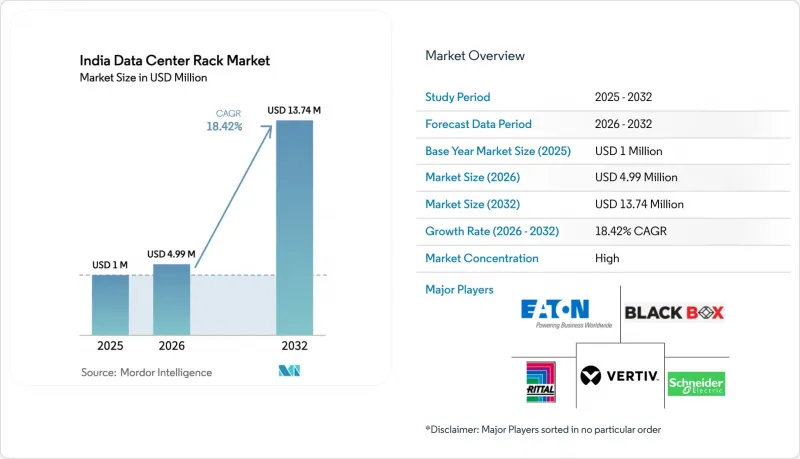
據 Mordor Intelligence 稱,印度資料中心機架市場預計在 2025 年價值 421 萬美元,從 2026 年的 499 萬美元成長到 2032 年的 1374 萬美元,在預測期(2026-2032 年)內複合年成長率為 18.42%。
本報告按機架尺寸(四分之一機架 9U-22U、全機架 42U-52U 等)、機架類型(開放式機櫃、隔音機架等)、冷卻方式(風冷機架、液冷機架等)、終端用戶行業(IT 和電信、銀行、金融服務和保險機房等)以及資料中心類型(託管機房等)進行分類中心類型(IT 和電信、銀行、金融服務和保險機房等)。市場預測以百萬美元為以金額為準。
印度資料中心機櫃市場的趨勢與洞察
資料中心設施部署的擴展
印度資料中心建設熱潮的推動力主要來自谷歌在維沙卡帕特南投資60億美元的項目以及信實集團計劃在古吉拉突邦建設的3吉瓦人工智慧園區。中央和邦政府的獎勵,例如馬哈拉斯特拉邦投資200億美元的“綠色綜合資料中心園區”,將土地、電力和一站式授權流程打包提供。新的可再生能源採購指南鼓勵開發商從設計階段就納入太陽能和風能抵消方案。因此,可容納15-100千瓦負載的標準42U至52U機架正逐漸成為預設配置。國內機架製造商受益於其靠近位置的優勢,能夠根據特定場地的抗震和熱工設計要求客製化機架。
加大對雲端運算和超大規模運算的投資
AWS累計到 2030 年營收將達到 127 億美元,並正在擴展其人工智慧賦能區域。同時,微軟、Oracle和 Equinix 也持續擴大其 50-100 兆瓦規模的園區。諸如生成式人工智慧之類的工作負載正將機架密度推高至 100 千瓦,使得液冷成為必需品。超大規模資料中心業者傾向於採用統一的機架機殼,以簡化其跨區域資料中心的物流。為此,供應商正在將快速連接歧管和後門熱交換器作為出廠選項。僅三家超大規模資料中心業者的採購量就已超過排名前 50 的公司的總合,凸顯了它們對行業標準的巨大影響力。
廉價貨架和假貨架的流通
對價格敏感的買家可能會選擇由薄鋼板製成的未經認證的外殼,這會增加火災和負載失效的風險。由於鋼材價格在每噸 63,500 至 68,500 印度盧比之間波動,降低材料規格的誘惑力越來越大,損害了可靠性。不合格的產品不太可能承受超大規模環境中常見的 1,200 公斤靜態負載。雖然海關當局現在要求提供 BIS 可追溯性代碼以遏制仿冒品的進口,但二級市場仍存在監管漏洞。
細分市場分析
預計到2025年,全尺寸機架將佔出貨量的68.75%,凸顯了超大規模資料中心業者對更高更深機架的偏好,以最佳化占地面積利用率。印度資料中心的全尺寸機架市場預計將以17.98%的複合年成長率成長,這反映了新建的100兆瓦資料中心園區普遍採用統一的部署範本。半尺寸機架雖然尺寸較小,但在邊緣站點正迅速發展,隨著營運商在空間和電力限制之間尋求平衡,到2032年,其在印度資料中心機櫃市場的佔有率可能達到兩位數。四分之一尺寸機架仍然是一個小眾市場,主要用於電信設備機房和零售後勤部門等受重量限制的場所,這些場所的設備安裝量受到限制。
第二代全機架採用拉絲橡膠墊圈、穿孔門和相容建築管理系統 (BMS) 的感測器陣列,無需進行大規模維修即可調節氣流。半機架設計標配滑出式隔板,可擴展 U 空間,方便未來升級,同時維持較低的初始投資。
封閉式機櫃佔總銷售額的72.35%,主要得益於多租戶場所對可上鎖、防塵隔間的需求。隨著銀行、金融和保險(BFSI)以及政府機構的工作負載轉移到託管資料中心,印度資料中心封閉式機架市場預計將穩定成長。開放式機架廣泛應用於專用超大規模資料中心,這些資料中心憑藉周界安全和結構化氣流設計,無需安裝機櫃門。隔音機架的複合年成長率高達20.01%,正部署在醫院資料室和都市區微邊緣資料中心,這些場所的噪音水平必須控制在60分貝以內。壁掛式機架雖然市佔率較小,但在5G基頻單元和分公司路由器領域仍扮演重要角色。
製造商正在採用複合板和高密度隔音乙烯基材料來製造隔音機架,同時又不增加機架的整體面積。符合 ISO 3744 噪音排放標準正逐漸成為醫療相關競標的強制性要求,這也推動了這些材料的應用。
其他好處:
- Excel格式的市場預測(ME)表
- 3個月的分析師支持
目錄
第1章:引言
- 研究假設和市場定義
- 調查範圍
第2章:調查方法
第3章執行摘要
第4章 市場狀況
- 市場概覽
- 市場促進因素
- 資料中心設施部署的擴展
- 加大對雲端運算和超大規模運算的投資
- 政府主導的數位化舉措(例如「數位印度」)
- 對託管和託管服務的需求不斷成長
- 邊緣運算在二、三線城市的擴展。
- 高密度人工智慧/機器學習機架的標準化
- 市場限制因素
- 廉價貨架和仿冒品的流通
- 較大的初始資本支出(CAPEX)和合規成本
- CRCA鋼材供應鏈的高度波動性
- 土地徵用及電力供應延誤
- 價值供應鏈分析
- 監理情勢
- 技術展望
- 波特五力分析
第5章 市場規模與成長預測
- 按機架尺寸
- 四分之一機架(9U 至 22U)
- 半機架(23U-27U)
- 整機架(42U 至 52U)
- 按機架類型
- 開放式機架
- 密封伺服器機櫃
- 壁掛式機架
- 隔音/聲學機架
- 散熱相容性
- 風冷機架
- 水冷機架
- 混合冷卻相容機架
- 按最終用戶行業分類
- 資訊科技/通訊
- BFSI
- 政府/公共部門
- 媒體與娛樂
- 醫療保健和生命科學
- 製造業
- 其他最終用戶
- 依資料中心類型
- 託管設施
- 超大規模/公司自建設施
- 其他(企業版、邊緣版等)
第6章 競爭情勢
- 市佔率分析
- 公司簡介
- Schneider Electric SE
- Vertiv Group Corp.
- Eaton Corporation plc
- Rittal GmbH & Co. KG
- Legrand SA
- nVent Electric plc
- Dell Technologies Inc.
- Hewlett Packard Enterprise Co.
- Fujitsu Limited
- Cisco Systems, Inc.
- IBM Corporation
- Huawei Technologies Co., Ltd.
- Lenovo Group Limited
- Super Micro Computer, Inc.
- Panduit Corporation
- Chatsworth Products, Inc.
- CommScope Holding Company, Inc.
- Tripp Lite(an Eaton brand)
- NetRack Enclosures Pvt Ltd
- Black Box Corporation
- Valrack Modular Systems Pvt Ltd
第7章 投資分析
第8章 市場機會與未來展望
According to Mordor Intelligence, the India data center rack market size was valued at USD 4.21 million in 2025 and estimated to grow from USD 4.99 million in 2026 to reach USD 13.74 million by 2032, at a CAGR of 18.42% during the forecast period (2026-2032).
This report is Segmented by Rack Size (Quarter Rack 9U-22U, Full Rack 42U-52U, and More), Rack Type (Open-Frame Racks, Soundproof Racks, and More), Cooling Compatibility (Air-Cooled Racks, Liquid-Cooled Racks, and More), End-User Industry (IT and Telecommunication, BFSI, and More), Data Center Type(Colocation Facilities and More). The Market Forecasts are Provided in Terms of Value (USD Million).
India Data Center Rack Market Trends and Insights
Increasing Deployment of Data Center Facilities
India's build-out wave is anchored by Google's USD 6 billion Visakhapatnam project and Reliance's planned 3 GW AI campus in Gujarat. Central and state incentives, such as Maharashtra's USD 20 billion Green Integrated Data Centre Parks, are bundling land, power, and single-window clearances. New guidelines on renewable procurement are prompting developers to embed solar and wind offsets at the design stage. Standard 42U-52U racks that support 15-100 kW loads are therefore becoming the default spec. Domestic rack makers benefit because proximity allows custom fabrication to meet site-specific seismic and thermal codes.
Growing Cloud Computing and Hyperscale Investments
AWS has earmarked USD 12.7 billion through 2030 to roll out AI-ready zones, while Microsoft, Oracle, and Equinix continue to scale 50-100 MW campuses. Workloads such as generative AI are pushing rack densities to 100 kW, making liquid-cooling readiness mandatory. Hyperscalers prefer uniform rack enclosures that streamline logistics across multi-region footprints. In response, suppliers are integrating quick-connect manifolds and rear-door heat exchangers as factory options. Procurement volumes from just three hyperscale buyers already exceed combined demand from the top fifty enterprises, underscoring their outsized influence on standards.
Availability of Cheap and Counterfeit Racks
Price-sensitive buyers sometimes select non-certified enclosures fabricated from thin-gauge steel, heightening fire risk and load failure. Steel cost swings between INR 63 500-68 500 per tonne intensify the temptation to down-spec materials, undermining reliability. Substandard units rarely support the 1 200-kg static loads common in hyperscale deployments. To curb counterfeit imports, customs authorities now mandate BIS traceability codes, but enforcement gaps persist in secondary markets.
Other drivers and restraints analyzed in the detailed report include:
- Government-Led Digital Initiatives
- Rising Demand for Colocation and Managed Hosting Services
- High Upfront CAPEX and Compliance Costs
For complete list of drivers and restraints, kindly check the Table Of Contents.
Segment Analysis
Full racks claiming 68.75% of 2025 shipments underscore how hyperscalers favor tall, deep frames that optimize floor utilization. The India data center rack market size for full racks is poised to expand at 17.98% CAGR, reflecting uniform deployment templates across new 100 MW campuses. Half racks, though a smaller base, are gaining momentum in edge sites, and their India data center rack market share could reach double digits by 2032 as operators balance space and power constraints. Quarter racks remain niche, serving telecom shelters and retail back-offices where weight limits cap equipment loads.
Second-generation full racks incorporate brush grommets, perforated doors, and BMS-ready sensor arrays, enabling airflow tuning without major retrofits. Half-rack designs now ship with slide-out sections that accept additional U-spaces, protecting initial capex while allowing future scaling.
Enclosed cabinets captured 72.35% sales because multi-tenant sites require lockable, dust-resistant compartments. The India data center rack market size for enclosed models will rise steadily as BFSI and government workloads move into colocation halls. Open-frame racks thrive in captive hyperscale halls, where perimeter security and structured airflow make doors redundant. Soundproof racks, advancing at a 20.01% CAGR, are entering hospital data rooms and urban micro-edge pods that need to stay within 60 dB noise limits. Wall-mount units hold a minor slice, yet remain relevant for 5G base-band units and branch-office routers.
Manufacturers are embedding composite panels and mass-loaded vinyl in acoustic racks without expanding overall footprint. Compliance with ISO 3744 noise-emission standards is becoming a bid requirement in healthcare tenders, bolstering adoption.
Complete Report Scope:
- By Rack Size
- Quarter Rack (9U-22U)
- Half Rack (23U-27U)
- Full Rack (42U-52U)
- By Rack Type
- Open-Frame Racks
- Enclosed Server Cabinets
- Wall-Mount Racks
- Soundproof / Acoustic Racks
- By Cooling Compatibility
- Air-Cooled Racks
- Liquid-Cooled Racks
- Hybrid Cooling-Ready Racks
- By End User Industry
- IT and Telecommunication
- BFSI
- Government and Public Sector
- Media and Entertainment
- Healthcare and Life Sciences
- Manufacturing
- Other End Users
- By Data Center Type
- Colocation Facilities
- Hyperscale/ Self-built Facilities
- Others (Enterprise, Edge among others)
List of Companies Covered in this Report:
- Schneider Electric SE
- Vertiv Group Corp.
- Eaton Corporation plc
- Rittal GmbH & Co. KG
- Legrand SA
- nVent Electric plc
- Dell Technologies Inc.
- Hewlett Packard Enterprise Co.
- Fujitsu Limited
- Cisco Systems, Inc.
- IBM Corporation
- Huawei Technologies Co., Ltd.
- Lenovo Group Limited
- Super Micro Computer, Inc.
- Panduit Corporation
- Chatsworth Products, Inc.
- CommScope Holding Company, Inc.
- Tripp Lite (an Eaton brand)
- NetRack Enclosures Pvt Ltd
- Black Box Corporation
- Valrack Modular Systems Pvt Ltd
Additional Benefits:
- The market estimate (ME) sheet in Excel format
- 3 months of analyst support
TABLE OF CONTENTS
1 INTRODUCTION
- 1.1 Study Assumptions and Market Definition
- 1.2 Scope of the Study
2 RESEARCH METHODOLOGY
3 EXECUTIVE SUMMARY
4 MARKET LANDSCAPE
- 4.1 Market Overview
- 4.2 Market Drivers
- 4.2.1 Increasing deployment of data-center facilities
- 4.2.2 Growing cloud-computing and hyperscale investments
- 4.2.3 Government-led digital initiatives (e.g., Digital India)
- 4.2.4 Rising demand for colocation and managed hosting services
- 4.2.5 Edge-computing expansion in Tier-2 and Tier-3 cities
- 4.2.6 Standardization for high-density AI/ML racks
- 4.3 Market Restraints
- 4.3.1 Availability of cheap and counterfeit racks
- 4.3.2 High upfront CAPEX and compliance costs
- 4.3.3 Volatile CRCA steel supply chain
- 4.3.4 Land acquisition and power-provisioning delays
- 4.4 Value / Supply-Chain Analysis
- 4.5 Regulatory Landscape
- 4.6 Technological Outlook
- 4.7 Porter's Five Forces Analysis
- 4.7.1 Bargaining Power of Buyers/Consumers
- 4.7.2 Bargaining Power of Suppliers
- 4.7.3 Threat of New Entrants
- 4.7.4 Threat of Substitute Products
- 4.7.5 Intensity of Competitive Rivalry
5 MARKET SIZE AND GROWTH FORECASTS
- 5.1 By Rack Size
- 5.1.1 Quarter Rack (9U-22U)
- 5.1.2 Half Rack (23U-27U)
- 5.1.3 Full Rack (42U-52U)
- 5.2 By Rack Type
- 5.2.1 Open-Frame Racks
- 5.2.2 Enclosed Server Cabinets
- 5.2.3 Wall-Mount Racks
- 5.2.4 Soundproof / Acoustic Racks
- 5.3 By Cooling Compatibility
- 5.3.1 Air-Cooled Racks
- 5.3.2 Liquid-Cooled Racks
- 5.3.3 Hybrid Cooling-Ready Racks
- 5.4 By End User Industry
- 5.4.1 IT and Telecommunication
- 5.4.2 BFSI
- 5.4.3 Government and Public Sector
- 5.4.4 Media and Entertainment
- 5.4.5 Healthcare and Life Sciences
- 5.4.6 Manufacturing
- 5.4.7 Other End Users
- 5.5 By Data Center Type
- 5.5.1 Colocation Facilities
- 5.5.2 Hyperscale/ Self-built Facilities
- 5.5.3 Others (Enterprise, Edge among others)
6 COMPETITIVE LANDSCAPE
- 6.1 Market Share Analysis
- 6.2 Company Profiles (includes Global level Overview, Market level overview, Core Segments, Financials as available, Strategic Information, Market Rank/Share for key companies, Products and Services, and Recent Developments)
- 6.2.1 Schneider Electric SE
- 6.2.2 Vertiv Group Corp.
- 6.2.3 Eaton Corporation plc
- 6.2.4 Rittal GmbH & Co. KG
- 6.2.5 Legrand SA
- 6.2.6 nVent Electric plc
- 6.2.7 Dell Technologies Inc.
- 6.2.8 Hewlett Packard Enterprise Co.
- 6.2.9 Fujitsu Limited
- 6.2.10 Cisco Systems, Inc.
- 6.2.11 IBM Corporation
- 6.2.12 Huawei Technologies Co., Ltd.
- 6.2.13 Lenovo Group Limited
- 6.2.14 Super Micro Computer, Inc.
- 6.2.15 Panduit Corporation
- 6.2.16 Chatsworth Products, Inc.
- 6.2.17 CommScope Holding Company, Inc.
- 6.2.18 Tripp Lite (an Eaton brand)
- 6.2.19 NetRack Enclosures Pvt Ltd
- 6.2.20 Black Box Corporation
- 6.2.21 Valrack Modular Systems Pvt Ltd
7 INVESTMENT ANALYSIS
8 MARKET OPPORTUNITIES AND FUTURE OUTLOOK

 OCP機架市場規模、佔有率和趨勢分析報告:按組件、機架類型、冷卻技術、最終用途和細分市場預測(2026-2033年)
 中東資料中心機櫃:市場佔有率分析、產業趨勢與統計及成長預測(2026-2031)德國資料中心機櫃:市場佔有率分析、產業趨勢與統計及成長預測(2026-2031 年)歐洲資料中心機櫃:市場佔有率分析、產業趨勢與統計及成長預測(2026-2031 年)法國資料中心機櫃:市場佔有率分析、產業趨勢與統計及成長預測(2026-2031 年)英國資料中心機櫃:市場佔有率分析、產業趨勢與統計及成長預測(2026-2031 年)西班牙資料中心機櫃:市場佔有率分析、產業趨勢與統計及成長預測(2026-2031 年)馬來西亞資料中心機櫃:市場佔有率分析、產業趨勢與統計及成長預測(2026-2031)資料中心機櫃電源分配單元(PDU):市場佔有率分析、行業趨勢和統計數據以及成長預測(2026-2031 年)
 資料中心機架市場-2026-2032年全球市場預測