


 |
市場調查報告書
商品編碼
2119724
馬來西亞資料中心機櫃:市場佔有率分析、產業趨勢與統計及成長預測(2026-2031)Malaysia Data Center Rack - Market Share Analysis, Industry Trends & Statistics, Growth Forecasts (2026 - 2031) |
||||||

※ 本網頁內容可能與最新版本有所差異。詳細情況請與我們聯繫。
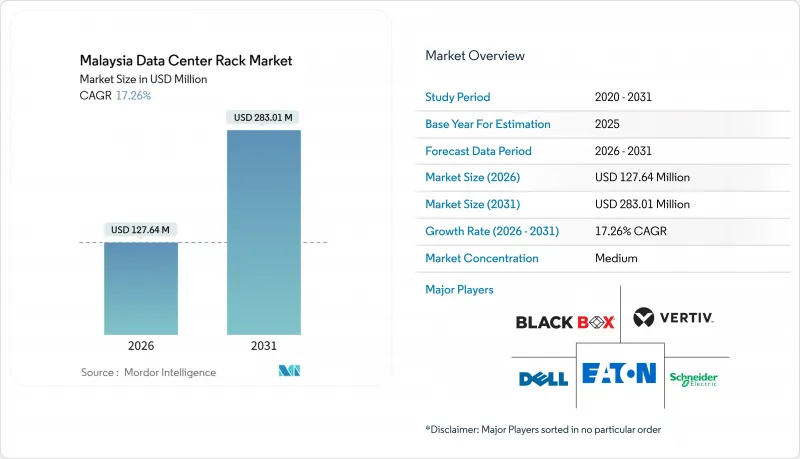
根據 Mordor Intelligence 預測,馬來西亞資料中心機架市場規模預計將在 2026 年達到 1.2764 億美元,到 2031 年達到 2.8301 億美元,複合年成長率為 17.26%。
本報告按機架尺寸(四分之一機架、半機架、全機架)、機架類型(封閉式機櫃、開放式機架、壁掛式機架和微邊緣機架)、存儲等級(一級和二級、三級和四級)、資料中心規模(小規模、中型、大型和超大規模)以及資料中心類型(託管、超大規模資料中心業者/雲端服務提供商、細分企業和邊緣計算)進行細分企業級和邊緣計算)。市場預測以美元計價。
馬來西亞資料中心機架市場的趨勢與洞察
增加對雲端運算和超大規模技術的投資
在馬來西亞,亞馬遜網路服務(AWS)、Google雲端、微軟和甲骨文已宣布投資超過160億美元用於雲端運算和人工智慧相關專案。每家超大規模資料中心業者都制定了可重複使用的機架材料清單,其中整合了Gigabit主幹交換器、液冷歧管和先進的線纜管理功能,這些功能可將安裝工作量減少20%,同時實現超過30千瓦的功率密度。預先協商的大宗訂單縮短了機架供應商的採購週期,但由於超大規模資料中心業者資料中心營運商會將所有子元件與開放原始碼替代方案進行比較,硬體利潤率正受到擠壓。這些合約的龐大規模已將馬來西亞的資料中心機櫃市場推至東南亞領先地位,促使全球銀行的本地子公司將對延遲敏感的工作負載從新加坡遷移到賽城。為此,區域供應鏈正在柔佛州和檳城認證新的鈑金加工商,以降低運輸成本並實現供應商多元化。隨著新的雲端區域的推出,超大規模資料中心業者正將重點轉向基於可再生能源的購電協議 (PPA),這間接增加了對能夠報告即時能耗和碳強度的機架控制器的需求。
人工智慧工作負載激增,需要高密度機架
人工智慧 (AI) 訓練叢集正將機架的功率預算從 10 千瓦推高至 150 千瓦,迫使營運商採用諸如晶片直接冷卻 (DTC) 和後門熱交換器等冷卻技術。 STT GDC 已在賽城部署了 150 千瓦的機架,實現了 1.15 的部分電源使用效率 (PUE)。惠普企業 (Hewlett Packard Enterprise) 提供了無風扇液冷解決方案,與風冷配置相比,可減少 90% 的碳排放。超微 (Supermicro) 的 DLC-2 冷卻液分配單元每個機架可處理 250 千瓦的功率,節能 40%。這些突破性技術的出現迫使機架製造商重新設計其機殼,增加洩漏偵測通道、冗餘快速斷開接頭和歧管安裝導軌。這會使組件成本增加 30% 至 50%,但允許營運商將每平方公尺的運算密度提高三倍。由於 AI 工作負載需要確定性的熱響應,供應商採用了光纖溫度感測器,可提供亞毫秒級的回饋,從而確保圖形處理單元即使在負載快速波動期間也能保持在安全的結溫閾值內。
電網升級的延誤是部署過程中的瓶頸。
馬來西亞國家能源公司(Tenaga Nacional Belhad)預測,到2035年,資料中心電力需求將達到5000兆瓦,但賽城(Cyberjaya)和剪切機 Alam)的變電站升級速度跟不上容量需求。營運商表示,將超過10兆瓦的電力連接到電網需要18至24個月的前置作業時間,迫使分階段建設,並增加了資金籌措成本。目前,一些設施依賴柴油或電池系統,這導致營運成本增加了15%。對於耗電量達150千瓦的AI機架來說,電力短缺問題最為嚴重,因為這些機架需要專用饋線,而傳統的開關設備無法滿足需求。柔佛州受惠於依斯干達經濟特區相關變電站建設的優先地位,這促使超大規模資料中心業者將建造重心南移,從而導致未來機架出貨量集中在該地區。
細分市場分析
儘管全機架仍是超大規模資料中心的核心,預計到2025年將佔出貨量的74.32%,但隨著營運商將運算能力擴展到移動邊緣位置,馬來西亞資料中心機櫃市場預計到2031年,半機架單元的複合年成長率將達到18.53%。按機架尺寸分類,隨著塔式微型資料中心支援5G回程傳輸和即時分析,半機架的市場佔有率預計將會成長。 EdgePoint Infrastructure和CelcomDigi的聯合部署證明了模組化半機架的經濟可行性,因為堅固的機櫃能夠承受溫度波動,同時將電力消耗量保持在5千瓦以下。
第二代半機架整合了不斷電系統(UPS)、1.5 千瓦鋰離子電池組和能源採集感測器,減少了現場維護次數,並將總體擁有成本 (TCO) 降低了 25%。雖然四分之一機架的市場佔有率仍然不到 10%,但它們在零售商店和工廠中越來越受歡迎,因為現場推理處理可以加速基於攝影機的品質檢測工作流程。 Supermicro 的 GB200 NVL72 在一個完整的機架中容納了 72 個圖形處理器 (GPU),使運營商能夠重新設計樓層平面圖以容納熱交換器通道,而無需增加整體占地面積。供應商透過提供滑軌套件、電纜鏈導軌和深度可調框架等配件來展開競爭,使半機架能夠容納各種伺服器底盤,而無需現場改造。
預計2025年,封閉式機櫃將佔馬來西亞資料中心機櫃市場總銷量的79.33%,複合年成長率(CAGR)為18.47%。其市場主導地位主要歸功於超大規模資料中心租戶對熱通道封閉、開門率超過80%的門板穿孔設計以及可將寄生冷卻損失降低高達25%的自適應氣流擋板的需求。隨著營運商採用需要密封框架以防止冷凝的液冷歧管,封閉式機櫃在馬來西亞資料中心機櫃市場的佔有率預計將逐步成長。
開放式機架因其易於維護而備受大學和工程實驗室的青睞,佔據約15%的市場佔有率,但無法直接安裝液冷迴路。壁掛式機架的市佔率不足6%,但隨著中小型零售商將POS伺服器部署在防竄改機殼中,其成長率高達16.8%。Schneider Electric的「NetShelter」機架配備免工具理線臂和後門熱交換器,可在熱通道進入前散發80%的機架廢氣。 Vertiv和Rittal目前正在機架中整合振動感測器和熱成像模組,以主動偵測風扇故障,從而將意外停機時間減少30%。這些智慧功能正在將馬來西亞資料中心機櫃市場從單純的通用鋼架市場轉變為支援數據驅動型營運的平台。
其他好處:
- Excel格式的市場預測(ME)表
- 3個月的分析師支持
目錄
第1章:引言
- 研究假設和市場定義
- 調查範圍
第2章:調查方法
第3章執行摘要
第4章 市場狀況
- 市場概覽
- 市場促進因素
- 5G網路的日益普及
- 光纖網路擴充
- 政府資料在地化政策和MSC 3.0的優惠待遇
- 增加對雲端運算和超大規模技術的投資
- 人工智慧工作負載激增,需要高密度機架
- 在農村地區通訊塔周圍擴展邊緣資料中心
- 市場限制因素
- 網路安全威脅和勒索軟體的興起。
- 資料中心熟練人員短缺
- 電網升級的延誤導致部署出現瓶頸。
- 巴生穀走廊地價飆升
- 產業價值鏈分析
- 監理情勢
- 技術展望
- 宏觀經濟因素的影響
- 波特五力分析
第5章 市場規模與成長預測
- 按機架尺寸
- 四分之一架
- 半架
- 全機架
- 按機架類型
- 密封櫃
- 開放式框架
- 壁掛式和微邊框外殼
- 層級特定
- 一級和二級
- 三級
- 第四級
- 按資料中心規模
- 小規模資料中心
- 中型資料中心
- 大型資料中心
- 超大規模資料中心
- 依資料中心類型
- 託管資料中心
- 超大規模資料中心業者資料中心/雲端服務供應商
- 企業和邊緣資料中心
第6章 競爭情勢
- 市場集中度
- 策略趨勢
- 市佔率分析
- 公司簡介
- Eaton Corporation plc
- Black Box Corporation
- Schneider Electric SE
- Vertiv Group Corp.
- Dell Inc.
- Hewlett Packard Enterprise Company
- Rittal GmbH and Co. KG
- GV Industries Sdn. Bhd.
- Wiwynn Corporation
- Cisco Systems Inc.
- Huawei Technologies Co. Ltd.
- Legrand SA
- Panduit Corp.
- Tripp Lite by Eaton
- Great Rack Sdn. Bhd.
- Chatsworth Products Inc.
- CommScope Holding Company Inc.
- Belden Inc.
- Delta Electronics Inc.
第7章 市場機會與未來展望
According to Mordor Intelligence, the Malaysia data center rack market size stands at USD 127.64 million in 2026 and is projected to reach USD 283.01 million by 2031, growing at a 17.26% CAGR.
This report is Segmented by Rack Size (Quarter Rack, Half Rack, and Full Rack), Rack Type (Enclosed Cabinet, Open-Frame, and Wall-Mount and Micro-Edge Enclosure), Tier Type (Tier 1 and 2, Tier 3, and Tier 4), Data Center Size (Small, Medium, Large, and Hyperscale), Data Center Type (Colocation, Hyperscalers/CSPs, and Enterprise and Edge). The Market Forecasts are Provided in Terms of Value (USD).
Malaysia Data Center Rack Market Trends and Insights
Growing Cloud and Hyperscale Investments
Malaysia hosts more than USD 16 billion in announced cloud and AI allocations from Amazon Web Services, Google Cloud, Microsoft, and Oracle. Each hyperscaler specifies repeatable rack bills of materials, integrating 400-gigabit spine switches, liquid-cooling manifolds, and advanced cable management that enable 30-kilowatt-plus densities while reducing installation labor by 20%. Pre-negotiated volume commitments shorten procurement cycles for rack vendors, but they also compress hardware margins because hyperscalers benchmark every sub-assembly against open-source alternatives. The scale of these commitments elevates the Malaysia data center rack market to first-tier status within Southeast Asia, encouraging local subsidiaries of global banks to migrate latency-sensitive workloads from Singapore to Cyberjaya. Regional supply chains respond by qualifying new sheet-metal fabricators in Johor and Penang, thereby lowering freight costs and creating a diversified vendor base. As new cloud regions enter service, hyperscalers are pivoting toward renewable-sourced power purchase agreements, indirectly boosting demand for rack controllers that report real-time energy consumption and carbon intensity.
Surge in AI Workloads Requiring High-Density Racks
Artificial intelligence training clusters shift rack power budgets from 10 kilowatts to 150 kilowatts, forcing operators to adopt direct-to-chip or rear-door heat-exchanger cooling. STT GDC implemented 150 kilowatt racks in Cyberjaya and achieved a partial power usage effectiveness of 1.15. Hewlett Packard Enterprise offers fanless liquid cooling that lowers carbon emissions by 90% relative to air-cooled configurations. Supermicro's DLC-2 coolant distribution unit accommodates 250 kilowatts per rack, delivering 40% energy savings. These breakthroughs compel rack manufacturers to redesign enclosures with leak-detection channels, redundant quick-disconnect couplings, and manifold mounting rails, adding 30% to 50% to the bill of materials but enabling operators to triple compute density per square meter. Because AI workloads require deterministic thermal response, suppliers embed fiber-optic temperature sensors that provide sub-millisecond feedback, ensuring graphics processing units remain within safe junction thresholds during rapid load swings.
Delays in Power-Grid Upgrades Causing Deployment Bottlenecks
Tenaga Nasional Berhad forecasts data-center electricity demand of 5,000 megawatts by 2035, yet substation upgrades in Cyberjaya and Shah Alam lag behind capacity reservations. Operators report 18- to 24-month lead times for new grid connections above 10 megawatts, forcing phased builds and inflating financing costs. Some facilities now rely on diesel or battery systems that raise operating expenses by 15%. The shortfall is most acute for AI-oriented racks pulling 150 kilowatts, which require dedicated feeders that legacy switchgear cannot accommodate. Johor benefits from prioritized substation construction tied to the Iskandar economic zone, motivating hyperscalers to shift builds southward and, in turn, concentrate future rack shipments in that region.
Other drivers and restraints analyzed in the detailed report include:
- Government Data-Localization Policies and MSC 3.0 Incentives
- Rising Dominance of the 5G Network
- Low Availability of Skilled Data-Center Personnel
For complete list of drivers and restraints, kindly check the Table Of Contents.
Segment Analysis
Full racks remain the backbone of hyperscale campuses, accounting for 74.32% of 2025 shipments, but the Malaysia data center rack market sees half-rack units growing at an 18.53% CAGR through 2031 as operators extend compute to mobile-edge locations. Within the Malaysia data center rack market size for rack size segmentation, half racks will command an expanding share as tower-based micro-data centers support 5G backhaul and real-time analytics. EdgePoint Infrastructure's deployments with CelcomDigi validate modular half-rack economics because ruggedized cabinets withstand temperature oscillations while keeping power budgets under 5 kilowatts.
Second-generation half racks integrate uninterruptible power supplies, 1.5 kilowatt lithium-ion battery packs, and energy-harvesting sensors, reducing site visits and shrinking total cost of ownership by 25%. Quarter racks remain below 10% share but are finding use in retail outlets and factory floors where on-premises inference accelerates camera-based quality-inspection workflows. Supermicro's GB200 NVL72 packs 72 graphics processing units in one full rack, prompting operators to redesign floor plans to accommodate heat-exchanger corridors rather than expand gross square footage. Vendors compete by offering accessories such as sliding rail kits, cable-chain escorts, and adjustable depth frames, enabling half racks to accept diverse server chassis without field re-machining.
Enclosed cabinets generated 79.33% of rack-type revenue in 2025 within the Malaysia data center rack market and are forecast to sustain an 18.47% CAGR. They dominate because hyperscale tenants demand hot-aisle containment, door-perforation patterns exceeding 80% open area, and adaptive airflow baffles that curtail parasitic cooling losses by as much as 25%. The Malaysia data center rack market share for enclosed cabinets will edge higher as operators retrofit liquid cooling manifolds that require sealed frames to avoid condensation.
Open-frame racks, favored by universities and engineering labs for accessibility, held about 15% share but cannot accommodate direct-liquid-cooling loops. Wall-mount formats, though under 6% share, grow at 16.8% because small and medium retailers deploy point-of-sale servers in tamper-proof enclosures. Schneider Electric's NetShelter uses tool-less cable-management arms and rear-door heat exchangers that dissipate 80% of rack exhaust before entering the hot aisle. Vertiv and Rittal now embed vibration sensors and thermal imaging modules that flag impending fan failures, decreasing unplanned downtime by 30%. These intelligence layers transform the Malaysia data center rack market from a commodity steel segment into a platform for data-driven operations.
Complete Report Scope:
- By Rack Size
- Quarter Rack
- Half Rack
- Full Rack
- By Rack Type
- Enclosed Cabinet
- Open-Frame
- Wall-Mount and Micro-Edge Enclosure
- By Tier Type
- Tier 1 and 2
- Tier 3
- Tier 4
- By Data Center Size
- Small Data Center
- Medium Data Center
- Large Data Center
- Hyperscale Data Center
- By Data Center Type
- Colocation Data Center
- Hyperscalers Data Center/CSPs
- Enterprise and Edge Data Center
List of Companies Covered in this Report:
- Eaton Corporation plc
- Black Box Corporation
- Schneider Electric SE
- Vertiv Group Corp.
- Dell Inc.
- Hewlett Packard Enterprise Company
- Rittal GmbH and Co. KG
- GV Industries Sdn. Bhd.
- Wiwynn Corporation
- Cisco Systems Inc.
- Huawei Technologies Co. Ltd.
- Legrand SA
- Panduit Corp.
- Tripp Lite by Eaton
- Great Rack Sdn. Bhd.
- Chatsworth Products Inc.
- CommScope Holding Company Inc.
- Belden Inc.
- Delta Electronics Inc.
Additional Benefits:
- The market estimate (ME) sheet in Excel format
- 3 months of analyst support
TABLE OF CONTENTS
1 INTRODUCTION
- 1.1 Study Assumptions and Market Definition
- 1.2 Scope of the Study
2 RESEARCH METHODOLOGY
3 EXECUTIVE SUMMARY
4 MARKET LANDSCAPE
- 4.1 Market Overview
- 4.2 Market Drivers
- 4.2.1 Rising Dominance of the 5G Network
- 4.2.2 Fiber Connectivity Network Expansion
- 4.2.3 Government Data-Localization Policies and MSC 3.0 Incentives
- 4.2.4 Growing Cloud and Hyperscale Investments
- 4.2.5 Surge in AI Workloads Requiring High-Density Racks
- 4.2.6 Expansion of Edge Data Centers Along Rural Telco Towers
- 4.3 Market Restraints
- 4.3.1 Increasing Cybersecurity Threats and Ransomware
- 4.3.2 Low Availability of Skilled Data-Center Personnel
- 4.3.3 Delays in Power-Grid Upgrades Causing Deployment Bottlenecks
- 4.3.4 Escalating Land Prices in the Klang Valley Corridor
- 4.4 Industry Value Chain Analysis
- 4.5 Regulatory Landscape
- 4.6 Technological Outlook
- 4.7 Impact of Macroeconomic Factors
- 4.8 Porter's Five Forces Analysis
- 4.8.1 Threat of New Entrants
- 4.8.2 Bargaining Power of Suppliers
- 4.8.3 Bargaining Power of Buyers
- 4.8.4 Threat of Substitutes
- 4.8.5 Competitive Rivalry
5 MARKET SIZE AND GROWTH FORECASTS (VALUE)
- 5.1 By Rack Size
- 5.1.1 Quarter Rack
- 5.1.2 Half Rack
- 5.1.3 Full Rack
- 5.2 By Rack Type
- 5.2.1 Enclosed Cabinet
- 5.2.2 Open-Frame
- 5.2.3 Wall-Mount and Micro-Edge Enclosure
- 5.3 By Tier Type
- 5.3.1 Tier 1 and 2
- 5.3.2 Tier 3
- 5.3.3 Tier 4
- 5.4 By Data Center Size
- 5.4.1 Small Data Center
- 5.4.2 Medium Data Center
- 5.4.3 Large Data Center
- 5.4.4 Hyperscale Data Center
- 5.5 By Data Center Type
- 5.5.1 Colocation Data Center
- 5.5.2 Hyperscalers Data Center/CSPs
- 5.5.3 Enterprise and Edge Data Center
6 COMPETITIVE LANDSCAPE
- 6.1 Market Concentration
- 6.2 Strategic Moves
- 6.3 Market Share Analysis
- 6.4 Company Profiles (includes Global level Overview, Market level overview, Core Segments, Financials as available, Strategic Information, Market Rank/Share for key companies, Products and Services, and Recent Developments)
- 6.4.1 Eaton Corporation plc
- 6.4.2 Black Box Corporation
- 6.4.3 Schneider Electric SE
- 6.4.4 Vertiv Group Corp.
- 6.4.5 Dell Inc.
- 6.4.6 Hewlett Packard Enterprise Company
- 6.4.7 Rittal GmbH and Co. KG
- 6.4.8 GV Industries Sdn. Bhd.
- 6.4.9 Wiwynn Corporation
- 6.4.10 Cisco Systems Inc.
- 6.4.11 Huawei Technologies Co. Ltd.
- 6.4.12 Legrand SA
- 6.4.13 Panduit Corp.
- 6.4.14 Tripp Lite by Eaton
- 6.4.15 Great Rack Sdn. Bhd.
- 6.4.16 Chatsworth Products Inc.
- 6.4.17 CommScope Holding Company Inc.
- 6.4.18 Belden Inc.
- 6.4.19 Delta Electronics Inc.
7 MARKET OPPORTUNITIES AND FUTURE OUTLOOK
- 7.1 White-Space and Unmet-Need Assessment

 OCP機架市場規模、佔有率和趨勢分析報告:按組件、機架類型、冷卻技術、最終用途和細分市場預測(2026-2033年)
 中東資料中心機櫃:市場佔有率分析、產業趨勢與統計及成長預測(2026-2031)印度資料中心機櫃:市場佔有率分析、產業趨勢與統計及成長預測(2026-2032 年)德國資料中心機櫃:市場佔有率分析、產業趨勢與統計及成長預測(2026-2031 年)歐洲資料中心機櫃:市場佔有率分析、產業趨勢與統計及成長預測(2026-2031 年)法國資料中心機櫃:市場佔有率分析、產業趨勢與統計及成長預測(2026-2031 年)英國資料中心機櫃:市場佔有率分析、產業趨勢與統計及成長預測(2026-2031 年)西班牙資料中心機櫃:市場佔有率分析、產業趨勢與統計及成長預測(2026-2031 年)資料中心機櫃電源分配單元(PDU):市場佔有率分析、行業趨勢和統計數據以及成長預測(2026-2031 年)
 資料中心機架市場-2026-2032年全球市場預測