

 |
市場調查報告書
商品編碼
2119590
雅加達資料中心:市場佔有率分析、產業趨勢與統計資料、成長預測(2026-2032 年)Jakarta Data Center - Market Share Analysis, Industry Trends & Statistics, Growth Forecasts (2026 - 2032) |
||||||

※ 本網頁內容可能與最新版本有所差異。詳細情況請與我們聯繫。
根據 Mordor Intelligence 預測,雅加達資料中心市場規模預計到 2026 年將達到 728.91 兆瓦,高於 2025 年的 658.78 兆瓦,預計到 2032 年將達到 1,336.09 兆瓦,2026 年至 2032 年的複合年成長率為 10.4%。
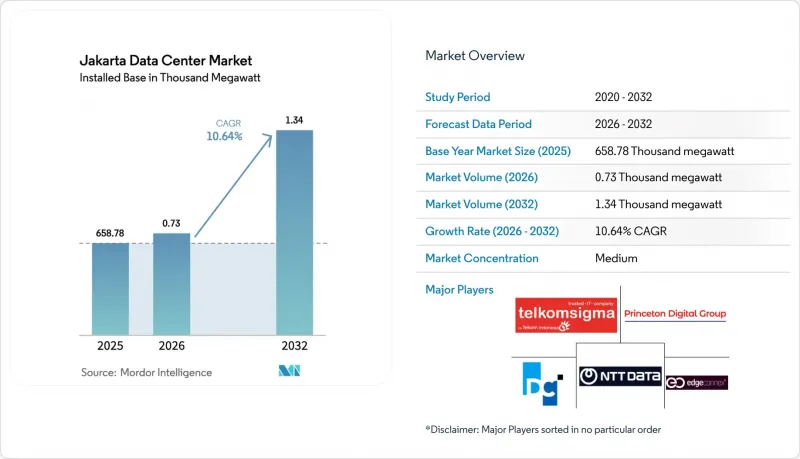
本報告按資料中心規模(小規模、中型、大型、超大型)、等級(Tier I 和 Tier II、Tier III 和 Tier IV)、使用率(未使用率、託管類型和最終用戶行業利用率)以及熱點進行細分。市場預測以容量(兆瓦)為單位。
雅加達資料中心市場趨勢與洞察
行動數據消費的爆炸性成長和5G的部署
印尼的5G網路覆蓋範圍在2024年加速發展,行動數據總流量成長9%,達到1790萬TB。這一激增迫使內容和應用提供者將工作負載部署在更靠近終端用戶的位置,從而導致雅加達資料中心市場對低延遲邊緣節點的需求增加。預計到2025年,與工業4.0相關的物聯網設備將創造1.62兆印尼幣的價值,進一步提升了對分散式處理能力的需求,而集中式資料中心無法有效處理此能力。隨著擴增實境(AR)商務和自動駕駛物流等對延遲敏感的服務日趨成熟,電信業者正優先在人口密集的都市區部署微模組。這些部署能夠改善使用者體驗,減少網路回程傳輸,並支援機架的持續運轉率。這一趨勢也推動了對適用於高密度5G邊緣環境的水冷和晶片級直刻技術的投資。
電子商務和金融科技的蓬勃發展對低延遲託管提出了更高的要求。
雅加達仍然是東南亞最大的電子商務中心,該地區的高流量平台需要高容錯性、低延遲的資料中心。 Tokopedia 在其人工智慧基礎架構上部署向量搜尋後,搜尋效能提升了十倍,凸顯了高效能託管的商業性價值。金融業也紛紛效法。 DOKU 基於阿里雲建構的災害復原配置在確保符合印尼央行監管規定的同時,降低了 20% 的營運成本。隨著線上支付處理速度的提升,即使雅加達資料中心市場整體租金下降,往返延遲低於 2 毫秒的託管服務供應商也能設定更高的價格。金融科技工作負載的高留存率,加上監管的監督,確保了可預測的正常運轉率,從而有效抵禦了需求的周期性波動。
雅加達都會區電費高企,電網擁塞。
印尼國家電力公司 (PLN) 2025 年的收費系統將企業電費定在每印尼幣996.74 至 1,699.53印尼幣之間,儘管託管價格有所下降,但營運成本卻因此上升。煤炭發電佔比高達 67%,使得可再生能源的採購變得困難,而再生能源對於追求淨零排放目標的全球雲端客戶至關重要。電網瓶頸導致專案上線日期延遲,迫使開發商安裝大規模的柴油發電機和現場電池系統,從而導致資本支出 (CAPEX) 增加 5%。高緯環球 (Cushman & Wakefield) 將雅加達列為亞太地區資料中心建設成本第四高的城市,主要原因是電力和人事費用的雙重壓力。這些不利因素正促使未來的資料中心建設轉向勿加泗-芝卡朗走廊,該地區由於高壓輸電線路和工業區規劃,電力連接更為順暢。
細分市場分析
大型資料中心的開發正在改變雅加達資料中心市場的經濟格局。儘管大型資料中心在2025年仍將佔據41.35%的最大市場佔有率,但巨型園區正以20.35%的複合年成長率快速擴張。這一成長速度反映了雲端服務供應商對20兆瓦連續容量、標準化閒置頻段以及降低每兆瓦營運成本(OPEX)的規模經濟需求。隨著人工智慧工作負載傾向高密度設計,受大型資料中心開發推動,雅加達資料中心市場規模預計將在2026年至2032年間成長一倍以上。
自動化、整合液冷以及現場變電站的建造將使大型站點的PUE值保持在1.35以下。雖然大型設施仍然是一個新興的細分市場,與諸如芝卡朗PDN等國家主導的人工智慧專案密切相關,但其底層技術——液冷和100GbE網路架構——將首先在大型園區部署。中小型設施將繼續發揮關鍵作用,它們能夠支援高密度邊緣節點,從而將5G和物聯網部署得更靠近用戶叢集。
其他好處:
- Excel格式的市場預測(ME)表
- 3個月的分析師支持
目錄
第1章:引言
- 研究假設和市場定義
- 調查範圍
- 研究方法
第2章:調查方法
第3章執行摘要
第4章 市場狀況
- 市場概覽
- 市場促進因素
- 行動數據使用量的爆炸性成長和5G的部署
- 電子商務和金融科技的蓬勃發展需要低延遲的託管服務。
- 政府的「印尼4.0」計劃和數據主權推廣
- 超大規模雲端服務提供者的進入正在促進校園建設。
- 新型海底電纜登陸設施(如 Echo、Apricot 等)的快速發展
- 綠色能源購電協議為獲得實現淨零排放目標的許可鋪平了道路。
- 市場限制因素
- 雅加達都會區電費高企,電網擁塞。
- 土地短缺和校園用地規劃法規要求校園擁有廣闊的場地
- 地震和洪水風險導致保險費上漲,進而推高了保險和資金籌措成本。
- 都市區水冷式冷卻系統用水限制
- 價值供應鏈分析
- 監理情勢
- 技術展望
第5章 市場規模及成長預測(價值:美元,發電容量:兆瓦)
- 按資料中心規模
- 小規模
- 中等的
- 大規模
- 百萬
- 大規模
- 基於層級的標準
- 一級和二級
- Tier III
- Tier IV
- 按吸收量
- 未使用金額
- 用過的
- 按搭配類型
- 超大規模
- 零售
- 批發的
- 按最終用戶行業分類
- BFSI
- 雲端服務供應商
- 電子商務
- 政府
- 製造業
- 媒體與娛樂
- 溝通
- 其他最終用戶
- 按搭配類型
- 按興趣領域
- 雅加達大都會圈
- 貝卡西奇卡蘭走廊
- 雅加達及其他地區
第6章 競爭情勢
- 市佔率分析
- 公司簡介
- Telkomsigma(PT Sigma Cipta Caraka)
- DCI Indonesia
- Princeton Digital Group
- NTT Global Data Centers Indonesia
- STT GDC Indonesia
- Indosat Ooredoo Hutchison
- EdgeConneX
- BDx Indonesia
- Biznet Data Center
- Telkomsat
- Tencent Cloud Indonesia
- Alibaba Cloud Indonesia
- Amazon Web Services(AWS)
- Google Cloud
- KDDI Telehouse Indonesia
- NeuCentrIX(Telkom Indonesia)
- Moratelindo D Cube
- NEX Data Center(Multipolar)
- Cyber CSF
- Elitery
- Garuda Cyber Indonesia
- Graha Technosoft Indonesia
- Lintasarta Cloudeka
第7章 市場機會與未來展望
According to Mordor Intelligence, jakarta data center market size in 2026 is estimated at 728.91 MW, growing from 2025 value of 658.78 MW with 2032 projections showing 1,336.09 MW, growing at 10.64% CAGR over 2026-2032.
This report is Segmented by Data Center Size (Small, Medium, Large, Mega, Massive), Tier Standard (Tier I and II, Tier III, Tier IV), Absorption (Non-Utilized, Utilized by Colocation Type and End-User Industry) and by Hotspot. The Market Forecasts are Provided in Terms of Volume (MW).
Jakarta Data Center Market Trends and Insights
Exploding mobile-data consumption and 5G roll-out
Indonesia's 5G coverage accelerated in 2024, lifting total mobile data traffic by 9% to 17.9 million TB. The surge forces content and application providers to house workloads closer to end users, which in turn raises demand for low-latency edge nodes across the Jakarta data center market IoT devices tied to Industry 4.0 programs are projected to contribute IDR 1,620 trillion in value by 2025, deepening the requirement for distributed processing capacity that centralized data centers cannot efficiently meet. As latency-sensitive services such as augmented-reality commerce and autonomous logistics mature, operators are prioritizing micro-modules inside dense urban footprints. These deployments improve user experience, reduce network backhaul and underpin sustained rack-fill rates. The trend also drives capital toward liquid-cooling and direct-to-chip technologies that fit high-density 5G edge environments.
E-commerce and fintech boom requiring low-latency hosting
Jakarta remains Southeast Asia's largest e-commerce hub, and the region's transaction-heavy platforms require resilient, latency-optimized data centers. Tokopedia reported a 10X smarter search capability after deploying vector search on AI-ready infrastructure, a result that highlights the commercial upside of high-performance hosting Financial players follow suit: DOKU's disaster-recovery configuration on Alibaba Cloud cut operating costs by 20% while safeguarding compliance with Bank Indonesia regulations. With online-payment velocity rising, colocation providers offering <2 ms round-trip latency can command premium pricing even as the broader Jakarta data center market faces rental compression. The stickiness of fintech workloads, combined with regulatory scrutiny, yields predictable occupancy and serves as a hedge against cyclical demand shifts.
High electricity tariffs and grid congestion in Greater Jakarta
PLN's 2025 tariff schedule ranges from IDR 996.74 to IDR 1,699.53 per kWh for commercial accounts, inflating opex at a time when colocation prices are falling. The 67% share of coal in the power mix complicates renewables procurement, a key requirement for global cloud clients pursuing net-zero mandates. Grid bottlenecks delay energization dates, forcing developers to install larger diesel reserves and on-site battery systems, raising capex by 5%. Cushman & Wakefield ranks Jakarta the fourth most expensive data center construction market in Asia Pacific, evidence of combined power and labor cost pressures. These headwinds are steering future builds toward the Bekasi-Cikarang Corridor, where high-voltage feeders and industrial zoning streamline connections.
Other drivers and restraints analyzed in the detailed report include:
- Making Indonesia 4.0 and the data-sovereignty push
- Influx of hyperscale cloud providers driving campus builds
- Land scarcity and zoning limits for large-footprint campuses
For complete list of drivers and restraints, kindly check the Table Of Contents.
Segment Analysis
Mega facilities are rewriting the Jakarta data center market's economics. While large sites still held the highest 2025 share at 41.35%, mega campuses are sprinting ahead at a 20.35% CAGR. That pace reflects cloud providers' need for contiguous 20 MW blocks, standardized white space and economies of scale that shrink per-MW opex. The Jakarta data center market size attributed to mega builds is poised to more than double from 2026-2032 as AI workloads favor high-density designs.
Automation, integrated liquid-cooling and onsite sub-station builds help mega sites achieve PUE figures below 1.35. Massive facilities remain an emerging niche aligned with sovereign AI projects such as the Cikarang PDN, but the underpinning technology-immersion cooling and 100 GbE fabrics-will filter into mega campuses first. Medium and small formats retain relevance by enabling densified edge nodes for 5G and IoT deployments close to user clusters.
Complete Report Scope:
- By Data Center Size
- Small
- Medium
- Large
- Mega
- Massive
- By Tier Standard
- Tier I and II
- Tier III
- Tier IV
- By Absorption
- Non-Utilised
- Utilised
- By Colocation Type
- Hyperscale
- Retail
- Wholesale
- By End-User Industry
- BFSI
- Cloud Service Providers
- E-Commerce
- Government
- Manufacturing
- Media and Entertainment
- Telecom
- Other End Users
- By Colocation Type
- By Hotspot
- Greater Jakarta
- Bekasi - Cikarang Corridor
- Rest of Jakarta
List of Companies Covered in this Report:
- Telkomsigma (PT Sigma Cipta Caraka)
- DCI Indonesia
- Princeton Digital Group
- NTT Global Data Centers Indonesia
- STT GDC Indonesia
- Indosat Ooredoo Hutchison
- EdgeConneX
- BDx Indonesia
- Biznet Data Center
- Telkomsat
- Tencent Cloud Indonesia
- Alibaba Cloud Indonesia
- Amazon Web Services (AWS)
- Google Cloud
- KDDI Telehouse Indonesia
- NeuCentrIX (Telkom Indonesia)
- Moratelindo D Cube
- NEX Data Center (Multipolar)
- Cyber CSF
- Elitery
- Garuda Cyber Indonesia
- Graha Technosoft Indonesia
- Lintasarta Cloudeka
Additional Benefits:
- The market estimate (ME) sheet in Excel format
- 3 months of analyst support
TABLE OF CONTENTS
1 INTRODUCTION
- 1.1 Study Assumptions and Market Definition
- 1.2 Scope of the Study
- 1.3 Study Methodology
2 RESEARCH METHODOLOGY
3 EXECUTIVE SUMMARY
4 MARKET LANDSCAPE
- 4.1 Market Overview
- 4.2 Market Drivers
- 4.2.1 Exploding mobile-data consumption and 5G roll-out
- 4.2.2 E-commerce and fintech boom requiring low-latency hosting
- 4.2.3 Government "Making Indonesia 4.0" and data-sovereignty push
- 4.2.4 Influx of hyperscale cloud providers driving campus builds
- 4.2.5 Rapid build-out of new submarine-cable landings (e.g., Echo, Apricot)
- 4.2.6 Green-energy PPAs to meet net-zero mandates unlocking permits
- 4.3 Market Restraints
- 4.3.1 High electricity tariffs and grid congestion in Greater Jakarta
- 4.3.2 Land scarcity and zoning limits for large-footprint campuses
- 4.3.3 Seismic and flood-risk premiums raising insurance/financing costs
- 4.3.4 Water-use restrictions for liquid-cooling in urban districts
- 4.4 Value / Supply-Chain Analysis
- 4.5 Regulatory Landscape
- 4.6 Technological Outlook
5 MARKET SIZE and GROWTH FORECASTS (VALUE USD and MW CAPACITY)
- 5.1 By Data Center Size
- 5.1.1 Small
- 5.1.2 Medium
- 5.1.3 Large
- 5.1.4 Mega
- 5.1.5 Massive
- 5.2 By Tier Standard
- 5.2.1 Tier I and II
- 5.2.2 Tier III
- 5.2.3 Tier IV
- 5.3 By Absorption
- 5.3.1 Non-Utilised
- 5.3.2 Utilised
- 5.3.2.1 By Colocation Type
- 5.3.2.1.1 Hyperscale
- 5.3.2.1.2 Retail
- 5.3.2.1.3 Wholesale
- 5.3.2.2 By End-User Industry
- 5.3.2.2.1 BFSI
- 5.3.2.2.2 Cloud Service Providers
- 5.3.2.2.3 E-Commerce
- 5.3.2.2.4 Government
- 5.3.2.2.5 Manufacturing
- 5.3.2.2.6 Media and Entertainment
- 5.3.2.2.7 Telecom
- 5.3.2.2.8 Other End Users
- 5.3.2.1 By Colocation Type
- 5.4 By Hotspot
- 5.4.1 Greater Jakarta
- 5.4.2 Bekasi - Cikarang Corridor
- 5.4.3 Rest of Jakarta
6 COMPETITIVE LANDSCAPE
- 6.1 Market Share Analysis
- 6.2 Company Profiles (includes Global level Overview, Market level overview, Core Segments, Financials as available, Strategic Information, Market Rank/Share for key companies, Products and Services, and Recent Developments)
- 6.2.1 Telkomsigma (PT Sigma Cipta Caraka)
- 6.2.2 DCI Indonesia
- 6.2.3 Princeton Digital Group
- 6.2.4 NTT Global Data Centers Indonesia
- 6.2.5 STT GDC Indonesia
- 6.2.6 Indosat Ooredoo Hutchison
- 6.2.7 EdgeConneX
- 6.2.8 BDx Indonesia
- 6.2.9 Biznet Data Center
- 6.2.10 Telkomsat
- 6.2.11 Tencent Cloud Indonesia
- 6.2.12 Alibaba Cloud Indonesia
- 6.2.13 Amazon Web Services (AWS)
- 6.2.14 Google Cloud
- 6.2.15 KDDI Telehouse Indonesia
- 6.2.16 NeuCentrIX (Telkom Indonesia)
- 6.2.17 Moratelindo D Cube
- 6.2.18 NEX Data Center (Multipolar)
- 6.2.19 Cyber CSF
- 6.2.20 Elitery
- 6.2.21 Garuda Cyber Indonesia
- 6.2.22 Graha Technosoft Indonesia
- 6.2.23 Lintasarta Cloudeka
7 MARKET OPPORTUNITIES and FUTURE OUTLOOK
- 7.1 White-Space and Unmet-Need Assessment

 亞特蘭大資料中心:市場佔有率分析、產業趨勢與統計及成長預測(2026-2031 年)北維吉尼亞資料中心:市場佔有率分析、產業趨勢與統計及成長預測(2026-2031 年)
 資料中心測試市場報告:趨勢、預測與競爭分析(至2035年)
 資料中心市場分析及預測(至2035年):類型、產品、服務、技術、組件、應用、部署、最終用戶、功能、解決方案中東和非洲資料中心房地產:市場佔有率分析、行業趨勢和統計數據以及成長預測(2026-2031 年)南美洲資料中心房地產:市場佔有率分析、產業趨勢與統計及成長預測(2026-2031 年)亞太地區資料中心房地產:市場佔有率分析、產業趨勢與統計及成長預測(2026-2031 年)北美資料中心房地產:市場佔有率分析、產業趨勢與統計及成長預測(2026-2031 年)歐洲資料中心房地產:市場佔有率分析、產業趨勢與統計及成長預測(2026-2031 年)資料中心房地產:市場佔有率分析、產業趨勢與統計、成長預測(2026-2031)