

 |
市場調查報告書
商品編碼
2118115
南美洲資料中心房地產:市場佔有率分析、產業趨勢與統計及成長預測(2026-2031 年)South America Data Center Real Estate - Market Share Analysis, Industry Trends & Statistics, Growth Forecasts (2026 - 2031) |
||||||

※ 本網頁內容可能與最新版本有所差異。詳細情況請與我們聯繫。
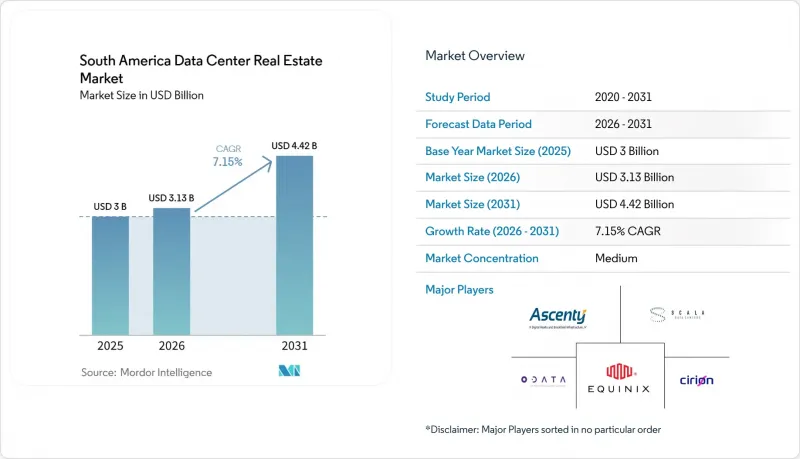
根據 Mordor Intelligence 預測,南美資料中心房地產市場規模將從 2025 年的 44.2 億美元,2026 年至 2031 年的年複合成長率(CAGR)為 7.15%。
本報告按物業類型(託管、超大規模等)、所有權類型(租賃和自有)、公司規模(大型企業和小型企業)、最終用戶(資訊科技和電信等)以及地區(巴西、阿根廷、哥倫比亞、智利和其他南美國家)進行細分。市場預測以美元計價。
南美洲資料中心房地產市場趨勢與洞察
超大規模雲端的擴張正在推動資料中心容量的成長。
全球雲端平台公司不再將南美洲視為成長緩慢的未來市場。大規模的預購合約正在改變營運商在整個南美洲資料中心房地產市場提供土地、電力和廠房(建築結構)的方式。 Ascenty計劃在2026年在聖保羅州的四個新設施中新增150兆瓦的AI專用容量,這表明供應商的藍圖正在迅速與大規模的AI和雲端運算需求保持一致。此外,超大規模合約佔據了小規模租戶可用的大量帶電土地。這提高了有效空置率,並增強了已接入電網的資料中心營運商的價格競爭力。此外,擁有電力供應保障且能夠快速交付的資料中心比電力供應不確定的大片土地更有價值,這使得在南美洲資料中心房地產市場中位置更具策略性。
企業向託管辦公模式的轉變正在推高租賃需求。
企業轉向託管模式正逐漸成為南美洲資料中心房地產市場的結構性特徵,而不僅僅是暫時的採購趨勢。預計到2025年,託管模式將佔據51.40%的市場佔有率,而租賃所有權模式則佔77.30%,這表明客戶正逐漸遠離對其基礎設施的直接所有權。企業選擇租賃容量,是因為它使他們能夠使用最先進的冷卻系統、更高的運轉率標準以及更快的部署速度,而無需將資金投入自有資料中心。這種轉變在人工智慧工作負載領域尤其顯著,因為自建資料中心的成本和營運複雜性都在不斷增加。因此,租戶群體進一步擴大,現在包括傳統企業用戶、監管機構以及使用混合雲和本地部署環境的組織。這一趨勢也推動了區域城市的租賃需求,這些城市中規模較小但服務不足的企業叢集正在尋求更靠近其業務所在地的可靠容量。
電網不穩定和高昂的電價推高了營運成本。
在南美洲資料中心房地產市場,電力傳輸比電力生產更為緊迫。在巴西,電力需求集中在輸電系統無法應對數位基礎設施大規模、持續負載的地區。在智利,挑戰不在於可再生能源的稀缺,而是能否有效率地將電力供應到關鍵需求點。電力仍然是託管營運商最大的營運成本之一,成本波動直接影響新園區的獲利預測。人工智慧設施面臨的壓力更大,因為更高的機架密度會增加電力消耗量和冷卻負荷。因此,電網的不確定性將延緩開發決策,提高已通過核准的電力連接的價值,並進一步增加南美洲資料中心房地產市場區位置經濟的風險因素。
細分市場分析
到2025年,託管資料中心將佔據南美洲資料中心房地產市場51.40%的佔有率,並繼續保持全部區域最成熟的物業類型。其優勢在於營運商中立的樞紐,這些樞紐以難以複製的方式將企業需求、雲端存取和高密度互連相結合。隨著更多租戶加入生態系統,這些資產的價值不斷提升,入住率和實體容量都成為關鍵因素。 2026年,Equinix將投資1.14億美元在聖保羅大都會圈開設「SP6」資料中心,進一步鞏固其作為南美洲資料中心房地產市場高階互聯園區的地位。此外,客戶對靈活合約結構的需求也使託管資料中心產業受益,尤其是在企業希望接近性雲端但又不想擁有自己的資料中心時。
在南美洲資料中心房地產市場,超大規模資料中心正逐漸成為更獨特的投資類別。具備多階段擴展能力的大型園區因其能夠滿足較長的前置作業時間、高密度部署以及客製化的公用設施方案等優勢,吸引了最多的投資。邊緣資料中心預計將以10.20%的複合年成長率成長,到2031年將成為南美洲資料中心房地產市場成長最快的物業類型。其吸引力源自於5G和分散式應用相關的低延遲用例,以及不受主要都會區限制的工作負載。模組化配置也日益受到關注,因為在大型永久性園區的授權和電力供應核准流程耗時較長的市場中,模組化配置能夠縮短引進週期。同時,隨著客戶將支出轉向已滿足最新效能和容錯標準的租賃環境,傳統企業自有資料中心的重要性正在下降。
預計到2025年,租賃所有權將佔南美洲資料中心房地產市場的77.30%,並在預測期內維持7.90%的複合年成長率。企業和雲端用戶越來越傾向於租賃資料中心容量,而不是擁有資料中心本身的房地產。這減輕了初始投資的負擔,並降低了設計缺陷、電網延遲和技術過時所帶來的風險。此外,租戶還可以根據功率密度和服務等級簽訂契約,而無需受限於單一自有建築的決策。隨著人工智慧工作負載需要比傳統伺服器機房更快的部署速度和更專業的IT基礎設施,這種柔軟性在南美洲資料中心房地產市場變得日益重要。
自有和自用設施在某些特定應用場景中仍然發揮著重要作用。政府機構、電信業者和一些金融機構出於安全、合規或營運方面的考慮,仍然直接管理其部分計算基礎設施。然而,許多此類用戶正在轉向混合營運模式,將自有環境與租賃容量結合,用於雲端、人工智慧和彈性工作負載。這意味著自有和自用設施並未消失,但與租賃供應相比,其策略重要性正在下降。因此,南美洲資料中心房地產市場正變得更加以資金籌措主導,長期租賃前景、公用設施接入和園區擴充性變得比單純的建築物所有權更為重要。
其他好處:
- Excel格式的市場預測(ME)表
- 三個月的分析師支持
目錄
第1章:引言
- 研究假設和市場定義
- 調查範圍
第2章:調查方法
第3章執行摘要
第4章 市場狀況
- 市場概覽
- 市場促進因素
- 超大規模雲端的擴張正在推動資料中心容量的成長。
- 企業向託管資料中心轉移,導致租賃需求增加。
- 資料主權政策正在推動對本地資料中心的投資。
- 電力短缺導致對高密度設施的需求增加。
- 對可再生能源的需求正在推動永續資料中心的發展。
- 光纖連接的擴展提高了資料中心位置的吸引力。
- 市場限制因素
- 電網不穩定和高昂的電價導致營運成本增加。
- 主要都會區土地短缺限制了新的開發案。
- 水資源短缺和環境核准延誤正在延緩工程的實施。
- 熟練的營運和維護人員短缺限制了成長。
- 價值供應鏈分析
- 供應鏈與生態系概述
- 主要原料、資源和供應商清單
- 主要銷售代理商和通路夥伴名單
- 主要最終用戶列表
- 監理情勢
- 技術展望
- 波特五力分析
第5章 市場規模與成長預測
- 按屬性類型
- 搭配
- 超大規模
- 邊緣資料中心屬性
- 模組化資料中心屬性
- 其他(批發、零售、B2B)
- 依所有權類型
- 租賃
- 房屋所有權
- 按公司規模
- 大公司
- 小型企業
- 最終用戶
- 資訊科技/通訊
- 銀行業、金融服務業及保險業
- 政府/公共部門
- 衛生保健
- 其他最終用戶
- 國家
- 巴西
- 阿根廷
- 哥倫比亞
- 智利
- 其他南美國家
第6章 競爭情勢
- 市場集中度
- 策略趨勢
- 市佔率分析
- 公司簡介
- Ascenty
- ODATA
- Equinix
- Scala Data Centers
- Cirion Technologies
- Elea Data Centers
- KIO Networks
- NTT Data
- EdgeConneX
- Tecto Data Centers
- HostDime
- UOL Diveo
- Takoda Data Centers
- MDC Data Centers
- DataBank Latam
- SONDA Data Centers
- OX Data Centers
- Win Empresas Data Centers
- EdgeUno
- Lumen Data Centers
第7章 市場機會與未來展望
According to Mordor Intelligence, the South America data center real estate market size is projected to expand from USD 3 billion in 2025 and USD 3.13 billion in 2026 to USD 4.42 billion by 2031, registering a CAGR of 7.15% between 2026 to 2031.
This report is Segmented by Property Type (Colocation, Hyperscale, and More), Ownership (Leased and Owner Occupied), Enterprise Size (Large Enterprises, and Small and Medium Enterprises), End-Users (Information Technology and Telecom, and More), and Geography (Brazil, Argentina, Colombia, Chile, and the Rest of South America). The Market Forecasts are Provided in Terms of Value (USD).
South America Data Center Real Estate Market Trends and Insights
Hyperscale Cloud Expansion Drives Data Center Capacity Growth
South America is no longer being treated as a slow, future buildout market by global cloud platforms. Large pre-commitments are changing how operators phase land, power, and shell delivery across the South America data center real estate market. Ascenty's 2026 plan to add 150 MW of AI-focused capacity across 4 new facilities in Sao Paulo state shows how quickly provider road maps are now aligning with large-scale AI and cloud demand. Very large hyperscale deals also remove a meaningful share of powered land from the pool that smaller tenants can access. That tightens effective vacancy and strengthens pricing for providers that already control grid-ready campuses. It also makes site selection more strategic in the South America data center real estate market because a campus with secure power and fast delivery now carries more value than a larger site with uncertain utility timing.
Enterprise Shift to Colocation Increases Leasing Demand
The enterprise move toward colocation is becoming a structural feature of the South America data center real estate market rather than a temporary sourcing preference. Colocation held a 51.40% share in 2025, and leased ownership held 77.30%, indicating how far customers have already moved away from owning infrastructure directly. Enterprises are choosing leased capacity because it gives them access to modern cooling, higher uptime standards, and faster deployment without tying up capital in a single-owned site. This shift is especially relevant for AI workloads, where the cost and operating complexity of building internally is rising. The result is a broader tenant base that now includes traditional enterprise users, regulated institutions, and organizations with mixed cloud and on-premises environments. It is also pushing leasing demand into secondary cities where smaller but underserved enterprise clusters want reliable capacity close to operations.
Grid Instability and High Electricity Costs Increase Operating Expenses
Power delivery remains a more immediate problem than power generation for the South America data center real estate market. In Brazil, demand is concentrated in areas where transmission systems were not built to handle large, continuous digital infrastructure loads. In Chile, the issue is less a lack of renewable power than the ability to efficiently deliver that power to the main demand nodes. Electricity remains one of the largest operating cost items for colocation providers, and cost swings directly affect margin assumptions for new campuses. These pressures matter even more for AI-oriented facilities because higher rack density increases both power draw and cooling intensity. Grid uncertainty, therefore, slows development decisions, raises the value of approved utility connections, and adds another layer of risk to site economics across the South America data center real estate market.
Other drivers and restraints analyzed in the detailed report include:
- Data Sovereignty Policies Boost Local Data Center Investments
- Power Constraints Increase Demand for High-Density Facilities
- Land Scarcity in Core Metro Areas Limits New Developments
For complete list of drivers and restraints, kindly check the Table Of Contents.
Segment Analysis
Colocation held a 51.40% share of the South America data center real estate market in 2025, and it remains the most established property type across the regional footprint. Its strength comes from carrier-neutral hubs that combine enterprise demand, cloud access, and dense interconnection in a way that is hard to replicate elsewhere. These assets gain value as more tenants join the ecosystem, which makes occupancy depth as important as physical capacity. Equinix opened SP6 in Greater Sao Paulo in 2026 with a USD 114 million investment, reinforcing the role of premium interconnection campuses in the South America data center real estate market. The colocation segment also benefits from customer demand for flexible contract structures, especially where enterprises want cloud adjacency without committing to owned real estate.
Hyperscale properties are becoming a more distinct investment class within the South America data center real estate market. Large campuses with multi-phase expansion potential are attracting the biggest commitments because they can support long lead times, higher density, and tailored utility planning. Edge data center properties are projected to grow at a 10.20% CAGR, making them the fastest-growing property type within the South America data center real estate market size through 2031. Their appeal stems from low-latency use cases tied to 5G, distributed applications, and workloads that cannot be confined to primary metros. Modular formats are also gaining traction because they can shorten deployment cycles in markets where permanent, large-scale campuses take longer to entitle and energize. At the same time, traditional enterprise-owned property formats are losing relative importance as customers shift spending toward leased environments that already support modern performance and resilience standards.
Leased ownership accounted for a 77.30% share of the South America Data Center Real Estate Market in 2025 and is projected to register a CAGR of 7.90% through the forecast period. Enterprises and cloud customers increasingly prefer leasing data center capacity rather than owning the underlying property. This lowers upfront capital needs and reduces exposure to design mistakes, grid delays, and technology obsolescence. It also allows tenants to contract around power density and service levels, rather than tying decisions to a single owned building. In the South America data center real estate market, that flexibility has become more important as AI workloads require faster deployment and more specialized infrastructure than legacy server rooms can provide.
Owner-occupied facilities still matter in a limited set of use cases. Government bodies, telecom operators, and some financial institutions continue to keep part of their computing base under direct control for security, compliance, or operating reasons. Even so, many of these users are moving toward hybrid operating models that combine owned environments with leased capacity for cloud, AI, and elastic workloads. This means the owner-occupied segment is not disappearing, but it is losing strategic weight relative to leased supply. The South America data center real estate market is therefore becoming more finance-driven, with long-term lease visibility, utility access, and campus scalability carrying greater weight than simple building ownership.
Complete Report Scope:
- By Property Type
- Colocation
- Hyperscale
- Edge Data Center Properties
- Modular Data Center Properties
- Others (Wholesale, Retail and Enterprise)
- By Ownership
- Leased
- Owner Occupied
- By Enterprise Size
- Large Enterprises
- Small and Medium Enterprises
- By End-Users
- Information Technology and Telecom
- Banking, Financial Services, and Insurance
- Government and Public Sector
- Healthcare
- Other End Users
- By Country
- Brazil
- Argentina
- Colombia
- Chile
- Rest of South America
List of Companies Covered in this Report:
- Ascenty
- ODATA
- Equinix
- Scala Data Centers
- Cirion Technologies
- Elea Data Centers
- KIO Networks
- NTT Data
- EdgeConneX
- Tecto Data Centers
- HostDime
- UOL Diveo
- Takoda Data Centers
- MDC Data Centers
- DataBank Latam
- SONDA Data Centers
- OX Data Centers
- Win Empresas Data Centers
- EdgeUno
- Lumen Data Centers
Additional Benefits:
- The market estimate (ME) sheet in Excel format
- 3 months of analyst support
TABLE OF CONTENTS
1 Introduction
- 1.1 Study Assumptions and Market Definition
- 1.2 Scope of the Study
2 Research Methodology
3 Executive Summary
4 Market Landscape
- 4.1 Market Overview
- 4.2 Market Drivers
- 4.2.1 Hyperscale Cloud Expansion Drives Data Center Capacity Growth
- 4.2.2 Enterprise Shift to Colocation Increases Leasing Demand
- 4.2.3 Data Sovereignty Policies Boost Local Data Center Investments
- 4.2.4 Power Constraints Increase Demand for High-Density Facilities
- 4.2.5 Renewable Energy Demand Supports Sustainable Data Center Development
- 4.2.6 Fiber Connectivity Expansion Enhances Data Center Location Appeal
- 4.3 Market Restraints
- 4.3.1 Grid Instability and High Electricity Costs Increase Operating Expenses
- 4.3.2 Land Scarcity in Core Metro Areas Limits New Developments
- 4.3.3 Water Stress and Environmental Approvals Delay Project Execution
- 4.3.4 Shortage of Skilled Operations and Maintenance Talent Constrains Growth
- 4.4 Value / Supply-Chain Analysis
- 4.4.1 Overview of the Supply Chain and Ecosystem
- 4.4.2 List of Key Raw Materials, Resources & Suppliers
- 4.4.3 List of Major Distributors and Channel Partners
- 4.4.4 List of Major End Users
- 4.5 Regulatory Landscape
- 4.6 Technological Outlook
- 4.7 Porter's Five Forces Analysis
- 4.7.1 Bargaining Power of Suppliers
- 4.7.2 Bargaining Power of Consumers
- 4.7.3 Threat of New Entrants
- 4.7.4 Threat of Substitutes
- 4.7.5 Intensity of Competitive Rivalry
5 Market Size & Growth Forecasts (Value, USD)
- 5.1 By Property Type
- 5.1.1 Colocation
- 5.1.2 Hyperscale
- 5.1.3 Edge Data Center Properties
- 5.1.4 Modular Data Center Properties
- 5.1.5 Others (Wholesale, Retail and Enterprise)
- 5.2 By Ownership
- 5.2.1 Leased
- 5.2.2 Owner Occupied
- 5.3 By Enterprise Size
- 5.3.1 Large Enterprises
- 5.3.2 Small and Medium Enterprises
- 5.4 By End-Users
- 5.4.1 Information Technology and Telecom
- 5.4.2 Banking, Financial Services, and Insurance
- 5.4.3 Government and Public Sector
- 5.4.4 Healthcare
- 5.4.5 Other End Users
- 5.5 By Country
- 5.5.1 Brazil
- 5.5.2 Argentina
- 5.5.3 Colombia
- 5.5.4 Chile
- 5.5.5 Rest of South America
6 Competitive Landscape
- 6.1 Market Concentration
- 6.2 Strategic Moves
- 6.3 Market Share Analysis
- 6.4 Company Profiles (Includes Global Level Overview, Market Level Overview, Core Segments, Financials as Available, Strategic Information, Products and Services, Recent Developments)
- 6.4.1 Ascenty
- 6.4.2 ODATA
- 6.4.3 Equinix
- 6.4.4 Scala Data Centers
- 6.4.5 Cirion Technologies
- 6.4.6 Elea Data Centers
- 6.4.7 KIO Networks
- 6.4.8 NTT Data
- 6.4.9 EdgeConneX
- 6.4.10 Tecto Data Centers
- 6.4.11 HostDime
- 6.4.12 UOL Diveo
- 6.4.13 Takoda Data Centers
- 6.4.14 MDC Data Centers
- 6.4.15 DataBank Latam
- 6.4.16 SONDA Data Centers
- 6.4.17 OX Data Centers
- 6.4.18 Win Empresas Data Centers
- 6.4.19 EdgeUno
- 6.4.20 Lumen Data Centers
7 Market Opportunities & Future Outlook
- 7.1 White-Space and Unmet-Need Assessment

 亞特蘭大資料中心:市場佔有率分析、產業趨勢與統計及成長預測(2026-2031 年)北維吉尼亞資料中心:市場佔有率分析、產業趨勢與統計及成長預測(2026-2031 年)雅加達資料中心:市場佔有率分析、產業趨勢與統計資料、成長預測(2026-2032 年)
 資料中心測試市場報告:趨勢、預測與競爭分析(至2035年)
 資料中心市場分析及預測(至2035年):類型、產品、服務、技術、組件、應用、部署、最終用戶、功能、解決方案中東和非洲資料中心房地產:市場佔有率分析、行業趨勢和統計數據以及成長預測(2026-2031 年)亞太地區資料中心房地產:市場佔有率分析、產業趨勢與統計及成長預測(2026-2031 年)北美資料中心房地產:市場佔有率分析、產業趨勢與統計及成長預測(2026-2031 年)歐洲資料中心房地產:市場佔有率分析、產業趨勢與統計及成長預測(2026-2031 年)資料中心房地產:市場佔有率分析、產業趨勢與統計、成長預測(2026-2031)