

 |
市場調查報告書
商品編碼
2118086
亞太地區資料中心房地產:市場佔有率分析、產業趨勢與統計及成長預測(2026-2031 年)Asia-Pacific Data Center Real Estate - Market Share Analysis, Industry Trends & Statistics, Growth Forecasts (2026 - 2031) |
||||||

※ 本網頁內容可能與最新版本有所差異。詳細情況請與我們聯繫。
根據 Mordor Intelligence 預測,亞太地區資料中心房地產市場規模將從 2025 年的 206.3 億美元成長到 2026 年的 232.7 億美元,到 2031 年將達到 435.7 億美元,2026 年至 2031 年的複合年成長率為 13.36%。
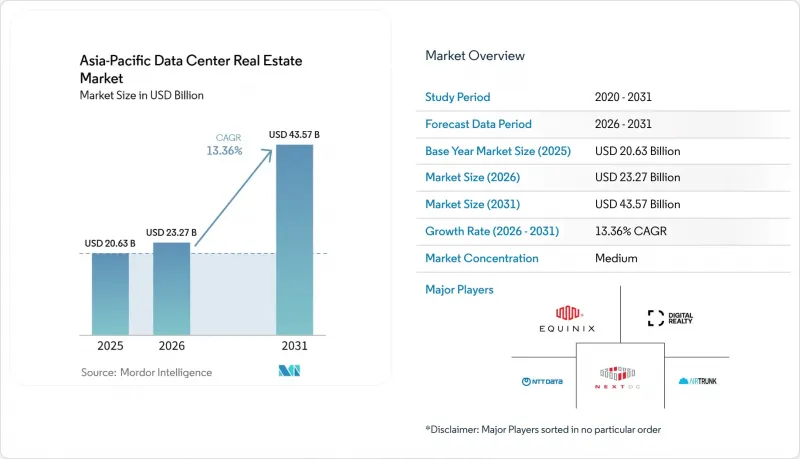
本報告按物業類型(託管、超大規模等)、所有權類型(租賃、公司自有)、公司規模(大型企業、中小企業)、最終用戶(資訊科技和電信等)以及地區(中國、日本、印度、澳洲及其他亞太地區)進行細分。市場預測以美元計價。
亞太地區資料中心房地產市場趨勢及洞察。
人工智慧工作負載正在加速對高密度資料中心的需求。
單一租戶人工智慧 (AI) 客戶正在重塑亞太資料中心房地產市場的需求格局,他們在建設開始前就鎖定容量,並要求客製化的高密度設計。這一趨勢縮短了交易週期,並減少了主要樞紐中可供小規模租戶使用的投機空間。機架密度的預期也在急劇上升,許多 AI 部署的設計遠遠超過傳統企業標準,重新定義了亞太地區資料中心房地產市場的電力、冷卻和結構要求。預計到 2025 年,該地區的資料中心開發平臺將達到 19.4 吉瓦,其中 3.7 吉瓦正在建設中,15.7 吉瓦處於規劃階段。這清楚地表明,為了滿足 AI 需求,供應正在迅速重新分配。馬來西亞和印度將佔 2025 年全部區域新增 IT 負載的 58%,這表明 AI 建設週期已擴展到該地區最成熟的區域之外。
超大規模資料中心業者的預租協議支援新增容量的擴張。
在亞太資料中心房地產市場,超大規模資料中心營運商的超大規模資料中心業者行為正在發揮市場調節機制的作用,因為容量往往在交付前數年就已鎖定。這降低了業主的投機性開發風險,但也導致小規模雲端服務供應商和企業用戶可用的資源減少。 2026年7月,亞馬遜數據服務公司簽署了一份為期17年的租賃協議,租用了位於孟買波瓦伊區一塊4英畝的土地。這表明,在印度的主要樞紐城市,長期合約正被用來確保未來預計短缺的供應。據AirTrunk公司稱,其位於柔佛州新山的JHB1和JHB2園區在2026年4月宣布投資30億美元建設JHB3和JHB4園區時,租賃率已接近100%。這一系列過程證實,在亞太資料中心房地產市場,主要地段仍然是需求主導,預租協議推動了新的供應,而不是開發商在需求顯現之前進行建設。
電網連接延遲正在減緩資料中心的發展。
在亞太地區,併網進度正成為資料中心房地產市場短期成長面臨的最嚴峻阻礙因素因素,因為併網進度往往落後於新設施的開發進度。這一差距在東南亞尤為突出,資料中心建設通常只需1-3年即可完成,而併網卻可能需要5年甚至更久。在柔佛州,由於電網基礎設施不足,2024年高達30%的新資料中心申請被駁回。這表明問題不僅限於發電能力。亞太地區90%的業者認為併網延誤是限制成長的最大阻礙因素,70%的業者也指出輸電能力有限,證實了接取和吞吐量都面臨壓力。這種情況促使亞太地區資料中心房地產市場的營運商將重點放在那些能夠在專案週期早期就確保變電站、電網基礎設施和公共產業批准的位置。
細分市場分析
到2025年,託管設施仍將維持其在各類物業中的領先地位,佔據亞太地區資料中心房地產市場45.80%的佔有率。這一主導地位反映了超大規模資料中心超大規模資料中心業者和企業租戶傾向於「託管容量」的趨勢,這使他們能夠避免完全擁有土地和建築物所帶來的資本負擔。在亞太資料中心房地產市場,預租趨勢進一步強化了這一趨勢,因為主要租戶通常會提前12至18個月預訂託管空間。因此,市場格局已經形成,頂級城市的大部分新增供應在更多企業租戶進入市場之前就被迅速消化。超大規模資料中心仍佔據第二大佔有率,並憑藉其在人工智慧園區擴張、密度增加和專業化程度提高的過程中獲得的單筆最大契約,成為第二大市場佔有率。
柔佛新山AirTrunk的擴建清楚地展現了這些超大規模資料中心的建設規模,JHB3和JHB4的建成將為這個幾乎滿載運轉的園區總合超過2GW的IT負載。模組化資料中心在印度的製造業走廊和東南亞工業區備受關注,因為預製設計可以將部署時間縮短至12至18個月。 「其他」類別(包括批發、零售和企業自有設施)面臨更大的壓力,因為許多老舊設施的設計無法應對人工智慧等級的功率密度。邊緣資料中心是成長最快的類型,預計到2031年將以16.10%的複合年成長率成長,這主要得益於5G部署、即時人工智慧推理以及智慧城市應用場景對低延遲的需求,而集中式資料中心無法滿足這些需求。這導致亞太地區資料中心房地產市場呈現出明顯的兩極化:託管仍然是當前需求的基礎,而邊緣容量正在塑造下一波分散式成長。
至2025年,租賃物業將佔亞太資料中心房地產市場規模的76.90%,成為主要的產權結構,並以13.90%的複合年成長率推動市場成長,直到2031年。這一雙重優勢表明,租賃模式不僅已在亞太資料中心房地產市場站穩腳跟,而且其作用還在不斷擴大。超大規模資料中心超大規模資料中心業者正轉向第三方租賃模式,因為他們更傾向於將更多資金用於伺服器、網路和軟體,而不是將資金投入房地產。在那些由於土地所有權和營運法規的限制,外國業者難以直接管理的國家,這種模式更具吸引力。這些限制使得租賃和管理模式成為企業在亞太地區多個市場進行國際業務擴張的實際可行的途徑。
機構投資者也支持這種所有權模式,因為越來越多的資本實體願意將穩定的資料中心資產視為主要基礎設施。日本於2025年實施的監管資金籌措將資料中心設施認定為符合日本房地產投資信託基金(J-REITs)收購條件的房地產,從而加強了租賃型開發的資金籌措基礎。 NTT Data計劃將資產併入一家在新加坡上市的房地產投資信託基金,也反映了類似的趨勢,營運商正透過資產再利用為亞太資料中心房地產市場增加供應籌集資金。在中國、日本和澳洲等市場,企業自有資產仍被國內超大規模資料中心業者和大型企業所利用,尤其是在由於其規模而認為直接管理較為合適的情況下。然而,由於租賃型物業擁有更廣泛的資本基礎、合規性和資產負債表的合理性,因此它們在亞太資料中心房地產市場中仍保持著更強的長期地位。
其他好處:
- Excel格式的市場預測(ME)表
- 3個月的分析師支持
目錄
第1章:引言
- 研究假設和市場定義
- 調查範圍
第2章:調查方法
第3章執行摘要
第4章 市場狀況
- 市場概覽
- 市場促進因素
- 人工智慧工作負載正在加速對更高密度的需求。
- 超大規模資料中心業者的預租賃行為正在支持新增容量的擴張。
- 亞太地區二次性市場正在吸引投資。
- 資料主權政策導致國內託管服務增加。
- 液冷技術的引進將使下一代設施的實現成為可能。
- 透過採購可再生能源支持永續。
- 市場限制因素
- 電網連接延誤阻礙了發展。
- 缺乏可用於電力供應的土地限制了主要樞紐的擴張。
- 建築成本上漲和人手不足給經濟帶來了壓力。
- 人工智慧驅動的維修的複雜性推高了升級成本。
- 價值供應鏈分析
- 供應鏈與生態系概述
- 主要原料、資源和供應商清單
- 主要銷售代理商和通路夥伴名單
- 主要最終用戶列表
- 監理情勢
- 技術展望
- 波特五力分析
第5章 市場規模與成長預測
- 按屬性類型
- 搭配
- 超大規模
- 邊緣資料中心屬性
- 模組化資料中心屬性
- 其他(批發、零售、B2B)
- 依所有權類型
- 租賃
- 房屋所有權
- 按公司規模
- 大公司
- 小型企業
- 最終用戶
- 資訊科技/通訊
- 銀行業、金融服務業及保險業
- 政府/公共部門
- 衛生保健
- 其他最終用戶
- 國家
- 中國
- 日本
- 印度
- 澳洲
- 其他亞太國家
第6章 競爭情勢
- 市場集中度
- 策略趨勢
- 市佔率分析
- 公司簡介
- AirTrunk
- Equinix, Inc.
- Digital Realty Trust, Inc.
- NTT DATA Group Corporation
- NEXTDC Limited
- ST Telemedia Global Data Centres
- Princeton Digital Group
- GDS Holdings Limited
- Chindata Group Holdings Limited
- BDx Data Centers
- AdaniConneX
- CtrlS Datacenters Limited
- Nxtra by Airtel
- Sify Technologies Limited
- Vantage Data Centers
- Colt Data Centre Services
- Telehouse
- Keppel Data Centres
- Digital Edge
- Empyrion Digital
第7章 市場機會與未來展望
According to Mordor Intelligence, the Asia-Pacific data center real estate market size is expected to increase from USD 20.63 billion in 2025 to USD 23.27 billion in 2026 and reach USD 43.57 billion by 2031, growing at a CAGR of 13.36% over 2026-2031.
This report is Segmented by Property Type (Colocation, Hyperscale, and More), Ownership (Leased and Owner Occupied), Enterprise Size (Large Enterprises, and Small and Medium Enterprises), End-Users (Information Technology and Telecom, and More), and Geography (China, Japan, India, Australia, Rest of Asia-Pacific). The Market Forecasts are Provided in Terms of Value (USD).
Asia-Pacific Data Center Real Estate Market Trends and Insights
AI Workloads Accelerate High-Density Data Center Demand
Single-tenant Artificial Intelligence (AI) customers are changing demand patterns in the Asia-Pacific data center real estate market by reserving capacity before construction begins and requesting bespoke, high-density designs. That behavior is compressing deal cycles and reducing the amount of speculative space that reaches smaller tenants in core hubs. Rack density expectations are also moving sharply upward, with many AI-oriented deployments now designed well above legacy enterprise standards, reshaping power, cooling, and structural requirements across the Asia-Pacific data center real estate market. The regional data center development pipeline reached 19.4GW in 2025, including 3.7GW under construction and 15.7GW in planning, underscoring how quickly supply is being repositioned to meet AI demand. Malaysia and India accounted for 58% of new IT load added across Asia-Pacific in 2025, which shows that the AI build cycle is already broadening beyond the region's most mature locations.
Hyperscaler Pre-Leasing Supports New Capacity Expansion
Hyperscaler pre-leasing acts as a market-clearing mechanism in the Asia-Pacific data center real estate market, as capacity is often committed years before delivery. That lowers speculative development risk for owners, but it also leaves less available inventory for smaller cloud and enterprise users. Amazon Data Services signed a 17-year lease for 4 acres in Mumbai's Powai district in July 2026, which shows how long-dated commitments are now being used to secure scarce future supply in major Indian hubs. AirTrunk said its JHB1 and JHB2 campuses in Johor Bahru were almost 100% contracted before it announced USD 3 billion for JHB3 and JHB4 in April 2026. This sequence confirms that the Asia-Pacific data center real estate market remains demand-led in its major hubs, with pre-leasing driving new supply forward rather than developers building ahead of visible demand.
Grid Interconnection Delays Slow Data Center Development
Grid interconnection timelines are becoming the most serious near-term constraint on growth in the Asia-Pacific data center real estate market, as they often extend beyond the development timelines for new facilities. The gap is clear in Southeast Asia, where data center construction can be completed in 1 to 3 years, but utility connection timelines can take more than 5 years. In Johor, up to 30% of new data center applications were rejected in 2024 due to grid delivery not being ready, indicating that the problem is not only about generation capacity. 90% of Asia-Pacific operators cited grid connection delays as their top growth constraint, and 70% also flagged transmission limits, confirming that access and throughput are under pressure. This is pushing operators in the Asia-Pacific data center real estate market toward locations where substations, transmission buildouts, and utility approvals can be secured earlier in the project cycle.
Other drivers and restraints analyzed in the detailed report include:
- Data Sovereignty Policies Increase In-Country Hosting Demand
- Liquid Cooling Adoption Enables Next-Generation Data Center Facilities
- Power-Ready Land Shortages Limit Core Hub Expansion
For complete list of drivers and restraints, kindly check the Table Of Contents.
Segment Analysis
Colocation facilities held 45.80% of the Asia-Pacific data center real estate market share in 2025, maintaining their leading position among property types. Their lead reflects hyperscalers' and enterprise tenants' preference for managed capacity that avoids the capital burden of owning land and buildings outright. In the Asia-Pacific data center real estate market, this preference is reinforced by pre-leasing behavior, as major tenants often secure colocation space 12 to 18 months before delivery. The result is a structure where most net new supply in top-tier cities is absorbed quickly, often before broader enterprise tenants can enter the pipeline. Hyperscale properties remain the second-largest type and are attracting the largest single-project commitments as AI campuses grow, densify, and become more specialized.
AirTrunk's expansion in Johor Bahru shows the scale of that hyperscale buildout, with JHB3 and JHB4 adding more than 2GW of combined IT load beside campuses that were already almost fully contracted. Modular properties are gaining traction in India's manufacturing corridors and in Southeast Asian industrial zones because prefabricated designs can shorten deployment windows to 12 to 18 months. The others category, which includes wholesale, retail, and enterprise-owned stock, is under more pressure because many older facilities were not designed for AI-grade power density. Edge data center properties are the fastest-growing type, with a 16.10% CAGR through 2031, driven by 5G buildouts, real-time AI inference, and smart-city use cases that require lower latency than centralized hubs can provide. That leaves the Asia-Pacific data center real estate market with a clear split: colocation remains the base of current demand, while edge capacity shapes the next wave of distributed growth.
Leased properties dominated ownership structures with 76.90% share of the Asia-Pacific data center real estate market size in 2025, and they also lead growth at 13.90% CAGR through 2031. That dual lead shows that leased models are not only well established but are also expanding their role in the Asia-Pacific data center real estate market. Hyperscalers are shifting toward third-party leased structures because they prefer to keep more balance-sheet capital available for servers, networking, and software rather than tying it up in real estate. The model is even more attractive in countries where land ownership or operating rules make direct control by foreign operators more difficult. Those constraints make leasehold and managed structures a practical route for international expansion across several Asia-Pacific markets.
Institutional finance is also supporting this ownership pattern, as more capital vehicles are now willing to treat stabilized data center assets as mainstream infrastructure. Japan's regulatory adjustment in 2025, which recognized data center equipment as real estate eligible for J-REIT acquisition, strengthened the financing case for leased development. NTT DATA's plan to inject assets into its Singapore-listed REIT points in the same direction, with operators using asset recycling to fund additional supply in the Asia-Pacific data center real estate market. Owner-occupied assets still serve domestic hyperscalers and large enterprises in markets such as China, Japan, and Australia, especially where scale justifies direct control. Even so, the wider capital base, regulatory fit, and balance-sheet logic keep leased properties in a stronger long-term position in the Asia-Pacific data center real estate market.
Complete Report Scope:
- By Property Type
- Colocation
- Hyperscale
- Edge Data Center Properties
- Modular Data Center Properties
- Others (Wholesale, Retail and Enterprise)
- By Ownership
- Leased
- Owner Occupied
- By Enterprise Size
- Large Enterprises
- Small and Medium Enterprises
- By End-Users
- Information Technology and Telecom
- Banking, Financial Services, and Insurance
- Government and Public Sector
- Healthcare
- Other End Users
- By Country
- China
- Japan
- India
- Australia
- Rest of Asia-Pacific
List of Companies Covered in this Report:
- AirTrunk
- Equinix, Inc.
- Digital Realty Trust, Inc.
- NTT DATA Group Corporation
- NEXTDC Limited
- ST Telemedia Global Data Centres
- Princeton Digital Group
- GDS Holdings Limited
- Chindata Group Holdings Limited
- BDx Data Centers
- AdaniConneX
- CtrlS Datacenters Limited
- Nxtra by Airtel
- Sify Technologies Limited
- Vantage Data Centers
- Colt Data Centre Services
- Telehouse
- Keppel Data Centres
- Digital Edge
- Empyrion Digital
Additional Benefits:
- The market estimate (ME) sheet in Excel format
- 3 months of analyst support
TABLE OF CONTENTS
1 Introduction
- 1.1 Study Assumptions and Market Definition
- 1.2 Scope of the Study
2 Research Methodology
3 Executive Summary
4 Market Landscape
- 4.1 Market Overview
- 4.2 Market Drivers
- 4.2.1 AI Workloads Accelerate High-Density Demand
- 4.2.2 Hyperscaler Pre-Leasing Supports New Capacity
- 4.2.3 Secondary Asia-Pacific Markets Attract Investment
- 4.2.4 Data Sovereignty Policies Increase In-Country Hosting
- 4.2.5 Liquid Cooling Adoption Enables Next-Generation Facilities
- 4.2.6 Renewable Procurement Supports Sustainable Development
- 4.3 Market Restraints
- 4.3.1 Grid Interconnection Delays Slow Development
- 4.3.2 Power-Ready Land Shortages Limit Core Hub Expansion
- 4.3.3 Construction Cost Inflation and Labor Shortages Pressure Economics
- 4.3.4 AI-Ready Retrofit Complexity Raises Upgrade Costs
- 4.4 Value / Supply-Chain Analysis
- 4.4.1 Overview of the Supply Chain and Ecosystem
- 4.4.2 List of Key Raw Materials, Resources & Suppliers
- 4.4.3 List of Major Distributors and Channel Partners
- 4.4.4 List of Major End Users
- 4.5 Regulatory Landscape
- 4.6 Technological Outlook
- 4.7 Porter's Five Forces Analysis
- 4.7.1 Bargaining Power of Suppliers
- 4.7.2 Bargaining Power of Consumers
- 4.7.3 Threat of New Entrants
- 4.7.4 Threat of Substitutes
- 4.7.5 Intensity of Competitive Rivalry
5 Market Size & Growth Forecasts (Value, USD)
- 5.1 By Property Type
- 5.1.1 Colocation
- 5.1.2 Hyperscale
- 5.1.3 Edge Data Center Properties
- 5.1.4 Modular Data Center Properties
- 5.1.5 Others (Wholesale, Retail and Enterprise)
- 5.2 By Ownership
- 5.2.1 Leased
- 5.2.2 Owner Occupied
- 5.3 By Enterprise Size
- 5.3.1 Large Enterprises
- 5.3.2 Small and Medium Enterprises
- 5.4 By End-Users
- 5.4.1 Information Technology and Telecom
- 5.4.2 Banking, Financial Services, and Insurance
- 5.4.3 Government and Public Sector
- 5.4.4 Healthcare
- 5.4.5 Other End Users
- 5.5 By Country
- 5.5.1 China
- 5.5.2 Japan
- 5.5.3 India
- 5.5.4 Australia
- 5.5.5 Rest of Asia-Pacific
6 Competitive Landscape
- 6.1 Market Concentration
- 6.2 Strategic Moves
- 6.3 Market Share Analysis
- 6.4 Company Profiles (Includes Global Level Overview, Market Level Overview, Core Segments, Financials as Available, Strategic Information, Products and Services, Recent Developments)
- 6.4.1 AirTrunk
- 6.4.2 Equinix, Inc.
- 6.4.3 Digital Realty Trust, Inc.
- 6.4.4 NTT DATA Group Corporation
- 6.4.5 NEXTDC Limited
- 6.4.6 ST Telemedia Global Data Centres
- 6.4.7 Princeton Digital Group
- 6.4.8 GDS Holdings Limited
- 6.4.9 Chindata Group Holdings Limited
- 6.4.10 BDx Data Centers
- 6.4.11 AdaniConneX
- 6.4.12 CtrlS Datacenters Limited
- 6.4.13 Nxtra by Airtel
- 6.4.14 Sify Technologies Limited
- 6.4.15 Vantage Data Centers
- 6.4.16 Colt Data Centre Services
- 6.4.17 Telehouse
- 6.4.18 Keppel Data Centres
- 6.4.19 Digital Edge
- 6.4.20 Empyrion Digital
7 Market Opportunities & Future Outlook
- 7.1 White-Space and Unmet-Need Assessment

 亞特蘭大資料中心:市場佔有率分析、產業趨勢與統計及成長預測(2026-2031 年)北維吉尼亞資料中心:市場佔有率分析、產業趨勢與統計及成長預測(2026-2031 年)雅加達資料中心:市場佔有率分析、產業趨勢與統計資料、成長預測(2026-2032 年)
 資料中心測試市場報告:趨勢、預測與競爭分析(至2035年)
 資料中心市場分析及預測(至2035年):類型、產品、服務、技術、組件、應用、部署、最終用戶、功能、解決方案中東和非洲資料中心房地產:市場佔有率分析、行業趨勢和統計數據以及成長預測(2026-2031 年)南美洲資料中心房地產:市場佔有率分析、產業趨勢與統計及成長預測(2026-2031 年)北美資料中心房地產:市場佔有率分析、產業趨勢與統計及成長預測(2026-2031 年)歐洲資料中心房地產:市場佔有率分析、產業趨勢與統計及成長預測(2026-2031 年)資料中心房地產:市場佔有率分析、產業趨勢與統計、成長預測(2026-2031)