

 |
市場調查報告書
商品編碼
2117546
歐洲資料中心房地產:市場佔有率分析、產業趨勢與統計及成長預測(2026-2031 年)Europe Data Center Real Estate - Market Share Analysis, Industry Trends & Statistics, Growth Forecasts (2026 - 2031) |
||||||

※ 本網頁內容可能與最新版本有所差異。詳細情況請與我們聯繫。
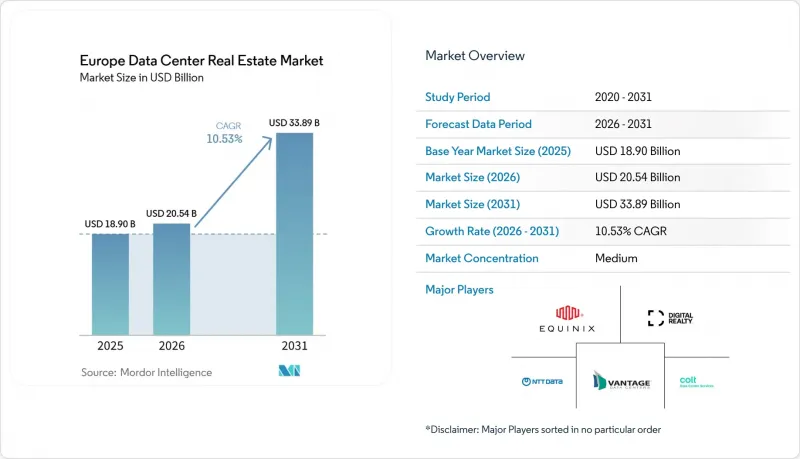
根據 Mordor Intelligence 預測,歐洲資料中心房地產市場規模將從 2025 年的 189 億美元和 2026 年的 205.4 億美元成長到 2031 年的 338.9 億美元,2026 年至 2031 年的複合年成長率為 10.53%。
本報告按物業類型(託管、超大規模等)、所有權類型(租賃、自有)、公司規模(大型企業、中小企業)、最終用戶(IT/電信等)和地區(英國、德國、法國、義大利及其他歐洲國家)進行分類。市場預測以美元計價。
歐洲資料中心房地產市場趨勢與洞察
整個 FLAP-D 中心超大規模雲端的擴展正在推動容量成長。
由於其高互連密度、租戶多樣性以及仍然最高的企業流量,FLAP-D走廊仍然是歐洲資料中心房地產市場營運的核心。歐盟委員會的「2025年人工智慧大陸行動計畫」進一步鞏固了這一地位,倡導大幅提升全部區域的處理能力,這將鼓勵在最成熟的節點上繼續進行大規模開發。歐洲資料中心協會(EDCA)也在2025年指出,加速基礎設施投資對於加強歐洲的數位主權至關重要,這與資本持續向核心樞紐集中的趨勢相符。另一方面,主要叢集的網路延遲迫使部分需求流向附近的二線城市,因為這些樞紐的連接延遲已經達到7到10年。 Equinix 於 2025 年 10 月宣布將在剪切機投資 39 億英鎊(49 億美元)來建造一個大型站點,這表明,儘管營運商仍希望擴大其核心連接骨幹網的規模,但他們也在探索其以外的其他電源。
人工智慧工作負載正在加速高密度資料中心的發展。
人工智慧正在改變歐洲資料中心房地產市場的實體設計。這是因為人工智慧賦能的設施的機架密度遠超過傳統託管機房。 2026年4月,歐洲輸電系統營運商協會(ENTSO-E)宣布,2025年至2030年間,歐洲資料中心的電力需求將成長超過50%。這意味著未來的設施不僅需要更大的占地面積,還需要大規模的電力供應和冷卻系統。這項變更增加了每兆瓦的建設成本,使得只有那些能夠管理熱設計、電力採購和巨額資本投資的開發商才有資格參與其中。 Nscale決定在Cineness的「Start Campus」部署NVIDIA GB300 NVL72,這顯示對人工智慧基礎設施的需求不再侷限於傳統的西歐中心,現在也能支援南部地區的大型計畫。此外,OpenAI 於 2025 年 7 月作為「星門」舉措的一部分擴展到挪威,這表明,在可再生能源和大規模發電能力能夠快速部署的地方,人工智慧工作負載正在創造新的地域激勵。
電網堵塞和供電延遲限制了新的發展。
電力接入是歐洲資料中心房地產市場最明顯的限制因素,因為主要樞紐的電力連接延遲可能遠遠超過正常的建設工期。國際能源總署(IEA)也指出,儘管專案儲備顯示成長130%,但到2030年,歐洲裝置容量可能僅成長70%,這意味著在目前的電力供應條件下,許多計畫中的專案可能無法投入運作。路透社在2026年2月報導,由於電網連接不足和網路堵塞,亞馬遜已暫時中止了部分歐洲地區的專案計劃,導致這些位置無法建造。這使得已獲得電力供應保障的土地成為稀缺資源,進一步拉大了現有業者和新進業者之間的差距。這也意味著,在歐洲資料中心房地產市場,租戶需求可能依然強勁,資金籌措管道也較為暢通,但交付進度可能會持續延遲。
細分市場分析
到2025年,託管資料中心將佔歐洲資料中心房地產市場的50.20%,證實了營運商中立的設施仍將是企業和服務供應商的主要平台。核心樞紐的這一細分市場依然最為強勁,因為這些樞紐擁有深厚的互聯互通和完善的租戶生態系統,從而能夠支持穩定的運轉率和長期的客戶關係。超大規模資料中心也透過大規模客製化建設模式不斷擴張,這些模式為核心租戶分配了專用容量塊。邊緣資料中心是成長最快的資料中心類型,預計到2031年,該細分市場在歐洲資料中心房地產市場的複合年成長率將達到13.80%。
邊緣運算領域的成長反映了對人工智慧推理、內容傳送和工業工作負載日益成長的需求,這些需求需要更靠近用戶和設備的運算能力,而不是僅僅依賴大規模都市資料中心。這催生了一種新的叢集建構邏輯,以光纜登陸點、交換節點和幾年前數位基礎設施還十分有限的區域城市為中心。 AtlasEdge在2026年獲得的13.9億美元資金籌措計劃表明,營運商正在投資於德國、奧地利和整個伊比利亞半島的分散式擴展,以滿足這些廣泛的需求模式。因此,歐洲資料中心房地產市場正在向一種新的組合結構轉變:託管仍然是主要的收入來源,超大規模資料中心正在擴大規模,而邊緣運算則在不斷擴大其地理覆蓋範圍的同時,也增加了合規性和營運的複雜性。
到2025年,租賃資產將佔歐洲資料中心房地產市場佔有率的79.80%,預計到2031年,該細分市場將以11.10%的複合年成長率成長。這表明,租賃不僅是當前市場的主導營運模式,也是未來擴張的首選結構。鑑於人工智慧基礎設施的成本、電力需求和升級週期難以準確預算,企業更傾向於租賃容量,因為它可以幫助他們保持資金柔軟性。機構投資者也更傾向於從信譽良好的租戶那裡獲得長期收入,而不是承擔營運設施本身帶來的日常複雜性。
在預計2025年的需求中,剩餘的20.2%由業主自用的設施構成,這些設施仍集中在金融機構、電信業者和某些對管理要求嚴格的公共部門。即使在政府主導的運算項目不斷擴展的地區,由營運商管理的客製化設施通常也比傳統的公司自有園區更實用。這持續推動長期市場平衡向擁有規模、先進工程能力和穩定電力供應的外部營運商傾斜。因此,歐洲資料中心房地產市場正日益由業主營運商主導。另一方面,最終用戶擁有資料中心僅限於管理要求明顯高於成本和柔軟性考慮的情況。
其他好處:
- Excel格式的市場預測(ME)表
- 3個月的分析師支持
目錄
第1章:引言
- 研究假設和市場定義
- 調查範圍
第2章:調查方法
第3章執行摘要
第4章 市場狀況
- 市場概覽
- 市場促進因素
- 在整個 FLAP-D 中心進行超大規模雲端擴展。
- AI工作負載加速高密度開發
- 資料主權政策正在推動國內託管服務的需求成長。
- 併網型次市場正在吸引新的投資。
- 可再生能源供應合約能夠提高長期經濟效益。
- 海底電纜帶來的更佳連接性提升了位置的吸引力。
- 市場限制因素
- 電網堵塞和供電延遲限制了新的發展。
- 由於授權問題和當地居民的反對,該項目的批准被推遲。
- 高壓設備短缺導致資料中心建設延期。
- 水資源短缺和冷凍限制加劇了營運方面的限制。
- 價值供應鏈分析
- 供應鏈與生態系概述
- 主要原料、資源和供應商清單
- 主要銷售代理商和通路夥伴名單
- 主要最終用戶列表
- 監理情勢
- 技術展望
- 波特五力分析
第5章 市場規模與成長預測
- 按屬性類型
- 搭配
- 超大規模
- 邊緣資料中心屬性
- 模組化資料中心屬性
- 其他(批發、零售、B2B)
- 依所有權類型
- 租賃
- 房屋所有權
- 按公司規模
- 大公司
- 小型企業
- 最終用戶
- IT/通訊
- 銀行業、金融服務業及保險業
- 政府/公共部門
- 衛生保健
- 其他最終用戶
- 國家
- 英國
- 德國
- 法國
- 義大利
- 其他歐洲國家
第6章 競爭情勢
- 市場集中度
- 策略趨勢
- 市佔率分析
- 公司簡介
- Equinix, Inc.
- Digital Realty Trust, Inc.
- NTT DATA GROUP CORPORATION
- Colt Data Centre Services
- Vantage Data Centers
- VIRTUS Data Centres
- DATA4 Group
- STACK Infrastructure
- Global Switch Holdings Limited
- Iron Mountain Incorporated
- CyrusOne
- Yondr Group
- NorthC Group
- AtlasEdge
- atNorth
- Green Mountain AS
- AQ Compute
- EdgeConneX
- Bulk Infrastructure
- Penta Infra
第7章 市場機會與未來展望
According to Mordor Intelligence, the Europe data center real estate market size is projected to expand from USD 18.90 billion in 2025 and USD 20.54 billion in 2026 to USD 33.89 billion by 2031, registering a CAGR of 10.53% between 2026 to 2031.
This report is Segmented by Property Type (Colocation, Hyperscale, and More), Ownership (Leased and Owner Occupied), Enterprise Size (Large Enterprises, and Small and Medium Enterprises), End-Users (Information Technology and Telecom, and More), and Geography (United Kingdom, Germany, France, Italy, and Rest of Europe). The Market Forecasts are Provided in Terms of Value (USD).
Europe Data Center Real Estate Market Trends and Insights
Hyperscale Cloud Expansion Across FLAP-D Hubs Drives Capacity Growth
The FLAP-D corridor remains the operating core of the Europe data center real estate market because interconnection density, tenant depth, and enterprise traffic are still strongest in those locations. The European Commission's 2025 AI Continent Action Plan reinforced that position by calling for a major increase in processing capacity across the region, which supports continuing large-scale development in the most established nodes. The European Data Centre Association also argued in 2025 that faster infrastructure investment is needed to strengthen Europe's digital sovereignty, which aligns with continued capital concentration in core hubs. At the same time, grid delays in major clusters are forcing some demand to spill into nearby secondary cities, because connection queues can already run for 7 to 10 years in the main hubs. Equinix's October 2025 commitment to invest GBP 3.9 billion (USD 4.9 billion) in a large Hertfordshire site shows that operators still want scale around the core connectivity backbone, even as they seek additional power outside it.
AI Workloads Accelerate High-Density Data Center Development
AI is changing the physical design of the Europe data center real estate market because rack densities for AI-ready facilities are now far above those used in conventional colocation halls. ENTSO-E said in April 2026 that European data center electricity demand will grow by more than 50% between 2025 and 2030, which means future facilities need more than extra floor area and must also secure much heavier power and cooling support. That shift is raising construction intensity per MW and narrowing the field of developers to those that can manage thermal design, power sourcing, and large capital commitments. Nscale's decision to place an NVIDIA GB300 NVL72 deployment at Start Campus in Sines showed that AI infrastructure demand is no longer limited to the legacy Western European hubs and can now support large projects in southern locations as well. OpenAI's July 2025 move into Norway under the Stargate initiative also underlined how AI workloads are creating new geographic pull factors wherever renewable power and large-scale capacity can be assembled quickly.
Grid Congestion and Power Delivery Delays Restrict New Developments
Grid access has become the clearest constraint on the Europe data center real estate market because power connection queues in major hubs can stretch far beyond normal construction timelines. The International Energy Agency also said Europe's installed data center capacity may rise by only 70% by 2030, despite a project pipeline pointing to 130% growth, suggesting many planned projects may never reach commissioning under current power conditions. Reuters reported in February 2026 that Amazon had paused planned European projects in some locations because of missing grid connections and network congestion, making those sites unfeasible. This turns existing powered land into a premium asset and widens the gap between incumbent operators and later entrants. It also means the Europe data center real estate market can show strong tenant demand and strong capital availability at the same time that delivery schedules keep slipping.
Other drivers and restraints analyzed in the detailed report include:
- Data Sovereignty Policies Increase In-Country Hosting Demand
- Grid-Ready Secondary Markets Draw New Investment
- Permitting Challenges and Community Opposition Slow Project Approvals
For complete list of drivers and restraints, kindly check the Table Of Contents.
Segment Analysis
Colocation held 50.20% of the Europe data center real estate market in 2025, confirming that carrier-neutral facilities remain the primary platform for enterprise and service provider demand. The segment remains strongest in the core hubs, where interconnection depth and tenant ecosystems support steady occupancy and long customer relationships. Hyperscale properties are also expanding through large build-to-suit structures that match anchor tenants with dedicated capacity blocks. Edge data center properties are the fastest-growing property type, with the Europe data center real estate market projected to record a 13.80% CAGR for that segment through 2031.
Edge growth reflects rising demand for AI inference, content delivery, and industrial workloads that require compute closer to users and devices, rather than relying solely on large metro campuses. This is creating new cluster logic around cable landing points, exchange nodes, and regional cities that had limited digital infrastructure a few years ago. AtlasEdge's USD 1.39 billion financing package in 2026 shows how operators are funding distributed expansion across Germany, Austria, and Iberia to capture that spread-out demand pattern. The Europe data center real estate market is therefore moving toward a portfolio mix in which colocation remains the earnings base, hyperscale adds scale, and edge broadens geographic reach, with higher compliance and operating complexity.
Leased assets held 79.80% of the Europe data center real estate market share in 2025, and that same segment is expected to grow at an 11.10% CAGR through 2031. This shows that leasing is not only the dominant operating model in the current base but also the preferred structure for future expansion. Enterprises favor leased capacity because it preserves capital flexibility at a time when AI infrastructure costs, power needs, and upgrade cycles remain difficult to budget with precision. Institutional investors also prefer long-duration income streams from creditworthy tenants rather than taking on the daily complexity of operating facilities themselves.
Owner-occupied facilities accounted for the remaining 20.2% of demand in 2025 and remained concentrated in financial institutions, telecom carriers, and certain public-sector settings with stringent control requirements. Even where sovereign compute programs are growing, operator-managed build-to-suit structures are often more practical than traditional self-owned campuses. This keeps the long-term balance tilted toward external operators with scale, engineering depth, and access to committed power. The Europe data center real estate market is therefore becoming more landlord-operator led. At the same time, ownership by end users remains limited to cases where control requirements clearly outweigh cost and flexibility concerns.
Complete Report Scope:
- By Property Type
- Colocation
- Hyperscale
- Edge Data Center Properties
- Modular Data Center Properties
- Others (Wholesale, Retail and Enterprise)
- By Ownership
- Leased
- Owner Occupied
- By Enterprise Size
- Large Enterprises
- Small and Medium Enterprises
- By End-Users
- Information Technology and Telecom
- Banking, Financial Services, and Insurance
- Government and Public Sector
- Healthcare
- Other End Users
- By Country
- United Kingdom
- Germany
- France
- Italy
- Rest of Europe
List of Companies Covered in this Report:
- Equinix, Inc.
- Digital Realty Trust, Inc.
- NTT DATA GROUP CORPORATION
- Colt Data Centre Services
- Vantage Data Centers
- VIRTUS Data Centres
- DATA4 Group
- STACK Infrastructure
- Global Switch Holdings Limited
- Iron Mountain Incorporated
- CyrusOne
- Yondr Group
- NorthC Group
- AtlasEdge
- atNorth
- Green Mountain AS
- AQ Compute
- EdgeConneX
- Bulk Infrastructure
- Penta Infra
Additional Benefits:
- The market estimate (ME) sheet in Excel format
- 3 months of analyst support
TABLE OF CONTENTS
1 Introduction
- 1.1 Study Assumptions and Market Definition
- 1.2 Scope of the Study
2 Research Methodology
3 Executive Summary
4 Market Landscape
- 4.1 Market Overview
- 4.2 Market Drivers
- 4.2.1 Hyperscale Cloud Expansion Across FLAP-D Hubs
- 4.2.2 AI Workloads Accelerate High-Density Development
- 4.2.3 Data Sovereignty Policies Raise In-Country Hosting Demand
- 4.2.4 Grid-Ready Secondary Markets Draw New Investment
- 4.2.5 Renewable Power Agreements Improve Long-Term Economics
- 4.2.6 Submarine Cable Connectivity Improves Location Appeal
- 4.3 Market Restraints
- 4.3.1 Grid Congestion and Power Delivery Delays Restrict New Developments
- 4.3.2 Permitting Challenges and Community Opposition Slow Project Approvals
- 4.3.3 High-Voltage Equipment Shortages Delay Data Center Construction
- 4.3.4 Water Scarcity and Cooling Regulations Increase Operating Constraints
- 4.4 Value / Supply-Chain Analysis
- 4.4.1 Overview of the Supply Chain and Ecosystem
- 4.4.2 List of Key Raw Materials, Resources & Suppliers
- 4.4.3 List of Major Distributors and Channel Partners
- 4.4.4 List of Major End Users
- 4.5 Regulatory Landscape
- 4.6 Technological Outlook
- 4.7 Porter's Five Forces Analysis
- 4.7.1 Bargaining Power of Suppliers
- 4.7.2 Bargaining Power of Consumers
- 4.7.3 Threat of New Entrants
- 4.7.4 Threat of Substitutes
- 4.7.5 Intensity of Competitive Rivalry
5 Market Size & Growth Forecasts (Value, USD)
- 5.1 By Property Type
- 5.1.1 Colocation
- 5.1.2 Hyperscale
- 5.1.3 Edge Data Center Properties
- 5.1.4 Modular Data Center Properties
- 5.1.5 Others (Wholesale, Retail and Enterprise)
- 5.2 By Ownership
- 5.2.1 Leased
- 5.2.2 Owner Occupied
- 5.3 By Enterprise Size
- 5.3.1 Large Enterprises
- 5.3.2 Small and Medium Enterprises
- 5.4 By End-Users
- 5.4.1 Information Technology and Telecom
- 5.4.2 Banking, Financial Services, and Insurance
- 5.4.3 Government and Public Sector
- 5.4.4 Healthcare
- 5.4.5 Other End Users
- 5.5 By Country
- 5.5.1 United Kingdom
- 5.5.2 Germany
- 5.5.3 France
- 5.5.4 Italy
- 5.5.5 Rest of Europe
6 Competitive Landscape
- 6.1 Market Concentration
- 6.2 Strategic Moves
- 6.3 Market Share Analysis
- 6.4 Company Profiles (Includes Global Level Overview, Market Level Overview, Core Segments, Financials as Available, Strategic Information, Products and Services, Recent Developments)
- 6.4.1 Equinix, Inc.
- 6.4.2 Digital Realty Trust, Inc.
- 6.4.3 NTT DATA GROUP CORPORATION
- 6.4.4 Colt Data Centre Services
- 6.4.5 Vantage Data Centers
- 6.4.6 VIRTUS Data Centres
- 6.4.7 DATA4 Group
- 6.4.8 STACK Infrastructure
- 6.4.9 Global Switch Holdings Limited
- 6.4.10 Iron Mountain Incorporated
- 6.4.11 CyrusOne
- 6.4.12 Yondr Group
- 6.4.13 NorthC Group
- 6.4.14 AtlasEdge
- 6.4.15 atNorth
- 6.4.16 Green Mountain AS
- 6.4.17 AQ Compute
- 6.4.18 EdgeConneX
- 6.4.19 Bulk Infrastructure
- 6.4.20 Penta Infra
7 Market Opportunities & Future Outlook
- 7.1 White-Space and Unmet-Need Assessment

 亞特蘭大資料中心:市場佔有率分析、產業趨勢與統計及成長預測(2026-2031 年)北維吉尼亞資料中心:市場佔有率分析、產業趨勢與統計及成長預測(2026-2031 年)雅加達資料中心:市場佔有率分析、產業趨勢與統計資料、成長預測(2026-2032 年)
 資料中心測試市場報告:趨勢、預測與競爭分析(至2035年)
 資料中心市場分析及預測(至2035年):類型、產品、服務、技術、組件、應用、部署、最終用戶、功能、解決方案中東和非洲資料中心房地產:市場佔有率分析、行業趨勢和統計數據以及成長預測(2026-2031 年)南美洲資料中心房地產:市場佔有率分析、產業趨勢與統計及成長預測(2026-2031 年)亞太地區資料中心房地產:市場佔有率分析、產業趨勢與統計及成長預測(2026-2031 年)北美資料中心房地產:市場佔有率分析、產業趨勢與統計及成長預測(2026-2031 年)資料中心房地產:市場佔有率分析、產業趨勢與統計、成長預測(2026-2031)