


 |
市場調查報告書
商品編碼
2119049
歐洲廣告支援的影片點播(AVOD):市場佔有率分析、行業趨勢與統計數據及成長預測(2026-2031 年)Europe Advertising Video-on-Demand (AVOD) - Market Share Analysis, Industry Trends & Statistics, Growth Forecasts (2026 - 2031) |
||||||

※ 本網頁內容可能與最新版本有所差異。詳細情況請與我們聯繫。
根據 Mordor Intelligence 預測,歐洲廣告支援的影片點播 (AVOD) 市場規模預計將在 2025 年達到 203.1 億美元,2026 年達到 216.4 億美元,到 2031 年達到 340.6 億美元,2026 年至 20319.49%。
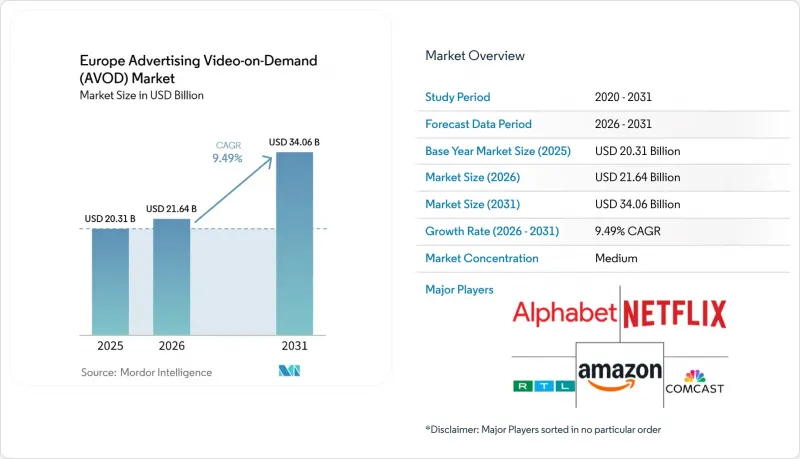
本報告按內容類型(電影、電視節目/劇集、紀錄片等)、設備類型(智慧型手機/平板電腦、智慧型電視、筆記型電腦/桌上型電腦等)、最終用戶(零售/電子商務、銀行、金融服務和保險、教育、醫療保健等)、廣告形式(前置式、片中廣告等)和地區進行細分。市場預測以美元計價。
歐洲廣告支援型影片點播 (AVOD) 市場的趨勢和洞察
擴大廣告支援型串流媒體計劃
Netflix、Amazon Prime Video 和 Disney+ 等平台推出的廣告支援套餐正在為歐洲廣告支援影片點播 (AVOD) 市場增加更多優質廣告位。 2024 年 11 月至 2025 年 4 月期間,Netflix 在西歐五個市場的廣告支援套餐觀看時間增加了 32%,顯示現有用戶使用該服務的頻率更高。同期,西班牙和英國的成長率均為 34%,使其成為該觀看模式成長最快的市場之一。 2026 年第一季,超過 60% 的 Netflix 新用戶選擇了廣告支援套餐。 Amazon Prime Video 也擴大了其內容庫,不再要求用戶單獨選擇廣告支援觀看,而是預設提供廣告支援。雖然不斷擴大的廣告位數量支撐了收入成長,但在某些廣告位上,供應量的成長速度超過了其變現效率。
向聯網電視過渡到電視觀看
2025年下半年,聯網電視在歐洲的優質影片廣告觀看量佔比達50%,較去年同期成長33%。到2025年,智慧電視在西班牙的普及率將達到94%,義大利達到93%,英國達到88%,德國達到86%,這將使廣告商能夠透過連網螢幕接觸更廣泛的家庭用戶群。這個設備基數正推動串流觀看擴大轉移到客廳螢幕,而廣告商也希望在客廳螢幕上獲得更長的觀看時間和更高的用戶參與度。此外,隨著智慧電視主螢幕擴大被用作廣告位,歐洲AVOD市場正在湧現出新型廣告位。三星廣告利用「TotalView」平台,提供覆蓋歐洲7,000萬台智慧電視的統一資料集,使廣告主能夠評估傳統電視和連網電視觀看方式的非重疊覆蓋範圍。 2024年,歐洲SVOD觀看時長成長超過200%,BVOD觀看時間成長近30%。
資料隱私和同意條例
在歐洲廣告支援的影片點播 (AVOD) 市場,隱私和用戶同意要求仍然是廣告定向投放的重要限制因素。歐洲資料保護委員會於 2025 年 11 月發布的指南明確指出,《數位服務法》(DSA) 第 26 條禁止使用特定類別的個人資料進行定向廣告投放,從而限制了可用於受眾選擇的資訊類型。這項限制是對 GDPR 已對平台和廣告商施加的義務的補充。提案的 GDPR 修正案可能允許使用者透過集中式「個人資訊管理系統」發出的訊號選擇退出個人化廣告。該提案包含對媒體服務供應商的豁免,這可能使與用戶有直接聯繫的公司受益。因此,擁有經認證的同意系統的廣播公司在歐洲影片市場將比主要依賴設備識別碼的服務更具優勢。
細分市場分析
到2025年,電視節目和劇集內容將佔歐洲廣告支援型影片點播(AVOD)市場37.29%的佔有率。這個細分市場受益於連續劇固有的重播和定期更新模式,觀眾可以在同一平台上連續觀看數週。 ITVX、TF1+、RTL+、Mediaset Infinity和ATRESplayer等廣播公司服務商利用其成熟的電視節目庫來維持劇集的穩定供應。這些節目庫允許在觀看過程中插入廣告位。這種便利性使得連續劇成為廣告商尋求在多個觀看管道中獲得重複曝光的寶貴內容。
預計到2031年,紀錄片將以10.21%的複合年成長率成長,成為成長最快的內容類別。這種形式與優質、品牌安全的觀看環境有關。 BVOD(廣播視訊點播)服務上的紀錄片節目廣告較少,並可透過直接銷售提供廣告機會。電影仍然是第二大內容類別。由於歐洲各國不同的內容窗口期安排,其AVOD(廣告支援的視訊點播)供應受到限制。其他類型的內容包括體育賽事直播片段、用戶生成影片和真人秀節目。歐洲廣播聯盟(EBU)於2026年5月擴大了英國FAST平台「歐洲歌唱大賽體育版」的發行範圍。
到2025年,智慧型手機和平板電腦將佔據歐洲AVOD市場佔有率的35.86%。行動觀看在18至34歲人群中仍然佔據重要地位,他們經常將廣告支援型服務作為付費電視的低成本替代方案,而且通常是在傳統晚間觀看時間之外。行動裝置支援短時觀看和隨時隨地觀看。其廣泛使用也為基於覆蓋率的廣告宣傳提供了支援。由於觀眾經常切換設備,因此這群人仍然是歐洲廣告支援型影片點播(AVOD)產業的核心。
預計到2031年,智慧電視的年複合成長率將達到10.06%。歐盟五國較高的家庭智慧聯網電視廣告資源。 2026年6月,三星廣告透過The Trade Desk和Google Display and Video 360平台開放了智慧型電視主螢幕廣告資源的程式化購買。在歐洲,筆記型電腦和桌上型電腦仍佔優質串流廣告觀看量的10%,主要用戶群為辦公人士。在智慧型電視普及率較低或使用者偏好外接裝置的地區,串流媒體棒和遊戲主機仍扮演著重要角色。
其他好處:
- Excel格式的市場預測(ME)表
- 3個月的分析師支持
目錄
第1章:引言
- 市場分析與定義的前提條件
- 分析範圍
第2章 分析方法
第3章執行摘要
第4章 市場狀況
- 市場概覽
- 宏觀經濟因素對市場的影響
- 市場促進因素
- 擴大廣告支援型影片點播 (AVOD) 串流媒體計劃
- 向聯網電視過渡到電視觀看
- 廣播公司擴大隨選和快速內容
- 程序化影片廣告的普及應用日益廣泛
- 聯網電視中用於分配器管理的識別訊號
- 社區運動和公共服務內容的商業化
- 市場限制因素
- 資料隱私和同意限制
- 受眾細分和庫存細分
- 過度的廣告會導致觀眾疲勞,並有疏遠觀眾的風險。
- 測量變異性和本地庫存流動性
- 產業價值鏈分析
- 監理情勢
- 技術展望
- 波特五力分析
第5章:預測市場規模與成長率
- 按內容類型
- 電影
- 電視節目和劇集內容
- 記錄
- 其他類型的內容
- 依設備類型
- 智慧型手機和平板電腦
- 智慧電視
- 筆記型電腦和桌上型電腦
- 其他類型的設備
- 最終用戶
- 媒體與娛樂
- 零售與電子商務
- 銀行、金融服務和保險業 (BFSI)
- 教育
- IT/通訊
- 醫療保健
- 其他最終用戶
- 廣告格式
- 前置式
- 中段滾動
- 後記
- 按地區
- 德國
- 英國
- 法國
- 義大利
- 西班牙
- 俄羅斯
- 其他歐洲國家
第6章 競爭情勢
- 市場集中度
- 策略趨勢
- 市佔率分析
- 公司簡介
- Alphabet Inc.
- Amazon.com, Inc.
- Netflix, Inc.
- RTL Group SA
- ITV plc
- ProSiebenSat.1 Media SE
- Paramount Global
- The Walt Disney Company
- Comcast Corporation
- Samsung Electronics Co., Ltd.
- LG Electronics Inc.
- Rakuten Group, Inc.
- Dailymotion SA
- TF1 Group
- Groupe M6
- France Televisions
- Mediaset SpA
- RAI-Radiotelevisione Italiana SpA
- Atresmedia Corporacion de Medios de Comunicacion, SA
- Channel Four Television Corporation
- Roku, Inc.
- Brightcove Inc.
- Kaltura, Inc.
- Vimeo, Inc.
- FreeWheel, A Comcast Company
- Magnite, Inc.
- The Trade Desk, Inc.
第7章 市場機會與未來展望
According to Mordor Intelligence, the Europe advertising video-on-demand (AVOD) market size is projected to be USD 20.31 billion in 2025, USD 21.64 billion in 2026, and reach USD 34.06 billion by 2031, registering a CAGR of 9.49% between 2026 and 2031.
This report is Segmented by Content Type (Movies and Films, TV Shows and Episodic Content, Documentaries, and More), Device Type (Smartphones and Tablets, Smart TVs, Laptops and Desktops, and More), End User (Retail and E-Commerce, BFSI, Education, Healthcare, and More), Ad Format (Pre-Roll, Mid-Roll, and More), and Geography. The Market Forecasts are Provided in Terms of Value (USD).
Europe Advertising Video-on-Demand (AVOD) Market Trends and Insights
Expansion of Ad-Supported Streaming Tiers
Ad-supported plans from Netflix, Amazon Prime Video, and Disney+ are adding more premium inventory to the Europe advertising video-on-demand (AVOD) market. Netflix's advertising tier recorded a 32% increase in viewing time across 5 Western European markets between November 2024 and April 2025, which showed that existing users were engaging more frequently with the service. Spain and the United Kingdom each recorded 34% growth during that period, placing both countries among the strongest markets for this viewing model. Ad-supported plans accounted for more than 60% of new Netflix subscriptions in the first quarter of 2026. Amazon Prime Video also expanded available inventory after making advertising the default option for its service, rather than requiring subscribers to choose advertising-supported viewing at sign-up. The larger inventory base is supporting revenue growth, although supply is increasing faster than monetization efficiency in some placements.
Migration of Television Viewing to Connected TV
Connected TV accounted for 50% of premium video advertising views in Europe during the second half of 2025, after increasing 33% year over year. Smart TV penetration reached 94% in Spain, 93% in Italy, 88% in the United Kingdom, and 86% in Germany during 2025, giving advertisers broad access to households through internet-connected screens. This device base is moving more streaming consumption to living-room screens, where advertisers seek longer viewing sessions and higher attention. The Europe AVOD market is also gaining new placement types as smart TV home screens become advertising inventory. Samsung Ads has used TotalView to provide a unified data set across 70 million European smart TVs, helping advertisers assess unduplicated reach across linear and connected television viewing. SVOD viewing in Europe increased more than 200% in 2024, while BVOD viewing rose nearly 30%.
Data Privacy and Consent Restrictions
Privacy and consent requirements remain a material constraint on advertising targeting in the Europe advertising video-on-demand market. The European Data Protection Board's November 2025 guidance clarified that Article 26 of the Digital Services Act prohibits targeted advertising using special-category personal data, reducing the types of information available for audience selection. The restriction adds to existing GDPR obligations for platforms and advertisers. A proposed GDPR reform could permit users to reject personalized advertising through a centralized Personal Information Management System signal. The proposal includes an exemption for media service providers, which could favor companies with direct subscriber relationships. Broadcasters with authenticated consent systems can therefore have an advantage over services that rely mainly on device-based identifiers in the Europe Advertising Video-on-Demand (AVOD) market.
Other drivers and restraints analyzed in the detailed report include:
- Broadcaster VOD and FAST Content Expansion
- Rising Programmatic Video Advertising Adoption
- Audience and Inventory Fragmentation
For complete list of drivers and restraints, kindly check the Table Of Contents.
Segment Analysis
TV Shows and Episodic Content accounted for 37.29% of the Europe advertising video-on-demand market in 2025. The segment benefits from the repeat viewing and regular release patterns associated with serialized programming, which can keep audiences returning to the same service over several weeks. Broadcaster services such as ITVX, TF1+, RTL+, Mediaset Infinity, and ATRESplayer use established television catalogs to maintain a regular supply of episodes. Those catalogs support advertising breaks within content sessions. This availability makes episodic programming useful for advertisers seeking repeat exposure over several viewing occasions.
Documentaries are projected to expand at a 10.21% CAGR through 2031, making them the fastest-growing content category. The format is associated with premium and brand-safe viewing environments. Documentary programming on BVOD services can run lower advertising loads and offer direct-sold advertising opportunities. Movies and Films remain the second-largest content category. Their AVOD supply is limited by content-windowing arrangements that differ across European countries. Other content types include live sports clips, user-generated video, and reality formats, while the European Broadcasting Union expanded Eurovision Sport to United Kingdom FAST platforms in May 2026.
Smartphones and Tablets held 35.86% of the Europe AVOD market in 2025. Mobile viewing remains important among consumers aged 18-34 who use ad-supported services as a lower-cost alternative to pay television and often watch outside traditional evening viewing hours. Mobile devices enable viewing during short sessions and outside the home. Their broad usage supports reach-based advertising campaigns. The segment remains central to the Europe advertising video-on-demand industry because viewers frequently move between devices.
Smart TVs are projected to expand at a 10.06% CAGR through 2031. High household penetration in the EU5 is supporting the shift to large-screen streaming. Advertisers value this setting because it supports longer viewing sessions and premium connected TV placements. In June 2026, Samsung Ads opened smart TV home-screen inventory to programmatic buying through The Trade Desk and Google Display and Video 360. Laptops and Desktops retained 10% of European premium streaming advertising views, mainly among office-based audiences. Streaming sticks and game consoles remain relevant where smart TV penetration is lower or viewers prefer external devices.
Complete Report Scope:
- By Content Type
- Movies and Films
- TV Shows and Episodic Content
- Documentaries
- Other Content Types
- By Device Type
- Smartphones and Tablets
- Smart TVs
- Laptops and Desktops
- Other Device Types
- By End User
- Media and Entertainment
- Retail and E-Commerce
- BFSI
- Education
- Information Technology and Telecommunications
- Healthcare
- Other End Users
- By Ad Format
- Pre-Roll
- Mid-Roll
- Post-Roll
- By Geography
- Germany
- United Kingdom
- France
- Italy
- Spain
- Russia
- Rest of Europe
List of Companies Covered in this Report:
- Alphabet Inc.
- Amazon.com, Inc.
- Netflix, Inc.
- RTL Group S.A.
- ITV plc
- ProSiebenSat.1 Media SE
- Paramount Global
- The Walt Disney Company
- Comcast Corporation
- Samsung Electronics Co., Ltd.
- LG Electronics Inc.
- Rakuten Group, Inc.
- Dailymotion SA
- TF1 Group
- Groupe M6
- France Televisions
- Mediaset S.p.A.
- RAI - Radiotelevisione Italiana S.p.A.
- Atresmedia Corporacion de Medios de Comunicacion, S.A.
- Channel Four Television Corporation
- Roku, Inc.
- Brightcove Inc.
- Kaltura, Inc.
- Vimeo, Inc.
- FreeWheel, A Comcast Company
- Magnite, Inc.
- The Trade Desk, Inc.
Additional Benefits:
- The market estimate (ME) sheet in Excel format
- 3 months of analyst support
TABLE OF CONTENTS
1 INTRODUCTION
- 1.1 Study Assumptions and Market Definition
- 1.2 Scope of the Study
2 RESEARCH METHODOLOGY
3 EXECUTIVE SUMMARY
4 MARKET LANDSCAPE
- 4.1 Market Overview
- 4.2 Impact of Macroeconomic Factors on the Market
- 4.3 Market Drivers
- 4.3.1 Expansion of Ad-Supported Streaming Tiers
- 4.3.2 Migration of Television Viewing to Connected TV
- 4.3.3 Broadcaster VOD and FAST Content Expansion
- 4.3.4 Rising Programmatic Video Advertising Adoption
- 4.3.5 Publisher-Controlled Identity Signals in Connected TV
- 4.3.6 Localized Sports and Public-Service Content Monetization
- 4.4 Market Restraints
- 4.4.1 Data Privacy and Consent Restrictions
- 4.4.2 Audience and Inventory Fragmentation
- 4.4.3 Ad-Load Fatigue and Viewer Churn Risk
- 4.4.4 Uneven Measurement and Local Inventory Liquidity
- 4.5 Industry Value-Chain Analysis
- 4.6 Regulatory Landscape
- 4.7 Technological Outlook
- 4.8 Porter's Five Forces Analysis
- 4.8.1 Bargaining Power of Suppliers
- 4.8.2 Bargaining Power of Buyers
- 4.8.3 Threat of New Entrants
- 4.8.4 Threat of Substitutes
- 4.8.5 Competitive Rivalry
5 MARKET SIZE AND GROWTH FORECASTS (VALUE)
- 5.1 By Content Type
- 5.1.1 Movies and Films
- 5.1.2 TV Shows and Episodic Content
- 5.1.3 Documentaries
- 5.1.4 Other Content Types
- 5.2 By Device Type
- 5.2.1 Smartphones and Tablets
- 5.2.2 Smart TVs
- 5.2.3 Laptops and Desktops
- 5.2.4 Other Device Types
- 5.3 By End User
- 5.3.1 Media and Entertainment
- 5.3.2 Retail and E-Commerce
- 5.3.3 BFSI
- 5.3.4 Education
- 5.3.5 Information Technology and Telecommunications
- 5.3.6 Healthcare
- 5.3.7 Other End Users
- 5.4 By Ad Format
- 5.4.1 Pre-Roll
- 5.4.2 Mid-Roll
- 5.4.3 Post-Roll
- 5.5 By Geography
- 5.5.1 Germany
- 5.5.2 United Kingdom
- 5.5.3 France
- 5.5.4 Italy
- 5.5.5 Spain
- 5.5.6 Russia
- 5.5.7 Rest of Europe
6 COMPETITIVE LANDSCAPE
- 6.1 Market Concentration
- 6.2 Strategic Moves
- 6.3 Market Share Analysis
- 6.4 Company Profiles (includes Global Level Overview, Market Level Overview, Core Segments, Financials as available, Strategic Information, Market Rank/Share, Products and Services, Recent Developments)
- 6.4.1 Alphabet Inc.
- 6.4.2 Amazon.com, Inc.
- 6.4.3 Netflix, Inc.
- 6.4.4 RTL Group S.A.
- 6.4.5 ITV plc
- 6.4.6 ProSiebenSat.1 Media SE
- 6.4.7 Paramount Global
- 6.4.8 The Walt Disney Company
- 6.4.9 Comcast Corporation
- 6.4.10 Samsung Electronics Co., Ltd.
- 6.4.11 LG Electronics Inc.
- 6.4.12 Rakuten Group, Inc.
- 6.4.13 Dailymotion SA
- 6.4.14 TF1 Group
- 6.4.15 Groupe M6
- 6.4.16 France Televisions
- 6.4.17 Mediaset S.p.A.
- 6.4.18 RAI - Radiotelevisione Italiana S.p.A.
- 6.4.19 Atresmedia Corporacion de Medios de Comunicacion, S.A.
- 6.4.20 Channel Four Television Corporation
- 6.4.21 Roku, Inc.
- 6.4.22 Brightcove Inc.
- 6.4.23 Kaltura, Inc.
- 6.4.24 Vimeo, Inc.
- 6.4.25 FreeWheel, A Comcast Company
- 6.4.26 Magnite, Inc.
- 6.4.27 The Trade Desk, Inc.
7 MARKET OPPORTUNITIES AND FUTURE OUTLOOK
- 7.1 White-Space and Unmet-Need Assessment

 非洲SVOD市場:市場佔有率分析、產業趨勢與統計及成長預測(2026-2031年)
 2026-2030年全球影音隨選市場北美廣告視訊點播(AVOD):市場佔有率分析、行業趨勢和統計數據以及成長預測(2026-2031 年)中東和非洲的廣告視訊點播 (AVOD):市場佔有率分析、行業趨勢與統計數據、成長預測 (2026-2031)南美洲廣告視訊點播 (AVOD):市場佔有率分析、產業趨勢與統計數據、成長預測 (2026-2031)交易型視訊點播 (TVOD):市場佔有率分析、行業趨勢和統計數據、成長預測 (2026-2031)廣告支援的視訊點播(AVOD):市場佔有率分析、行業趨勢和統計數據以及成長預測(2026-2031 年)訂閱式影片發送服務(SVOD):市場佔有率分析、行業趨勢和統計數據以及成長預測(2026-2031 年)
 隨選視訊市場:2026-2032年全球市場預測(依服務模式、內容類型、商品搭售結構、製作模式、語言提供、收費週期、影像品質、設備類型及供應商類型分類)
 2026-2030年全球視訊點播市場