


 |
市場調查報告書
商品編碼
2099882
交易型視訊點播 (TVOD):市場佔有率分析、行業趨勢和統計數據、成長預測 (2026-2031)Transactional Video-on-Demand (TVOD) - Market Share Analysis, Industry Trends & Statistics, Growth Forecasts (2026 - 2031) |
||||||

※ 本網頁內容可能與最新版本有所差異。詳細情況請與我們聯繫。
據 Mordor Intelligence 稱,2025 年交易型視訊點播 (VOD) 市場價值為 431.8 億美元,預計到 2031 年將達到 623 億美元,而 2026 年為 462.1 億美元,預測期(2026-2031 年)的複合年成長率為 6.16%。
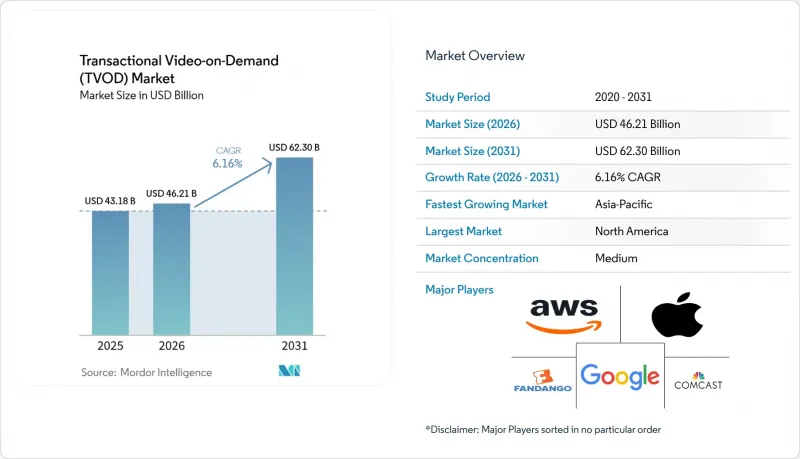
本報告按內容類型(電影、電視節目、紀錄片及其他內容)、收入模式(租賃/數位電視、購買/實體店、付費點播及其他收入模式)、設備類型(智慧型手機和平板電腦、智慧電視、筆記型電腦和桌上型電腦及其他設備)以及地區進行細分。市場預測以美元計價。
全球交易型視訊點播 (TVOD) 市場趨勢與洞察
消費者越來越願意為獲取新發行的內容付費。
當一部電影仍保留著院線發行時的熱度,更像是「新片」而非老片時,消費者的付費意願最高。高價租賃之所以有效,是因為觀眾通常將一部大片的上映視為獨特的、一次性的體驗,而不僅僅是日常片庫中的選擇。這使得在影片首發窗口期前後,交易型視訊點播市場的價格能夠遠高於傳統的片庫租賃。這種模式對於那些想要立即觀看但又不想等待後續訂閱的用戶來說尤其有效。它也有利於那些能夠加快購買速度、簡化從發現到支付流程的平台。因此,交易型視訊點播市場仍保持著訂閱套餐無法完全取代的獲利模式。
擴大各工作室和區域的高級窗戶數量。
在2025年至2026年間,本片的「黃金窗口期」策略從臨時發行轉變為更具規劃性的製片廠策略。多家大型製片廠在院線發行和TVOD(電視點播)發行之間保持了足夠的間隔,許多熱門影片至少在45天內不會在家庭付費串流平台上線。迪士尼也為其主要影片製定了較長的院線發行和數位發行間隔,部分影片間隔超過兩個月,甚至有一部影片用了102天才在TVOD平台上線。派拉蒙公開承諾至少45天的院線發行窗口期。這表明,延長「黃金窗口期」的策略正在獲得越來越多的支持,並且並非僅限於一家製片廠。這對付費視訊點播市場來說是利好消息,因為延遲的家庭發行往往會將需求集中在數位發行初期這個更集中的時期。更長的等待時間不但沒有降低觀眾的興趣,反而提升了首次付費觀看的價值。
訂閱捆綁銷售和廣告支援服務的興起正在削弱交易需求。
訂閱套餐和廣告支援服務持續對基於目錄的交易模式構成壓力,因為它們減少了用戶一次性購買舊片的需求。 2025年初,各大付費SVOD平台新增用戶中,絕大多數來自廣告支援方案。這表明,低成本的入門途徑正在吸引大量新用戶。當影片廣泛可用且不再受限於付費發行期時,免費且低成本的串流選項構成了特別顯著的威脅。這削弱了用戶對片庫影片和劇集的重複租賃行為,尤其是在每個家庭都已使用多種串流媒體服務的成熟市場。當交易型視訊點播市場試圖在提供龐大片庫而非提供即時性、獨家性或直播觀看等方面競爭時,它受到的影響最大。因此,各平台越來越專注於新上映電影和基於活動的付費點播內容,而這些內容目前尚無直接的廣告支援服務替代方案。
細分市場分析
2025年,電影和影像內容將佔付費視訊點播市場規模的58.32%。這種主導地位源自於其從院線發行到付費分發的發行模式,這種模式確保了新電影仍然是付費數位需求的主要驅動力。熱門系列電影、獲獎影片和合家歡影片營造了稀缺性,從而支撐了它們在上線訂閱服務之前以單次交易價格出售的模式。紀錄片雖然規模較小,但作為一個獨立的類別仍然佔據一席之地,觀眾願意在高品質的調查新聞和自然紀錄片廣泛上線串流服務之前就付費觀看。 「其他內容」板塊,包括體育賽事、音樂表演和早期互動形式,正在為付費視訊點播行業開闢道路,使其不再局限於電影片庫。
預計到2031年,電視節目和劇集內容將以6.72%的複合年成長率成長,成為成長最快的內容板塊。這一成長主要得益於高需求新劇集、韓劇以及付費觀看動畫的管道,而這些內容的發行權往往分散在不同地區。 Zee Entertainment旗下的「Z5」平台在2026年FIFA世界盃開幕後的兩週內,每週有效用戶加倍,達到2,700萬。該平台提供起價799印度盧比(約9.56美元)的三個月套餐。亞馬遜在印度整合的「Prime Video」和「MX Player」平台也利用TVOD(隨選視訊)模式,在熱門影集轉為訂閱發行前,提供搶先觀看的管道。因此,即使逐集觀看模式越來越依賴混合平台模式,付費視訊隨選市場仍佔有重要地位。
區域分析
2025年,北美佔據了全球視訊點播交易市場41.87%的佔有率。美國仍然是定價和使用情況的主要標桿,亞馬遜Prime Video、Apple TV和Google TV引領著整個產業的租賃和購買行為。加拿大也呈現類似的趨勢,其影片發行時間、平台存取以及消費者習慣都與美國市場高度一致。在墨西哥,付費用戶群持續成長,這得益於OXXO現金券和SPEI匯款等混合支付模式,這些模式促進了傳統信用卡用戶群以外的交易。在南美洲,巴西的視訊點播平台數量從2024年的60個增加到2025年的106個,整個生態系統中可觀看的影片超過13.8萬部。這表明,儘管價格敏感性仍然是一個挑戰,但平台基礎設施仍在蓬勃發展。
在歐洲,各市場的交易環境不盡相同,其中德國和英國在西歐主要平台中表現突出。與其他許多歐洲市場相比,德國歷來經歷了更為顯著的從實體所有權向數位購買的轉變。同時,在法國,來自廣告支援型和免費串流媒體服務的日益成長的壓力減少了消費者重複購買經典影片的空間。樂天電視(Rakuten TV)透過擴展通訊業者的分銷網路來應對這項挑戰,並於2026年3月與沃達豐西班牙電視(Vodafone TV Spain)達成合作,為其產品組合新增了約6000部租賃影片。義大利的CHILI進行了以TVOD、AVOD和B2B服務為核心的轉型升級,而沙烏地阿拉伯和阿拉伯聯合大公國仍然是全部區域商業性化程度最高的市場。
預計到2031年,亞太地區將以7.67%的複合年成長率成長,成為交易型視訊點播市場成長最快的地區。日本、印度和韓國正透過高品質的本地內容、與通訊業者的捆綁交易以及對熱門劇集和文化內容的搶先觀看的強勁需求,推動這一成長。印度的支付基礎設施尤其重要,到2025年,UPI將使大量數位用戶能夠輕鬆實現一鍵支付。此外,亞馬遜將MX Player整合到印度的Prime Video中,使印度成為多模式實驗的試驗場,在單一服務中試行SVOD、AVOD、TVOD和附加元件訂閱等模式。
其他好處:
- Excel格式的市場預測(ME)表
- 3個月的分析師支持
目錄
第1章:引言
- 研究假設和市場定義
- 調查範圍
第2章:調查方法
第3章執行摘要
第4章 市場狀況
- 市場概覽
- 市場促進因素
- 消費者越來越願意為獲取新發行的內容付費。
- 擴大各工作室和各區域的高級窗戶數量。
- 融合租賃與購買流程的混合型OTT生態系的發展
- 智慧電視和連網型設備的滲透率
- 行動錢包和一鍵支付在新興市場的普及
- CDN 和轉碼器最佳化可減少每次交易交付的摩擦。
- 市場限制因素
- 訂閱服務的捆綁銷售和廣告型服務的興起正在削弱交易需求。
- 回頭客對價格的敏感度限制了他們的購買頻率。
- 各大平台內容重複現象為差異化帶來了壓力。
- 權限分散和視窗設定日益複雜,導致營運成本上升。
- 產業價值鏈分析
- 監理情勢
- 技術展望
- 宏觀經濟因素對市場的影響
- 波特五力分析
第5章 市場規模與成長預測
- 按內容類型
- 電影和影像作品
- 電視節目和劇集內容
- 記錄
- 其他內容類型
- 按收入模式
- 租賃/DTR(下載租賃)
- 購買/EST(電子銷售)
- 按次付費觀看
- 其他收入模式
- 依設備類型
- 智慧型手機和平板電腦
- 智慧電視
- 筆記型電腦和桌上型電腦
- 其他設備
- 按地區
- 北美洲
- 美國
- 加拿大
- 墨西哥
- 南美洲
- 巴西
- 阿根廷
- 智利
- 其他南美國家
- 歐洲
- 德國
- 英國
- 法國
- 義大利
- 西班牙
- 其他歐洲國家
- 亞太地區
- 中國
- 日本
- 印度
- 韓國
- 澳洲
- 其他亞太國家
- 中東
- 沙烏地阿拉伯
- 阿拉伯聯合大公國
- 卡達
- 其他中東國家
- 非洲
- 南非
- 埃及
- 奈及利亞
- 其他非洲國家
- 北美洲
第6章 競爭情勢
- 市場集中度
- 策略趨勢
- Vendor Positioning Analysis
- 公司簡介
- Amazon.com, Inc.
- Apple Inc.
- Google LLC(Alphabet Inc.)
- Fandango Media, LLC
- Comcast Corporation
- Roku, Inc.
- Sony Group Corporation
- Rakuten Group, Inc.
- Lionsgate Plc
- Orange SA
- America Movil, SAB de CV
- Fetch TV Pty Limited
- CHILI SpA
- Pathe SAS
- SF Studios AB
- JioStar Media and Distribution Ltd.
- Zee Entertainment Enterprises Limited
- Preemz, LLC
- Plex, Inc.
- DIRECTV, LLC
第7章 市場機會與未來展望
According to Mordor Intelligence, the transactional video-on-demand market size was valued at USD 43.18 billion in 2025 and is estimated to grow from USD 46.21 billion in 2026 to reach USD 62.30 billion by 2031, at a CAGR of 6.16% during the forecast period (2026-2031).
This report is Segmented by Content Type (Movies and Films, TV Shows, Documentaries, and Other Content Types), Revenue Model (Rental/DTR, Purchase/EST, Pay-Per-View, and Other Revenue Models), Device Type (Smartphones and Tablets, Smart TVs, Laptops and Desktops, and Other Devices), and Geography. The Market Forecasts are Provided in Terms of Value (USD).
Global Transactional Video-on-Demand (TVOD) Market Trends and Insights
Rising Consumer Willingness to Pay for New-Release Access
Consumer willingness to pay is strongest when a title still carries theatrical buzz, and the release feels current rather than archival. Premium rentals work because viewers often treat a major film launch as a one-off rather than a routine catalog choice. That supports a pricing lane in the transactional video-on-demand market that sits well above standard library rentals during periods of concentrated demand around the first digital window. The model is especially effective for households that want immediate access but do not want to wait for a later subscription release. It also favors platforms that make checkout fast and reduce the number of steps between discovery and payment. As a result, the transactional video-on-demand market continues to hold a monetization position that subscription bundles do not fully absorb.
Expansion of Premium Windowing Across Studios and Territories
Premium windowing moved from a temporary release response into a more deliberate studio strategy during 2025 and 2026. Several major studios maintained meaningful gaps between theatrical release and TVOD availability, and many top films remained unavailable on home transaction channels for at least 45 days. Disney also maintained longer theatrical-to-digital release windows for major releases, with some titles extending well beyond 2 months and one reaching 102 days before TVOD availability. Paramount publicly committed to a minimum 45-day theatrical window, which signaled that longer premium timing had support beyond a single studio. This helps the transactional video-on-demand market because the delayed home debut often concentrates demand into a more intense opening digital period. Instead of diluting interest, a longer wait can raise the value of the first paid access moment.
Subscription Bundling and Ad-Supported Alternatives Eroding Transactional Demand
Subscription bundles and ad-supported services continue to pressure catalog-based transactions by reducing the need for one-off purchases of older titles. Ad-supported tiers accounted for the majority of gross subscriber additions across premium SVOD platforms in early 2025, indicating that low-cost entry points were attracting a large share of new users. Free and low-cost streaming choices are especially disruptive when the title is widely available and no longer tied to a premium release window. This weakens repeat rental behavior for library films and series, particularly in mature markets where households already carry multiple streaming services. The transactional video-on-demand market is most exposed when it tries to compete on broad catalog access rather than on urgency, exclusivity, or live viewing. That is why platforms are leaning more heavily into new-release movies and event pay-per-view, where ad-supported substitutes are less direct.
Other drivers and restraints analyzed in the detailed report include:
- Growth of Hybrid OTT Ecosystems That Bundle Rental and Purchase Flows
- Smart TV and Connected Device Penetration
- Price Sensitivity for Repeat Viewers Limiting Purchase Frequency
For complete list of drivers and restraints, kindly check the Table Of Contents.
Segment Analysis
Movies and Films accounted for 58.32% share of the transactional video-on-demand market size in 2025. This lead stems from the theatrical-to-transactional release pattern, which still makes new-release films the main driver of paid digital demand. Franchise blockbusters, awards-season titles, and family releases create scarcity that supports per-transaction pricing before subscription availability begins. Documentaries remained a smaller but distinct category, with viewers willing to pay for premium investigative and nature titles ahead of broader streaming access. The Other content types segment included sports events, music performances, and early interactive formats, giving the transactional video-on-demand industry a path beyond a film-only catalog mix.
TV Shows and Episodic Content are projected to expand at a 6.72% CAGR through 2031, making it the fastest-growing content segment. Growth is being supported by premium access to high-demand season launches, K-drama titles, and anime series, where rights are often fragmented by region. Zee Entertainment's Z5 platform doubled its weekly active users to 27 million within 2 weeks of the FIFA World Cup 2026, with transactional packages starting at INR 799 (USD 9.56) for 3 months. Amazon's combined Prime Video and MX Player platform in India also uses TVOD as the early-access layer for high-demand titles before they move into subscription circulation. This keeps the transactional video-on-demand market relevant even as episodic viewing becomes more tied to hybrid platform design.
Complete Report Scope:
- By Content Type
- Movies and Films
- TV Shows and Episodic Content
- Documentaries
- Other Content Types
- By Revenue Model
- Rental / DTR (Download to Rent)
- Purchase / EST (Electronic Sell-Through)
- Pay-Per-View
- Other Revenue Models
- By Device Type
- Smartphones and Tablets
- Smart TVs
- Laptops and Desktops
- Other Devices
- By Geography
- North America
- United States
- Canada
- Mexico
- South America
- Brazil
- Argentina
- Chile
- Rest of South America
- Europe
- Germany
- United Kingdom
- France
- Italy
- Spain
- Rest of Europe
- Asia-Pacific
- China
- Japan
- India
- South Korea
- Australia
- Rest of Asia-Pacific
- Middle East
- Saudi Arabia
- United Arab Emirates
- Qatar
- Rest of Middle East
- Africa
- South Africa
- Egypt
- Nigeria
- Rest of Africa
- North America
Geography Analysis
North America held 41.87% of the transactional video-on-demand market share in 2025. The United States remained the main pricing and volume benchmark, with Amazon Prime Video, Apple TV, and Google TV shaping common rental and purchase behavior across the category. Canada followed a similar pattern because release timing, storefront access, and consumer habits closely align with those of the US market. Mexico continued to expand its paid audience as hybrid payment models, such as OXXO cash vouchers and SPEI transfers, helped support transactions beyond the traditional credit card base. In South America, Brazil's VOD platform count rose from 60 in 2024 to 106 in 2025, with more than 138,000 titles available across the ecosystem, indicating that platform infrastructure continued to deepen even as pricing sensitivity remained an issue.
Europe remained a split transactional landscape, with Germany and the UK standing out among the larger Western European storefronts. Germany has historically shown a stronger shift from physical ownership to digital purchase than many other European markets. France faced greater pressure from ad-supported and free streaming services, reducing the room for repeat catalog transactions. Rakuten TV responded by widening operator-led distribution, including a March 2026 partnership with Vodafone TV Spain that added around 6,000 rental titles to the operator environment. Italy's CHILI moved ahead with a relaunch built around TVOD, AVOD, and business-to-business services, while Saudi Arabia and the United Arab Emirates remained the most commercially advanced markets across the broader Middle East and Africa region.
Asia-Pacific is projected to expand at a 7.67% CAGR through 2031, making it the fastest-growing region in the transactional video-on-demand market. Japan, India, and South Korea support this expansion through premium local content, telecom bundle relationships, and strong demand for early access viewing around popular franchises and cultural exports. India's payment infrastructure is especially important because UPI made one-click transactions routine for a very large digital audience in 2025. Amazon's integration of MX Player into Prime Video in India also turned the country into a multi-model test bed for SVOD, AVOD, TVOD, and add-on subscriptions within a single service.
- Amazon.com, Inc.
- Apple Inc.
- Google LLC (Alphabet Inc.)
- Fandango Media, LLC
- Comcast Corporation
- Roku, Inc.
- Sony Group Corporation
- Rakuten Group, Inc.
- Lionsgate Plc
- Orange S.A.
- America Movil, S.A.B. de C.V.
- Fetch TV Pty Limited
- CHILI S.p.A.
- Pathe SAS
- SF Studios AB
- JioStar Media and Distribution Ltd.
- Zee Entertainment Enterprises Limited
- Preemz, LLC
- Plex, Inc.
- DIRECTV, LLC
Additional Benefits:
- The market estimate (ME) sheet in Excel format
- 3 months of analyst support
TABLE OF CONTENTS
1 INTRODUCTION
- 1.1 Study Assumptions and Market Definition
- 1.2 Scope of the Study
2 RESEARCH METHODOLOGY
3 EXECUTIVE SUMMARY
4 MARKET LANDSCAPE
- 4.1 Market Overview
- 4.2 Market Drivers
- 4.2.1 Rising Consumer Willingness to Pay for New Release Access
- 4.2.2 Expansion of Premium Windowing Across Studios and Territories
- 4.2.3 Growth of Hybrid OTT Ecosystems That Bundle Rental and Purchase Flows
- 4.2.4 Smart TV and Connected Device Penetration
- 4.2.5 Mobile Wallet and One-Click Checkout Adoption in Emerging Markets
- 4.2.6 CDN and Codec Optimization Lowering Per-Transaction Delivery Friction
- 4.3 Market Restraints
- 4.3.1 Subscription Bundling and Ad-Supported Alternatives Erode Transactional Demand
- 4.3.2 Price Sensitivity for Repeat Viewers Limits Purchase Frequency
- 4.3.3 Content Overlap Across Major Platforms Compresses Differentiation
- 4.3.4 Rights Fragmentation and Windowing Complexity Raise Operating Costs
- 4.4 Industry Value Chain Analysis
- 4.5 Regulatory Landscape
- 4.6 Technological Outlook
- 4.7 Impact of Macroeconomic Factors on the Market
- 4.8 Porter's Five Forces Analysis
- 4.8.1 Threat of New Entrants
- 4.8.2 Bargaining Power of Buyers
- 4.8.3 Bargaining Power of Suppliers
- 4.8.4 Threat of Substitutes
- 4.8.5 Intensity of Competitive Rivalry
5 MARKET SIZE AND GROWTH FORECASTS (VALUE)
- 5.1 By Content Type
- 5.1.1 Movies and Films
- 5.1.2 TV Shows and Episodic Content
- 5.1.3 Documentaries
- 5.1.4 Other Content Types
- 5.2 By Revenue Model
- 5.2.1 Rental / DTR (Download to Rent)
- 5.2.2 Purchase / EST (Electronic Sell-Through)
- 5.2.3 Pay-Per-View
- 5.2.4 Other Revenue Models
- 5.3 By Device Type
- 5.3.1 Smartphones and Tablets
- 5.3.2 Smart TVs
- 5.3.3 Laptops and Desktops
- 5.3.4 Other Devices
- 5.4 By Geography
- 5.4.1 North America
- 5.4.1.1 United States
- 5.4.1.2 Canada
- 5.4.1.3 Mexico
- 5.4.2 South America
- 5.4.2.1 Brazil
- 5.4.2.2 Argentina
- 5.4.2.3 Chile
- 5.4.2.4 Rest of South America
- 5.4.3 Europe
- 5.4.3.1 Germany
- 5.4.3.2 United Kingdom
- 5.4.3.3 France
- 5.4.3.4 Italy
- 5.4.3.5 Spain
- 5.4.3.6 Rest of Europe
- 5.4.4 Asia-Pacific
- 5.4.4.1 China
- 5.4.4.2 Japan
- 5.4.4.3 India
- 5.4.4.4 South Korea
- 5.4.4.5 Australia
- 5.4.4.6 Rest of Asia-Pacific
- 5.4.5 Middle East
- 5.4.5.1 Saudi Arabia
- 5.4.5.2 United Arab Emirates
- 5.4.5.3 Qatar
- 5.4.5.4 Rest of Middle East
- 5.4.6 Africa
- 5.4.6.1 South Africa
- 5.4.6.2 Egypt
- 5.4.6.3 Nigeria
- 5.4.6.4 Rest of Africa
- 5.4.1 North America
6 COMPETITIVE LANDSCAPE
- 6.1 Market Concentration
- 6.2 Strategic Moves
- 6.3 Vendor Positioning Analysis
- 6.4 Company Profiles (includes Global Level Overview, Market Level Overview, Core Segments, Financials as available, Strategic Information, Market Rank/Share, Products and Services, Recent Developments)
- 6.4.1 Amazon.com, Inc.
- 6.4.2 Apple Inc.
- 6.4.3 Google LLC (Alphabet Inc.)
- 6.4.4 Fandango Media, LLC
- 6.4.5 Comcast Corporation
- 6.4.6 Roku, Inc.
- 6.4.7 Sony Group Corporation
- 6.4.8 Rakuten Group, Inc.
- 6.4.9 Lionsgate Plc
- 6.4.10 Orange S.A.
- 6.4.11 America Movil, S.A.B. de C.V.
- 6.4.12 Fetch TV Pty Limited
- 6.4.13 CHILI S.p.A.
- 6.4.14 Pathe SAS
- 6.4.15 SF Studios AB
- 6.4.16 JioStar Media and Distribution Ltd.
- 6.4.17 Zee Entertainment Enterprises Limited
- 6.4.18 Preemz, LLC
- 6.4.19 Plex, Inc.
- 6.4.20 DIRECTV, LLC
7 MARKET OPPORTUNITIES AND FUTURE OUTLOOK
- 7.1 White-Space and Unmet-Need Assessment

 非洲SVOD市場:市場佔有率分析、產業趨勢與統計及成長預測(2026-2031年)
 2026-2030年全球影音隨選市場北美廣告視訊點播(AVOD):市場佔有率分析、行業趨勢和統計數據以及成長預測(2026-2031 年)中東和非洲的廣告視訊點播 (AVOD):市場佔有率分析、行業趨勢與統計數據、成長預測 (2026-2031)南美洲廣告視訊點播 (AVOD):市場佔有率分析、產業趨勢與統計數據、成長預測 (2026-2031)歐洲廣告支援的影片點播(AVOD):市場佔有率分析、行業趨勢與統計數據及成長預測(2026-2031 年)廣告支援的視訊點播(AVOD):市場佔有率分析、行業趨勢和統計數據以及成長預測(2026-2031 年)訂閱式影片發送服務(SVOD):市場佔有率分析、行業趨勢和統計數據以及成長預測(2026-2031 年)
 隨選視訊市場:2026-2032年全球市場預測(依服務模式、內容類型、商品搭售結構、製作模式、語言提供、收費週期、影像品質、設備類型及供應商類型分類)
 2026-2030年全球視訊點播市場