


 |
市場調查報告書
商品編碼
2119042
南美洲廣告視訊點播 (AVOD):市場佔有率分析、產業趨勢與統計數據、成長預測 (2026-2031)South America Advertising Video-on-Demand (AVOD) - Market Share Analysis, Industry Trends & Statistics, Growth Forecasts (2026 - 2031) |
||||||

※ 本網頁內容可能與最新版本有所差異。詳細情況請與我們聯繫。
據 Mordor Intelligence 稱,南美洲 AVOD(廣告視訊點播)市場預計在 2025 年達到 58 億美元,從 2026 年的 62.1 億美元成長到 2031 年的 102.5 億美元,在預測期(2026-2031 年)內複合年成長率為 10.54%。
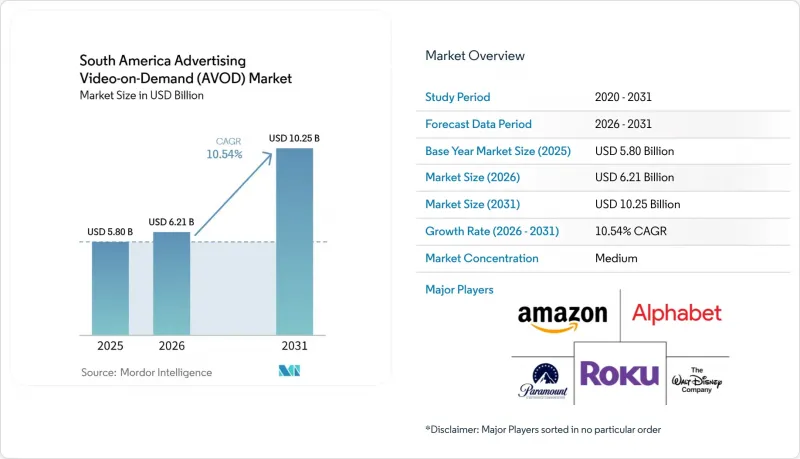
本報告按內容類型(電影、電視節目/劇集、紀錄片及其他內容)、裝置類型(智慧型手機和平板電腦、智慧型電視、筆記型電腦和桌上型電腦等)、最終用戶(媒體和娛樂等)、廣告形式(前置式、片中廣告、片尾廣告)和地區進行細分。市場預測以美元計價。
南美AVOD(廣告視訊點播)市場的趨勢與洞察
擴大低價廣告支援型串流媒體計劃
低價套餐的出現加速了南美AVOD(廣告支援視訊點播)市場的成長,其成長速度超過了單純內容支出帶來的成長。 2025年第三季度,Netflix的廣告支援套餐在受訪市場活躍帳戶的佔比達到40%(低於2024年第四季的26%)。同時,Disney+的廣告支援套餐採用率在同一時期從35%上升至44%。到2026年,巴西七大主流串流平台中有五家將提供低價的廣告支援套餐。這些套餐作用的擴大意味著廣告主可以觸及更新、更注重價格的用戶,而非僅限於有限的次要受眾。除了程序化廣告資源外,平台還在銷售贊助權,這有助於將廣告支援套餐的廣告資源定位為更具策略性的廣告產品。巴西目前正在考慮的視聽框架(例如提議引入 CONDECINE 稅和強制 10% 的本地內容撥款)可能會在未來增加對本地製作的支出並豐富內容庫。
從傳統電視廣告預算轉換到連網電視廣告時段
隨著品牌尋求線性廣播以外的影片受眾,廣告預算正轉向聯網電視。預計到2026年,巴西聯網電視的廣告支出將達到1.7億美元,而今年該國聯網電視廣告支出預計將成長23.7%。聯網電視提供受眾層面的定向畫像分析,而傳統電視主要依賴覆蓋範圍廣的指標。這種轉變要求南美AVOD(廣告視訊點播)市場的平台為廣告主提供可靠且一致的衡量結果。這項改變也促使像環球電視台(Globo)這樣的廣播公司在拓展廣播權的同時,擴大聯網電視廣告投放規模。預計到2026年,南美洲線上影片市場規模將達到340億美元,首次超過傳統電視收入。隨著廣告商對影片宣傳活動的定向和檢驗要求日益提高,這種轉變可能會持續下去。
廣告收入低迷和外匯波動
南美洲的廣告價格低於北美和西歐,這使得內容密集型平台難以建立獲利模式。尤其是在阿根廷,疲軟的貨幣匯率會導致以該地貨幣續約的廣告合約的美元價值降低。這種差異不僅是價格問題,也源自於能夠負擔大規模廣告市場高昂價格的國內廣告商數量減少。較低的每小時受眾收入限制了可用於內容創作的資金,從而限制了平台吸引優質受眾的能力。一些平台正透過與「零售媒體」夥伴關係應對這項挑戰,將廣告曝光與商業數據和可衡量的結果掛鉤。這種方法有望在不完全依賴受眾數量的情況下提供更高價值的廣告位。 Mercado Libre 報告稱,其 2026 年第一季的美元廣告收入年增 73%,這表明與商業相關的廣告工具在該地區具有吸引力。
細分市場分析
到2025年,電影將佔南美洲廣告視訊點播(AVOD)市場佔有率的39.41%,成為該地區最大的內容類型。電影庫有助於服務商發起觀看會話並維持觀看時間長度。 YouTube、亞馬遜和Tubi利用其龐大的電影庫吸引觀眾,而無需投入大規模原創製作預算。 Encripta S/A在YouTube上的免費電影分發活動,在截至2026年7月的12個月內,每月不重複訪客達到7,720萬,創造了2,000萬巴西幣(約380萬美元)的收入。同期,廣告收入佔該公司總收入的30%。該公司2026年全年營收目標為3,000萬巴西幣(約570萬美元),並正在嘗試垂直視訊格式。
紀錄片預計將成為內容類型中成長最快的,2026年至2031年的複合年成長率將達到10.94%。巴西的真實犯罪和社會紀錄片對於那些尋求在本地廣受歡迎且易於拓展至其他市場的串流服務而言,是一種理想的內容形式。 Netflix在2025年新增了55部巴西影片,過去12個月中,巴西內容在該平台上的全球觀看時間成長了39%。雖然電視劇和劇集類內容的市佔率並非最大,但它們卻能帶來最長的觀看時間。更長的觀看時間意味著每位觀眾能獲得更多的廣告曝光,並為插播廣告創造更多機會。與委託製作原創內容相比,購買巴西院線發行影片的單次觀看成本更高,這有助於豐富內容庫,並提升南美AVOD(廣告視訊點播)市場的盈利。
到2025年,智慧型手機和平板電腦將佔據南美洲廣告視訊點播(AVOD)市場31.73%的佔有率。這反映出該地區大部分地區已普遍採用「行動優先」的觀看習慣。巴西和哥倫比亞價格實惠的資料通訊套餐和較高的智慧型手機普及率促進了用戶在小螢幕上觀看影片。垂直螢幕影片,例如電視節目、體育賽事和短影片內容,特別適合行動裝置觀看。 YouTube及其相關影片服務受益於多年來在行動友善設計和分發基礎設施方面的累積。筆記型電腦、桌上型電腦和其他設備將佔據剩餘的市場佔有率,但隨著行動和智慧電視觀看的日益普及,它們的佔有率正在下降。
預計2026年至2031年間,智慧電視的複合年成長率將達到11.15%,在所有設備中成長最高。 Comscore於2025年在南美洲六個市場進行的一項調查發現,97%的連網電視用戶擁有智慧電視。大螢幕觀看非常適合家庭觀看和品牌導向宣傳活動,其廣告價格可能高於行動廣告位。家庭受眾測量技術的進步進一步強化了將電視廣告預算轉移到聯網電視的合理性。 2025年第一季在超過7,000萬台搭載三星Tizen、LG webOS、Android TV和Google TV系統的智慧型電視上推出了「Mercado Play」服務。該服務每月新增400萬用戶,並提供超過15900小時的免費廣告支援內容。
其他好處:
- Excel格式的市場預測(ME)表
- 3個月的分析師支持
目錄
第1章:引言
- 市場分析與定義的前提條件
- 分析範圍
第2章 分析方法
第3章執行摘要
第4章 市場狀況
- 市場概覽
- 宏觀經濟因素對市場的影響
- 市場促進因素
- 擴大低價廣告支援型串流媒體計劃
- 從傳統電視廣告預算轉換到連網電視廣告時段
- 智慧電視和連網電視越來越受歡迎
- 行動優先觀看體驗和經濟實惠的資料方案
- 零售媒體與串流商務的融合
- 本地語言和區域內容的貨幣化
- 市場限制因素
- 廣告收入下滑和外匯波動
- 衡量指標碎片化和跨平台歸因的局限性
- 過度的廣告會導致觀眾疲勞和疏離。
- 盜版、內容外洩和版權執法不力。
- 產業價值鏈分析
- 監理情勢
- 技術展望
- 波特五力分析
第5章:預測市場規模與成長率
- 按內容類型
- 電影
- 電視節目和劇集內容
- 記錄
- 其他類型的內容
- 依設備類型
- 智慧型手機和平板電腦
- 智慧電視
- 筆記型電腦和桌上型電腦
- 其他類型的設備
- 最終用戶
- 媒體與娛樂
- 零售與電子商務
- 銀行、金融服務和保險業 (BFSI)
- 教育
- IT/通訊
- 醫療保健
- 其他最終用戶
- 廣告格式
- 前置式
- 中段滾動
- 後記
- 按地區
- 巴西
- 阿根廷
- 哥倫比亞
- 智利
- 秘魯
- 其他南美國家
第6章 競爭情勢
- 市場集中度
- 策略趨勢
- 市佔率分析
- 公司簡介
- Alphabet Inc.
- The Walt Disney Company
- Paramount, a Skydance Corporation
- Roku, Inc.
- Amazon.com, Inc.
- Netflix, Inc.
- Warner Bros. Discovery, Inc.
- Comcast Corporation
- MercadoLibre, Inc.
- Globo Comunicacao e Participacoes SA
- Telefonica, SA
- America Movil, SAB de CV
- Samsung Electronics Co., Ltd.
- LG Electronics Inc.
- Tubi, Inc.
- Canela Media, Inc.
- TelevisaUnivision, Inc.
- Plex, Inc.
- Adsmovil, Inc.
- Entravision Communications Corporation
第7章 市場機會與未來展望
According to Mordor Intelligence, the South America advertising video-on-demand (AVOD) market size was valued at USD 5.80 billion in 2025 and estimated to grow from USD 6.21 billion in 2026 to reach USD 10.25 billion by 2031, at a CAGR of 10.54% during the forecast period (2026-2031).
This report is Segmented by Content Type (Movies and Films, TV Shows and Episodic Content, Documentaries, and Other Content Types), Device Type (Smartphones and Tablets, Smart TVs, Laptops and Desktops, and More), End User (Media and Entertainment, and More), Ad Format (Pre-Roll, Mid-Roll, and Post-Roll), and Geography. The Market Forecasts are Provided in Terms of Value (USD).
South America Advertising Video-on-Demand (AVOD) Market Trends and Insights
Expansion of Low-Cost Ad-Supported Streaming Tiers
Lower-priced plans have broadened the audience for the South America advertising video-on-demand (AVOD) market more quickly than content spending alone could have. Netflix's ad-supported plan reached 40% of active accounts across tracked markets in Q3 2025, compared with 26% in Q4 2024, while Disney+ ad-tier use rose from 35% to 44% over the same period. In 2026, 5 of Brazil's 7 major streaming platforms offered lower-cost, ad-funded access. The growing role of these plans means advertisers are reaching newer and more price-sensitive subscribers rather than a limited secondary audience. Platforms are also selling sponsorships alongside programmatic placements, helping position ad-supported inventory as a more deliberate advertising product. Brazil's pending audiovisual framework, including a proposed Condecine levy and a 10% local-content requirement, may increase local production spending and strengthen catalog depth over time
Migration of Linear Television Budgets to CTV Inventory
Advertising budgets are moving toward connected TV as brands seek video audiences beyond linear broadcast. Connected TV spending in Brazil reached USD 170 million in 2026, and the country's connected TV advertising spend is projected to grow by 23.7% this year. Connected TV offers audience-level targeting and viewer profiles, while linear television primarily relies on broader reach metrics. This change requires platforms in the South America advertising video-on-demand (AVOD) market to provide credible, consistent measurement for advertisers. It also encourages broadcasters such as Globo to expand connected TV inventory alongside their broadcast rights. Online video was projected to generate USD 34 billion in South America in 2026, surpassing traditional television revenue for the first time. The change is likely to remain durable because buyers increasingly expect targeting and verification in their video campaigns.
Low Advertising Yield and Currency Volatility
Advertising rates in South America are lower than in North America and Western Europe, creating a difficult revenue model for platforms investing in content. Currency depreciation, especially in Argentina, can reduce the USD value of advertising commitments when contracts are renewed in local currencies. The gap is not only a pricing issue, as fewer domestic advertisers can afford the rates charged in larger advertising economies. Lower revenue per viewer-hour can constrain the funds available for content, limiting a platform's ability to attract premium audiences. Some platforms are responding through retail-media partnerships that link advertising exposure to commerce data and measurable outcomes. This approach may support higher-value placements without relying solely on audience size. Mercado Libre reported that advertising revenue rose 73% year over year in USD terms in Q1 2026, showing the appeal of commerce-linked advertising tools in the region.
Other drivers and restraints analyzed in the detailed report include:
- Growth of Smart TV and Connected TV Reach
- Mobile-First Viewing and Affordable Data Packages
- Fragmented Measurement and Limited Cross-Platform Attribution
For complete list of drivers and restraints, kindly check the Table Of Contents.
Segment Analysis
Movies and films held 39.41% of the South America advertising video-on-demand (AVOD) market share in 2025, making them the largest content type in the region. Film libraries help services start viewing sessions and maintain viewing time. YouTube, Amazon, and Tubi use extensive film catalogs to attract audiences without requiring large original production budgets. Encripta S/A's free film distribution activity on YouTube reached 77.2 million unique monthly users and generated BRL 20 million (USD 3.8 million) in the 12 months ending July 2026. Advertising accounted for 30% of the company's revenue during that period. The company was targeting BRL 30 million (USD 5.7 million) for the full year of 2026 and was testing vertical video formats.
Documentaries are projected to record the fastest content-type growth at a 10.94% CAGR from 2026 to 2031. Brazilian true-crime and social documentaries have become useful formats for services seeking content that works locally and can travel to other markets. Netflix added 55 Brazilian titles in 2025, while viewing of national content on the platform increased 39% in hours watched globally during the preceding 12 months. Television shows and episodic content do not have the largest share, but they can create the longest viewing sessions. Longer sessions increase the number of available advertising impressions per viewer. They also create more suitable places for mid-roll advertising. Licensing Brazilian theatrical titles can cost less per viewing hour than commissioning original content, which supports catalog depth and the economics of the South America advertising video-on-demand (AVOD) market.
Smartphones and tablets accounted for 31.73% of the South America advertising video-on-demand (AVOD) market in 2025. This position reflects mobile-first viewing across large parts of the region. Affordable data and high smartphone use in Brazil and Colombia have supported video consumption on smaller screens. Television shows, sports, and short-form vertical video are particularly suited to mobile use. YouTube and related video services have benefited from their long-standing mobile design and distribution. Laptops, desktops, and other devices accounted for the remaining share, though their share is weakening as mobile and smart TV viewing become more common.
Smart TVs are expected to grow at an 11.15% CAGR from 2026 to 2031, the fastest rate among device types. A 2025 Comscore survey across 6 South American markets found that 97% of connected TV viewers owned a smart TV. Large-screen viewing can bring higher advertising rates than mobile placements because it supports household viewing and brand-oriented campaigns. Household-level audience measurement is improving the case for shifting television budgets to connected TV. MercadoLibre launched Mercado Play on more than 70 million smart TVs in Q1 2025 across Samsung Tizen, LG webOS, Android TV, and Google TV. The service reached 4 million monthly viewers and offered more than 15,900 hours of free ad-supported content.
Complete Report Scope:
- By Content Type
- Movies and Films
- TV Shows and Episodic Content
- Documentaries
- Other Content Types
- By Device Type
- Smartphones and Tablets
- Smart TVs
- Laptops and Desktops
- Other Device Types
- By End User
- Media and Entertainment
- Retail and E-Commerce
- BFSI
- Education
- Information Technology and Telecommunications
- Healthcare
- Other End Users
- By Ad Format
- Pre-Roll
- Mid-Roll
- Post-Roll
- By Geography
- Brazil
- Argentina
- Colombia
- Chile
- Peru
- Rest of South America
List of Companies Covered in this Report:
- Alphabet Inc.
- The Walt Disney Company
- Paramount, a Skydance Corporation
- Roku, Inc.
- Amazon.com, Inc.
- Netflix, Inc.
- Warner Bros. Discovery, Inc.
- Comcast Corporation
- MercadoLibre, Inc.
- Globo Comunicacao e Participacoes S.A.
- Telefonica, S.A.
- America Movil, S.A.B. de C.V.
- Samsung Electronics Co., Ltd.
- LG Electronics Inc.
- Tubi, Inc.
- Canela Media, Inc.
- TelevisaUnivision, Inc.
- Plex, Inc.
- Adsmovil, Inc.
- Entravision Communications Corporation
Additional Benefits:
- The market estimate (ME) sheet in Excel format
- 3 months of analyst support
TABLE OF CONTENTS
1 INTRODUCTION
- 1.1 Study Assumptions and Market Definition
- 1.2 Scope of the Study
2 RESEARCH METHODOLOGY
3 EXECUTIVE SUMMARY
4 MARKET LANDSCAPE
- 4.1 Market Overview
- 4.2 Impact of Macroeconomic Factors on the Market
- 4.3 Market Drivers
- 4.3.1 Expansion of Low-Cost Ad-Supported Streaming Tiers
- 4.3.2 Migration of Linear Television Budgets to CTV Inventory
- 4.3.3 Growth of Smart TV and Connected TV Reach
- 4.3.4 Mobile-First Viewing and Affordable Data Packages
- 4.3.5 Retail-Media and Streaming-Commerce Convergence
- 4.3.6 Local-Language and Regional Content Monetization
- 4.4 Market Restraints
- 4.4.1 Low Advertising Yield and Currency Volatility
- 4.4.2 Fragmented Measurement and Limited Cross-Platform Attribution
- 4.4.3 Ad-Load Fatigue and Viewer Churn
- 4.4.4 Piracy, Content Leakage, and Weak Copyright Enforcement
- 4.5 Industry Value Chain Analysis
- 4.6 Regulatory Landscape
- 4.7 Technological Outlook
- 4.8 Porter's Five Forces Analysis
- 4.8.1 Threat of New Entrants
- 4.8.2 Bargaining Power of Suppliers
- 4.8.3 Bargaining Power of Buyers
- 4.8.4 Threat of Substitutes
- 4.8.5 Competitive Rivalry
5 MARKET SIZE AND GROWTH FORECASTS (VALUE)
- 5.1 By Content Type
- 5.1.1 Movies and Films
- 5.1.2 TV Shows and Episodic Content
- 5.1.3 Documentaries
- 5.1.4 Other Content Types
- 5.2 By Device Type
- 5.2.1 Smartphones and Tablets
- 5.2.2 Smart TVs
- 5.2.3 Laptops and Desktops
- 5.2.4 Other Device Types
- 5.3 By End User
- 5.3.1 Media and Entertainment
- 5.3.2 Retail and E-Commerce
- 5.3.3 BFSI
- 5.3.4 Education
- 5.3.5 Information Technology and Telecommunications
- 5.3.6 Healthcare
- 5.3.7 Other End Users
- 5.4 By Ad Format
- 5.4.1 Pre-Roll
- 5.4.2 Mid-Roll
- 5.4.3 Post-Roll
- 5.5 By Geography
- 5.5.1 Brazil
- 5.5.2 Argentina
- 5.5.3 Colombia
- 5.5.4 Chile
- 5.5.5 Peru
- 5.5.6 Rest of South America
6 COMPETITIVE LANDSCAPE
- 6.1 Market Concentration
- 6.2 Strategic Moves
- 6.3 Market Share Analysis
- 6.4 Company Profiles (includes Global Level Overview, Market Level Overview, Core Segments, Financials as available, Strategic Information, Market Rank/Share, Products and Services, Recent Developments)
- 6.4.1 Alphabet Inc.
- 6.4.2 The Walt Disney Company
- 6.4.3 Paramount, a Skydance Corporation
- 6.4.4 Roku, Inc.
- 6.4.5 Amazon.com, Inc.
- 6.4.6 Netflix, Inc.
- 6.4.7 Warner Bros. Discovery, Inc.
- 6.4.8 Comcast Corporation
- 6.4.9 MercadoLibre, Inc.
- 6.4.10 Globo Comunicacao e Participacoes S.A.
- 6.4.11 Telefonica, S.A.
- 6.4.12 America Movil, S.A.B. de C.V.
- 6.4.13 Samsung Electronics Co., Ltd.
- 6.4.14 LG Electronics Inc.
- 6.4.15 Tubi, Inc.
- 6.4.16 Canela Media, Inc.
- 6.4.17 TelevisaUnivision, Inc.
- 6.4.18 Plex, Inc.
- 6.4.19 Adsmovil, Inc.
- 6.4.20 Entravision Communications Corporation
7 MARKET OPPORTUNITIES AND FUTURE OUTLOOK
- 7.1 White-space and Unmet-Need Assessment

 非洲SVOD市場:市場佔有率分析、產業趨勢與統計及成長預測(2026-2031年)
 2026-2030年全球影音隨選市場北美廣告視訊點播(AVOD):市場佔有率分析、行業趨勢和統計數據以及成長預測(2026-2031 年)中東和非洲的廣告視訊點播 (AVOD):市場佔有率分析、行業趨勢與統計數據、成長預測 (2026-2031)歐洲廣告支援的影片點播(AVOD):市場佔有率分析、行業趨勢與統計數據及成長預測(2026-2031 年)交易型視訊點播 (TVOD):市場佔有率分析、行業趨勢和統計數據、成長預測 (2026-2031)廣告支援的視訊點播(AVOD):市場佔有率分析、行業趨勢和統計數據以及成長預測(2026-2031 年)訂閱式影片發送服務(SVOD):市場佔有率分析、行業趨勢和統計數據以及成長預測(2026-2031 年)
 隨選視訊市場:2026-2032年全球市場預測(依服務模式、內容類型、商品搭售結構、製作模式、語言提供、收費週期、影像品質、設備類型及供應商類型分類)
 2026-2030年全球視訊點播市場