


 |
市場調查報告書
商品編碼
2118169
複合板岩屋頂材料:市場佔有率分析、產業趨勢與統計、成長預測(2026-2031)Composite Slate Roofing - Market Share Analysis, Industry Trends & Statistics, Growth Forecasts (2026 - 2031) |
||||||

※ 本網頁內容可能與最新版本有所差異。詳細情況請與我們聯繫。
根據 Mordor Intelligence 預測,複合板岩屋頂市場規模預計將在 2025 年達到 24.2 億美元,2026 年達到 25.4 億美元,到 2031 年達到 33.4 億美元,2026 年至 2031 年的複合年成長率為 5.63%。
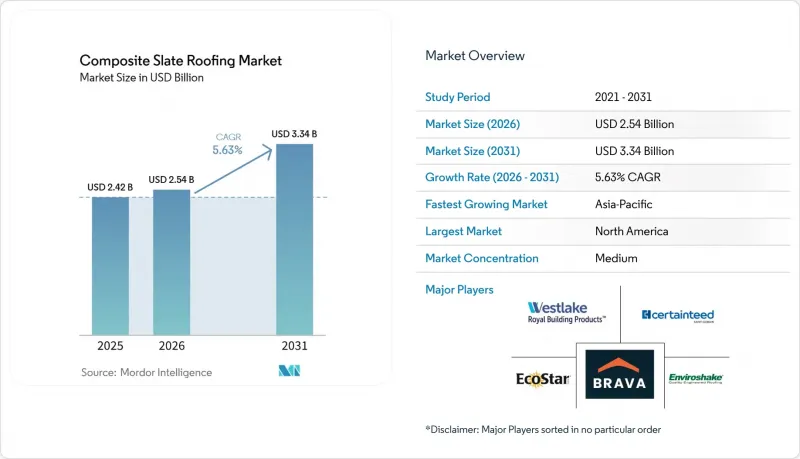
本報告按類型(瓦片、瓷磚、板材)、材料(聚合物複合材料、橡膠複合材料等)、最終用戶(住宅等)、施工類型(新建、維修/屋頂改造)、屋頂類型(平屋頂、坡屋頂)和地區(亞太地區、北美、歐洲、南美、中東和非洲)進行細分。市場預測以美元計價。
全球複合板岩屋頂市場趨勢及洞察
市場對高度耐用且維護成本極低的屋頂解決方案的需求日益成長。
複合板岩屋頂市場正受益於一個明顯的趨勢,即市場對維護週期更長、維護成本更低的屋頂系統的需求日益成長。製造商通常為這類產品提供50年或更長時間的保固,這遠遠超過了人們對標準瀝青屋頂的預期,並改變了業主對更換時間和長期價值的評估方式。複合板岩屋頂市場也受惠於日益完善的環境認證系統。例如,EcoStar已為其屋頂產品獲得了UL認證的環境產品聲明(EPD),強調其產品碳含量更低,對掩埋的負擔更小。因此,買家越來越傾向於將屋頂視為長壽命的建築構件,而非需要反覆維修的零件,並要求在單一規範中同時滿足防火、結構完整性、耐候性和永續性。這種轉變在老舊住宅存量中最為顯著,並且在公共部門採購中也日益明顯,更長的生命週期規劃已經開始影響建築圍護結構的決策。
易受強風暴侵襲地區的屋頂更換和維修活動增加。
由於天氣因素造成的損壞而非劣化磨損,複合板岩屋頂市場正受益於更換週期的增加。到2025年,更換住宅屋頂的平均成本將達到17,631美元,這進一步凸顯了選擇能夠提高耐久性和獲得有利保險理賠結果的材料的經濟重要性。抗衝擊的4級系統與保險費折扣的關聯性日益增強,使得重新鋪設屋頂比簡單的維修更具經濟意義。鑑於維修和重新鋪設屋頂已經佔據了最大的市場入口,這些天氣狀況和保險趨勢進一步鞏固了重新鋪設屋頂在複合板岩屋頂市場中的結構性地位。
與傳統屋頂材料相比,初始安裝成本較高
複合板岩屋頂市場在推廣方面仍面臨許多障礙,因為其安裝系統成本遠高於標準瀝青瓦。這種成本差距在價格敏感的住宅市場、低收入郊區住宅以及開發中地區尤為突出,因為在這些地區,屋頂主要出於功能性考慮,設計或抗災能力並非首要考慮因素。造成這項挑戰的原因在於,儘管與天然板岩相比,複合板岩屋頂的價值提案最為顯著,但實際上,許多客戶需要在複合板岩產品和建築瀝青瓦之間做出選擇。 Brava Roof Tile公司於2026年4月下調MultiWide板岩屋頂系統的價格,顯示供應商正在積極努力提高產品的可及性,同時又不偏離其以性能為導向的市場定位。此舉也表明,該領域的利潤率管理仍然面臨挑戰,利潤率受到再生聚合物供應以及用於增強防火和耐候性的特殊添加劑成本的影響。在複合板岩屋頂材料市場,透過提高消費者對產品生命週期價值的認知以及提供保險相關優惠來促進其推廣,被認為比單純加劇價格競爭更為有效。
細分市場分析
預計到2025年,瓦片將佔複合板岩屋頂市場54.72%的佔有率。這反映了瓦片非常適合屋頂更換流程,而這種流程在成熟的住宅市場中十分普遍。瓦片的規格與現有承包商的施工習慣相符,使施工流程保持熟悉,並減少更換過程中的干擾。這一點在北美尤其重要,因為該地區現有住宅的需求遠高於新建住宅。此外,瓦片還有助於快速報價、簡化工人排班,並便於住宅在時間緊迫的風暴相關更換項目中理解施工流程。因此,瓦片有望繼續保持主導地位,因為它能夠滿足大量翻新需求的營運要求。
預計到2031年,面板將以6.24%的年複合成長率(CAGR)實現最快成長,這主要得益於人們對互鎖系統日益成長的興趣,因為互鎖系統能夠提高安裝效率和耐候性。 FWAVE的XTM平台正是這項轉變的典範,它將4級抗衝擊性和150英里/小時的抗風性能與互鎖設計結合。面板在商業領域的應用也日益成長,專案業主正在尋求外觀高階、抗風性能更強的屋頂解決方案。瓦片在公共場所和注重設計的應用中仍然佔據重要地位,因為更傳統的形狀在長期使用週期中仍然具有價值。此外,能源之星(ENERGY STAR)屋頂產品標準正在推動以反射性能為重點的產品開發,以支持能夠更有效地整合塗層和設計表面特性的產品形式。因此,在複合板岩屋頂市場,雖然瓦片預計仍將保持其銷售領先地位,但面板的需求預計將在商業場所、抗災應用場景和高性能應用場景中擴大。
聚合物複合複合材料憑藉其優異的色彩穩定性、抗衝擊性和耐候性,預計2025年將佔據複合板岩屋頂市場43.57%的佔有率。領先的製造商透過對配方、品質一致性和產品認證的全面管理,已有效地實現了這種材料的商業化,並涵蓋了廣泛的地理範圍。 Westlake Royal Building Products, Inc. 以這些性能優勢為核心,透過正式的產品文件和對符合現行建築規範的支持,打造了其「DaVinci Roofscapes」系列產品。複合材料和纖維水泥複合材料在一些特定細分市場仍有需求,這些市場會考慮抗冰雹性能、使用再生材料或中等價格等因素來影響購買決策。複合板岩屋頂產業仍然高度依賴聚合物化學,因為它能夠最全面地在單一系統中平衡重量、外觀、防火性和抗衝擊性。
預計到2031年,再生塑膠複合複合材料將以6.52%的複合年成長率(CAGR)實現最高成長率,顯示永續性標準正開始重塑複合板岩屋頂市場的材料選擇趨勢。商業買家和公共項目越來越關注再生材料的含量、環境聲明以及支持在整個生命週期中減少環境影響的採購規則。一項關於採用廢棄塑膠的農業廢棄物衍生屋頂配方的同行評審研究預計將於2026年發表,該研究預計將論證這些材料可以在減少隱含碳排放的同時,獲得未來屋頂需求的顯著佔有率,從而印證了該領域已確立的商業性方向。 EcoStar的屋頂系列產品使用高達80%的升級回收材料,並已獲得UL認證的環境產品聲明(EPD),這是一個具體的商業案例,表明再生材料的提案正在從概念走向規範。雖然橡膠和纖維水泥只要其具體技術特性符合專案需求,仍將繼續發揮重要作用,但就材料主導、差異化和永續性驅動的成長而言,再生塑膠在複合板岩屋頂市場中正日益佔據主導地位。
區域分析
預計到2025年,北美將佔複合板岩屋頂市場41.82%的佔有率,並有望繼續維持全球需求中心地位。美國仍然是最大的貢獻者,這得益於活躍的屋頂更換工程、針對抗衝擊材料的既定保險激勵措施以及不斷老化的住宅存量持續推動的更換需求。 2024年,美國屋頂維修和更換總成本接近310億美元,其中風災和冰雹造成的損失佔住宅相關保險索賠的一半以上。加州將於2026年1月生效的2025年能源標準預計將催生一個新的需求細分市場,該市場將青睞符合標準的輕質、隔熱性能良好的屋頂系統。在加拿大,冬季耐久性和抗冰雹性能的要求支撐了區域需求,而在墨西哥,儘管規模較小,但高階住宅開發領域仍然存在顯著的市場機會。
預計歐洲將佔據複合板岩屋頂市場第二大佔有率,這主要得益於維修活動的活性化、對建築圍護結構日益嚴格的要求以及對高品質屋頂外觀的持續關注。歐盟關於建築能效的指令以及德國的GEG和法國的RE2020等國家標準,正在推動建築圍護結構材料性能認證需求的成長。此外,環境產品聲明(EPD)在歐洲採購中的重要性日益凸顯,這使得像EcoStar這樣能夠提供檢驗的生命週期文件的公司受益匪淺。儘管在該地區,複合材料在歷史建築維修的應用仍存在一些結構性限制,但它仍然是複合板岩屋頂市場的重要領域,尤其是在豪華住宅和維修中。
亞太地區預計將成為複合板岩屋頂市場成長最快的地區,到2031年複合年成長率預計為6.34%。這一成長主要得益於中國、印度和整個東南亞地區的建設活動,以及都市區和公共建築對高階屋頂材料的日益認可。日本和韓國也是重要的市場,因為隨著抗災建築標準的提高和惡劣天氣條件的日益增多,輕質、抗衝擊的屋頂系統的價值也在不斷提升。雖然南美洲、中東和非洲目前市場規模較小,但巴西和沙烏地阿拉伯提供了明確的市場准入機會,對豪華住宅的需求以及大量的在建項目將推動細分市場的擴張。在太陽輻射強、氣候條件惡劣的地區,複合板岩屋頂市場可以透過提供低維護成本、抗紫外線、耐用性和高階外觀等優勢,在競爭中脫穎而出。
其他好處:
- Excel格式的市場預測(ME)表
- 3個月的分析師支持
目錄
第1章:引言
- 研究假設和市場定義
- 調查範圍
第2章:調查方法
第3章執行摘要
第4章 市場狀況
- 市場概覽
- 市場促進因素
- 市場對高耐久性且維護成本低的屋頂材料的需求日益成長。
- 易受強風暴侵襲地區的屋頂更換和維修工作量增加。
- 嚴格的建築規範與高效率的建築圍護結構標準
- 市場對輕質天然石板屋頂材料替代品的需求日益成長。
- 增加對抗衝擊和耐候屋頂系統的投資。
- 市場限制因素
- 與傳統屋頂材料相比,其初始安裝成本較高。
- 高階應用中天然板岩的性能與美學偏好
- 不同地區的建築規範和產品認證要求有差異
- 價值鏈分析
- 波特五力分析
第5章 市場規模與成長預測
- 按類型
- 單身的
- 瓦
- 控制板
- 材料
- 聚合物複合材料
- 橡膠複合材料
- 纖維水泥複合材料
- 再生塑膠複合複合材料
- 其他複合材料
- 最終用戶
- 住宅
- 商業
- 產業
- 依建築類型
- 新建工程
- 維修和重鋪屋頂
- 按屋頂類型
- 平屋頂
- 斜屋頂
- 按地區
- 亞太地區
- 中國
- 印度
- 日本
- 韓國
- 其他亞太國家
- 北美洲
- 美國
- 加拿大
- 墨西哥
- 歐洲
- 德國
- 英國
- 法國
- 義大利
- 俄羅斯
- 其他歐洲國家
- 南美洲
- 巴西
- 阿根廷
- 其他南美國家
- 中東和非洲
- 沙烏地阿拉伯
- 南非
- 其他中東和非洲國家
- 亞太地區
第6章 競爭情勢
- 市場集中度
- 策略趨勢
- 市佔率和排名分析
- 公司簡介
- Atlas Roofing Corporation
- Baker Roofing Company
- Boral Roofing
- BRAVA Roof Tile
- CEDUR
- CertainTeed, LLC
- Colorado Roofing Contractors LLC
- Ecostar
- Enviroshake Quality Engineered Roofing
- Euroshield
- FWAVE
- GAF Materials LLC
- IKO Ltd
- Owens Corning
- TAMKO Building Products LLC
- Westlake Royal Building Products
第7章 市場機會與未來展望
According to Mordor Intelligence, the composite slate roofing market size reached USD 2.42 billion in 2025 and USD 2.54 billion in 2026, before reaching USD 3.34 billion by 2031, and is expected to register a CAGR of 5.63% from 2026 to 2031.
This report is Segmented by Type (Shingles, Tiles, Panels), Material Type (Polymer Composite, Rubber Composite, and More), End User (Residential, and More), Installation Type (New Construction, Renovation and Replacement), Roof Type (Flat Roofs, Sloped Roofs), and Geography (Asia-Pacific, North America, Europe, South America, Middle East and Africa). The Market Forecasts are Provided in Terms of Value (USD).
Global Composite Slate Roofing Market Trends and Insights
Growing Demand for Durable and Low-Maintenance Roofing Solutions
The composite slate roofing market benefits from a clear shift toward roofing systems that offer longer service intervals and lower upkeep over an asset's lifecycle. Manufacturers commonly sell products in this category with warranties of 50 years or more, which significantly exceeds standard asphalt expectations and changes how owners assess replacement timing and long-term value. The composite slate roofing market also gains from stronger environmental documentation. For instance, EcoStar secured a UL-certified Environmental Product Declaration that highlights lower embodied carbon and reduced landfill pressure for its roofing products. As a result, buyers increasingly view roofs less as recurring repair items and more as long-lived building components that must address fire performance, structural integrity, weather exposure, and sustainability requirements within a single specification. This shift is strongest in aging residential stock and is also becoming more visible in institutional procurement, where longer lifecycle planning already influences building envelope decisions.
Increasing Roof Replacement and Renovation Activities in Storm-Prone Regions
The composite slate roofing market benefits from a replacement cycle increasingly linked to weather-related losses rather than age-based wear. In 2025, the average residential roof replacement cost reached USD 17,631, increasing the financial importance of selecting materials that improve durability and claim outcomes. Class 4 impact-rated systems are increasingly associated with insurance premium discounts, making roof replacement decisions financially significant beyond the repair scope alone. Since renovation and replacement already represented the largest installation pathway, this weather and insurance dynamic continues to reinforce the structural role of reroofing in the composite slate roofing market.
Higher Initial Installation Cost Compared to Conventional Roofing Materials
The composite slate roofing market continues to face a significant adoption barrier, as installed system costs remain well above those of standard asphalt alternatives. This cost gap is especially important in price-sensitive residential segments, lower-income suburban applications, and developing regions, where roofing remains a functional purchase before it becomes a design or resilience-driven decision. The challenge persists because the category's value proposition is strongest when buyers compare it with natural slate, while many customers are actually choosing between composite products and architectural asphalt shingles. Brava Roof Tile's price reduction on its Multi-Width Slate Roof System in April 2026 would indicate that suppliers are actively trying to improve accessibility without moving away from performance-based positioning. This move would also suggest that margin management remains tight in a segment influenced by recycled polymer availability and the cost of specialized additives that support fire and weather performance. For the composite slate roofing market, broader adoption is more likely to improve through lifecycle value education and insurance-linked benefits than through price compression alone.
Other drivers and restraints analyzed in the detailed report include:
- Stringent Building Codes and Energy-Efficient Building Envelope Standards
- Rising Preference for Lightweight Alternatives to Natural Slate Roofing
- Performance And Aesthetic Preference For Natural Slate In Premium Applications
For complete list of drivers and restraints, kindly check the Table Of Contents.
Segment Analysis
Shingles are expected to account for 54.72% of the composite slate roofing market size in 2025, reflecting their strong fit with the dominant reroofing workflow across mature residential markets. The shingle format aligns with existing contractor practices, keeps labor processes familiar, and reduces disruption in replacement projects. This factor is especially important in North America, where existing homes account for a large share of demand, rather than greenfield construction. Shingles also support faster quoting, simpler crew planning, and easier homeowner acceptance during time-sensitive, storm-related replacements. As a result, the composite slate roofing market is expected to keep shingles in the leading position, as the format aligns with the operational requirements of high-volume renovation demand.
Panels are projected to record the fastest growth, at a CAGR of 6.24% through 2031, driven by rising interest in interlocking systems that improve installation efficiency and weather performance. FWAVE's XTM platform highlights this shift by combining an interlocking design with Class 4 impact resistance and a 150 mph wind warranty. Panels are also gaining traction in commercial settings, where project owners seek roofing solutions that offer a premium appearance and stronger wind-uplift performance. Tiles remain relevant in institutional and design-led applications, where a more traditional profile continues to hold value over longer specification cycles. ENERGY STAR roof product criteria are also encouraging product development focused on reflective performance, supporting formats that can integrate coatings and engineered surface behavior more effectively. Therefore, the composite slate roofing market is expected to retain shingle volume leadership while panel demand expands across commercial, resilience-led, and performance-sensitive use cases.
Polymer composite is expected to capture 43.57% of the composite slate roofing market share in 2025, supported by its established balance of color stability, impact resistance, and weather durability. Large manufacturers have commercialized this material base effectively by controlling formulation, quality consistency, and product certification across wider geographic footprints. Westlake Royal Building Products has positioned DaVinci Roofscapes around these performance strengths through formal product documentation and current code compliance support. Rubber composite and fiber cement composite continue to serve targeted niches where hail resilience, recycled feedstock use, or mid-market pricing can influence purchasing decisions. The composite slate roofing industry continues to depend heavily on polymer chemistry because it offers the broadest route to balancing weight, appearance, fire performance, and impact resistance in a single system.
Recycled plastic composite is forecast to register the fastest growth, at a CAGR of 6.52% through 2031, indicating that sustainability criteria are beginning to reshape material preferences within the composite slate roofing market. Commercial buyers and public projects are paying closer attention to recycled content, environmental declarations, and procurement rules that support lower lifecycle impact. A 2026 peer-reviewed study on waste plastics-integrated agro-waste roofing formulations is expected to argue that such materials could capture a meaningful share of future roofing demand while reducing embodied carbon, supporting the commercial direction already visible in this segment. EcoStar's roofing range, which uses up to 80% upcycled content and is supported by a UL-certified Environmental Product Declaration, provides a direct commercial example of how the recycled-content proposition is moving from concept to specification. Rubber and fiber cement will remain relevant where their specific technical profiles fit project needs, but recycled plastics are increasingly setting the pace for material innovation, differentiation, and sustainability-led growth within the composite slate roofing market.
Complete Report Scope:
- By Type
- Shingles
- Tiles
- Panels
- By Material Type
- Polymer Composite
- Rubber Composite
- Fiber Cement Composite
- Recycled Plastic Composite
- Other Composite Materials
- By End User
- Residential
- Commercial
- Industrial
- By Installation Type
- New Construction
- Renovation and Replacement
- By Roof Type
- Flat Roofs
- Sloped Roofs
- By Geography
- Asia-Pacific
- China
- India
- Japan
- South Korea
- Rest of Asia-Pacific
- North America
- United States
- Canada
- Mexico
- Europe
- Germany
- United Kingdom
- France
- Italy
- Russia
- Rest of Europe
- South America
- Brazil
- Argentina
- Rest of South America
- Middle-East and Africa
- Saudi Arabia
- South Africa
- Rest of Middle-East and Africa
- Asia-Pacific
Geography Analysis
North America is projected to hold 41.82% of the composite slate roofing market size in 2025, keeping the region at the center of global demand. The United States remains the largest contributor, supported by strong reroofing activity, well-established insurance incentives for impact-rated materials, and aging housing stock that continues to drive replacement demand. The value of roof repair and replacement costs in the United States reached nearly USD 31 billion in 2024, with wind and hail accounting for more than half of all residential claims. California's 2025 energy standards, effective January 2026, are expected to add a code-driven demand layer that favors compliant, lightweight, and thermally efficient roofing systems. Canada supports regional demand through requirements for winter durability and exposure to hail, while Mexico remains a smaller but visible opportunity in upper-tier residential development.
Europe is expected to hold the second-largest share of the composite slate roofing market, supported by renovation activity, stricter building envelope expectations, and the continued relevance of premium roof aesthetics. The EU Energy Performance of Buildings Directive and national standards, such as Germany's GEG and France's RE2020, support stronger demand for documented material performance in the building envelope. Environmental Product Declarations are also becoming more important in European procurement, benefiting companies that can provide verified lifecycle documentation, such as EcoStar. The region still presents structural limitations for composites in heritage work, but it remains an important premium and retrofit geography for the composite slate roofing market.
Asia-Pacific is expected to be the fastest-growing region in the composite slate roofing market, with a forecast CAGR of 6.34% through 2031. Construction activity across China, India, and Southeast Asia, along with rising acceptance of premium roofing materials in urban and institutional applications, supports this growth. Japan and South Korea also add relevance, as disaster-resilient building standards and weather exposure increase the value of lightweight, impact-resistant roofing systems. South America and the Middle East and Africa remain smaller in current scale, but Brazil and Saudi Arabia offer visible entry opportunities where premium residential demand and construction pipelines support niche expansion. In high-solar and weather-stressed settings, the composite slate roofing market can differentiate through lower maintenance needs, UV stability, and the ability to combine resilience with a premium appearance.
- Atlas Roofing Corporation
- Baker Roofing Company
- Boral Roofing
- BRAVA Roof Tile
- CEDUR
- CertainTeed, LLC
- Colorado Roofing Contractors LLC
- Ecostar
- Enviroshake Quality Engineered Roofing
- Euroshield
- FWAVE
- GAF Materials LLC
- IKO Ltd
- Owens Corning
- TAMKO Building Products LLC
- Westlake Royal Building Products
Additional Benefits:
- The market estimate (ME) sheet in Excel format
- 3 months of analyst support
TABLE OF CONTENTS
1 Introduction
- 1.1 Study Assumptions and Market Definition
- 1.2 Scope of the Study
2 Research Methodology
3 Executive Summary
4 Market Landscape
- 4.1 Market Overview
- 4.2 Market Drivers
- 4.2.1 Growing Demand for Durable and Low-Maintenance Roofing Solutions
- 4.2.2 Increasing Roof Replacement and Renovation Activities in Storm-Prone Regions
- 4.2.3 Stringent Building Codes and Energy-Efficient Building Envelope Standards
- 4.2.4 Rising Preference for Lightweight Alternatives to Natural Slate Roofing
- 4.2.5 Growing Investment in Impact-Resistant and Weather-Resilient Roofing Systems
- 4.3 Market Restraints
- 4.3.1 Higher Initial Installation Cost Compared to Conventional Roofing Materials
- 4.3.2 Performance and Aesthetic Preference for Natural Slate in Premium Applications
- 4.3.3 Variations in Regional Building Codes and Product Certification Requirements
- 4.4 Value Chain Analysis
- 4.5 Porter's Five Forces Analysis
- 4.5.1 Threat of New Entrants
- 4.5.2 Bargaining Power of Suppliers
- 4.5.3 Bargaining Power of Buyers
- 4.5.4 Threat of Substitutes
- 4.5.5 Competitive Rivalry
5 Market Size and Growth Forecasts (Value)
- 5.1 By Type
- 5.1.1 Shingles
- 5.1.2 Tiles
- 5.1.3 Panels
- 5.2 By Material Type
- 5.2.1 Polymer Composite
- 5.2.2 Rubber Composite
- 5.2.3 Fiber Cement Composite
- 5.2.4 Recycled Plastic Composite
- 5.2.5 Other Composite Materials
- 5.3 By End User
- 5.3.1 Residential
- 5.3.2 Commercial
- 5.3.3 Industrial
- 5.4 By Installation Type
- 5.4.1 New Construction
- 5.4.2 Renovation and Replacement
- 5.5 By Roof Type
- 5.5.1 Flat Roofs
- 5.5.2 Sloped Roofs
- 5.6 By Geography
- 5.6.1 Asia-Pacific
- 5.6.1.1 China
- 5.6.1.2 India
- 5.6.1.3 Japan
- 5.6.1.4 South Korea
- 5.6.1.5 Rest of Asia-Pacific
- 5.6.2 North America
- 5.6.2.1 United States
- 5.6.2.2 Canada
- 5.6.2.3 Mexico
- 5.6.3 Europe
- 5.6.3.1 Germany
- 5.6.3.2 United Kingdom
- 5.6.3.3 France
- 5.6.3.4 Italy
- 5.6.3.5 Russia
- 5.6.3.6 Rest of Europe
- 5.6.4 South America
- 5.6.4.1 Brazil
- 5.6.4.2 Argentina
- 5.6.4.3 Rest of South America
- 5.6.5 Middle-East and Africa
- 5.6.5.1 Saudi Arabia
- 5.6.5.2 South Africa
- 5.6.5.3 Rest of Middle-East and Africa
- 5.6.1 Asia-Pacific
6 Competitive Landscape
- 6.1 Market Concentration
- 6.2 Strategic Moves
- 6.3 Market Share (%)/Ranking Analysis
- 6.4 Company Profiles (includes Global Overview, Market Overview, Core Segments, Financials as available, Strategic Information, Products and Services, and Recent Developments)
- 6.4.1 Atlas Roofing Corporation
- 6.4.2 Baker Roofing Company
- 6.4.3 Boral Roofing
- 6.4.4 BRAVA Roof Tile
- 6.4.5 CEDUR
- 6.4.6 CertainTeed, LLC
- 6.4.7 Colorado Roofing Contractors LLC
- 6.4.8 Ecostar
- 6.4.9 Enviroshake Quality Engineered Roofing
- 6.4.10 Euroshield
- 6.4.11 FWAVE
- 6.4.12 GAF Materials LLC
- 6.4.13 IKO Ltd
- 6.4.14 Owens Corning
- 6.4.15 TAMKO Building Products LLC
- 6.4.16 Westlake Royal Building Products
7 Market Opportunities and Future Outlook
- 7.1 White-Space and Unmet-Need Assessment

 2026-2030年全球屋頂市場
 菲律賓屋頂材料:市場佔有率分析、產業趨勢與統計及成長預測(2026-2031 年)
 屋面材料市場:2026-2032年全球市場預測(按屋頂類型、材料類型、安裝類型、分銷管道和應用分類)水泥屋頂材料市場:2026-2032年全球市場預測(依產品種類、厚度、材質成分、應用、最終用途及通路分類)中東和北非屋頂材料市場:市場佔有率分析、行業趨勢和統計數據以及成長預測(2026-2031 年)中東歐屋頂材料:市場佔有率分析、產業趨勢與統計及成長預測(2026-2031 年)亞太地區屋頂材料:市場佔有率分析、產業趨勢與統計及成長預測(2026-2031)南美洲屋頂材料市場:市場佔有率分析、產業趨勢與統計、成長預測(2026-2031年)東協屋頂材料市場:市佔率分析、產業趨勢與統計、成長預測(2026-2031年)美國屋頂材料:市場佔有率分析、產業趨勢與統計及成長預測(2026-2031 年)