


 |
市場調查報告書
商品編碼
2114378
菲律賓屋頂材料:市場佔有率分析、產業趨勢與統計及成長預測(2026-2031 年)Philippines Roofing - Market Share Analysis, Industry Trends & Statistics, Growth Forecasts (2026 - 2031) |
||||||

※ 本網頁內容可能與最新版本有所差異。詳細情況請與我們聯繫。
據 Mordor Intelligence 稱,菲律賓屋頂材料市場預計到 2026 年將達到 364.6 億平方公尺,高於 2025 年的 340.4 億平方公尺,預計到 2031 年將達到 514.3 億平方公尺。
預計從 2026 年到 2031 年,其複合年成長率將達到 7.12%。
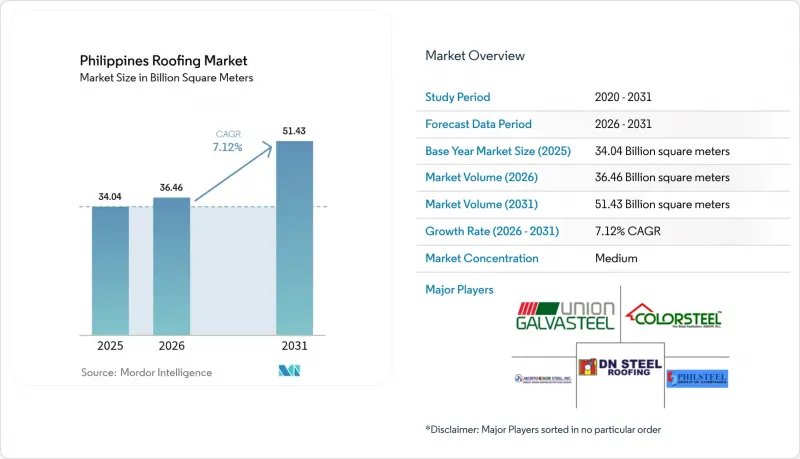
本報告按產品類型(瀝青瓦、瓷磚屋頂、金屬屋頂及其他屋頂材料)和最終用戶行業(住宅和非住宅)進行細分。市場預測以銷量(平方公尺)為基礎。
菲律賓屋頂材料市場趨勢與洞察
政府主導的「建設更美好、更多」基礎建設項目激增
「建設更美好、更多」計畫涵蓋多個重點項目,其中包括為公共市場、避難所和交通樞紐指定新型屋頂材料的項目。預製金屬屋頂憑藉其長期保全,已成為這些競標的標準選擇,確保了預測期內全年持續旺盛的需求。國家採購法規目前優先考慮具有卓越抗風性和浮力性能的系統,鼓勵重點地區的地方政府效仿聯邦政府的模式。 2025會計年度預算為1.507兆菲律賓披索,基礎建設支出將維持在GDP的5.2%,儘管財政緊縮,專案儲備仍將保持穩定。這項加快的進度將縮短人流量大的公共設施的屋頂更換週期,有助於在當前的建築熱潮之後,維持菲律賓屋頂市場的永續發展。
海外勞工匯款推動了住宅建設熱潮。
2024年,海外菲律賓勞工的匯款金額成長,較去年同期成長顯著,對國內生產毛額(GDP)貢獻龐大。研究表明,這筆收入的相當一部分被用於住宅建設,導致屋頂和外牆的支出大幅增加。房屋發展互助基金(Pag-IBIG)的補貼降低了房屋抵押貸款的實際利率,鼓勵購屋者選擇特定金屬等級的屋頂材料。在邦阿西楠省和伊洛伊洛省等擁有大量外籍勞工的省份,2024年的住宅建築許可證數量顯著成長,超過了全國平均水平。由於匯款受全球勞動力需求而非當地經濟週期的影響,這筆資金流動為菲律賓屋頂市場帶來了強勁的長期優勢。
原物料價格波動
2024年,中國實施的出口限制和飆升的運費推高了鍍鋅鋼板的價格。由於進口鋼材佔國內鋼鐵消費的大部分,外匯波動和貿易政策會直接影響屋頂材料報價。瀝青成本的急劇上漲擠壓了瀝青瓦產品的利潤空間,迫使製造商縮減維修專案的促銷活動。國內鋼廠只能滿足部分鋼鐵需求,縮短了承包商的價格窗口,並使工程預算更加複雜。菲律賓期貨市場缺乏對沖選項加劇了價格波動,導致開發商在施工前不願囤積庫存。雖然像Philsteel這樣的垂直整合型公司可以減輕價格波動的影響,但菲律賓屋頂材料市場整體上仍高度依賴全球原料的供需週期。
細分市場分析
預計到2025年,金屬板材將佔菲律賓屋頂市場83.72%的佔有率,並預計在2031年之前以7.55%的年均成長率成長,超過整體市場成長速度。預塗鍍鋅鋼板因其輕盈、符合抗風標準且成本績效,被廣泛應用並保持主要選擇地位。在金屬行業,隨著安裝商將安裝導軌和淨計量技術相結合,太陽能相容產品正在迅速發展。優質塗層也日益受到關注,尤其是在沿海地區,因為在這些地區,耐腐蝕性至關重要。
在歷史街區和高檔住宅,瓦片屋頂仍然很常見,因為在這些地方,美觀比成本和結構承重更為重要。然而,瓦片的重量限制了其在颱風多發地區的使用。在馬尼拉大都會區的老舊住宅維修工程中,由於椽條無法支撐沉重的瓦片,通常會使用瀝青瓦。瀝青價格上漲以及強颱風過後沿海地區實際上禁止使用瀝青,都對這一市場造成了影響。其他材料,例如瀝青卷材、聚碳酸酯板和尼帕棕櫚葉,則用於臨時建築和農場,但隨著金屬屋頂在公共住宅中越來越普遍,它們的市場佔有率正在下降。
其他好處
- Excel格式的市場預測(ME)表
- 3個月的分析師支持
目錄
第1章:引言
- 研究假設和市場定義
- 調查範圍
第2章:調查方法
第3章執行摘要
第4章 市場狀況
- 市場概覽
- 市場促進因素
- 政府主導的「建設更美好、更多」基礎建設項目激增
- 海外務工人員匯款推動了住宅建設熱潮
- 向環保節能建築標準邁進
- 旨在引入抗颱風建築圍護結構的國家計劃
- 與太陽能發電相容的金屬屋頂系統的出現。
- 市場限制因素
- 原物料價格波動(鋼鐵、瀝青)
- 豪華屋頂系統的初始成本很高
- 持證屋頂工短缺
- 價值鏈分析
- 波特五力模型
第5章 市場規模與成長預測
- 依產品類型
- 瀝青瓦
- 瓦屋頂
- 金屬屋頂
- 其他屋頂材料
- 按最終用戶行業分類
- 住宅
- 非住宅
第6章 競爭情勢
- 市場集中度
- 策略趨勢
- 市佔率和排名分析
- 公司簡介
- Alpha Pro Steel Makers
- BlueScope
- BP Canada
- COH Builders Centre
- Colorsteel Systems Corporation
- DN Steel
- Dura Roof
- GAF Materials LLC
- IKO Industries
- Jacinto Color Steel Inc.
- Marusugi Co. Ltd
- Metalink
- Metroof
- Onduline
- Owens Corning
- Philsteel Holdings Corporation
- Puyat Steel Corporation
- Sanlex Roofmaster Center Co. Inc.
- Sheehan Inc.
- TERREAL
- Union Galvasteel Corporation
第7章 市場機會與未來展望
According to Mordor Intelligence, Philippines roofing market size in 2026 is estimated at 36.46 billion square meters, growing from 2025 value of 34.04 billion square meters with 2031 projections showing 51.43 billion square meters, growing at 7.12% CAGR over 2026-2031.
This report is Segmented by Product Type (Asphalt Shingles, Tile Roofing, Metal Roofing, and Other Roofing) and End-User Industry (Residential and Non-Residential). The Market Forecasts are Provided in Terms of Volume (Square Meters).
Philippines Roofing Market Trends and Insights
Surge in Build Better More Infrastructure Pipeline
The Build Better More plan features flagship projects, including those that specify new roofing for public markets, evacuation centers, and transport hubs. Pre-engineered metal roofs with long-term warranties have become the default option in these tenders, securing significant annual demand throughout the forecast period. National procurement rules now privilege systems with superior wind-uplift ratings, nudging local governments in key regions to copy the federal template. A 2025 budget of PHP 1.507 trillion preserves infrastructure outlays at 5.2% of GDP, smoothing the project pipeline despite fiscal tightening. This accelerated timetable shortens the public-building replacement cycle in high-traffic facilities, helping sustain the Philippines' roofing market beyond the current construction surge.
Residential Construction Boom Driven by OFW Remittances
OFW remittances increased in 2024, demonstrating growth compared to the previous year and making a significant contribution to GDP. Surveys indicate a notable portion of this income is allocated to homebuilding, resulting in substantial spending on roofs and envelopes. Pag-IBIG's subsidy lowers effective interest rates on mortgages, encouraging buyers to opt for specific metal brackets. Provinces with large migrant-worker communities, such as Pangasinan and Iloilo, experienced significant growth in residential permits in 2024, surpassing the national average. Since remittances are influenced by global labor demand rather than local economic cycles, this cash flow provides the Philippines' roofing market with a dependable long-term advantage.
Raw-Material Price Volatility
Galvanized-steel prices rose in 2024 as China limited exports and freight rates climbed. With imports covering a significant portion of domestic steel use, currency shifts and trade policies immediately pass through to roof quoting. Bitumen cost spikes squeezed asphalt-shingle margins, prompting manufacturers to curtail promotions in the retrofit channel. Local mills meet only a portion of steel demand, so contractors now shorten price-validity windows, complicating project budgeting. A lack of hedging tools in the Philippine futures market amplifies volatility, discouraging developers from stockpiling ahead of builds. Although backward-integrated players such as Philsteel cushion shocks, the broader Philippines roofing market remains sensitive to global raw-material cycles.
Other drivers and restraints analyzed in the detailed report include:
- Momentum Toward Green and Energy-Efficient Building Codes
- National Push for Typhoon-Resilient Building Envelopes
- High Upfront Cost of Premium Roofing Systems
For complete list of drivers and restraints, kindly check the Table Of Contents.
Segment Analysis
Metal panels accounted for 83.72% of the Philippines Roofing Market share in 2025 and are expected to grow at a rate of 7.55% through 2031, outpacing the overall market. Pre-painted galvanized steel is widely used due to its low weight, compliance with wind codes, and cost-effectiveness, making it the primary choice. Within the metal industry, solar-ready variants are scaling rapidly as installers pair mounting rails with the net-metering boom. Premium coatings are also gaining traction, particularly in coastal zones where corrosion resistance is a priority.
Tile roofs maintain a presence in heritage districts and luxury estates, where aesthetics are prioritized over cost and structural load. However, their heavier weight limits their use in typhoon-prone areas. Asphalt shingles are used in retrofit jobs for older Metro Manila subdivisions where rafters cannot support heavier tiles. Rising bitumen costs and informal coastal bans after severe typhoons are impacting this segment. Other materials, such as bituminous sheets, polycarbonate, and nipa thatch, are used for temporary structures and farms, but their share is declining as public housing increasingly adopts metal roofing.
Complete Report Scope:
- By Product Type
- Asphalt Shingles
- Tile Roofing
- Metal Roofing
- Other Roofing
- By End-user Industry
- Residential
- Non-residential
List of Companies Covered in this Report:
- Alpha Pro Steel Makers
- BlueScope
- BP Canada
- COH Builders Centre
- Colorsteel Systems Corporation
- DN Steel
- Dura Roof
- GAF Materials LLC
- IKO Industries
- Jacinto Color Steel Inc.
- Marusugi Co. Ltd
- Metalink
- Metroof
- Onduline
- Owens Corning
- Philsteel Holdings Corporation
- Puyat Steel Corporation
- Sanlex Roofmaster Center Co. Inc.
- Sheehan Inc.
- TERREAL
- Union Galvasteel Corporation
Additional Benefits:
- The market estimate (ME) sheet in Excel format
- 3 months of analyst support
TABLE OF CONTENTS
1 Introduction
- 1.1 Study Assumptions and Market Definition
- 1.2 Scope of the Study
2 Research Methodology
3 Executive Summary
4 Market Landscape
- 4.1 Market Overview
- 4.2 Market Drivers
- 4.2.1 Surge in government-led "Build Better More" infrastructure pipeline
- 4.2.2 Residential construction boom driven by OFW remittances
- 4.2.3 Momentum toward green and energy-efficient building codes
- 4.2.4 National push for typhoon-resilient building envelopes
- 4.2.5 Emergence of solar-ready metal roofing systems
- 4.3 Market Restraints
- 4.3.1 Raw-material price volatility (steel, bitumen)
- 4.3.2 High upfront cost of premium roofing systems
- 4.3.3 Shortage of certified roofing installers
- 4.4 Value Chain Analysis
- 4.5 Porter's Five Forces
- 4.5.1 Bargaining Power of Suppliers
- 4.5.2 Bargaining Power of Buyers
- 4.5.3 Threat of New Entrants
- 4.5.4 Threat of Substitutes
- 4.5.5 Degree of Competition
5 Market Size and Growth Forecasts (Value)
- 5.1 By Product Type
- 5.1.1 Asphalt Shingles
- 5.1.2 Tile Roofing
- 5.1.3 Metal Roofing
- 5.1.4 Other Roofing
- 5.2 By End-user Industry
- 5.2.1 Residential
- 5.2.2 Non-residential
6 Competitive Landscape
- 6.1 Market Concentration
- 6.2 Strategic Moves
- 6.3 Market Share (%)/Ranking Analysis
- 6.4 Company Profiles (includes Global level Overview, Market level overview, Core Segments, Financials as available, Strategic Information, Market Rank/Share for key companies, Products and Services, and Recent Developments)
- 6.4.1 Alpha Pro Steel Makers
- 6.4.2 BlueScope
- 6.4.3 BP Canada
- 6.4.4 COH Builders Centre
- 6.4.5 Colorsteel Systems Corporation
- 6.4.6 DN Steel
- 6.4.7 Dura Roof
- 6.4.8 GAF Materials LLC
- 6.4.9 IKO Industries
- 6.4.10 Jacinto Color Steel Inc.
- 6.4.11 Marusugi Co. Ltd
- 6.4.12 Metalink
- 6.4.13 Metroof
- 6.4.14 Onduline
- 6.4.15 Owens Corning
- 6.4.16 Philsteel Holdings Corporation
- 6.4.17 Puyat Steel Corporation
- 6.4.18 Sanlex Roofmaster Center Co. Inc.
- 6.4.19 Sheehan Inc.
- 6.4.20 TERREAL
- 6.4.21 Union Galvasteel Corporation
7 Market Opportunities and Future Outlook
- 7.1 White-space and Unmet-Need Assessment

 2026-2030年全球屋頂市場
 複合板岩屋頂材料:市場佔有率分析、產業趨勢與統計、成長預測(2026-2031)
 屋面材料市場:2026-2032年全球市場預測(按屋頂類型、材料類型、安裝類型、分銷管道和應用分類)水泥屋頂材料市場:2026-2032年全球市場預測(依產品種類、厚度、材質成分、應用、最終用途及通路分類)中東和北非屋頂材料市場:市場佔有率分析、行業趨勢和統計數據以及成長預測(2026-2031 年)中東歐屋頂材料:市場佔有率分析、產業趨勢與統計及成長預測(2026-2031 年)亞太地區屋頂材料:市場佔有率分析、產業趨勢與統計及成長預測(2026-2031)南美洲屋頂材料市場:市場佔有率分析、產業趨勢與統計、成長預測(2026-2031年)東協屋頂材料市場:市佔率分析、產業趨勢與統計、成長預測(2026-2031年)美國屋頂材料:市場佔有率分析、產業趨勢與統計及成長預測(2026-2031 年)