


 |
市場調查報告書
商品編碼
2118159
貨櫃堆場物流:市場佔有率分析、產業趨勢與統計、成長預測(2026-2031)Container Depot Logistics - Market Share Analysis, Industry Trends & Statistics, Growth Forecasts (2026 - 2031) |
||||||

※ 本網頁內容可能與最新版本有所差異。詳細情況請與我們聯繫。
據 Mordor Intelligence 稱,2025 年貨櫃堆場物流市場價值為 585.4 億美元,預計 2026 年將達到 620.7 億美元,到 2031 年將達到 820.6 億美元,2026 年至 2031 年的複合年成長率為 5.74%。
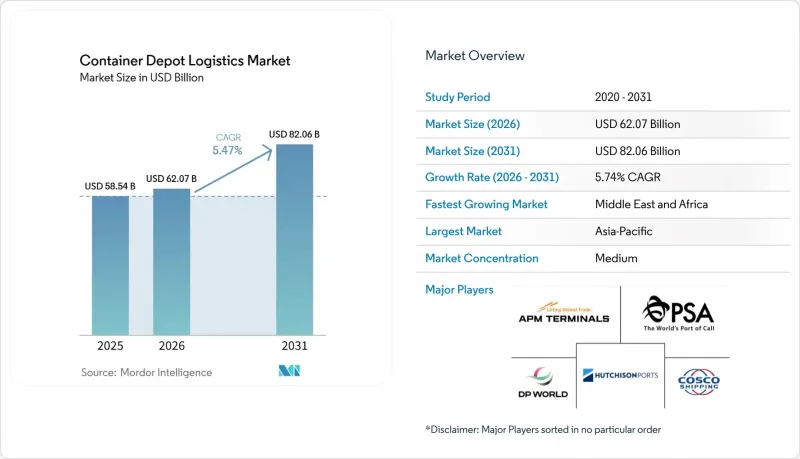
由於貿易量的成長,主要航線對港外倉儲、裝卸和轉運能力的需求不斷增加,市場正在擴張。本報告按堆場類型(內陸貨櫃堆場、貨櫃貨運站等)、服務類型(倉儲、裝卸、維護與維修、清潔與清洗等)、貨櫃類型(乾貨貨櫃、冷藏貨櫃)、貿易形式(國際貿易等)和地區(北美、南美、亞太、歐洲、中東和非洲)進行細分。市場預測以美元計價。
全球貨櫃堆場物流市場趨勢及洞察
貨櫃貿易的成長需要港外緩衝能力。
創紀錄的貿易量正在為整個貨櫃堆場物流市場帶來對港外倉儲和轉運空間的結構性需求。世界貿易組織(WTO)預測,到2026年,全球貨物貿易將成長3%,這確保了該產業在關稅壓力下仍擁有穩定的需求基礎。此外,聯合國貿易和發展會議(UNCTAD)的數據顯示,全球海運貿易量超過120億噸,支撐著貨櫃的持續流通以及主要貿易樞紐對臨時倉儲的持續需求。在貨櫃堆場物流市場,這種貿易量的成長並未在各地區均衡體現。出口導引型地區吸收了出口尖峰時段的貨物,而進口主導地區則處理了積壓的空貨櫃。這種不平衡意味著,倉儲能力、定價和運轉率更多地取決於區域特徵,而非全球平均值。
壅塞港口對快速貨櫃週轉的需求日益成長。
港口擁塞持續推動貨櫃堆場物流市場的發展。這是因為當門戶碼頭空間緊張時,港外堆場可以發揮「安全閥」的作用。承運商越來越傾向於選擇能夠提供艙位、報關支援和更快卡車運輸的堆場。這些功能可以縮短週轉時間並提高資產運轉率。此外,貨櫃堆場物流市場也受惠於等待文件處理的貨櫃運轉率的增加。這些貨櫃在紙面上已處於運輸狀態,但實際上處於待命狀態,直到完成合規和海關檢查。 2025年9月,PSA國際集團將PSA孟買港的年吞吐能力加倍,達到480萬個標準箱。這表明營運商正在將港口擴建與更廣泛的陸路處理量計劃相結合。因此,擁有更完善的卡車預訂系統、配備OCR識別功能的閘口和堆場協調能力的堆場正在獲得明顯的服務優勢。
主要港口及內陸需求中心周邊堆場用地短缺。
土地稀缺仍然是貨櫃堆場物流市場面臨的最大限制因素之一,因為它阻礙了繁忙港口叢集附近處理能力的快速擴張。高需求走廊需要大片土地、便利的卡車運輸以及與鐵路和公路的連接,但這些位置的土地價格更高,授權核准時間也最長。在賈瓦哈拉爾·尼赫魯港(JNPA)附近的貨櫃堆場物流市場,這種情況尤其明顯。為了因應該地區空貨櫃存放場營運分散的問題,RSA Global宣佈在賴加德縣烏蘭市興建一座佔地62英畝的自動化設施,耗資2,580印度盧比(約3.07億美元)。此類大型專案需要數年的土地徵用和基礎設施規劃,導致供應擴張遠遠落後於需求成長。歐洲物流走廊也面臨類似的壓力,鹿特丹、安特衛普和漢堡附近的內陸碼頭必須與其他工業和住宅用地競爭。
細分市場分析
到2025年,內陸貨櫃堆場(ICD)將繼續保持其在所有堆場類型中的領先地位,佔據貨櫃堆場物流市場佔有率的34.16%。其優勢在於,它們作為內陸清關、集散和運輸樞紐,服務於那些不希望將所有貨物處理都局限於港口區域的製造地區。在貨櫃堆場物流市場,位於貨運鐵路走廊、國道和工業區沿線的內陸貨櫃堆場仍備受青睞。這些走廊減少了內陸運輸的摩擦,並幫助承運商更有效地利用港口處理能力。這種地理位置也使得內陸貨櫃堆場在遠離主要碼頭的生產群集的貿易路線中發揮核心作用。
在貨櫃堆場物流市場中,預計到2031年,空箱堆場將以8.60%的複合年成長率成長,成為成長最快的堆場類型。航運公司正在出口區附近增設空箱堆場,以便在季節性尖峰時段和航運通道中斷期間快速處理訂艙。 RSA Global計劃在JNPA附近建造的自動化堆場表明,貨櫃堆場物流市場正從分散的人工空箱處理模式轉向規模更大、技術驅動、運力更可控的樞紐模式。貨櫃貨運站(CFS)仍然發揮作用,但由於港口直接交付政策和土地資源限制,其傳統的倉儲功能正面臨越來越大的壓力。
2025年,貨櫃倉儲服務佔貨櫃堆場物流市場規模的38.92%,在各類服務中佔比最高。這個主導地位反映了一個簡單的營運事實:每個貨櫃在卸貨、清關、出貨和重新安置之間的某個環節都需要暫時存放。此外,航運公司、貨運代理和堆場營運商在繁忙地段簽訂的長期合約也確保了貨櫃堆場物流行業的穩健發展。例如,All Cargo Terminals公司擴建了其位於JNPA附近的貨櫃貨運站(CFS)的容量,並於2026年1月續簽了為期10年的合約。這充分體現了現有業者如何利用與港口的長期合作關係來維持運轉率和規模。
在貨櫃堆場物流市場,貨櫃維護和維修服務預計到2031年將以9.76%的複合年成長率成長,顯著高於整體市場成長率。主要促進因素是,在本世紀初產量激增之後,目前有更大比例的貨櫃船隊正進入定期維護和維修期。此外,隨著航運公司更加重視合規性、責任風險和服務質量,貨櫃堆場物流行業的狀況檢查也變得更加嚴格。雖然貨櫃裝卸服務仍然與港口吞吐量密切相關,但清潔、清洗、燻蒸、重新貼標和重新包裝等服務正成為那些尋求成長但又不想購買新土地的企業更具盈利的選擇。
區域分析
到2025年,亞太地區將佔全球貨櫃堆場物流市場59.99%的佔有率,成為最大的區域市場。該地區仍然是全球貿易中重要的生產和出口樞紐,對內陸貨櫃碼頭(ICD)、貨櫃貨運站(CFS)和空貨櫃存放場的需求持續旺盛,無論這些設施位於沿海還是內陸走廊。印度的貨櫃堆場物流市場尤其活躍,港口擴建、內陸運輸網路發展以及對空貨櫃存放場的投資正在重塑工廠與海港之間的貨物和設備運輸方式。 PSA孟買港二期擴建工程將吞吐能力提升至480萬標準箱,以及Kühne-Nagel在日本港務集團(JNPA)附近新建的貨櫃貨運站,都體現了基礎建設的不斷深化。日本也積極拓展其物流基礎設施,國土交通省正在製定京濱港占地面積新建物流設施的規劃,並持續推進其戰略性貨櫃港口政策。
由於高昂的服務費用、嚴格的合規標準和卓越的基礎設施,北美和歐洲仍然是貨櫃堆場物流領域利潤豐厚的市場。隨著近岸外包業務的興起,越來越多的貨櫃經由太平洋運往內陸製造業走廊,墨西哥的重要性日益凸顯。 APM Terminals在拉薩羅·卡德納斯港啟動二期工程後,正加速擴建,顯示新興製造業驅動的需求正迅速推動港口和堆場容量的提升。在歐洲,隨著營運商尋求更靈活的方式跨越擁擠的運輸走廊,韌性計畫正在支持對內陸和沿海基礎設施的投資。南美洲也透過農產品和食品出口以及冷鏈需求,不斷擴大其在貨櫃堆場物流市場的佔有率,Suape的全電氣化貨櫃碼頭為冷藏貨櫃和永續性基礎設施樹立了新的標竿。
預計到2031年,中東和非洲地區的複合年成長率將達到7.61%,成為貨櫃堆場物流市場成長最快的區域板塊。沙烏地阿拉伯、阿拉伯聯合大公國(阿拉伯聯合大公國)和東非門戶港口正因航運路線的轉變、物流走廊的開發以及私營碼頭的資本投資而對堆場容量的需求不斷成長,因此備受關注。杜拜環球港務集團(DP World)和APM碼頭公司於2026年2月宣佈在吉達伊斯蘭港建立策略夥伴關係。南方貨櫃碼頭在2025年的貨櫃吞吐量也超過130萬標準箱,每週船舶停泊次數增加至38次。因此,該地區的貨櫃堆場物流市場成長速度超過了許多成熟地區,這一趨勢在那些私人投資者急於搶在公共基礎設施預算之前進行建設的地區尤為明顯。
其他好處:
- Excel格式的市場預測(ME)表
- 3個月的分析師支持
目錄
第1章:引言
- 研究假設和市場定義
- 調查範圍
第2章:調查方法
第3章執行摘要
第4章 市場狀況
- 市場概況及貨櫃場物流的重要性
- 市場促進因素
- 隨著貨櫃貿易的擴張,港口外的緩衝能力變得越來越必要。
- 堵塞港口對快速貨櫃運輸的需求日益成長。
- 對冷藏貨櫃和特種貨櫃的需求不斷成長
- 數位化場地視覺化、預約系統和即時車位分配
- 航運公司和無船承運人向外包堆場營運的轉型
- 脫碳壓力正在推動列車車庫層面的電氣化,並減少等待時間。
- 市場限制因素
- 主要港口周邊及內陸高需求地區堆場用地短缺。
- 倉庫勞動強度與安全合規成本
- 空容器分佈波動及其重新分配效率低。
- 中型倉庫自動化投資報酬率存在不確定性。
- 法律規範
- 價值鍊和分銷管道的結構分析
- 技術創新的前景
- 波特五力分析
- 貨櫃處理量趨勢
- 進出口貿易分析
- 港口和碼頭基礎設施分析
- 永續性和ESG分析
- 貨櫃堆場物流市場趨勢
- 地緣政治事件對供應鏈變化的影響
第5章 市場規模及成長預測(價值,2026-2031 年)
- 按倉庫類型
- 內陸貨櫃場(ICD)
- 貨櫃貨運站(CFS)
- 空容器堆場(ECD)
- 港口型貨櫃場
- 按服務類型
- 貨櫃儲存服務
- 貨櫃裝卸服務
- 貨櫃維護和修理(M&R)服務
- 貨櫃清潔和清洗服務
- 其他加值物流服務
- 按容器類型
- 乾貨容器
- 冷藏貨櫃
- 依貿易類型
- 國際和轉運貨櫃處理
- 國內貨櫃運輸
- 按地區/國家
- 北美洲
- 美國
- 加拿大
- 墨西哥
- 南美洲
- 巴西
- 秘魯
- 智利
- 阿根廷
- 其他南美國家
- 亞太地區
- 中國
- 日本
- 印度
- 韓國
- 澳洲
- 東南亞
- 其他亞太國家
- 歐洲
- 英國
- 德國
- 法國
- 西班牙
- 義大利
- 比荷盧經濟聯盟(比利時、荷蘭、盧森堡)
- 北歐國家(丹麥、芬蘭、冰島、挪威、瑞典)
- 其他歐洲國家
- 中東和非洲
- 阿拉伯聯合大公國
- 沙烏地阿拉伯
- 南非
- 奈及利亞
- 其他中東和非洲國家
- 北美洲
第6章 競爭情勢
- 市場集中度
- 關鍵策略趨勢
- 市佔率分析
- 公司簡介
- APM Terminals
- DP World
- PSA International
- COSCO SHIPPING Lines Co., Ltd.
- Hutchison Ports
- Shanghai International Port(Group)Co., Ltd.
- CMA CGM Group
- SSA Marine
- International Container Terminal Services, Inc.
- Adani Ports and Special Economic Zone Limited
- Eurogate Container Terminal GmbH
- Mediterranean Shipping Company SA
- Container Corporation of India Limited
- Gateway Distriparks Limited
- Qube Holdings Limited
- China Merchants Port Holdings
- Abu Dhabi Ports Group
- Rhenus Group(Including Contargo)
- Allcargo Logistics Limited
- Depot Connect International
- Den Hartogh Logistics
- Bertschi Group
第7章 市場機會與未來展望
According to Mordor Intelligence, the container depot logistics market size was valued at USD 58.54 billion in 2025 and is projected to reach USD 62.07 billion in 2026, and reach USD 82.06 billion by 2031, growing at a CAGR of 5.74% from 2026 to 2031.
The market is expanding as higher containerized trade volumes drive demand for off-port storage, handling, and repositioning capacity across major shipping corridors. This report is Segmented by Depot Type (ICDs, CFS, and More), by Service Type (Storage, Handling, Maintenance and Repair, Cleaning and Washing, and More), by Container Type (Dry and Reefer), by Trade Orientation (International and More), and by Geography (North America, South America, Asia-Pacific, Europe, and Middle East and Africa). The Market Forecasts are Provided in Terms of Value (USD).
Global Container Depot Logistics Market Trends and Insights
Growth in Containerized Trade Requiring Off-Port Buffer Capacity
Record trade volumes are creating a structural need for off-port storage and staging space across the container depot logistics market. The World Trade Organization projects global merchandise trade growth of 3% in 2026, providing the sector with a clear demand base even under tariff pressure. UNCTAD also shows that global seaborne trade exceeded 12 billion tons, supporting sustained container circulation and recurring demand for temporary storage at major trade nodes. In the container depot logistics market, this rise in volume does not translate evenly because export-heavy locations absorb peak outbound loads while import-led locations handle return-empty backlogs. That imbalance is making capacity, pricing, and utilization more location-specific than broad global averages suggest.
Rising Need for Faster Container Turnaround at Congested Ports
Port congestion continues to support the container depot logistics market because off-port depots act as relief valves when gateway terminals run short of space. Carriers are placing greater value on depots that can offer guaranteed slots, customs support, and faster truck moves, as these features reduce cycle time and improve asset utilization. The container depot logistics market is also seeing higher occupancy from documentation-hold containers, which are still in transit on paper but remain physically idle until compliance or customs checks are completed. PSA International doubled annual handling capacity at PSA Mumbai to 4.8 million TEUs in September 2025, which shows how operators are pairing port expansion with broader landside throughput planning. Depots with truck appointment systems, OCR-enabled gates, and better yard coordination are therefore gaining a clear service advantage.
Yard Land Scarcity Near Major Ports and Inland Demand Clusters
Land scarcity remains one of the most significant constraints on the container depot logistics market because capacity cannot expand quickly near the busiest port clusters. High-demand corridors need large plots, truck access, and rail or road connectivity, yet those same locations also face the highest land values and the longest approval timelines. The container depot logistics market shows this clearly around JNPA, where fragmented empty yard operations prompted RSA Global to announce a 62-acre automated facility in Uran, Raigad, with an investment of INR 2,580 crore (USD 307 million). Large projects like that require years of site assembly and infrastructure planning, which means supply response is much slower than demand growth. European logistics corridors face similar pressure because inland terminals near Rotterdam, Antwerp, and Hamburg must compete with other industrial and residential uses.
Other drivers and restraints analyzed in the detailed report include:
- Expansion of Reefer and Specialized Container Handling Needs
- Digital Yard Visibility, Appointment Systems, and Real-Time Slot Allocation
- Volatile Empty Container Flows and Repositioning Inefficiencies
For complete list of drivers and restraints, kindly check the Table Of Contents.
Segment Analysis
Inland container depots accounted for 34.16% of the container depot logistics market share in 2025, maintaining their leading position across depot formats. Their strength lies in their role as inland customs, consolidation, and dispatch nodes for manufacturing regions that do not want all cargo processing to remain at the port gate. The container depot logistics market continues to favor ICDs along freight rail corridors, national highways, and industrial belts, as these links reduce friction in inland transit and help carriers use port capacity more efficiently. This position also makes ICDs central to trade lanes where production clusters are far from major terminals.
Empty container depots are projected to expand at a 8.60% CAGR through 2031 in the container depot logistics market, making them the fastest-growing depot type. Shipping lines are placing more empty units near export zones to meet bookings faster during seasonal peaks and corridor disruptions. The RSA Global automated yard planned near JNPA shows how the container depot logistics market is moving from fragmented, manual empty-handling to larger, technology-enabled hubs with stronger throughput discipline. Container freight stations still play a role, but direct port delivery policies and land constraints are putting more pressure on their traditional storage function.
Container storage services accounted for 38.92% of the container depot logistics market size in 2025, giving them the largest share among service categories. This lead reflects a simple operational fact: each container still needs a temporary holding point at some stage between discharge, clearance, dispatch, and repositioning. The container depot logistics industry also keeps this segment resilient through long-term contracts between carriers, freight forwarders, and depot operators at high-traffic nodes. Allcargo Terminals expanded its CFS capacity near JNPA and secured a 10-year contract extension in January 2026, demonstrating how incumbents leverage long-standing port relationships to maintain utilization and scale.
Container maintenance and repair services are forecast to grow at a 9.76% CAGR through 2031 in the container depot logistics market, well above the overall pace. The main driver is that a larger share of the fleet is moving into scheduled inspection and repair windows after the production surge earlier in the decade. The container depot logistics industry is also seeing stricter condition checks as carriers pay closer attention to compliance, liability exposure, and service quality. Container handling services still move closely with port throughput, while cleaning, washing, fumigation, relabeling, and repackaging offer a more profitable route for operators that want growth without buying more land.
Complete Report Scope:
- By Depot Type
- Inland Container Depots (ICDs)
- Container Freight Stations (CFS)
- Empty Container Depots (ECDs)
- Port-Based Container Depots
- By Service Type
- Container Storage Services
- Container Handling Services
- Container Maintenance and Repair (M&R) Services
- Container Cleaning and Washing Services
- Other Value-Added Logistics Services
- By Container Type
- Dry Containers
- Reefer Containers
- By Trade Orientation
- International/Transshipment Container Handling
- Domestic Container Movement
- By Region/Country
- North America
- United States
- Canada
- Mexico
- South America
- Brazil
- Peru
- Chile
- Argentina
- Rest of South America
- Asia-Pacific
- China
- Japan
- India
- South Korea
- Australia
- South East Asia
- Rest of Asia-Pacific
- Europe
- United Kingdom
- Germany
- France
- Spain
- Italy
- BENELUX (Belgium, Netherlands, and Luxembourg)
- NORDICS (Denmark, Finland, Iceland, Norway, and Sweden)
- Rest of Europe
- Middle East and Africa
- United Arab Emirates
- Saudi Arabia
- South Africa
- Nigeria
- Rest of the Middle East And Africa
- North America
Geography Analysis
Asia-Pacific accounted for 59.99% of the container depot logistics market share in 2025, making it the leading region. The region remains the main production and export base for global trade, generating persistent demand for ICDs, CFS sites, and empty yards across both coastal and inland corridors. The Container depot logistics market is particularly active in India, where port expansion, inland links, and investment in empty yards are reshaping how cargo and equipment move between factories and maritime gateways. PSA Mumbai's Phase 2 expansion to 4.8 million TEUs and Kuehne+Nagel's new CFS near JNPA both reflect that deeper infrastructure buildout. Japan is also expanding its logistics base, with the Ministry of Land, Infrastructure, Transport and Tourism outlining plans for new logistics facility floor space in the Keihin Port complex and continuing its strategic container port policy.
North America and Europe remain high-value revenue pools in the container depot logistics market because service fees are higher, compliance standards are stricter, and infrastructure quality is stronger. Mexico is becoming increasingly important as nearshoring drives more container flows through the Pacific and into inland manufacturing corridors. APM Terminals accelerated expansion at Lazaro Cardenas after inaugurating Phase II in March 2026, demonstrating how quickly new manufacturing-linked demand is pulling forward port and depot capacity needs. In Europe, resilience planning is supporting investment in inland and coastal infrastructure as operators seek more flexible ways to move cargo across congested corridors. South America is also gaining weight in the container depot logistics market through agrifood exports and cold chain demand, with Suape's fully electrified container terminal setting a new benchmark for reefer-ready, sustainability-linked infrastructure.
The Middle East and Africa are projected to grow at a 7.61% CAGR through 2031, making it the fastest-expanding regional bloc in the container depot logistics market. Saudi Arabia, the UAE, and East African gateways are attracting attention because rerouted flows, logistics corridor development, and private terminal capital are increasing the need for supporting depot capacity. DP World and APM Terminals announced a strategic partnership at Jeddah Islamic Port in February 2026, and the Southern container terminal handled more than 1.3 million TEUs in 2025 as weekly vessel calls rose to 38. The container depot logistics market is therefore opening faster in this region than in many mature geographies, especially where private investors are willing to build ahead of public infrastructure budgets.
- APM Terminals
- DP World
- PSA International
- COSCO SHIPPING Lines Co., Ltd.
- Hutchison Ports
- Shanghai International Port (Group) Co., Ltd.
- CMA CGM Group
- SSA Marine
- International Container Terminal Services, Inc.
- Adani Ports and Special Economic Zone Limited
- Eurogate Container Terminal GmbH
- Mediterranean Shipping Company S.A.
- Container Corporation of India Limited
- Gateway Distriparks Limited
- Qube Holdings Limited
- China Merchants Port Holdings
- Abu Dhabi Ports Group
- Rhenus Group (Including Contargo)
- Allcargo Logistics Limited
- Depot Connect International
- Den Hartogh Logistics
- Bertschi Group
Additional Benefits:
- The market estimate (ME) sheet in Excel format
- 3 months of analyst support
TABLE OF CONTENTS
1 Introduction
- 1.1 Study Assumptions and Market Definition
- 1.2 Scope of the Study
2 Research Methodology
3 Executive Summary
4 Market Landscape
- 4.1 Market Overview and Importance of Container Depot Logistics
- 4.2 Market Drivers
- 4.2.1 Growth In Containerized Trade Requiring Off-Port Buffer Capacity
- 4.2.2 Rising Need for Faster Container Turnaround at Congested Ports
- 4.2.3 Expansion of Reefer And Specialized Container Handling Needs
- 4.2.4 Digital Yard Visibility, Appointment Systems, and Real-Time Slot Allocation
- 4.2.5 Shift Toward Outsourced Depot Operations By Shipping Lines and NVOCCs
- 4.2.6 Decarbonization Pressure Encouraging Depot-Level Electrification and Idle-Time Reduction
- 4.3 Market Restraints
- 4.3.1 Yard Land Scarcity Near Major Ports and Inland Demand Clusters
- 4.3.2 Depot Labor Intensity and Safety Compliance Costs
- 4.3.3 Volatile Empty Container Flows And Repositioning Inefficiencies
- 4.3.4 Automation Payback Uncertainty in Mid-Sized Depots
- 4.4 Regulatory Framework
- 4.5 Value Chain and Distribution Channel Architecture Analysis
- 4.6 Technology Innovations Outlook
- 4.7 Porter's Five Forces Analysis
- 4.7.1 Threat of New Entrants
- 4.7.2 Bargaining Power of Suppliers
- 4.7.3 Bargaining Power of Buyers
- 4.7.4 Threat of Substitutes
- 4.7.5 Rivalry Among Competitors
- 4.8 Container Throughput Trends
- 4.9 Import-Export Trade Analysis
- 4.10 Port and Terminal Infrastructure Analysis
- 4.11 Sustainability and ESG Analysis
- 4.12 Evolution of Container Depot Logistics Market
- 4.13 Impact of Geo-Political Events on Supply Chain Shifts
5 Market Size and Growth Forecasts (Value, 2026-2031)
- 5.1 By Depot Type
- 5.1.1 Inland Container Depots (ICDs)
- 5.1.2 Container Freight Stations (CFS)
- 5.1.3 Empty Container Depots (ECDs)
- 5.1.4 Port-Based Container Depots
- 5.2 By Service Type
- 5.2.1 Container Storage Services
- 5.2.2 Container Handling Services
- 5.2.3 Container Maintenance and Repair (M&R) Services
- 5.2.4 Container Cleaning and Washing Services
- 5.2.5 Other Value-Added Logistics Services
- 5.3 By Container Type
- 5.3.1 Dry Containers
- 5.3.2 Reefer Containers
- 5.4 By Trade Orientation
- 5.4.1 International/Transshipment Container Handling
- 5.4.2 Domestic Container Movement
- 5.5 By Region/Country
- 5.5.1 North America
- 5.5.1.1 United States
- 5.5.1.2 Canada
- 5.5.1.3 Mexico
- 5.5.2 South America
- 5.5.2.1 Brazil
- 5.5.2.2 Peru
- 5.5.2.3 Chile
- 5.5.2.4 Argentina
- 5.5.2.5 Rest of South America
- 5.5.3 Asia-Pacific
- 5.5.3.1 China
- 5.5.3.2 Japan
- 5.5.3.3 India
- 5.5.3.4 South Korea
- 5.5.3.5 Australia
- 5.5.3.6 South East Asia
- 5.5.3.7 Rest of Asia-Pacific
- 5.5.4 Europe
- 5.5.4.1 United Kingdom
- 5.5.4.2 Germany
- 5.5.4.3 France
- 5.5.4.4 Spain
- 5.5.4.5 Italy
- 5.5.4.6 BENELUX (Belgium, Netherlands, and Luxembourg)
- 5.5.4.7 NORDICS (Denmark, Finland, Iceland, Norway, and Sweden)
- 5.5.4.8 Rest of Europe
- 5.5.5 Middle East and Africa
- 5.5.5.1 United Arab Emirates
- 5.5.5.2 Saudi Arabia
- 5.5.5.3 South Africa
- 5.5.5.4 Nigeria
- 5.5.5.5 Rest of the Middle East And Africa
- 5.5.1 North America
6 Competitive Landscape
- 6.1 Market Concentration
- 6.2 Key Strategic Moves
- 6.3 Market Share Analysis
- 6.4 Company Profiles (includes Global level Overview, Market level overview, Core Segments, Financials as available, Strategic Information, Market Rank/Share for key companies, Products & Services, and Recent Developments)
- 6.4.1 APM Terminals
- 6.4.2 DP World
- 6.4.3 PSA International
- 6.4.4 COSCO SHIPPING Lines Co., Ltd.
- 6.4.5 Hutchison Ports
- 6.4.6 Shanghai International Port (Group) Co., Ltd.
- 6.4.7 CMA CGM Group
- 6.4.8 SSA Marine
- 6.4.9 International Container Terminal Services, Inc.
- 6.4.10 Adani Ports and Special Economic Zone Limited
- 6.4.11 Eurogate Container Terminal GmbH
- 6.4.12 Mediterranean Shipping Company S.A.
- 6.4.13 Container Corporation of India Limited
- 6.4.14 Gateway Distriparks Limited
- 6.4.15 Qube Holdings Limited
- 6.4.16 China Merchants Port Holdings
- 6.4.17 Abu Dhabi Ports Group
- 6.4.18 Rhenus Group (Including Contargo)
- 6.4.19 Allcargo Logistics Limited
- 6.4.20 Depot Connect International
- 6.4.21 Den Hartogh Logistics
- 6.4.22 Bertschi Group
7 Market Opportunities and Future Outlook
- 7.1 White-space and Unmet-Need Assessment

 2026年全球物流自動化人工智慧(AI)市場報告
 歐洲物流自動化:市場佔有率分析、產業趨勢與統計及成長預測(2026-2031 年)物流自動化:市場佔有率分析、產業趨勢與統計、成長預測(2026-2031)亞太地區貨櫃堆場物流:市場佔有率分析、產業趨勢與統計及成長預測(2026-2031)歐洲貨櫃堆場物流:市場佔有率分析、產業趨勢與統計及成長預測(2026-2031)美國貨櫃堆場物流:市場佔有率分析、產業趨勢與統計及成長預測(2026-2031 年)
 物流自動化市場預測至2034年-按組件、功能、技術、應用、最終用戶和地區分類的全球分析
 物流自動化市場:按組件、物流類型、技術、運作模式、部署類型、應用和最終用戶產業分類-2026-2032年全球市場預測北美物流自動化:市場佔有率分析、產業趨勢與統計及成長預測(2026-2031 年)
 物流自動化市場機會、成長要素、產業趨勢分析及2026-2035年預測